
Key Points and Summary – Picking the “best” U.S. warships is nearly impossible, but a handful of icons clearly stand out. USS Constitution, “Old Ironsides,” embodies the Navy’s origins and early victories. Iowa-class battleships like USS New Jersey and USS Missouri fused speed, armor, and 16-inch firepower—and kept fighting into the missile age.
-USS Enterprise (CV-6) became the most decorated U.S. ship of World War II, carrying the Pacific War on her flight deck.
-USS Nautilus rewrote undersea warfare as the world’s first nuclear-powered submarine. Together, these ships trace America’s rise from wooden frigates to nuclear-era sea dominance.
The 5 Greatest U.S. Warships Ever: From Old Ironsides to Big Mo
Trying to choose the five best warships in US history is akin to trying to choose your favorite child, there are far too many ships to narrow it down to just five.
However, it would be difficult not to include the Iowa-class battleships (like the USS New Jersey and USS Missouri) for their combined speed, firepower, and service history; the USS Enterprise (CV-6), the most decorated ship of WWII; the USS Constitution, “Old Ironsides” the oldest ship in the US Navy; and the USS Nautilus (SSN-571), the first nuclear-powered submarine.
The USS Constitution, “Old Ironsides”
The USS Constitution, also known as Old Ironsides, is a three-masted wooden-hulled heavy frigate of the United States Navy. She is the world’s oldest commissioned warship still afloat.
The ship was launched in 1797, one of six original frigates authorized for construction by the Naval Act of 1794 and the third constructed.
Joshua Humphreys designed the frigates to be the young Navy’s capital ships, and so Constitution and her sister ships were larger and more heavily armed and built than standard frigates of the period.
Constitution’s hull was 21 inches (530 mm) thick, with a 204 ft (62 m) length overall and a beam of 43 ft 6 in (13.26 m).
Her first duties were to protect American merchant shipping during the Quasi-War with France and to defeat the Barbary pirates in the First Barbary War.
During the War of 1812, the ship famously defeated the British frigate HMS Guerriere. It was during this battle that cannonballs were seen to bounce off her hull, leading to the nickname “Old Ironsides”.
After being saved from being scrapped in 1830 due to public sentiment (fueled by Oliver Wendell Holmes’s poem “Old Ironsides”), the ship underwent restoration and sailed around the world in 1844.
Old Ironsides became a museum ship in 1907, was recommissioned in 1931, and toured 90 ports along the U.S. coast. In 1997, she sailed under her own power for the first time in over a century to celebrate her 200th birthday. She was again recommissioned for an annual turnaround cruise in Boston Harbor.
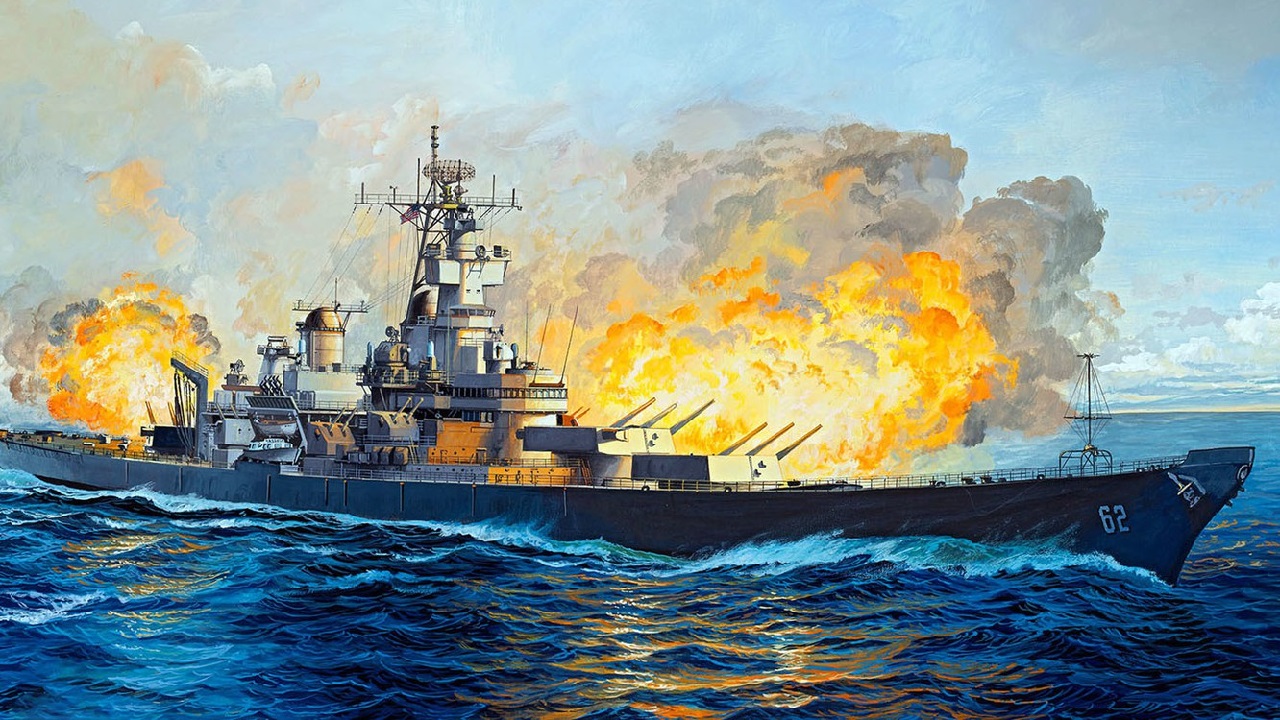
USS New Jersey (BB-62)
The Iowa-class battleships were incredible warships, representing a pinnacle of battleship design due to their exceptional speed, powerful guns, and advanced fire control systems. Their design allowed them to be fast enough to outrun or chase down other major warships, and their 16-inch guns, combined with advanced fire control, made them highly accurate and effective.
They also had robust armor and extensive anti-aircraft batteries, and their larger size compared to other battleships allowed for significant modernization during the Cold War, including the addition of missile systems.Their design allowed them to achieve speeds over 30 knots, a significant advantage that let them dictate the terms of engagements and retreat if necessary.
The USS New Jersey, a 45,000-ton Iowa-class battleship, was built at the Philadelphia Navy Yard, Pennsylvania. Commissioned in May 1943, the New Jersey went to the Pacific in early 1944 and received her baptism of fire during the invasion of the Marshall Islands.
She was the Fifth Fleet’s flagship during the mid-February raid on the Japanese base at Truk, where she used her guns to sink one enemy ship and join in sinking another. The big battlewagon also took part in raids on Japanese-held islands, the Marianas invasion, the Battle of Philippine Sea, the Battle of Leyte Gulf, and operations against the Philippines.
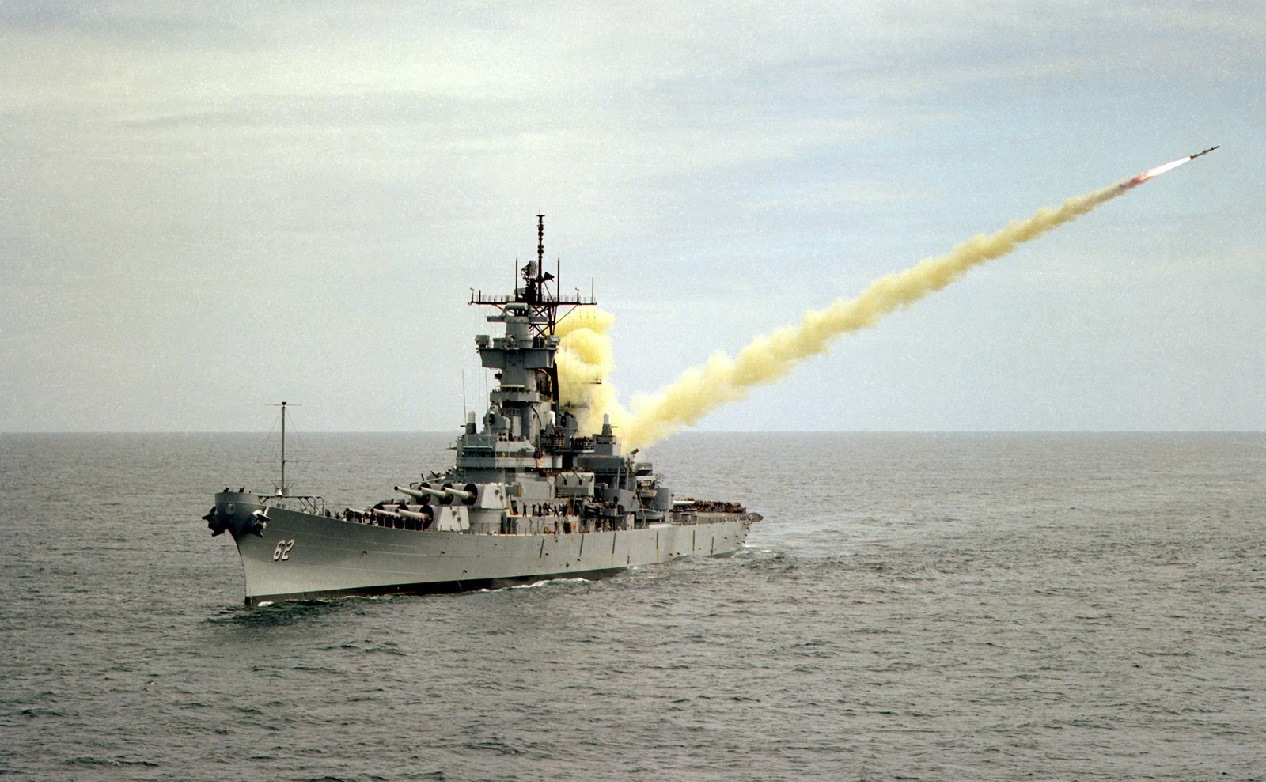
An aerial port bow view of the battleship USS NEW JERSEY (BB-62) launching an RGM-84 Harpoon missile on the Pacific Missile Test Center Range.
From August 1944, she was the flagship of Admiral William F. Halsey’s Third Fleet.
New Jersey continued her Pacific combat operations into 1945, supporting the invasions of Iwo Jima and the Ryukyus. She went to the Atlantic in 1947 and made one midshipmen’s training cruise to Europe before decommissioning in June 1948.
The USS New Jersey was recommissioned in November 1950, and served two Korean combat tours in 1951 and 1953, before beind decommissioned again in August 1957.
USS New Jersey was the only battleship recalled to duty during the Vietnam War. She recommissioned in April 1968 and arrived off Southeast Asia in September. From then until April 1969, she conducted frequent bombardments along the South Vietnamese coast. While preparing for a second Vietnam tour, she was ordered inactivated and decommissioned in December 1969.
Under President Reagan’s big navy build up, the New Jersey was brought back for a fourth time in December 1982. Her big guns were once again fired in combat during the Lebanon crisis of 1983-84. Decommissioned again in February 1991, USS New Jersey was towed from the Pacific to the Atlantic in 1999. She now serves as a museum ship in Camden, New Jersey.
USS Enterprise (CV-6)
Arguably, the most famous aircraft carrier of all time, “The Big E,” a Yorktown-class carrier during WWII, had an incredible combat record. She is also, arguably the greatest carrier of all-time.
Launched in 1936, the USS Enterprise was one of only three American carriers commissioned before World War II to survive the war – the others being the USS Saratoga (CV-3) and the USS Ranger (CV-4).
The USS Enterprise also participated in more major actions of the war against the Imperial Japanese Navy than any other U.S. warship during WWII. She took part in the Battle of Midway – helping to turn the tide in the Pacific against the Japanese.
USS Enterprise also fought at the Battle of the Eastern Solomons, the Battle of Santa Cruz Islands, and later in the Battle of the Philippine Sea and the Battle of Leyte Gulf. During the Guadalcanal Campaign, her aircraft covered the landings. In February 1945, Enterprise took part in the Iwo Jima invasion, then raids on the Japanese home islands, and the Okinawa campaign in April.
By the end of the war, The “Big E’s” aircraft and guns had shot down 911 enemy planes, sunk 71 ships, and damaged or destroyed another 192 vessels. On three different occasions during the war, the Japanese had announced that she had been sunk in battle, which earned her the nickname “The Grey Ghost.”
USS Nautilus
The USS Nautilus, the world’s first nuclear submarine, was commissioned by the U.S. Navy in 1954.
The Nautilus was constructed under the direction of U.S. Navy Captain Hyman G. Rickover, who in 1947 was put in charge of the Navy’s nuclear-propulsion program and began work on an atomic submarine.
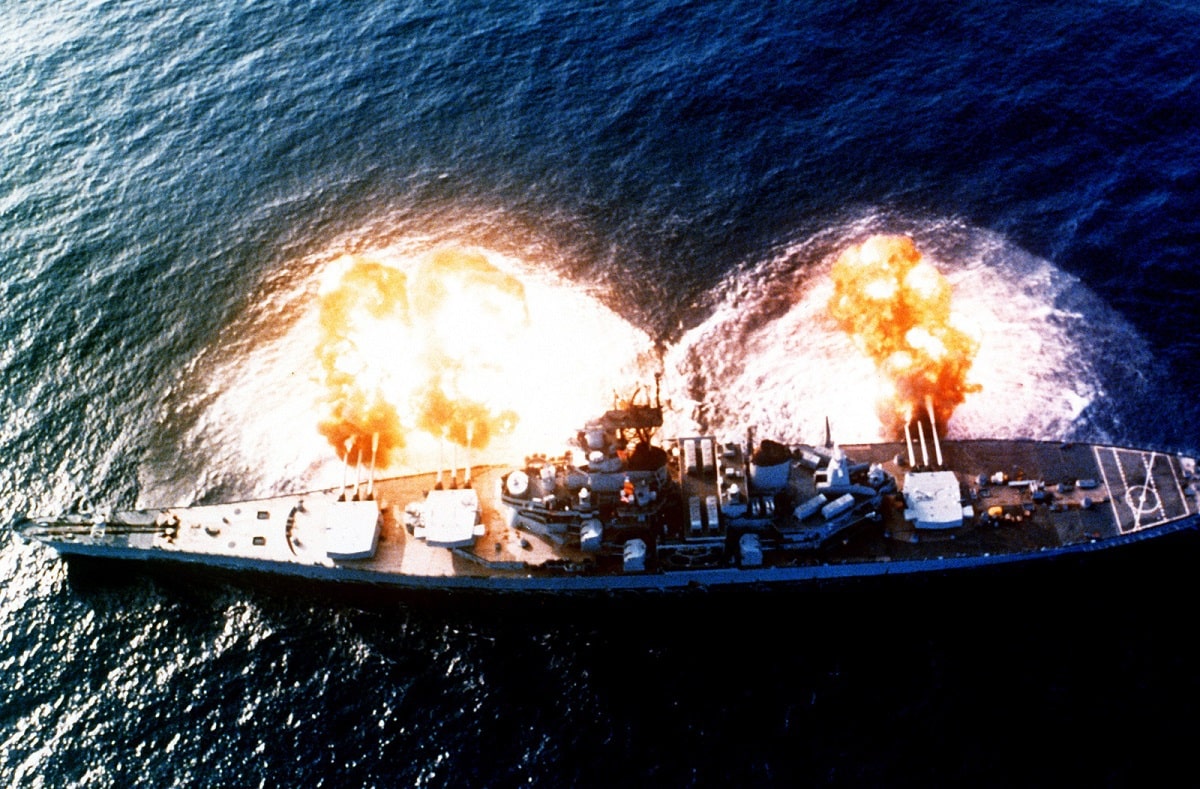
An overhead view of the battleship USS NEW JERSEY (BB-62) firing a full broadside to starboard during a main battery firing exercise.
Rickover succeeded in developing and delivering the world’s first nuclear submarine years ahead of schedule, which today would be absolutely unheard of.
The Nautilus was commissioned on September 30, 1954. She first ran under nuclear power on the morning of January 17, 1955. Commanding Officer, Commander Eugene P. Wilkinson, ordered all lines cast off and signaled the memorable and historic message, “Underway On Nuclear Power.”
The Nautilus was much larger than the diesel submarines of the day, measuring 319 feet and displacing 3,180 tons. It could remain submerged for unlimited periods because its atomic engine needed no air and only a minimal quantity of nuclear fuel. The uranium-powered nuclear reactor produced steam that drove the propulsion turbines, allowing the Nautilus to travel underwater at speeds exceeding 20 knots.
On July 23, 1958, the Nautilus conducted the first crossing of the North Pole by a ship. At 11:15 pm on August 3, 1958, the Commanding Officer, Commander William R. Anderson, announced to his crew, “For the world, our country, and the Navy – the North Pole.”
Designated a National Historic Landmark in 1982, the world’s first nuclear submarine went on exhibit in 1986 as the Historic Ship Nautilus at the Submarine Force Museum in Groton, Connecticut.
USS Missouri (BB-63) “The Big Mo”
The USS Missouri, a 45,000-ton Iowa-class battleship built by the New York Navy Yard, was commissioned on 11 June 1944. Arriving in the Pacific war zone in January 1945, Missouri supported the Iwo Jima invasion, the Ryukyus campaign and raids on Japan’s home islands during the following months.
In May 1945, she became the Third Fleet’s flagship and was the site of the Japanese surrender ceremony on September 2, 1945, that ended World War II. The images of that iconic moment aboard the Big Mo, under the huge 16-inch guns, will forever be part of the Navy’s lore.
The big battlewagon was a highly decorated battleship that earned eight battle stars during her service to the nation—three during World War II and five during the Korean War. Missouri was also the first battleship to fire Tomahawk cruise missiles at Iraqi targets at the commencement of Operation Desert Storm.
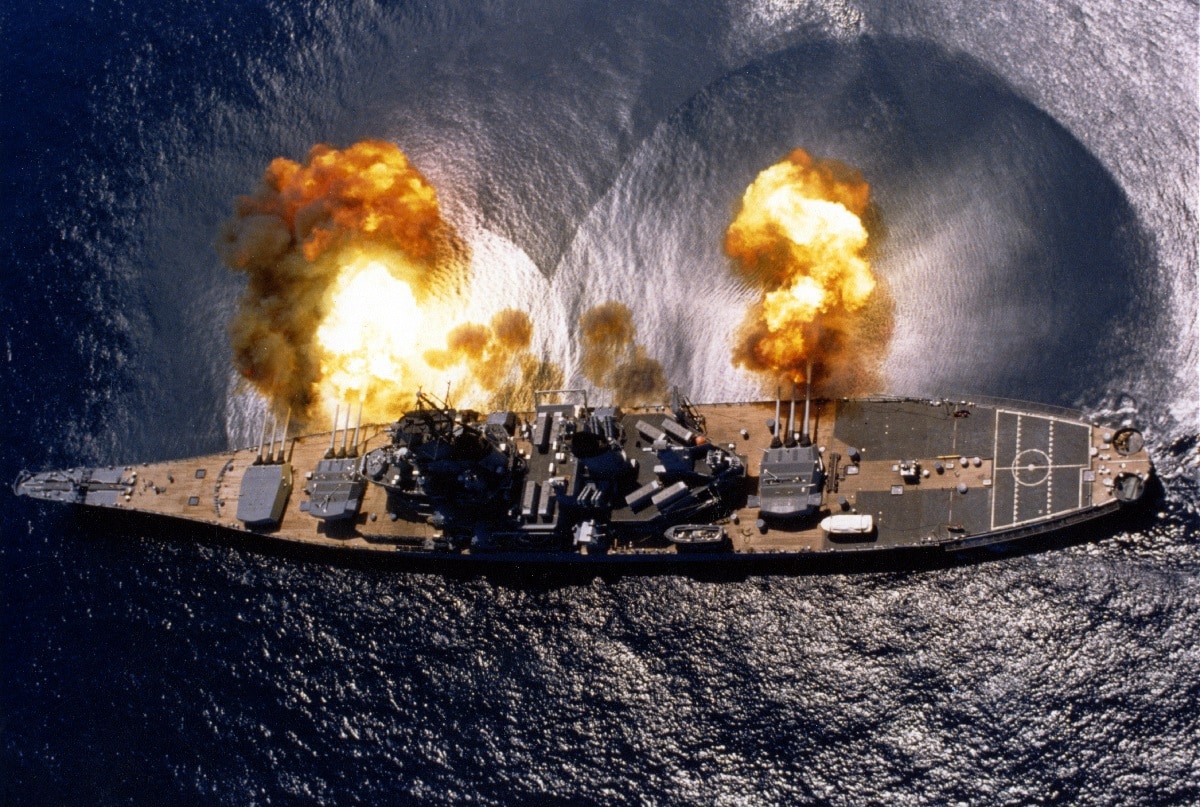
USS Iowa (BB-61) Fires a full broadside of nine 16/50 and six 5/38 guns during a target exercise near Vieques Island, Puerto Rico, 1 July 1984. Photographed by PHAN J. Alan Elliott. Note concussion effects on the water surface, and 16-inch gun barrels in varying degrees of recoil. Official U.S. Navy Photograph, from the the Department of Defense Still Media Collection.
On December 7, 1991, Missouri took part in a “voyage to remembrance” to mark the 50th anniversary of the Pearl Harbor attacks. During that ceremony, Missouri hosted President George H.W. Bush, the first such presidential visit for the battleship since Harry Truman boarded her in September 1947.
On March 31, 1992, Missouri was decommissioned and remained part of the reserve fleet until January 12, 1995.
Stricken from the Naval Vessel Register in 1995, Missouri was transferred to Pearl Harbor, Hawaii, in June 1998 to become a museum ship and memorial.
About the Author: Steve Balestrieri
Steve Balestrieri is a National Security Columnist. He served as a US Army Special Forces NCO and Warrant Officer. In addition to writing on defense, he covers the NFL for PatsFans.com and is a member of the Pro Football Writers of America (PFWA). His work was regularly featured in many military publications