
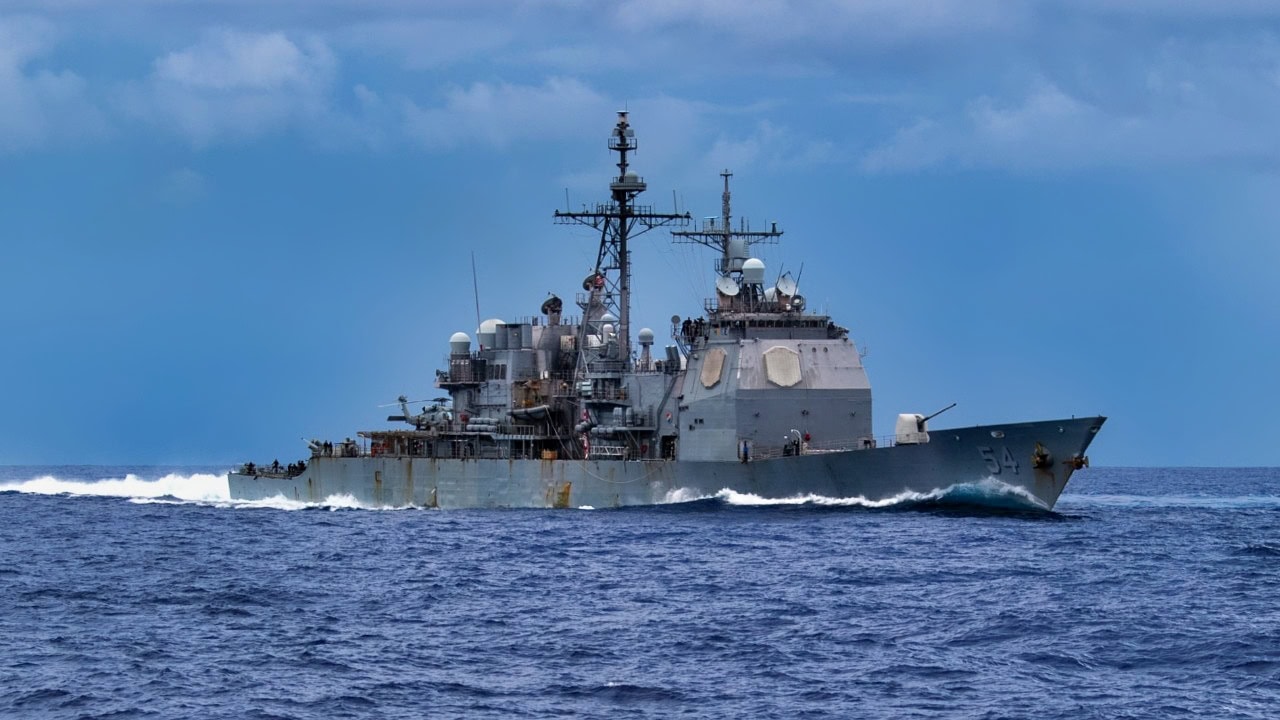
Key Points and Summary – The Ticonderoga-class Aegis cruisers were supposed to get a new lease on life through the Navy’s Cruiser Modernization Program.
-Instead, the effort became a $1.84 billion cautionary tale. Lacking an acquisition strategy, independent cost estimates, risk planning, or meaningful oversight, the program stumbled into delays, shoddy workmanship, and spiraling costs—only three of seven ships actually completed upgrades.
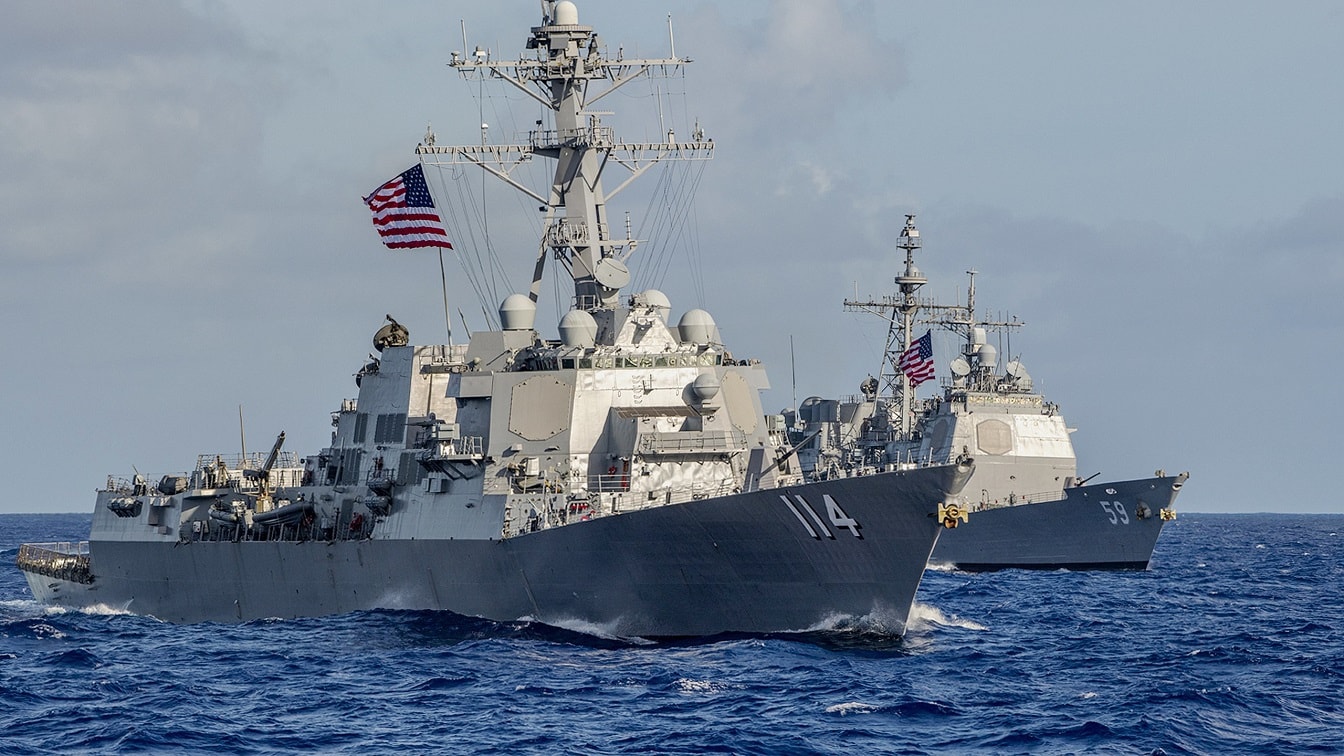
The Arleigh Burke-class guided-missile destroyer USS Ralph Johnson (DDG 114) and the Ticonderoga-class guided-missile cruiser USS Princeton (CG 59) steam in formation during dual carrier operations with the Nimitz and Theodore Roosevelt Carrier Strike Groups (CSG). Dual carrier operations unify the tactical power of two individual CSG, providing fleet commanders with an unmatched, unified credible combat force capable of operating indefinitely. The CSGs are on a scheduled deployments to the Indo-Pacific.
-Aging 1980s architecture proved poorly suited to 21st-century sensors and combat systems, and mishaps such as botched sonar dome work on USS Vicksburg highlighted deeper quality problems.
-As Arleigh Burke destroyers take over, the Ticonderogas are fading out with no museum preservation in sight.
Why Did the Ticonderoga-Class Cruiser Refits Fail?
The Battle of Fort Ticonderoga, which took place on May 10, 1775, was the first American victory of the Revolutionary War. (The fact that one of the Continental Army’s senior leaders in that engagement was eventual traitor Benedict Arnold is one of the sad ironies of that conflict.)
Although it was a land battle and not a naval one, the 20th-century United States Navy had no qualms about putting aside interservice rivalries long enough to name an entire class of warships in honor of the clash, namely the Ticonderoga-class guided missile cruisers (CGs).
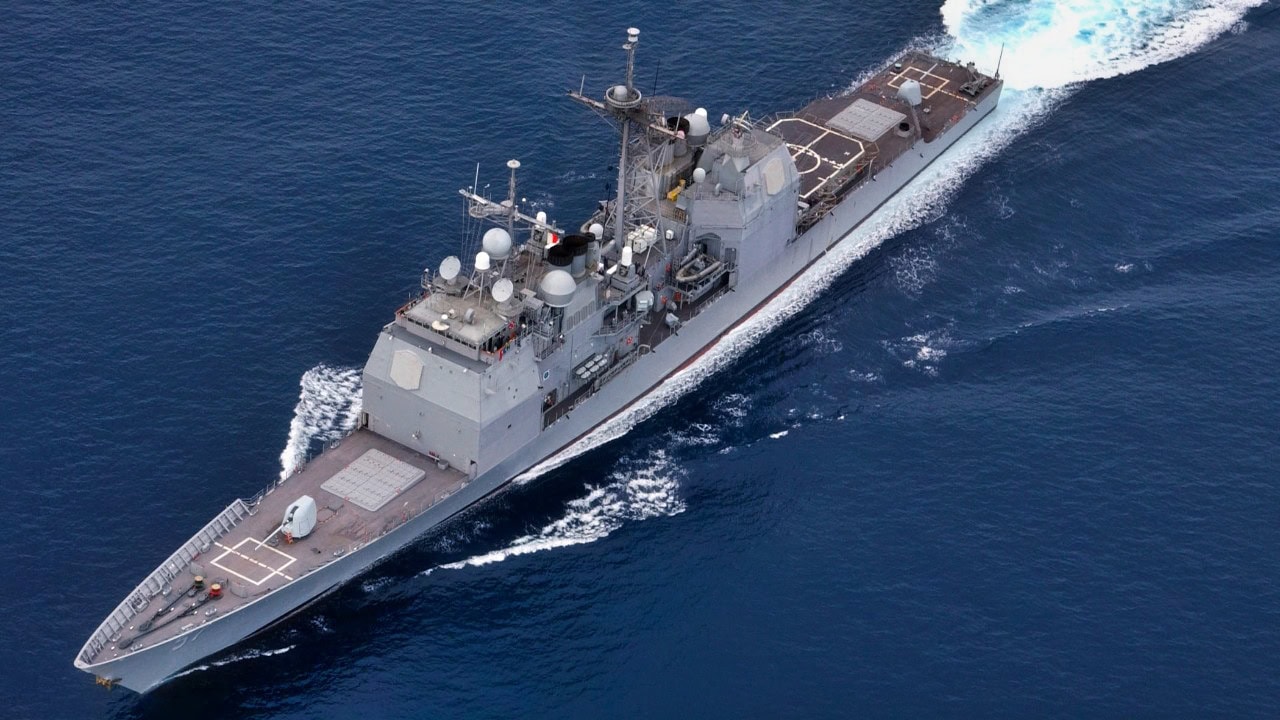
Ticonderoga-Class.
As a whole, the Ticonderogas have had a reasonably successful career, having faithfully served for well over four decades.
However, the ambitious plan to refit these warships turned out to be a major disappointment. So then, this begs the question: Why did the Ticonderoga-class cruisers’ upgrade efforts fail so miserably?
Bottom Line Up Front (BLUF)
The would-be improvements fell under the auspices of the USN’s Cruiser Modernization Program, with the goal of modernizing the computing and display infrastructure, as well as the Hull, Mechanical, and Electrical (HM&E) systems.
Presumably, this would’ve extended the vessels’ service life by five years.
Alas, the noble goal became a $1.84 billion boondoggle, with only three out of seven ships benefiting from the completion of the modernization efforts.
So, what went wrong with the refits?
In a nutshell, as stated by a highly damning General Accountability Office (GAO) report, “The Navy did not develop key program planning and oversight tools and documents for the cruiser modernization effort, such as an acquisition strategy, independent cost estimate, risk management plan, baseline, and Navy program oversight meetings, according to Navy officials.”
Ouch.
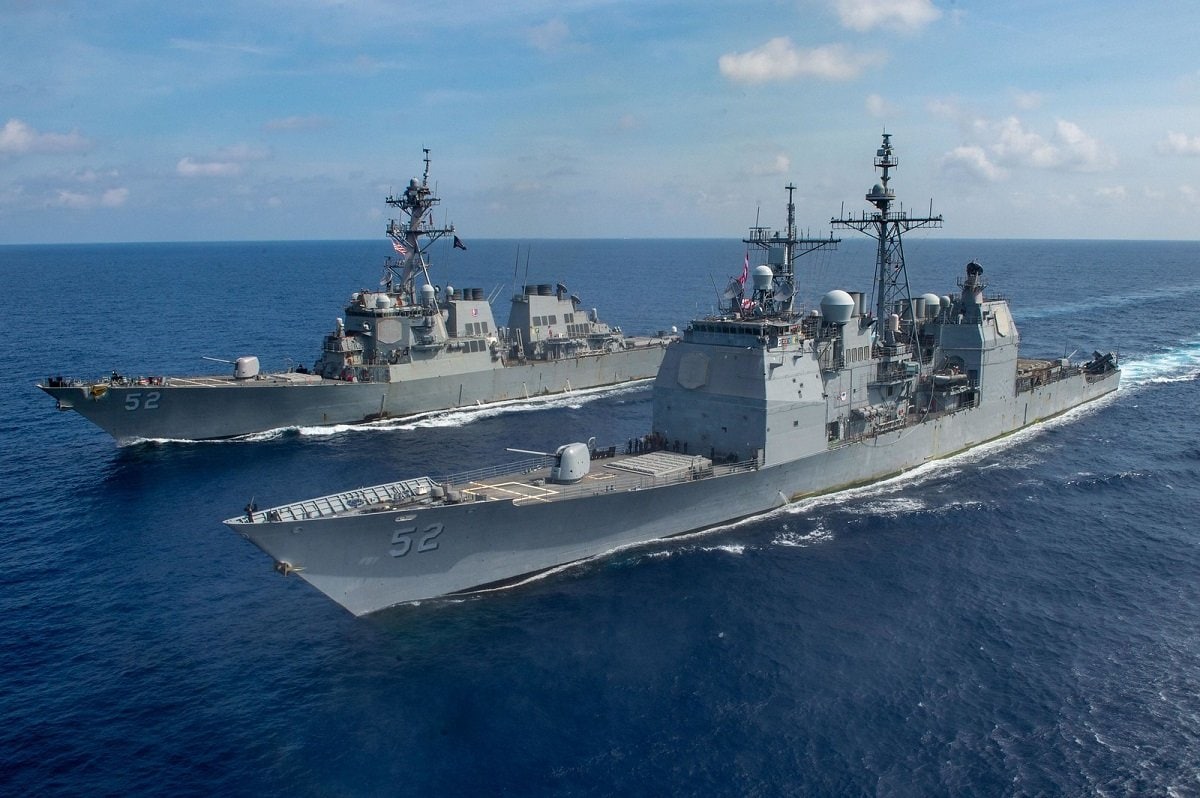
SOUTH CHINA SEA (April 18, 2020) The Ticonderoga-class guided missile cruiser USS Bunker Hill (CG 52), front, and the Arleigh Burke-class guided-missile destroyer USS Barry (DDG 52) transit the South China Sea. Bunker Hill is deployed to the U.S. 7th Fleet area of operations and is operating with the America Expeditionary Strike Group in support of security and stability in the Indo-Pacific region. (U.S. Navy photo by Mass Communication Specialist 3rd Class Nicholas V. Huynh/Released)200418-N-IW125-2047.
To cite just one example, the contractor performed subpar quality work on the sonar dome of the USS Vicksburg (CG-69)—a critical element of the warship’s anti-submarine warfare (ASW) mission—resulting in additional cost and schedule delays due to necessary rework.
In a broader sense, the 1980s-era architecture of the cruisers proved less adaptable to integrating 21st-century radar technology than the Navy brass had initially anticipated.
Ticonderoga-Class Initial History
These warships were the designated successors to the Virginia-class cruisers (which went down in history as final class of nuclear-powered cruisers).
The lead ship of the class, USS Ticonderoga (CG-47), was laid down January 27, 1980, launched on April 25, 1981, and commissioned on January 22, 1983; she made history as the first U.S. Navy warship to incorporate the Aegis combat system. 26 more completed vessels would follow between July 1984 and July 1994; USS Port Royal (CG-73) was the proverbial “Last of the Mohicans.”
19 of these cruisers were built by Ingalls Shipbuilding and eight by Bath Iron Works.
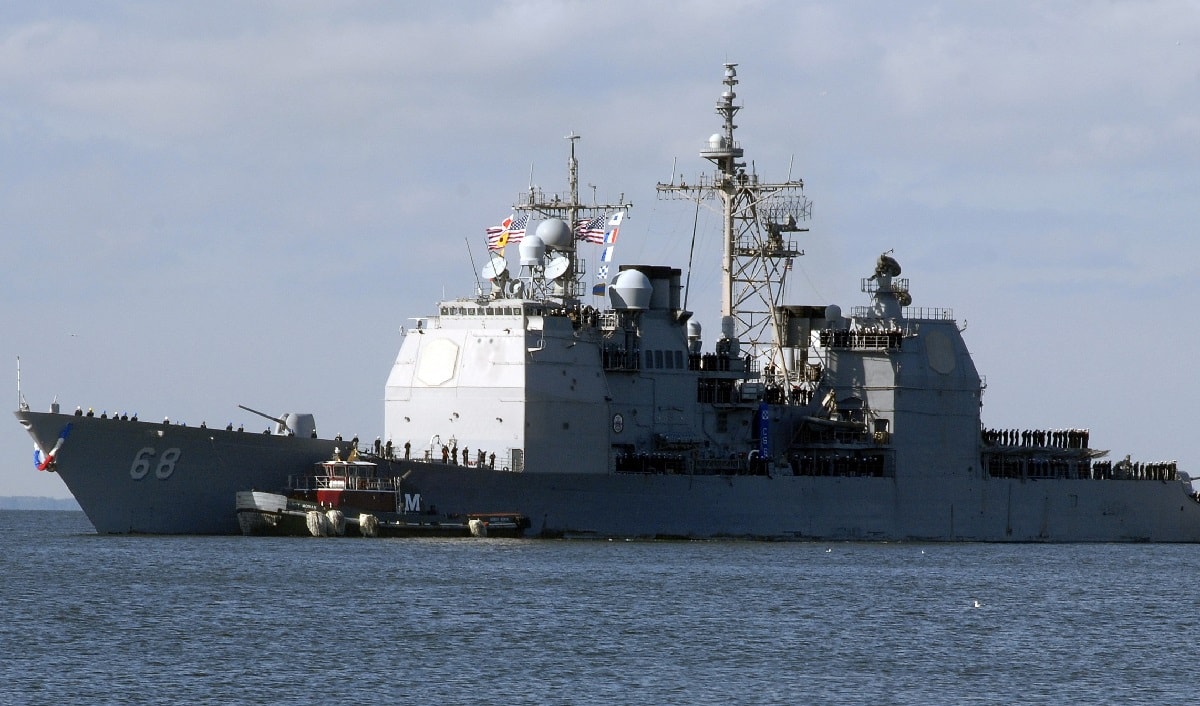
The Ticonderoga-class guided-missile cruiser USS Anzio (CG 68) returns to Naval Station Norfolk after completing a six-month deployment in the U.S. 5th and 6th Fleet areas of responsibility. Anzio served off the Horn of Africa as the flagship of the international anti-piracy task force, Combined Task Force (CTF) 151. (U.S. Navy photo by Mass Communication Specialist 3rd Class John Suits/Released).
Ticonderoga-Class Tech Specs and Vital Stats
-Displacement: 9,600 long tons fully laden
-Hull Length: 567 feet (173 meters)
-Beam Width: 55 feet (16.8 meters)
-Draft: 34 feet (10.2 meters)
-Maximum Speed: 32.5 knots (60 km/h; 37.4 mph)
-Crew Complement: 24 commissioned officers and 300 enlisted seamen
–Armament: MK41 vertical launching system Standard Missile (MR); Vertical Launch ASROC (VLA) Missile; Tomahawk Cruise Missile; 6 x MK-46 torpedoes (from two triple mounts); 2 x MK 45 5-inch/54 caliber lightweight guns; 2 x Phalanx close-in weapons systems (CIWS)
Operational History in Brief
One of the biggest real-world combat engagements for the Ticonderoga cruisers was Operation Earnest Will (24 July 1987 – 26 September 1988), the military protection of Kuwaiti-owned tankers from Iranian attacks during the Tanker War phase of the Iran-Iraq War.
Unfortunately, that combat participation would take an unfortunate twist & turn for one particular Ticonderoga-class ship, namely the USS Vincennes (CG-49).
It was a classic example of Clausewitz’s “fog of war” coming into play.
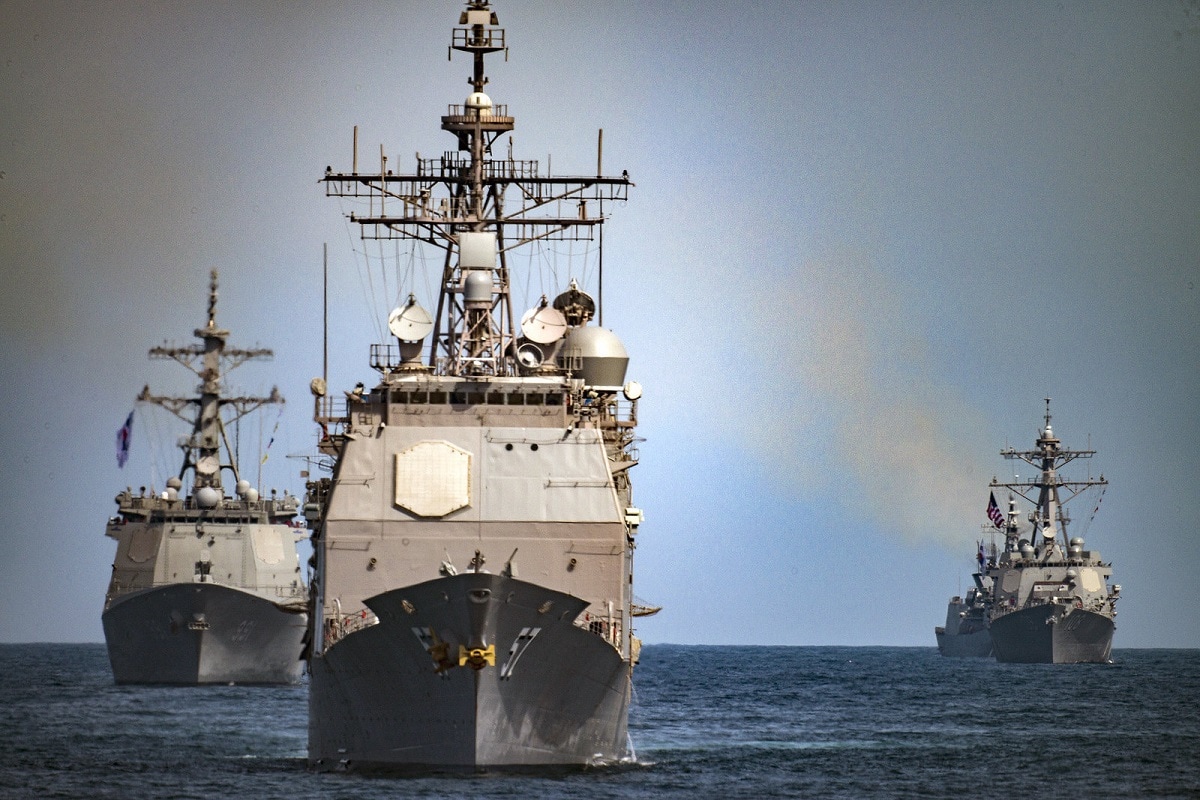
PACIFIC OCEAN (May 3, 2017) The Ticonderoga-class guided-missile cruiser USS Lake Champlain (CG 57), center, leads the Republic of Korea destroyers Sejong the Great (DDG 991), left, and Yang Manchun (DDH 973) while transiting the Western Pacific. The U.S. Navy has patrolled the Indo-Asia-Pacific routinely for more than 70 years promoting regional peace and security. (U.S. Navy photo by Mass Communication Specialist 2nd Class Z.A. Landers/Released) 170503-N-GD109-160
Whilst engaged in the midst of battle with Iranian Revolutionary Guard gunboats, CG-49’s skipper, Capt. William C. Rogers III, mistook an approaching civilian airliner, Iran Air Flight 655 to be an Iranian Air Force F-14 Tomcat fighter jet on an attack vector, based on misreported radar returns.
Captain Rogers had the plane shot down, resulting in 290 tragic deaths.
Fast-forward to February 20, 2008, and on a much more pleasant note, the USS Lake Erie (CG-70) successfully intercepted a non-functioning National Reconnaissance Office (NRO) satellite with a single modified tactical Standard Missile-3 (SM-3) approximately 133 nautical miles over the Pacific Ocean as the satellite traveled in space at more than 17,000 mph.
Where Are They Now?
Seven of the Ticonderogas remain in active service.
15 more have been decommissioned and sent to the National Defense Reserve Fleet (AKA the “mothball fleet”), and the final five are consigned to be either scrapped or sunk as target ships.
They’re being phased out to make room for the latest block of Arleigh Burke-class destroyers.
As far as we can ascertain, there are no plans to preserve any of the Ticonderoga cruisers for posterity as floating museums.
Such a pity.
About the Author: Christian D. Orr, Defense Expert
Christian D. Orr is a Senior Defense Editor. He is a former Air Force Security Forces officer, Federal law enforcement officer, and private military contractor (with assignments worked in Iraq, the United Arab Emirates, Kosovo, Japan, Germany, and the Pentagon). Chris holds a B.A. in International Relations from the University of Southern California (USC) and an M.A. in Intelligence Studies (concentration in Terrorism Studies) from American Military University (AMU). He is also the author of the newly published book “Five Decades of a Fabulous Firearm: Celebrating the 50th Anniversary of the Beretta 92 Pistol Series.”