
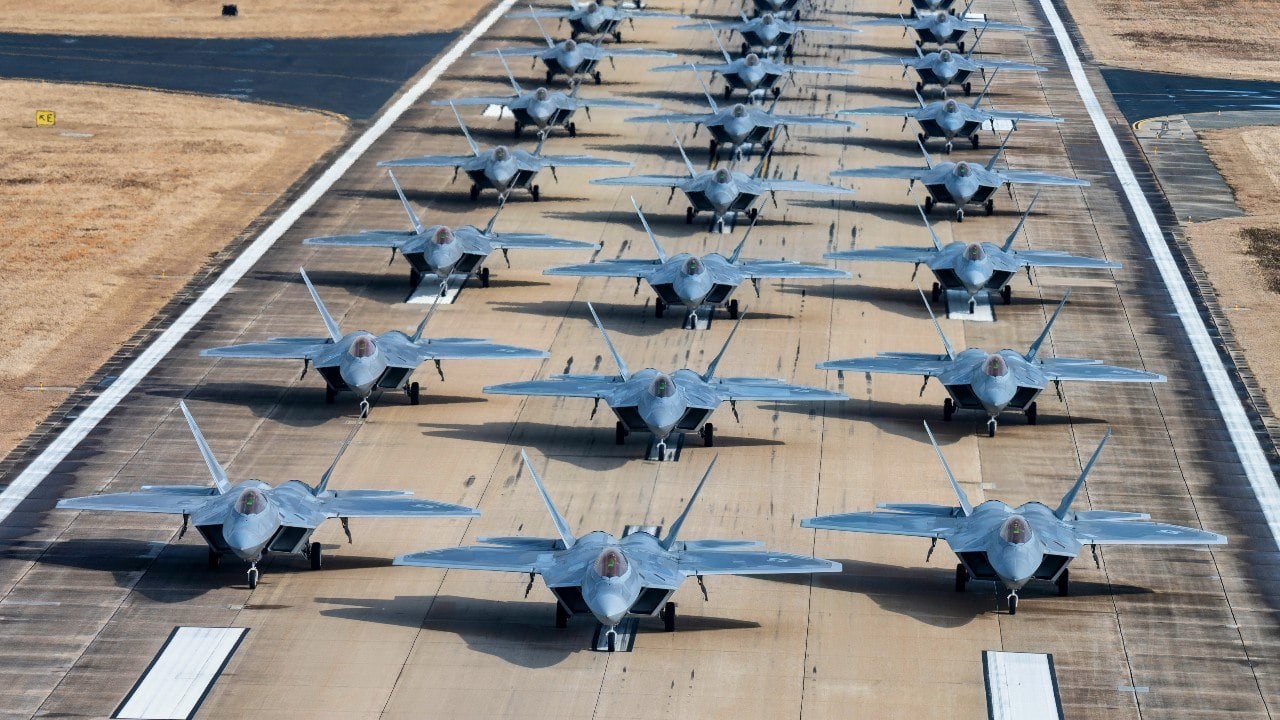
Key Points and Summary: The F-22 Raptor was built to address a specific Cold War problem: guaranteeing U.S. air superiority against the most advanced Soviet fighters and air defenses.
-That problem never really went away.
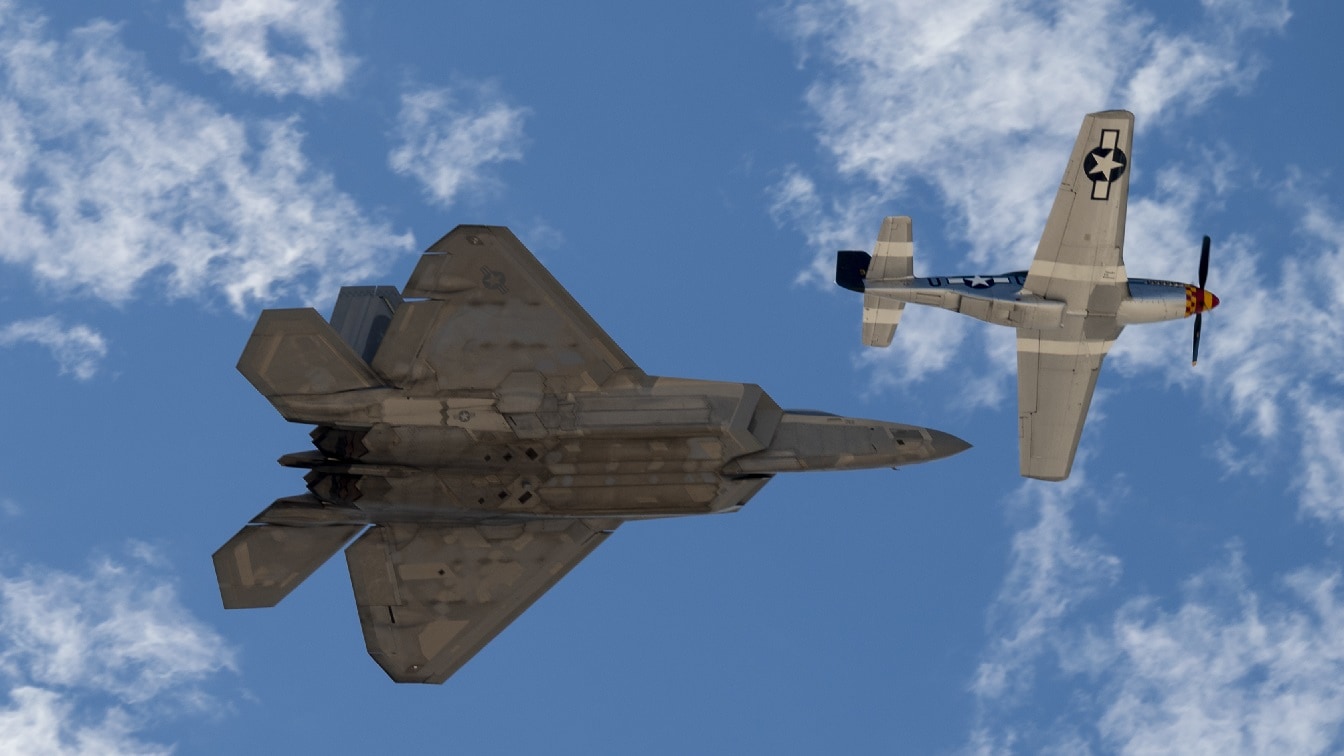
A P-51D Mustang and F-22 Raptor participate in a traditional “Heritage Flight” during the 2022 Marine Corps Air Station Miramar Air Show at MCAS Miramar, San Diego, California, Sept. 24, 2022. The theme for the 2022 MCAS Miramar Air Show, “Marines Fight, Evolve and Win,” reflects the Marine Corps’ ongoing modernization efforts to prepare for future conflicts. (U.S. Air Force photo by Adam Bowles)
-Despite production being cut to just 187 jets and the line closed in 2009, the Raptor’s stealth, supercruise, and sensor fusion still make it the only dedicated air-dominance fighter the U.S. has.
-As China fields more capable aircraft and dense air-defense networks, delays and uncertainty around NGAD mean the F-22 must remain upgraded, deployed, and central to deterrence in Europe and the Indo-Pacific for years to come.
The F-22 Raptor Still Has One Job: Own the Sky
In recent months, the U.S. Air Force’s oldest fifth-generation aircraft has been at the center of a debate over the composition of America’s fighter fleet.
As Washington weighs how quickly it can field the Next Generation Air Dominance (NGAD) family of systems and whether it can even complete the long-suffering Navy F/A-XX program, senior officials and lawmakers have openly acknowledged that the F-22 will need to remain operational and relevant for longer than initially anticipated.
The reality is this: China is fielding increasingly capable new aircraft, scaling at an unprecedented rate, and iterating more quickly than the U.S. aviation industry has ever.
China’s push to compete with the U.S. Air Force is forcing Washington to make moves quickly, and even to make difficult decisions about the future of some programs – but it raises the questions: how is an aircraft that was developed in the 1980s and 1990s still operationally relevant, and why was it made in the first place?
The Origins of the F-22
The F-22 Raptor, developed by Lockheed Martin and first flown in September 1997, was conceived during a Cold War threat environment that convinced U.S. strategists they were at risk of losing control of the air.
The F-22, therefore, was not designed to be a general-purpose fighter: it was built to address a particular strategic problem that American planners believed aircraft of the time could not handle.
And the reason the F-22 remains relevant today is not just because it has received upgrades over the decades – it’s because the threat environment, in many ways, is the same as it was when the aircraft was conceived.
By the late 1970s and early 1980s, the U.S. Air Force was increasingly concerned that its edge in air combat was eroding – not in terms of numbers necessarily, but in terms of power and capability.
The Soviet Union was fielding a new generation of fighters, including the MiG-29 and Su-27, that dramatically narrowed the performance gap with Western aircraft.
At the same time, Moscow was investing heavily in integrated air defense systems that combined early-warning radars, surface-to-air missiles, and command-and-control networks designed to deny airspace to NATO aircraft across Europe.
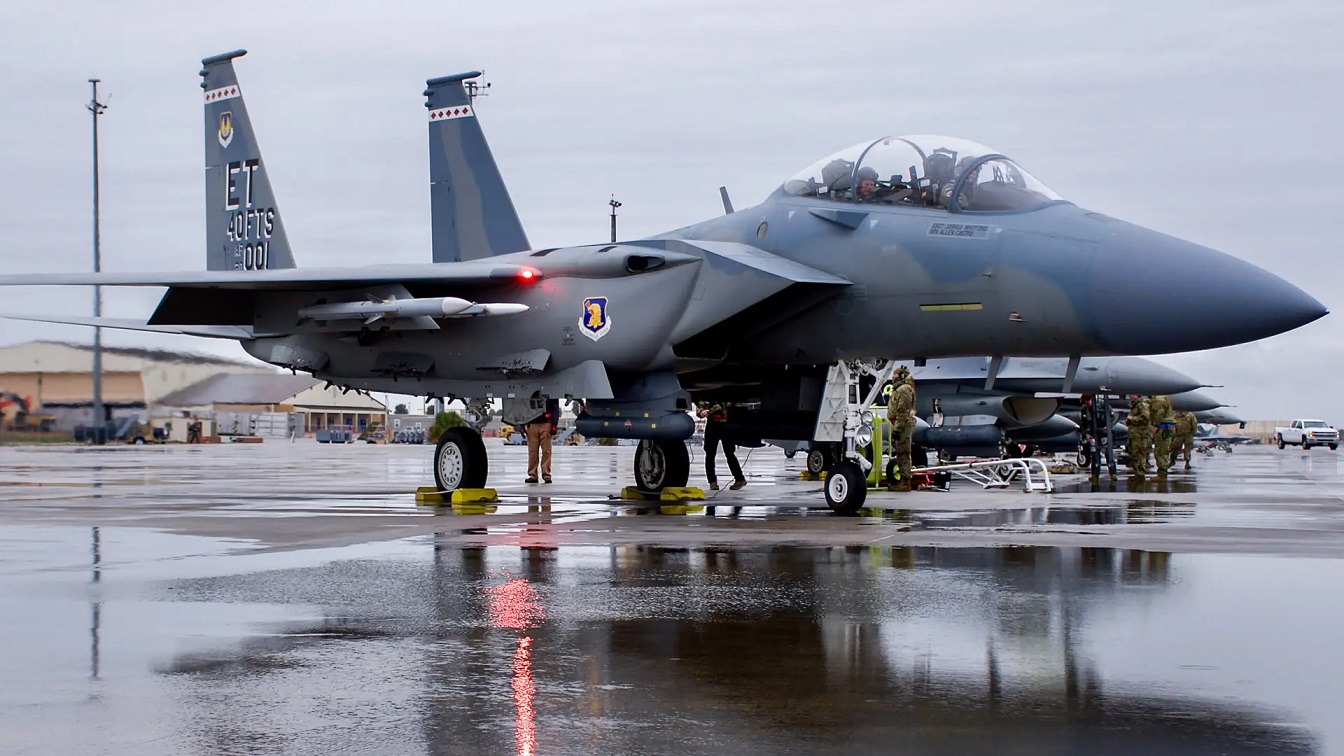
F-15EX. Image Credit: U.S. Air Force.
The U.S. Air Force already had a solution to this: the McDonnell Douglas F-15 Eagle. While the aircraft was still competent, it was ultimately a design from a different era.
The consensus was that upgrading fourth-generation fighters would constitute a solid upgrade. Still, it would not be enough against a peer adversary that was now operating a dense, layered defense system and increasingly capable interceptors.
It was obvious: if American aircraft could not detect and engage threats before being detected themselves, attrition in a high-intensity conflict would have been unacceptably high.
The Advanced Tactical Fighter program began in the 1980s against this backdrop, and it demanded an aircraft that would guarantee air superiority against the most capable adversary the United States had arguably ever faced.
It required stealth, supercruise, extreme maneuverability, and sensor fusion – all of which were not pursued simply for prestige but because they had become necessary.
What’s more: the F-22 was never intended to be a multirole workhorse. It was always an air-dominance platform designed to clear the skies and enable bombers, tankers, and less survivable aircraft to operate safely in contested airspace.
That very narrow focus made it expensive and vulnerable to cost-slashing measures after the Cold War ended – but it also explains why its capabilities remain difficult to replace to this day. And why it’s still in service.
The collapse of the Soviet Union dramatically altered the program’s trajectory; however, procurement was slashed from more than 700 to just 187 operational jets.
Budgets were tightening, but the F-22 still survived. That being said, the aircraft – as with any other – would eventually fall out of favor and in 2009, the Obama administration terminated production altogether.
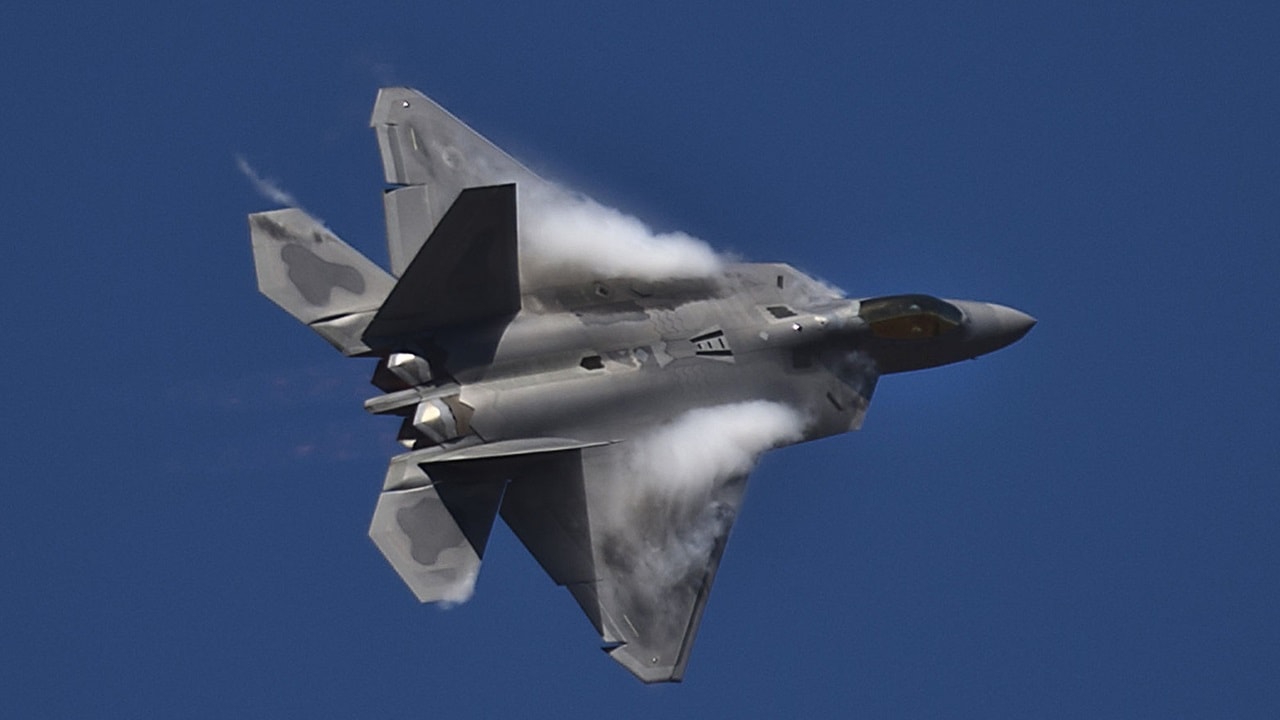
A U.S. Air Force F-22 Raptor from 94th Fighter Squadron Langley Air Force Base, Va., takes off to perform an aerial demonstration for an estimated 180,000 spectators at the Australian International Airshow, March 2, 2013 at Avalon Airport in Geelong, Australia. The F-22 demo team are currently deployed to the 18th Fighter Wing, Kadena Air Base, Japan to support pacific theater operations. This is the first official demonstration of the F-22 Raptors capabilities at an airshow outside the United States. The Australian International Airshow 2013 (AIA13), is held biennially, and is one of the largest international trade shows in the Pacific. The Airshow is expected to draw 350,000 visitors and has featured 500 defense exhibitors from 35 countries and is designed to bolster business opportunities in the international aviation sector. U.S. Pacific Command (USPACOM) participation in AIA13 directly supports theater engagement goals and objectives and further enhances relationships with other Pacific nations. (Department of Defense photo by U.S. Air Force Tech. Sgt. Michael R. Holzworth/Released)
But despite the claims that the F-22 was a relic of a threat that no longer existed, the strategic logic that made it such a formidable asset never actually disappeared.
Over the last decade, both China and Russia have invested heavily in advanced fighters, long-range sensors, and sophisticated air defense networks that mirror the challenges the F-22 was initially designed to overcome.
The reality that air superiority cannot be assumed in a conflict with peer competitors explains why the F-22, despite its age and limited numbers, continues to feature prominently in deterrence planning.
The aircraft has been regularly deployed to Europe and the Indo-Pacific in response to Russian and Chinese activity – and at the same time, delays and cost concerns surrounding NGAD have forced policymakers to confront the risk of a future air superiority gap.
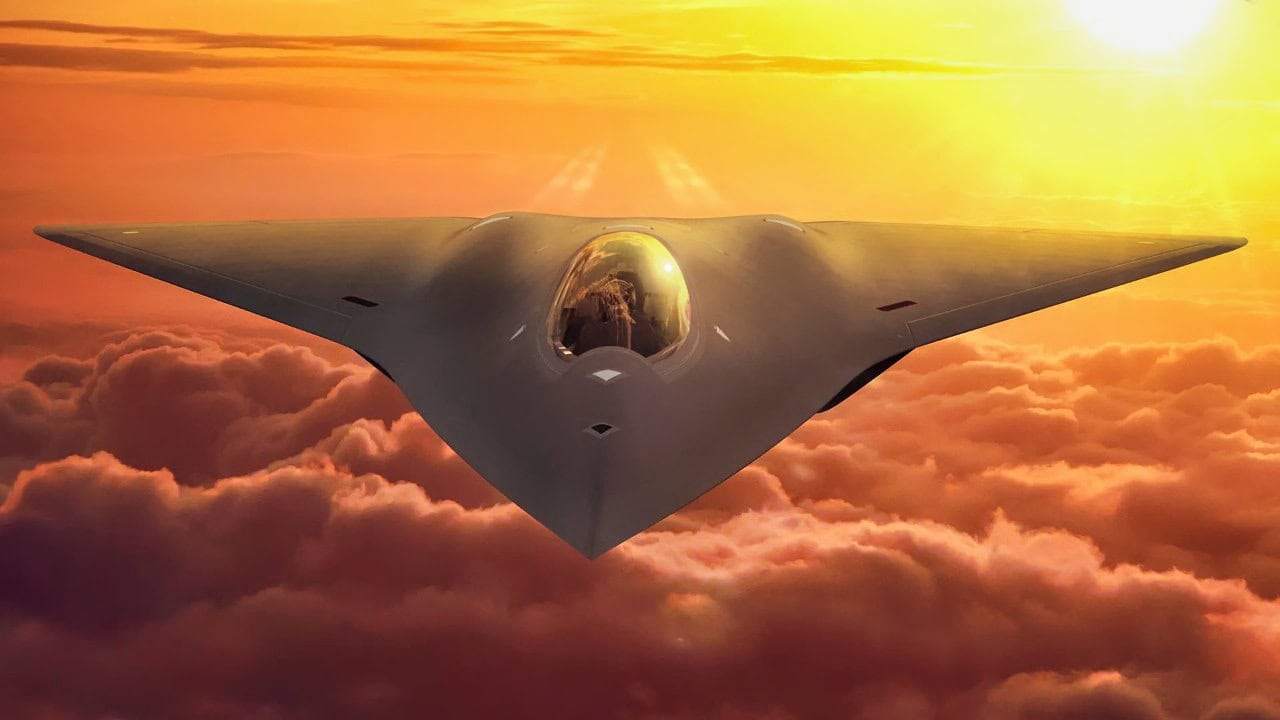
NGAD Fighter via Lockheed Martin.
In that sense, the current focus on sustaining the F-22 for as long as necessary may suggest poor foresight and planning.
Still, it’s also a reminder of how enduring the problem of air dominance actually is.
The Raptor was built to hedge against a peer competitor that could challenge the U.S. in the skies.
Until NGAD can credibly assume that role and be fielded in substantial numbers, the logic that led to the F-22 in the first place will continue to shape U.S. airpower planning.
About the Author:
Jack Buckby is a British author, counter-extremism researcher, and journalist based in New York who writes frequently for National Security Journal. Reporting on the U.K., Europe, and the U.S., he works to analyze and understand left-wing and right-wing radicalization, and reports on Western governments’ approaches to the pressing issues of today. His books and research papers explore these themes and propose pragmatic solutions to our increasingly polarized society. His latest book is The Truth Teller: RFK Jr. and the Case for a Post-Partisan Presidency.