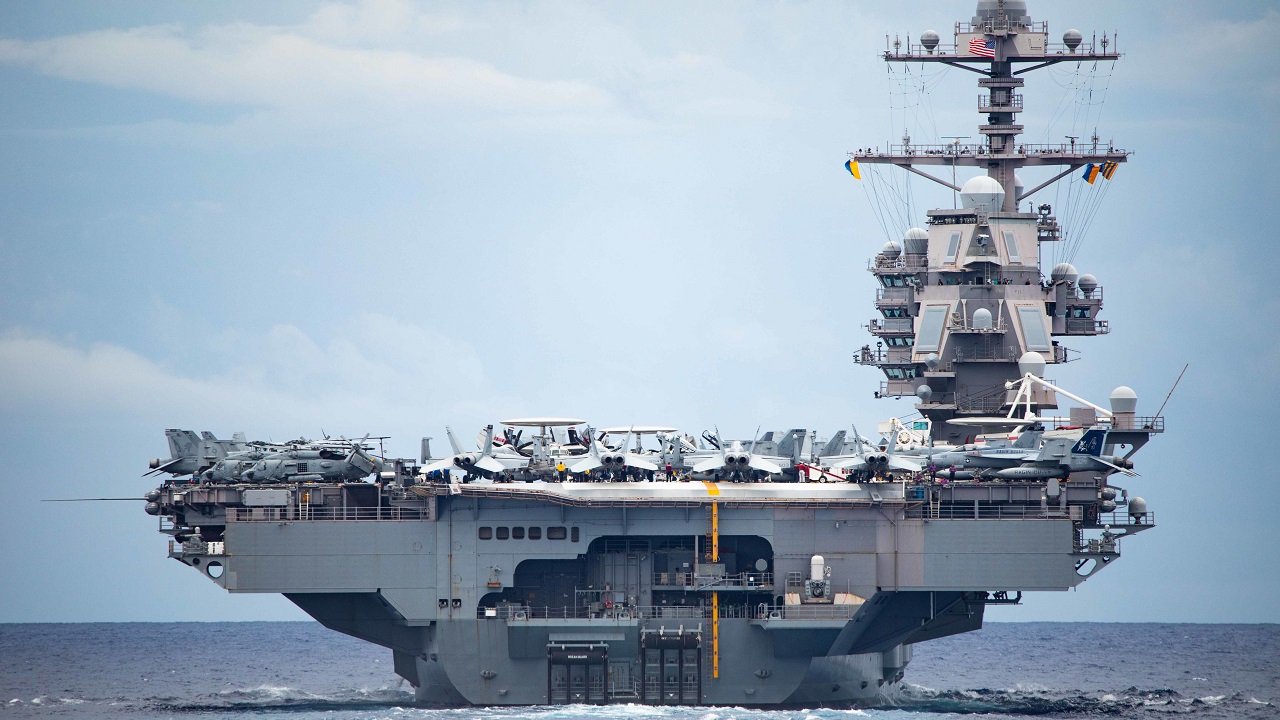
Key Point and Summary – Nimitz-class carriers are getting old and will need help staying relevant in the years to come, a clear headache and challenge for the U.S. Navy. However, they have earned their reputation through decades of forward presence, power projection, and deterrence—and they are not being left behind as the Ford-class matures.
-The piece argues that upgrades have reshaped Nimitz survivability and combat relevance in a tougher threat environment defined by China.
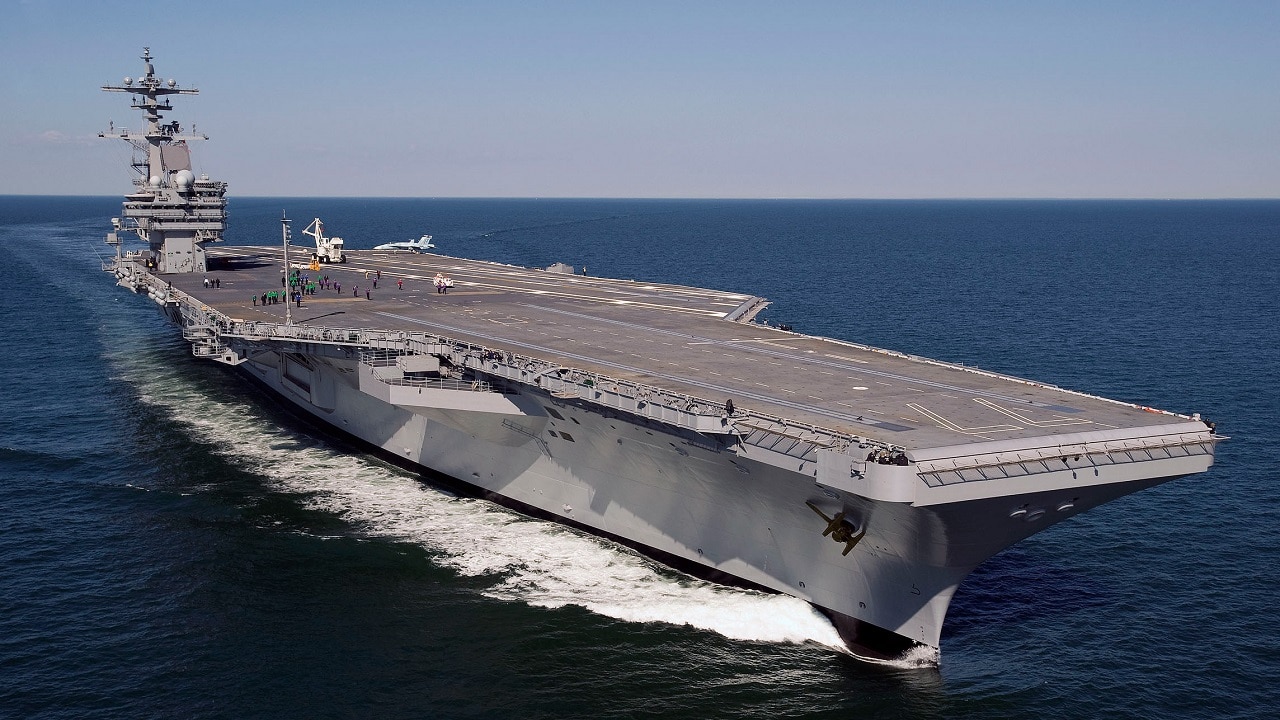
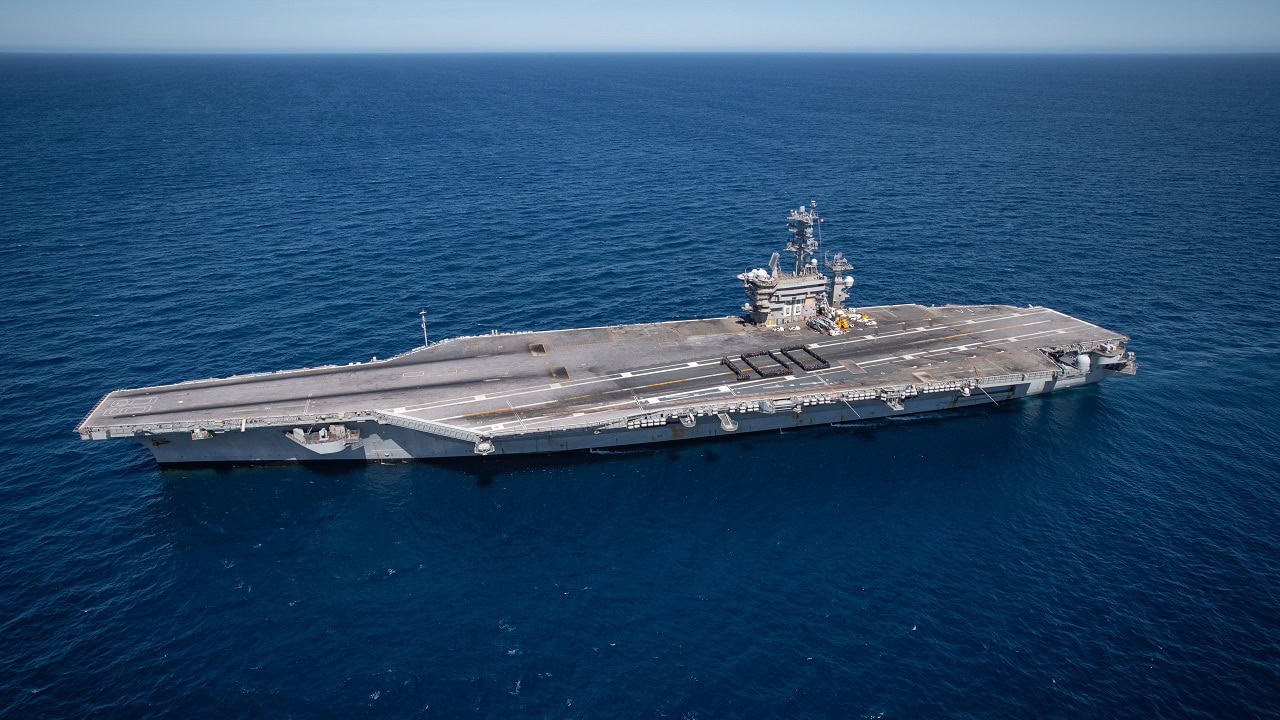
The aircraft carrier USS George H. W. Bush (CVN 77) on builder’s trials, 2/13/2009. The ship, named after the nation’s 41st president, is the 10th and final Nimitz-class, nuclear-powered carrier built at Northrop Grumman Shipbuilding-Newport News. Photo by John Whalen, Northrop Grumman Shipbuilding.
-New landing precision (JPALS) supports modern air wings, including the F-35C, while layered defenses are strengthened by tighter networking with Aegis-equipped escorts, improved interceptors, and more capable electronic warfare.
-The Ford’s edge is sortie generation and electrical power, but upgraded Nimitz hulls remain formidable partners in high-end operations.
Why the Navy Still Bets on Nimitz-Class Carriers Even as Ford Arrives
The distinguished and successful combat performance of the Nimitz-class carriers has earned the ships a permanent resting place in the annals of Naval history, as they have projected power, propelled and sustained air attacks, and operated as a powerful “deterrent” and symbol of American power.
These carriers have not only launched successful war campaigns but also safeguarded international waterways for decades. Protecting free commerce and movement on the seas is one of the Navy’s key, yet often lesser recognized missions, given the large percentage of international trade that takes place over water. This is one key reason why the US Navy does a lot of forward operations, placing carriers in critical, high-value areas of great significance to world waterway travel.
The deterrence mission, however, is of course never to be overlooked, particularly in today’s threat environment wherein China not only threatens Taiwan but operates a larger Navy than the US.
Of course, this does not mean it is superior, but the Chinese naval threat is increasingly being taken extremely seriously at the Pentagon.
It is likely one reason why the US Navy recently conducted dual-carrier operations in the Pacific to “scale” the potential for a massive-scale, networked air attack campaign. Improved interoperability, networking, and tactical air-to-surface mission coordination multiply the scale, scope, and operational envelope
Nimitz-Class Aircraft Carriers Support the Ford-Class
As for the Nimitz, some may wonder how they will compare to the Ford-class once it is more fully operational, yet upgrades to the Nimitz carriers are not to be overlooked.
There are several critical areas where the Nimitz carriers have been adapted to a new, more serious, and changing threat environment.
For example, they have received cutting-edge GPS-enabled aircraft-carrier landing technology called the Joint Precision Approach and Landing System.
While pilots have succeeded in landing in difficult and dangerous conditions for many years, JPALs introduces a new measure of precision when it comes to a pilot’s “glide scope” and descent onto a carrier deck. This can be extremely helpful for pilots who “bank: and seek to land in rough sea conditions, high winds, or under enemy fire. JPALs are also part of a series of modifications that help aircraft carriers accommodate the now-operational F-35C, the first-of-its-kind sea-launched stealth fighter.
Carrier Defenses
Some of the largest improvements to the Nimitz-class, however, may come in the realm of layered ship defenses.
There are several key reasons for this, the first and potentially most apparent of which is an increased ability to network with destroyers, cruisers, and other ships in its Carrier Strike Group.
This enables vastly improved protection for carriers, as Aegis-capable destroyers can perform cruise and ballistic missile defense at ranges sufficient to alert carriers to incoming threats and, in many cases, intercept them. Carrier-layered defenses also include advanced applications of EW, interceptor weapons such as Close-In-Weapons-Systems, and shorter range offensive and defensive weapons such as SeaRAM.
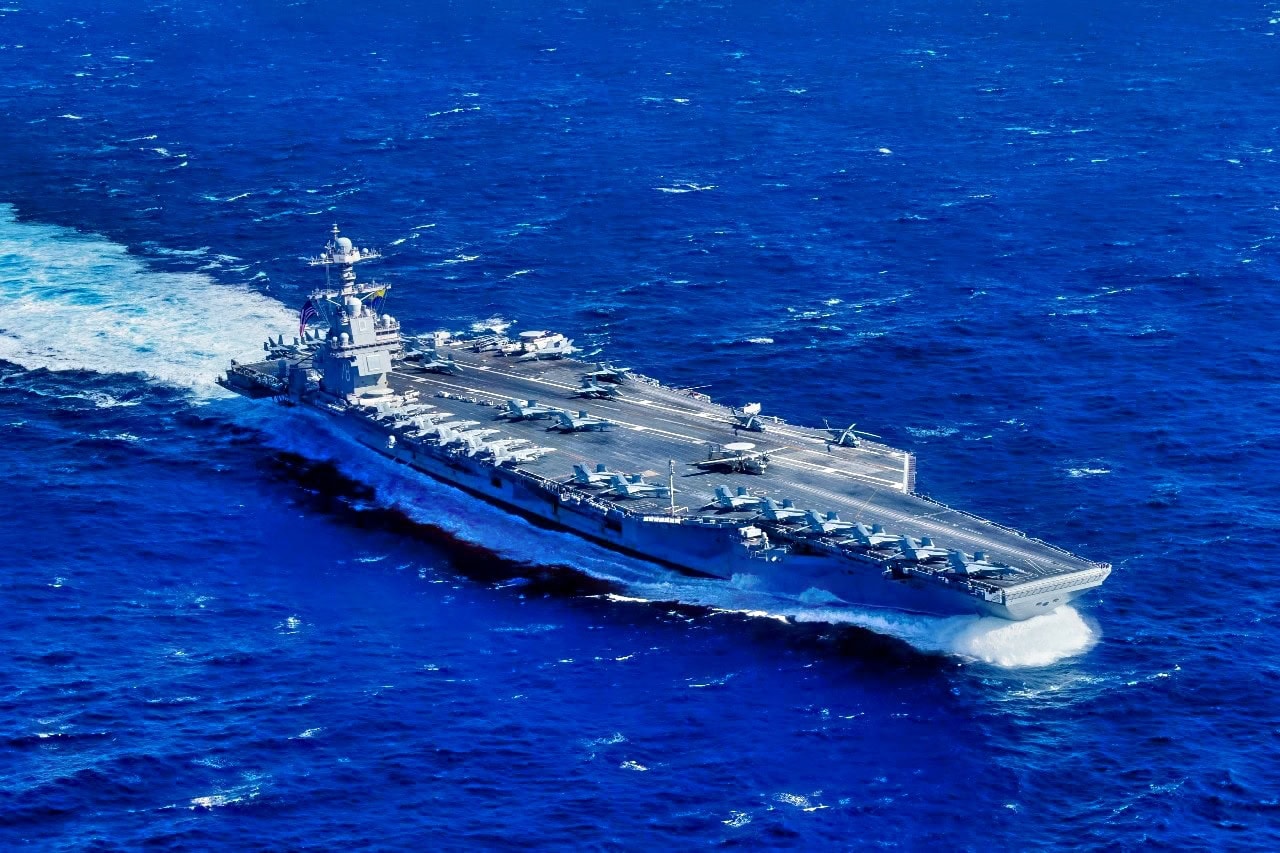
The world’s largest aircraft carrier, USS Gerald R. Ford (CVN 78), sails in formation with the Arleigh Burke-class guided missile destroyers USS Winston Churchill (DDG 81), USS Mitscher (DDG 57), USS Mahan (DDG 72), USS Bainbridge (DDG 96), and USS Forrest Sherman (DDG 98) in the Atlantic Ocean, Nov. 12, 2024. The Gerald R. Ford Carrier Strike Group is underway in the Atlantic Ocean completing Group Sail. Group Sail is the first at-sea integrated phase training event during a routine deployment training cycle. It is designed to challenge the Gerald R. Ford CSG’s ability to use the capabilities of the USS Gerald R. Ford (CVN 78), USS Winston S. Churchill (DDG 81), Carrier Air Wing (CVW) 8, Destroyer Squadron (DESRON) 2, and embarked Information Warfare team as a cohesive Strike Group to meet Navy and Joint Warfighting requirements that increases warfighting capability and tactical proficiency across all domains. (U.S. Navy photo by Mass Communication Specialist 2nd Class Maxwell Orlosky)
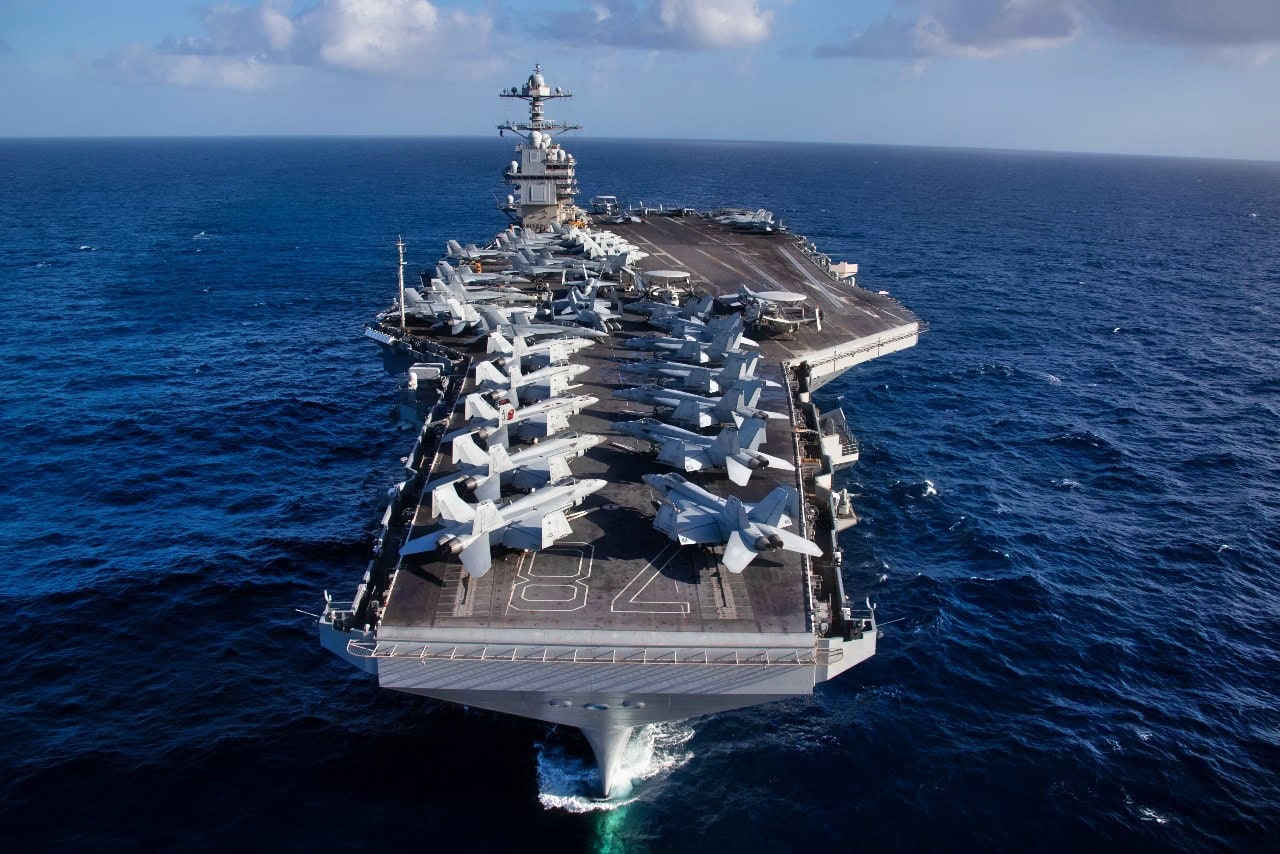
The world’s largest aircraft carrier USS Gerald R. Ford (CVN 78), steams in the Mediterranean Sea, Dec. 24, 2023. The Gerald R. Ford Carrier Strike Group is currently operating in the Mediterranean Sea. The U.S. maintains forward-deployed, ready, and postured forces to deter aggression and support security and stability around the world. (U.S. Navy photo by Mass Communication Specialist 2nd Class Jacob Mattingly)
The other large surge forward in aircraft carrier survivability and warfighting prowess relates to the rapid adoption of networking technologies.
Ships in a Carrier Strike Group, such as destroyers and cruisers, now offer new dimensions of protection to carriers through technologies such as the Aegis 10 Combat System, which combines ballistic and cruise-missile radar into a single system that can cue fire control and launch defensive interceptors.
An SM-6, for example, can now, due to a software upgrade, track and destroy moving targets by adjusting course in flight.
Lasers & EW
US Navy destroyers are increasingly being armed with scalable lasers able to operate as both optical sensors and weapons to incinerate or simply disable an enemy aircraft, drone, or incoming missile.
There have also been breakthroughs in electronic warfare, with weapons able to find and “jam” or disable enemy communications or weapon guidance systems.
EW technologies are increasingly capable of deconflicting a cluttered spectrum to “frequency hop” to counter enemy “jamming,” identify hostile versus friendly electronic signa,ls or launch a series of difficult-to-detect narrow “pencil beam” kinds of electronic beams to disable or jam an enemy system.
There are also upgraded close-in ship defenses increasingly able to track and intercept threats much more quickly, often using AI-enabled advanced algorithms to identify and destroy threats at exponentially greater speeds.
Ford-class Future
As for whether upgraded Nimitz-class carriers will compete with or rival the Ford class, there are several key variables to consider.
Nimitz would perform quite well alongside the Ford class.
(Mar. 12, 2022) Sailors aboard USS Nimitz (CVN 68) assemble on the flight deck and form a human ‘100’ to commemorate the centennial of the aircraft carrier. On March 20, 1922 the former USS Jupiter (Collier #3) recommissioned as the USS Langley (CV 1), the U. S. Navy’s first aircraft carrier. One hundred years later, Nimitz and Ford-class aircraft carriers are the cornerstone of the Navy’s ability to maintain sea control and project power ashore. Nimitz is the first in its class and the oldest commissioned aircraft carrier afloat., carrying with it a legacy of innovation, evolution and dominance. Nimitz is underway in the 3rd Fleet Area of Operations. (U.S. Navy photo by Mass Communication Specialist 3rd Class Elliot Schaudt)
Yet, the primary difference lies in Ford’s 33-percent higher sortie rate, enabled by a larger deck and megawatt generators that provide unprecedented on-board electrical power.
This can help store energy and also power up and sustain power-reliant emerging weapons systems such as lasers, new EW applications, and radar and fire control systems.

U.S. Navy sailors view the Nimitz-Class aircraft carrier USS Carl Vinson (CVN-70) from the hangar bay of the aircraft carrier USS Theodore Roosevelt (CVN-71). Theodore Roosevelt was deployed in the U.S. 5th Fleet area of responsibility supporting Operation Inherent Resolve, strike operations in Iraq and Syria as directed, maritime security operations and theater security cooperation efforts in the region.
About the Author: Kris Osborn
Kris Osborn is the President of Warrior Maven – Center for Military Modernization. Osborn previously served at the Pentagon as a highly qualified expert in the Office of the Assistant Secretary of the Army—Acquisition, Logistics & Technology. Osborn has also worked as an anchor and on-air military specialist at national TV networks. He has appeared as a guest military expert on Fox News, MSNBC, The Military Channel, and The History Channel. He also has a Masters Degree in Comparative Literature from Columbia University.