
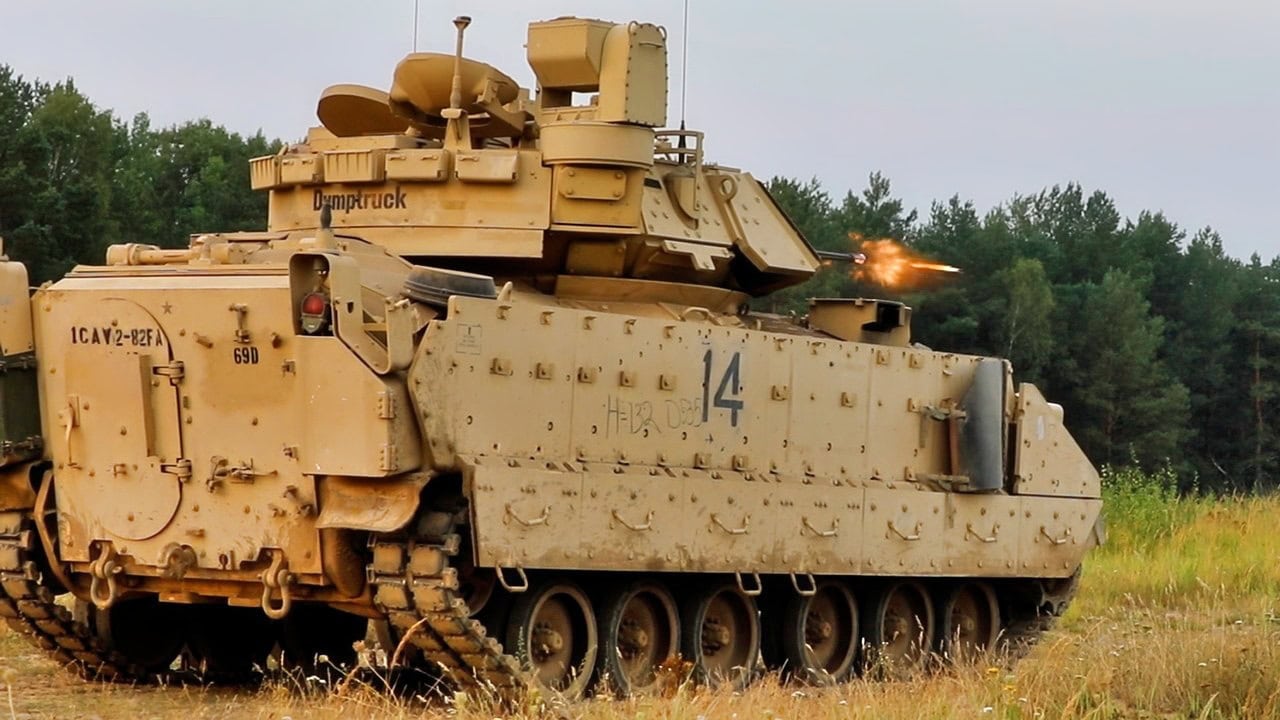
Key Points and Summary – The Bradley Fighting Vehicle has outlived every would-be successor, but the Army is running out of easy upgrades.
-The newest M2A4E1 package adds Iron Fist active protection, sharper FLIR sights, and better climate control for crews.

XM30 Image. Defense Contractor Handout.
-Those fixes matter in a drone-heavy fight, yet the vehicle still struggles with cramped infantry space and survivability once hit.
-After Iraq’s losses and Ukraine’s lessons, the service is betting the XM30 program will finally end the cycle.
-Two finalists—GDLS’ Griffin III and American Rheinmetall’s KF41 Lynx—promise hybrid power, open-architecture electronics, and a larger gun, along with an unmanned turret, modular armor, and a growth room for counter-drone systems.
Have We Run Out of Upgrades for the Bradley Fighting Vehicle?
Named for the legendary General Omar Bradley, the Bradley infantry fighting vehicle (IFV) is one of the most time-honored and battletested IFVs of all time.
The Bradley made its operational debut with the U.S. Army and first proved its effectiveness in the crucible of combat during the 1991 Persian Gulf War. The M2 variant during that conflict ended up destroying more of dictator Saddam Hussein’s main battle tanks (MBTs) than the legendary M1 Abrams MBT did. During the current Russia-Ukraine War, a Ukrainian Bradley crew destroyed one of Russia’s ultramodern T-90M MBTs.
Time marches on, however, and the venerable IFV is showing its age. The question is whether the Bradely can still be upgraded in ways that keep it relevant in modern combat.
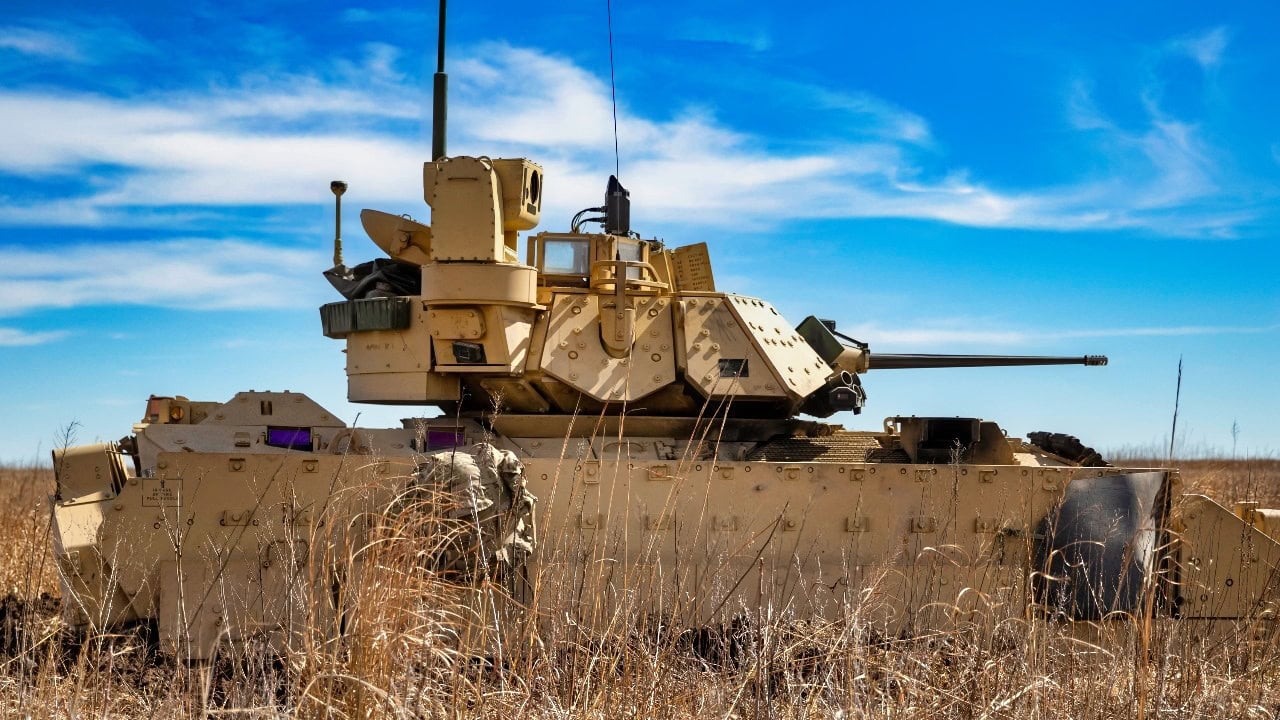
U.S. Army Soldiers with the 3rd Battalion, 66th Armored Regiment, 1st Infantry Division, participated in a battalion wide training event consisting of attacking and defending Bradley Fighting Vehicles and M1 Abrams Main Battle Tanks, on Fort Riley, February 4, 2024. The defending teams dug hasty trench defenses to further conceal and provide cover for their tanks. (U.S. Army Photo by Spc. Kenneth Barnet)
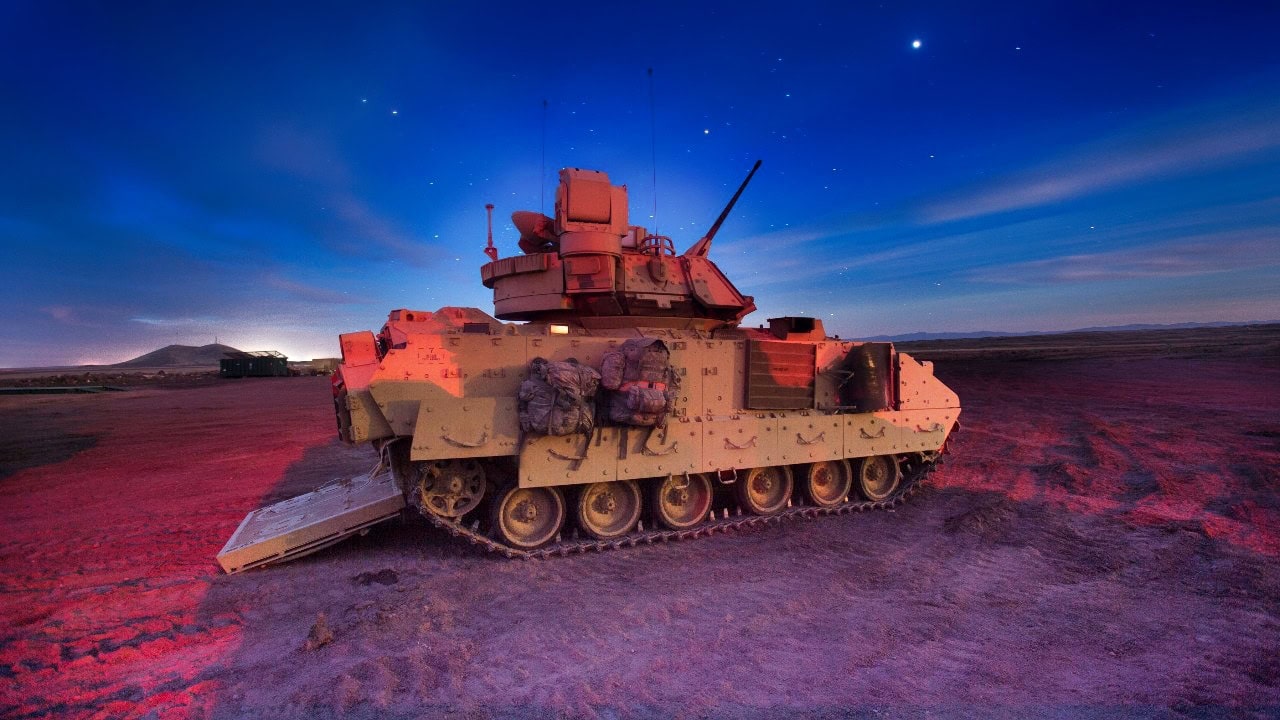
Engineers with the 116th Brigade Engineer Battalion conduct M2A3 Bradley fighting vehicle gunnery qualification on March 27, 2018, Orchard Combat Training Center, south of Boise, Idaho. Combat engineers with the 116th BEB trained through gunnery table XII, evaluating their ability to execute collective platoon-level tasks in a tactical live-fire environment; including integrating dismounted soldiers with their assigned BFV. (U.S. Army National Guard photo by 1LT Robert Barney)
The Latest & Greatest: Enter the M2A4E1
In May 2024, the Army unveiled the latest edition of the old warhorse, the M2A4E1, which it touted as “ the “most modern and survivable version.” Among the upgrades are:
-The Iron Fist active protection system to detect and intercept incoming missiles and rockets using radar and infrared trackers and explosive projectiles
-An improved high-definition forward-looking infrared gunner’s sight and an environmental control unit to prevent heat stress
However…
Even with the A4E1 improvements, the Bradley has its shortcomings, including cramped space for infantrymen, vulnerability to catching fire after being hit, and survivability challenges against modern threats.
Its weaknesses are not a recent discovery. During the 2003 Iraq War, the vehicle was vulnerable to improvised explosive devices and rocket-propelled grenades. By the end of the war, roughly 150 Bradleys had been destroyed; 55 in 2006 alone.
The Effort to Replace the Bradley Part I: Repeated Failures
Efforts to replace the Bradley have tended to fall short. They are cynically summed up in the pun-laden title of a damning March 2020 report by Mark Thompson of the Project On Government Oversight: “The Army’s Lousy Tracked Record.”
–The Armored Systems Modernization collapsed in 1992 (the year after the Bradley proved its worth in Operation Desert Storm) when the Cold War ended and costs skyrocketed.
–Next came the Future Combat Systems (FCS) in 2003 which promised a fleet of networked lightweight vehicles. Billions of taxpayer dollars later, none of the promised systems could withstand the realities of Iraq and Afghanistan, and the FCS was ignominiously canceled in 2009.
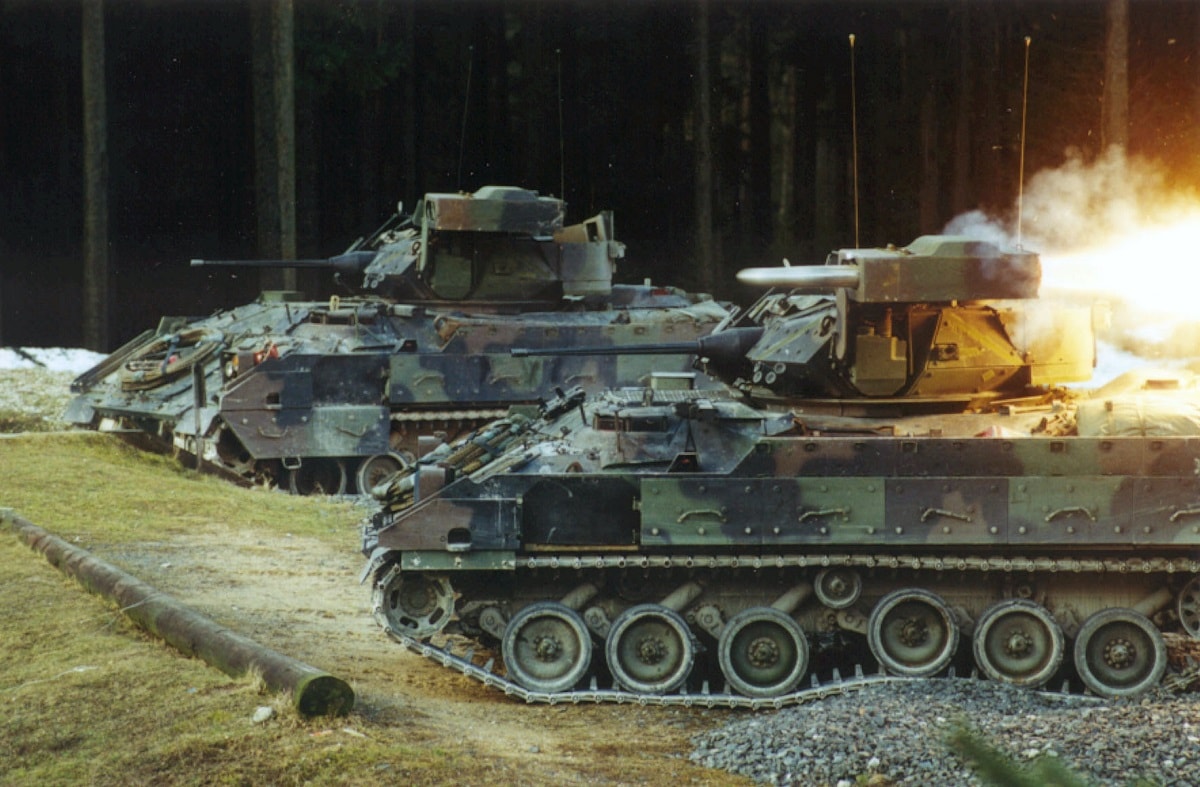
M2 Bradley Infantry Fighting Vehicle.
–Then came the Ground Combat Vehicle, a fortified armored personnel carrier for a new era of mechanized warfare. Alas, the prototypes were so bloody heavy they could barely fit on a C-17 Globemaster III cargo plane and cost more money than the Abrams. That program died in 2014.
The Effort to Replace the Bradley Part I: XM30
Which brings us now to the XM30 program. This latest program started as a 2020 reset of the Optionally Manned Fighting Vehicle that was part of the 2018 Next Generation Combat Vehicle initiative, which faltered due to a lack of qualifying contractors.
As noted by Kyle Gunn writing for Task & Purpose, the Army has set out the following key criteria for the XM30 candidates:
–Carrying capacity for a crew of two and six infantry soldiers, thus matching the Bradley’s squad compatibility while reducing the number of in-vehicle crew thanks to an unmanned turret and other automations.
–A hybrid-electric powertrain to provide greater fuel efficiency, reduced thermal and acoustic signatures, and the ability to run sensors on “silent watch” (vitally important to conceal the vehicle from drones carrying thermal cameras).
–Open-architecture digital systems that allow rapid upgrades without redesigning the entire vehicle. Everything could be updated, from sensors and radios to active protection and autonomy packages.
–The most notable leap is in lethality. The XM30 is expected to field the XM913 50-mm cannon or a 30-mm gun with an upgrade path, giving it far greater range and the ability to fire programmable airburst munitions designed to counter both light armored threats and aerial drones.
With all that in mind, there are currently two finalists for the XM30 bid.
First is the General Dynamics Land Systems (GLDS) Griffin III. GLDS produces the M1 Abrams, which gives the company a track record of building effective armored fighting vehicles for the Army. Indeed, the Griffin III platform is compatible with the digital architecture envisioned for the M1E3 variant of the Abrams. Other desirable features include an unmanned XM913 50-mm turret, placing the crew in a protected capsule within the hull, hybrid-electric drive, and modular armor.
Its competitor is the American Rheinmetall Combat Vehicles KF41 Lynx, built by the U.S. subsidiary of Rheinmetall AG, the fifth-largest European arms manufacturer. Congress is adamant about the XM30 selectee being “Made In The USA,” and accordingly American Rheinmetall is partnering with Raytheon, Textron, and L3Harris to build the vehicle.
The KF41 Lynx has already established some degree of credibility, and it’s being fielded by the Hungarian Defense Forces. Among its desirable features are a more modular and spacious design and a Lance 2.0 turret that carries a 30-mm cannon with upgrade potential. The standard variant carries a crew of three and eight infantry, but the U.S. version could be configured to match the Army’s two-crew, six-dismount requirement.
Time will tell if either one of the XM30 candidates wins the race. In the meantime, the Bradley IFV, just like its WWII flesh & blood namesake, will keep soldiering on.
About the Author: Christian D. Orr, Defense Expert
Christian D. Orr is a Senior Defense Editor. He is a former Air Force Security Forces officer, Federal law enforcement officer, and private military contractor (with assignments worked in Iraq, the United Arab Emirates, Kosovo, Japan, Germany, and the Pentagon). Chris holds a B.A. in International Relations from the University of Southern California (USC) and an M.A. in Intelligence Studies (concentration in Terrorism Studies) from American Military University (AMU). He is also the author of the newly published book “Five Decades of a Fabulous Firearm: Celebrating the 50th Anniversary of the Beretta 92 Pistol Series.”