

Should You Be ‘Brainwashed’ To Get in a U.S. Army Bradley Fighting Vehicle?
A remark a drill sergeant made during U.S. Army Basic Combat Training has always stuck with me. He was talking about the Bradley Fighting Vehicle. “Some of you are going to be assigned to the Bradley,” he yelled. “And the Army is going to have to brainwash you to get inside!”
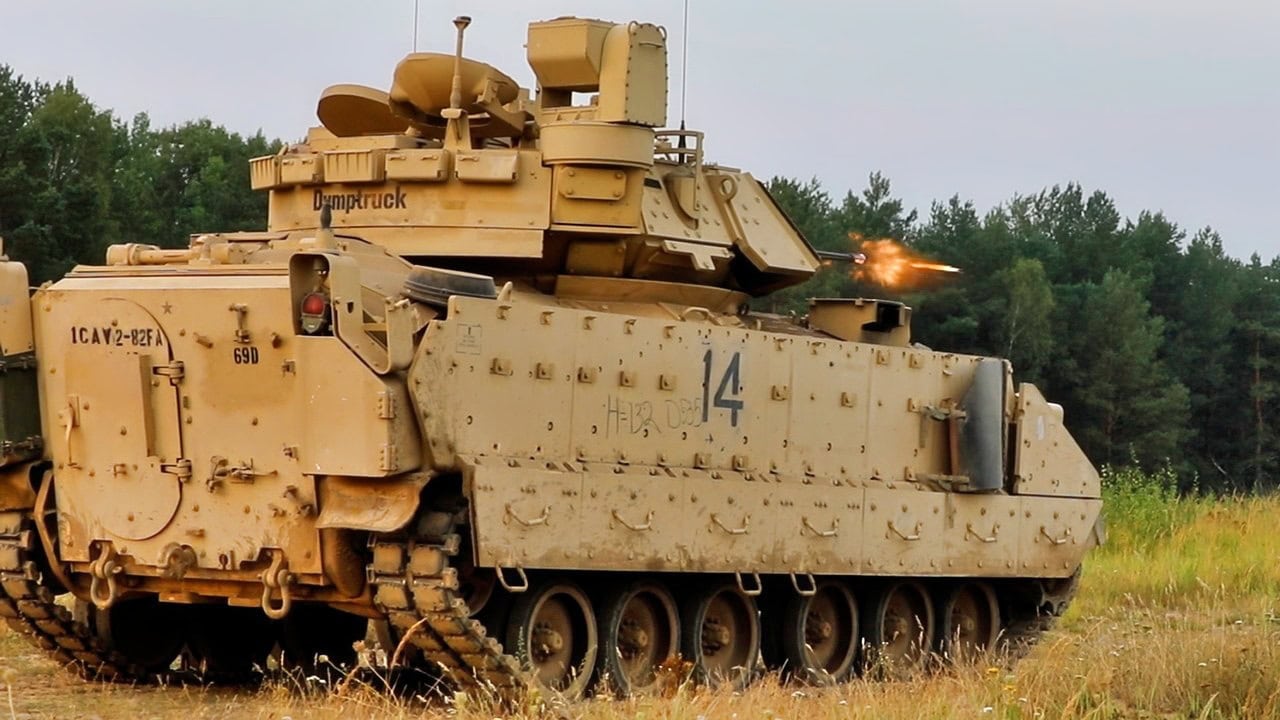
Troopers with 3rd Armored Brigade Combat Team, 1st Cavalry Division firing the 25mm canon on a Bradley fighting vehicle in order to zero the vehicles weapons systems at a range in Poland. Ranges such as these familiarize troopers with the vehicles systems in order to ensure combat readiness.
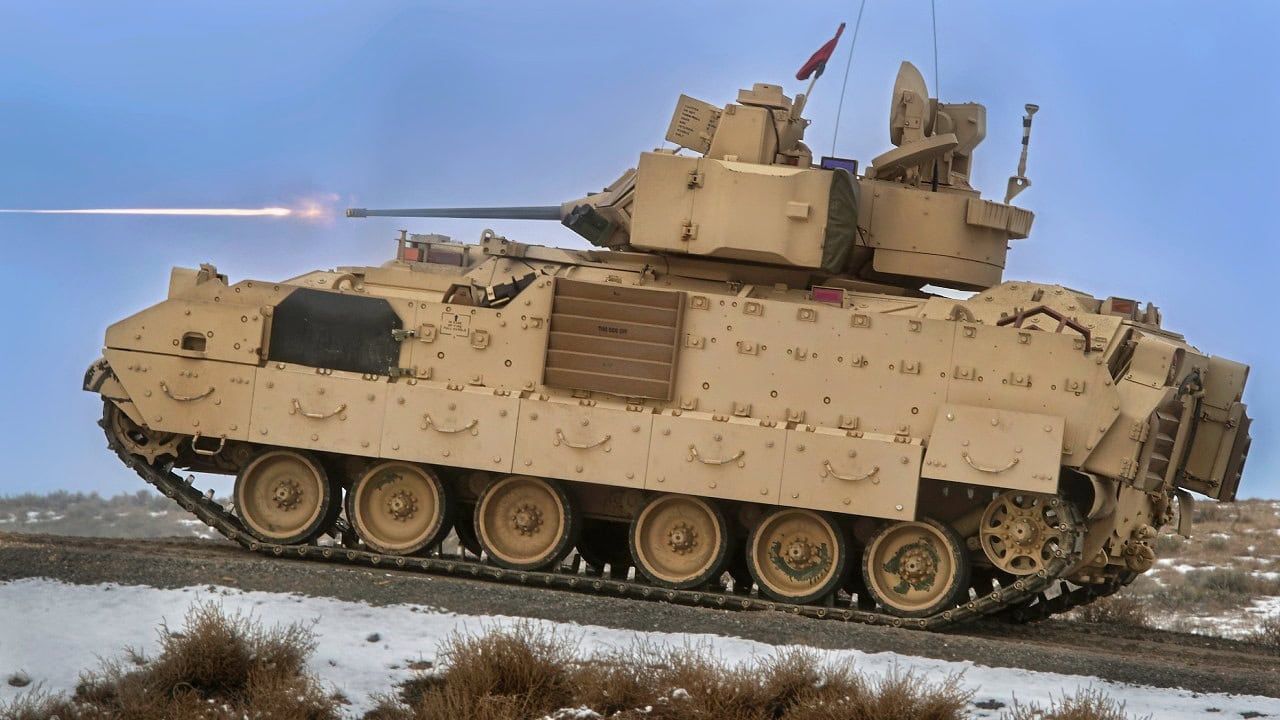
The Bradley Fighting Vehicle cuts loose several rounds from the 25mm main gun on the orchard Combat Training Center Range.
Soldiers completed training this week of the Bradley Commanders Course with the 204th Regional Training Institute, (RTI), of the Idaho Army National Guard on Gowen Field. The course is designed to train active duty, reserve and national guard officers and non-commissioned officers in combat critical M3 Bradley Fighting Vehicle Commander Skills. Field exercises were conducted on the newest Range 10, the Digital Air Ground Integrated Range (DAGIR), on the Orchard Combat Training Center grounds.
What did this mean? After all, we were already getting brainwashed in all ways the Army does that during basic training. This was many years after the Bradley’s great performance during Operation Desert Storm. Around 2,200 Bradleys were used during the First Gulf War. They certainly helped the United States pulverize Saddam Hussein’s Soviet-era tanks and armored personnel carriers (APCs).
This Armored Vehicle Is Special
But what made the Bradley so special? Several years after basic training, I was an Infantry officer when I peered inside my first Bradley up close.
I quickly saw what the drill sergeant was getting at. This was a small vehicle, and an infantry squad was going to have to cram inside.
Plus, the armor did not look very thick. I found out later that it was made of an amalgam of layers consisting of aluminum, steel, and spaced laminate belts. Later and more modern Bradleys had some level of explosive reactive armor. But to me, the infantry fighting vehicle looked thin-skinned and unable to take a punch, even from a rocket-propelled grenade or a mortar round.
How Fast Can It Go and Is Speed a Selling Point?
The other question I had was speed. Was this little guy fast enough to maneuver around the battlefield? If it wasn’t altogether that safe, then surely it could outrun other tanks and APCs. I had seen the Bradley trucking down roads, and it looked fast. Indeed, the Bradley can reach about 41 miles per hour on the blacktop, and in the field it could reach up to about 34 miles per hour. That wasn’t bad.
Don’t Forget the Firepower
The Bradley has good firepower from its effective M242 25mm Bushmaster chain gun, and some models were equipped with TOW anti-tank missiles. These were useful during the Russia-Ukraine War when Bradleys donated to Ukraine blasted some Russian tanks and took them out of action.
Creating Violent Action With Soldiers Onboard
Perhaps speed is not the most important aspect of a Bradley, but it can definitely shoot and scoot when called upon. The Ukrainians raved about its maneuverability on uneven terrain against the Russians. It could quickly unload a squad and let them launch first-person-view drones or send Javelin anti-tank missiles downrange.
Master Gunner Raves About Modern Arms Systems on the Bradley
So perhaps the most important aspect of a Bradley is gunnery. Sgt. Maj. LeRoy Hinton was a master gunner on this APC:
“The most important thing is the gunners and loaders when we talk about Bradleys. The Bradley Fighting Vehicle is a little easier for a new person to learn. Now, we do have changes in technology from the days when I first started working in the Bradley. We had the first generation auxiliary sight and the first generation thermal sight. We didn’t have laser range finders back then,” Hinton said during an interview with Defense Media Network.
“I understand from talking to some of the people here at Fort Carson [Colo.] that now all you have to do is aim the hand station, push a button. Now you have the laser range finder, so they are trying to find more ways now to enhance the fighting capabilities of the vehicles. If you are a crew member, that means you have to do more training. Simulations that we use only give you so much experience, but then you actually have to get in the vehicle and go on the range and do gunnery training and fire on targets.”
Firepower trumps speed, according to Hinton. That may mean that the Bradley is actually safer to ride in than I had thought, and it did not require any kind of “brainwashing” to be willing to enter its friendly confines.
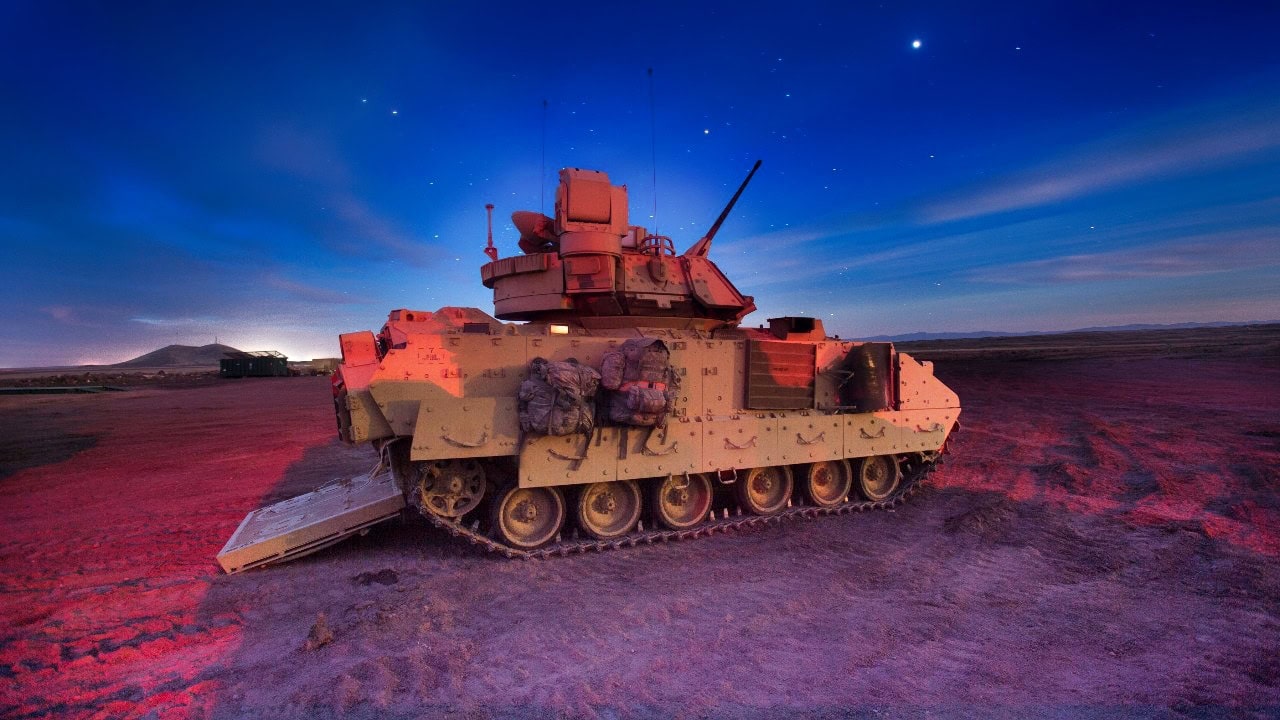
Engineers with the 116th Brigade Engineer Battalion conduct M2A3 Bradley fighting vehicle gunnery qualification on March 27, 2018, Orchard Combat Training Center, south of Boise, Idaho. Combat engineers with the 116th BEB trained through gunnery table XII, evaluating their ability to execute collective platoon-level tasks in a tactical live-fire environment; including integrating dismounted soldiers with their assigned BFV. (U.S. Army National Guard photo by 1LT Robert Barney)
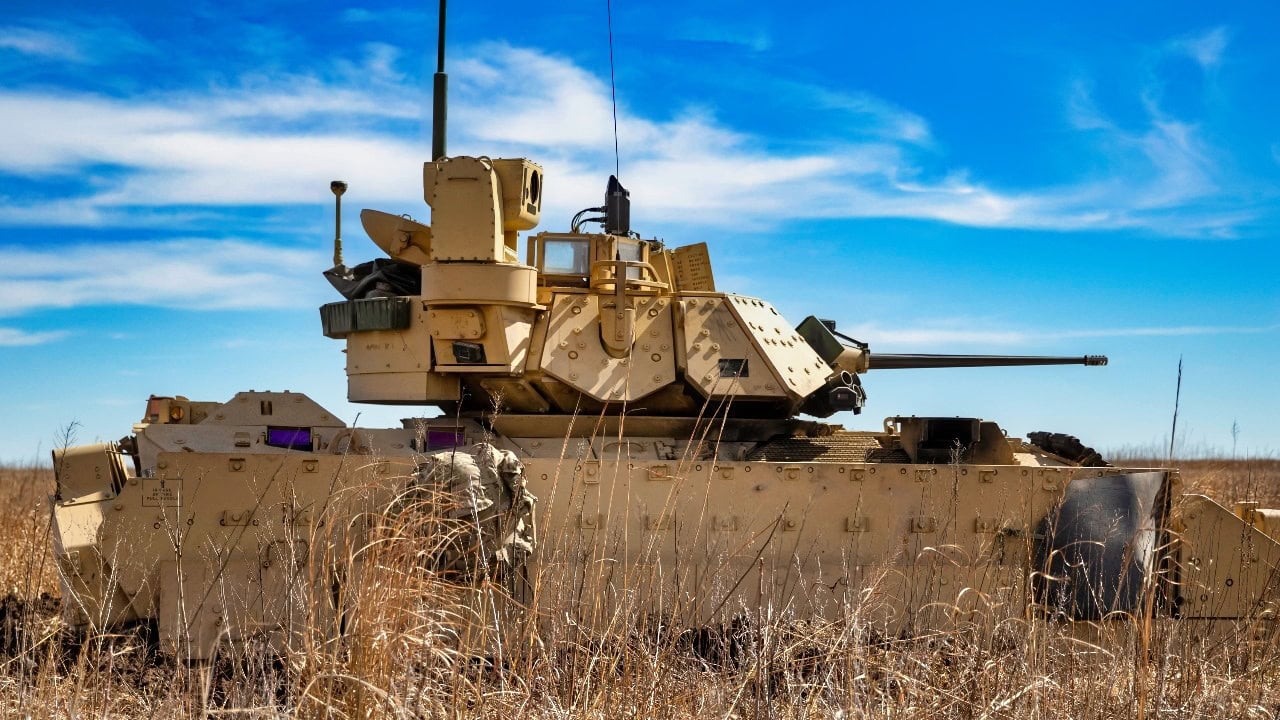
U.S. Army Soldiers with the 3rd Battalion, 66th Armored Regiment, 1st Infantry Division, participated in a battalion wide training event consisting of attacking and defending Bradley Fighting Vehicles and M1 Abrams Main Battle Tanks, on Fort Riley, February 4, 2024. The defending teams dug hasty trench defenses to further conceal and provide cover for their tanks. (U.S. Army Photo by Spc. Kenneth Barnet)
Armed Reconnaissance Is a Selling Point
I like the Bradley for its scouting and reconnaissance capability. This vehicle is perfect for armored cavalry regiments, with which it can forge ahead looking for enemy contact or to gather information about an adversary’s armor composition.
If I had it to do over again, I would have enlisted in the Armor branch and would have served as a 19-Delta cavalry scout. There is something alluring about being the pointy end of the spear leading a “hell on wheels” group of M1A2 Abrams tanks.
No Need for Brainwashing After All
Someday the Bradley will be replaced by the XM30 Mechanized Infantry Combat Vehicle. That will be a sad day.
The Bradley has proved its worth over the years—its firepower, speed, and maneuverability are shining bright spots for the workhorse. I don’t think the Army would have needed to brainwash me to get inside or to operate the arms systems. This vehicle will be remembered fondly by many crew members, and it has served the Army well during numerous conflicts.
About the Author: Dr. Brent M. Eastwood
Author of now over 3,000 articles on defense issues, Brent M. Eastwood, PhD is the author of Don’t Turn Your Back On the World: a Conservative Foreign Policy and Humans, Machines, and Data: Future Trends in Warfare plus two other books. Brent was the founder and CEO of a tech firm that predicted world events using artificial intelligence. He served as a legislative fellow for US Senator Tim Scott and advised the senator on defense and foreign policy issues. He has taught at American University, George Washington University, and George Mason University. Brent is a former US Army Infantry officer. He can be followed on X @BMEastwood.