
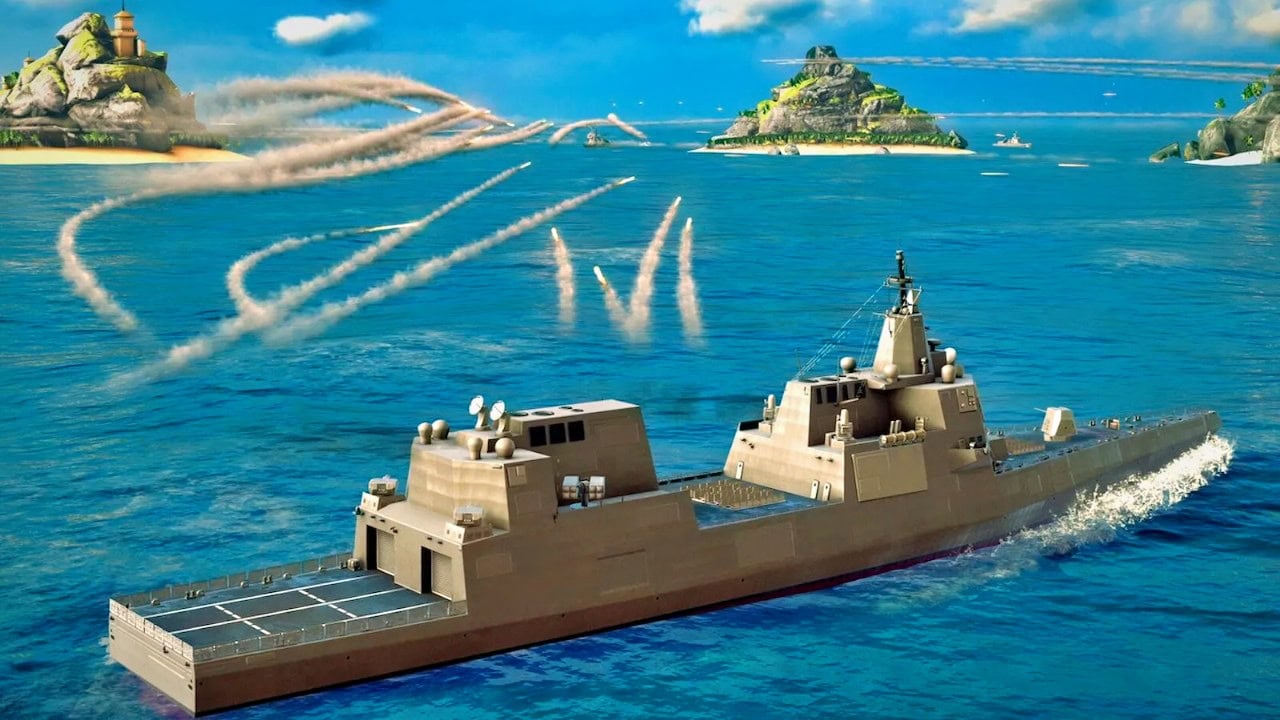
Key Points and Summary – Drone swarms, cruise missiles, and cheap loitering munitions have made modern surface warships look like easy prey.
-But that verdict freezes the story at the “action” phase of war. Precision strike is proliferating, sensors are everywhere, and kill chains are faster—especially in the littorals.

Dec. 4, 2017) Sailors man the rails as the Navy’s forward-deployed aircraft carrier, USS Ronald Reagan (CVN 76), arrives at Commander, Fleet Activities Yokosuka after a scheduled patrol. The Ronald Reagan Carrier Strike Group conducted 87 days of strike group operations in the Western Pacific, including the waters south of Japan, the Philippine Sea and the South China Sea. Ronald Reagan provides a combat-ready force, which protects and defends the collective maritime interests of the U.S. and its allies and partners in the Indo-Asia-Pacific region. (U.S. Navy photo by Mass Communication Specialist 2nd Class Janweb B. Lagazo/Released)
-The “reaction” is already underway: layered air and missile defense, electronic warfare, decoys, dispersed formations, and manned–unmanned teaming that pushes scouts and risk outward.
-Surface combatants won’t be invulnerable, but they can be resilient—still essential for logistics, sea denial, alliance reassurance, and sustained power projection.
-The winners will be navies that adapt faster than their adversaries.
Are U.S. Navy Surface Warships Doomed?
The modern surface combatant is under siege. Cheap drones skim the waves. Cruise missiles arc in from over the horizon. Uncrewed systems now threaten from above, below, and across the electromagnetic spectrum.
Footage from the Red Sea and the Black Sea feeds the conclusion that in a great power war, surface ships are floating coffins—useful for intimidating weaker states, but liabilities against Russia, China, or even a determined Iran or North Korea.
That conclusion is wrong. It misunderstands how military competition actually works. What we are witnessing is not the end of the surface navy but another turn in the action–reaction cycle that governs war.
The Mirage of the Decisive Weapon
Every generation convinces itself that it has found a war-ending technology. In the early 20th century, it was the battleship. Then came the submarine, and then airpower. Finally the aircraft carrier arrived.
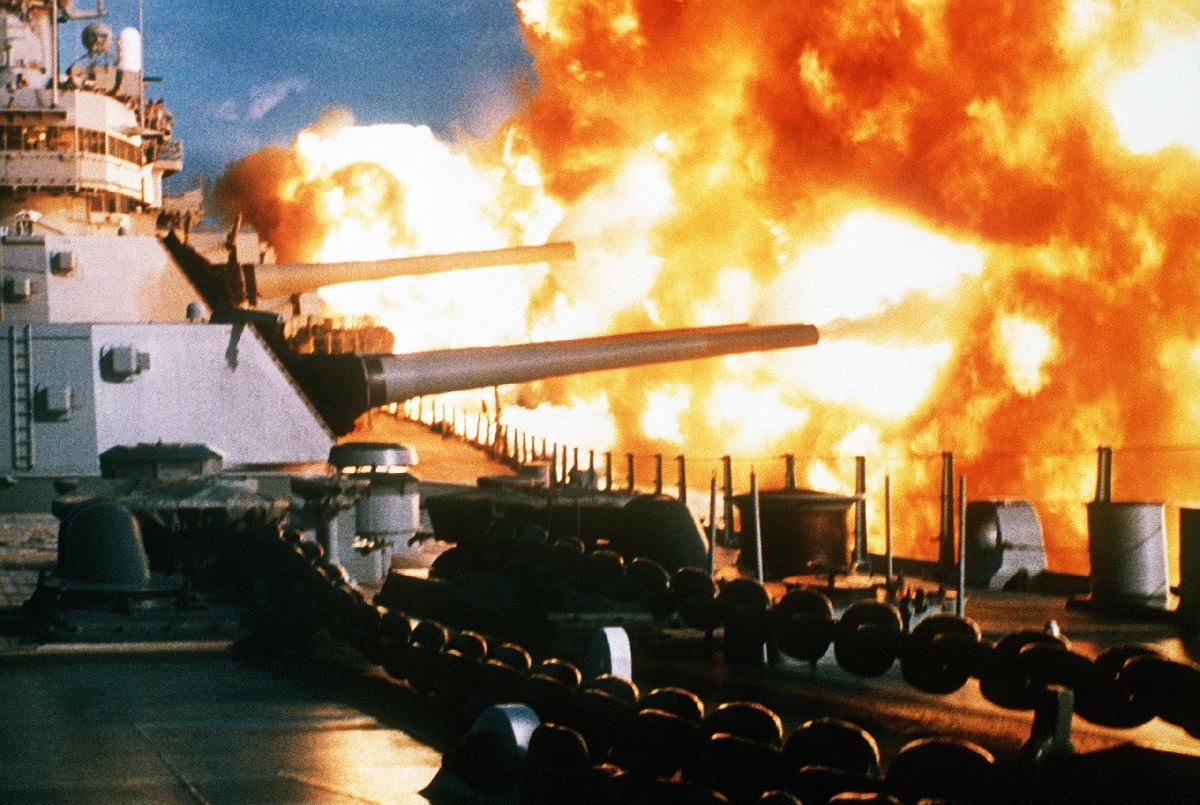
Iowa-class Battleship firing. Image: Creative Commons.
Each innovation delivered a genuine advantage until opponents adapted.
Today’s drones and missiles feel different because they are numerous, networked, and comparatively cheap. Saturation attacks are designed to strain advanced defenses. Relatively inexpensive munitions can force billion-dollar ships to expend scarce, high-end interceptors simply to stay in the fight.
But cost asymmetry is not new. Torpedoes were cheaper than battleships, and anti-tank weapons were cheaper than tanks. Improvised explosive devices were cheaper than armored vehicles. None of these developments rendered a platform obsolete. They forced change—sometimes painful, sometimes protracted, but change nonetheless.
Action: Massed Precision Comes of Age
The “action” phase of the cycle is clear. Precision strike capabilities are now widely available. A growing range of states and some non-state actors can field uncrewed aerial vehicles, anti-ship cruise missiles, and loitering munitions that complicate naval operations. Sensors are ubiquitous and targeting cycles are faster. In many contested theaters, especially in the littorals, the sea is becoming harder to hide in than it used to be.
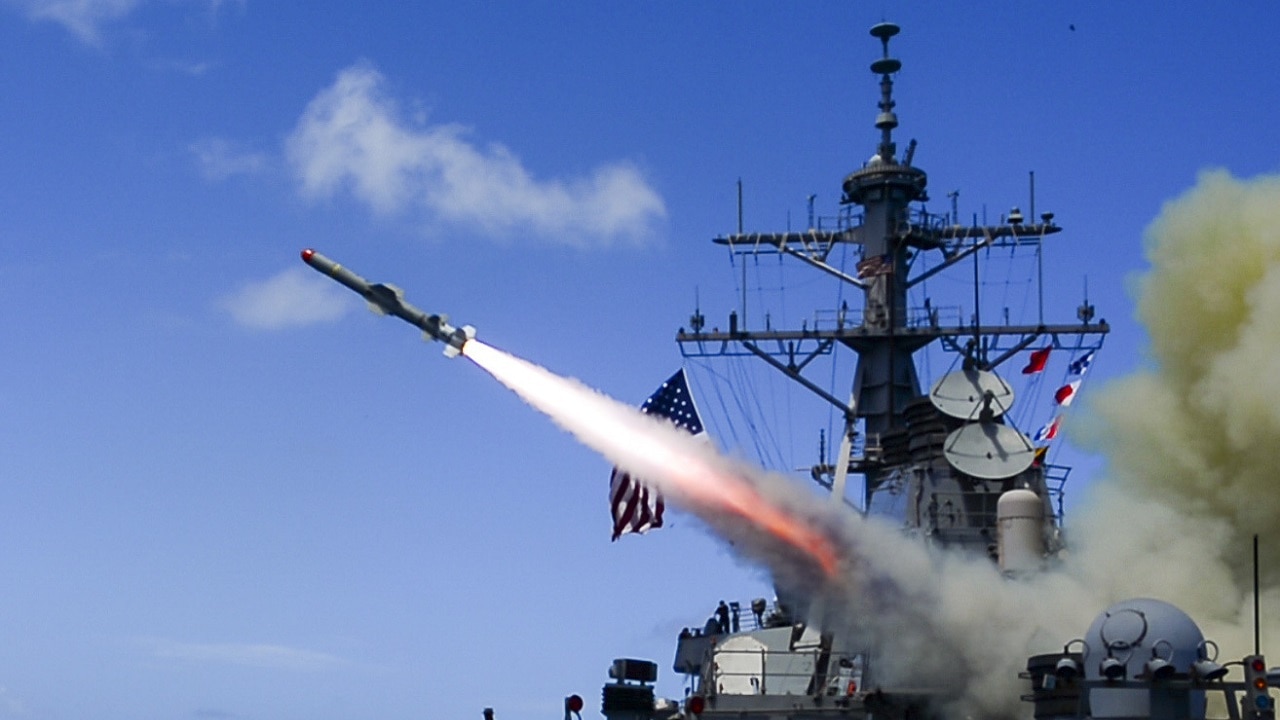
WATERS NEAR GUAM (Mar. 10, 2016) – Arleigh Burke-class guided missile destroyer USS Fitzgerald (DDG 62) conducts a live fire of a harpoon missile during Multi-Sail 2016. Multi Sail is a bilateral training exercise aimed at interoperability between the U.S. and Japanese forces. This exercise builds interoperability and benefits from realistic, shared training, enhancing our ability to work together to confront any contingency. (U.S. Navy photo by Mass Communication Specialist 3rd Class Eric Coffer/Released)
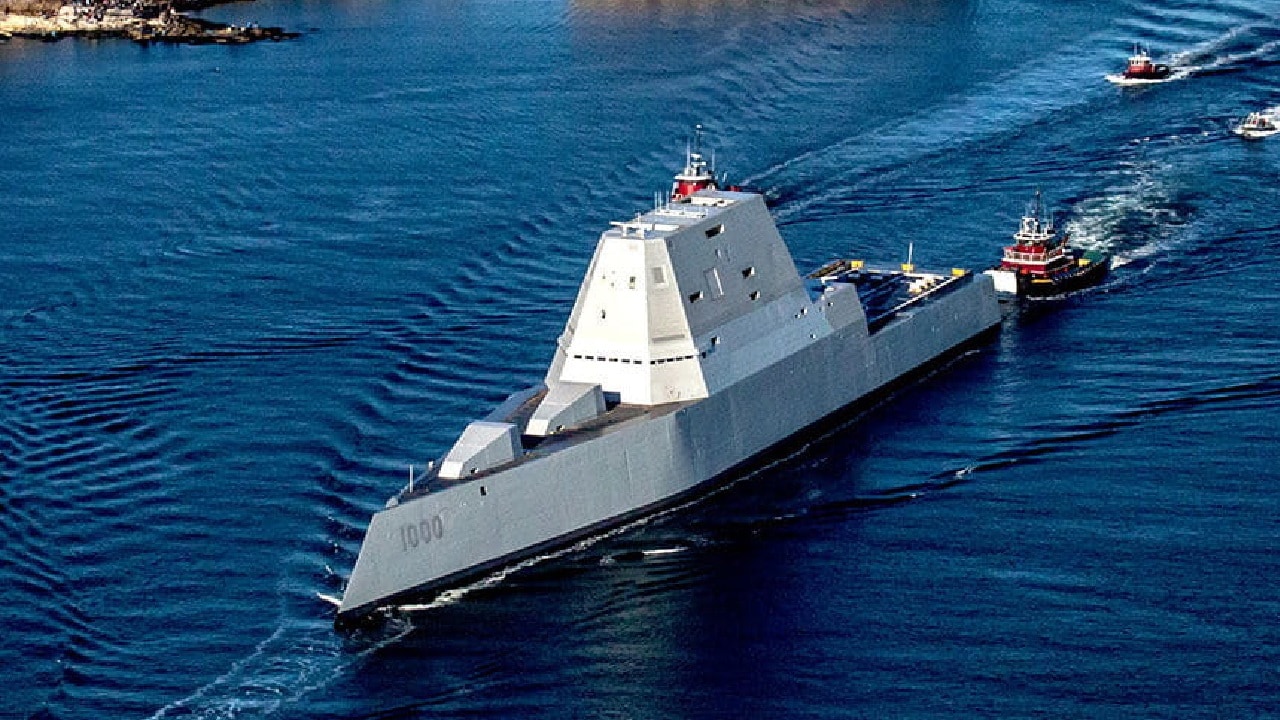
Zumwalt-class destroyer. Image Credit: Raytheon.
Surface ships optimized for uncontested environments now face layered threats arriving simultaneously from multiple domains. Large formations and concentrated high-value units are easier to track, easier to cue against, and harder to defend indefinitely.
What is important is not one specific platform or weapon, but rather the fusion of sensing, networking and command-and-control. Commercial satellites, open-source maritime data, and proliferating passive sensors are increasingly compressing the kill chain, while enhanced data fusion and cross-domain coordination is shortening the decision cycle between detection and engagement. Even if individual sensors can be degraded, the redundancy of sensors across domains complicates concealment and recovery efforts.
This is not to say surface ships will never have sanctuary, or that all targets will be known and there will be no element of surprise. It does mean the margin for error is smaller, mistakes are more rapidly exploited, and large surface combatants operating near hostile shores need to assume they are being observed.
Reaction: Resilience, Not Invulnerability
The “reaction” phase is underway. Navies are adapting by emphasizing layered defense, sensor fusion, and networked survivability. Missile defense is increasingly distributed across formations and networks rather than concentrated in a single hull. Electronic warfare, decoys, and deception—long sidelined by post–Cold War habits—are receiving renewed operational emphasis.
Equally important is dispersion. Tight, carrier-centric formations are giving way to looser force packages that complicate adversary targeting. Firepower is being disaggregated across multiple platforms, many of them uncrewed. Surface ships are evolving into command nodes, sensor hubs, and magazine platforms rather than solitary symbols of dominance.
Defense, in this context, does not mean impenetrability. Resilience is what matters. A force must be able to absorb pressure, degrade enemy targeting, and deny clean, decisive outcomes.
Adaptation: A New Role for Surface Combatants
Adaptation is where the real argument lies. The question is not whether surface combatants can survive unchanged but whether their role can be rethought fast enough.
Large surface ships cannot be optimized primarily for presence missions and then expected to thrive in high-end war. Nor can they be treated as exquisite assets whose loss would be strategically paralyzing. Their future lies in integration—with uncrewed undersea vehicles that extend sensing and strike, with uncrewed surface vessels that complicate the surface picture, and with aerial systems that multiply reach and confuse defenses.
Surface combatants will increasingly fight as part of mixed manned–unmanned teams. Uncrewed systems will scout, screen, and absorb risk. Crewed ships will provide endurance, command authority, sustained firepower, and political control that is crucial when escalation looms.
This logic applies with particular force to aircraft carriers. They remain powerful instruments—but only if employed with restraint, range, and integration, not as symbols daring an adversary to take a shot.
The Wrong Lesson to Draw
Those who argue that surface ships are only useful against weaker opponents are making a familiar analytical error: freezing the action–reaction cycle at a single moment. They see the action, ignore the reaction, and declare the platform dead before adaptation has played out.
Great powers do not fight by abandoning entire domains. Control of the surface still matters for sea denial, logistics, alliance assurance, and sustained power projection. Submarines cannot do everything. Aircraft cannot be everywhere at once. Space and cyber do not move fuel, food, and ammunition across oceans.
Surface ships are more vulnerable than they once were—but vulnerability is not obsolescence.
The Hard Reality
Surface combatants are neither relics nor talismans. They are entering a harsher competitive environment in which survival depends less on individual platforms and more on how intelligently those platforms are employed within a broader network-centric system.
The navies that succeed will be those that accept that warfare offers no permanent advantage, only continuous adaptation.
About the Author: Dr. Andrew Latham
Andrew Latham is a non-resident fellow at Defense Priorities and a professor of international relations and political theory at Macalester College in Saint Paul, MN. You can follow him on X: @aakatham.