
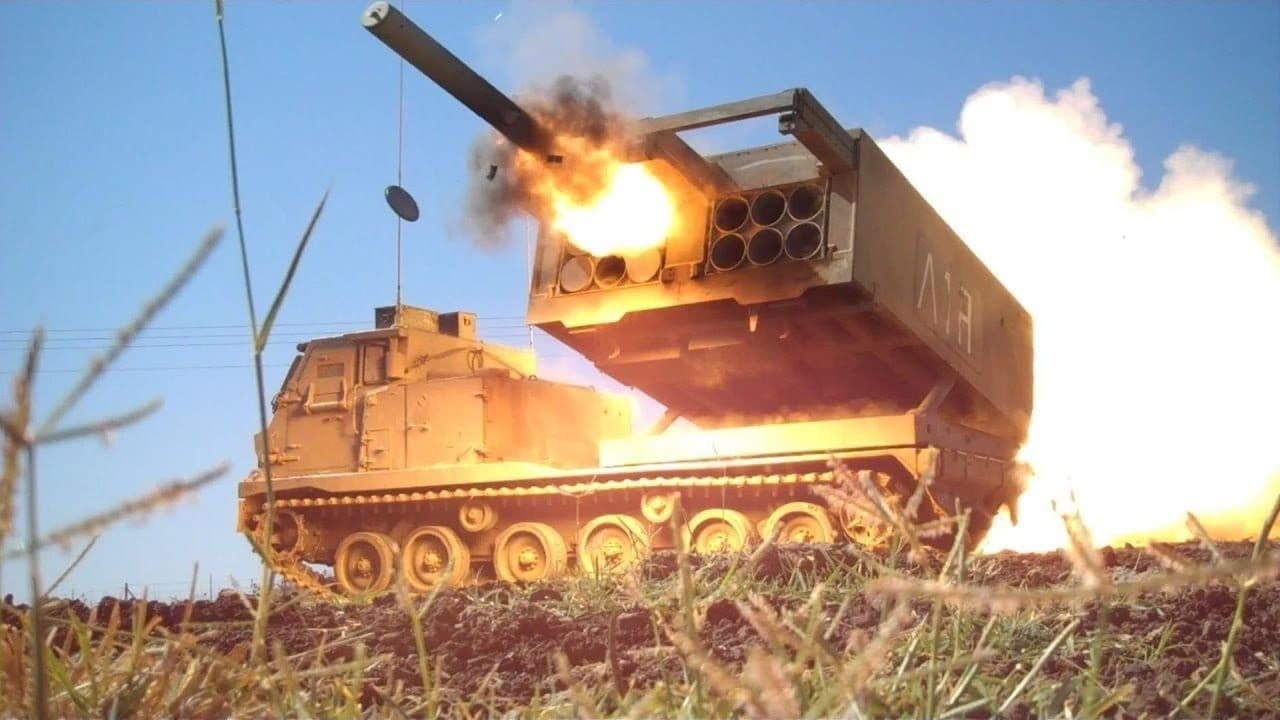
Synopsis: The much-hyped “Mar-a-Lago peace deal” is not a peace deal at all—only a political gesture between Washington and Kyiv that leaves the core disputes untouched.
-The war’s real obstacles remain the same: irreconcilable territorial demands, incompatible security guarantees, and the high-stakes question of control over the Zaporizhzhia nuclear plant.
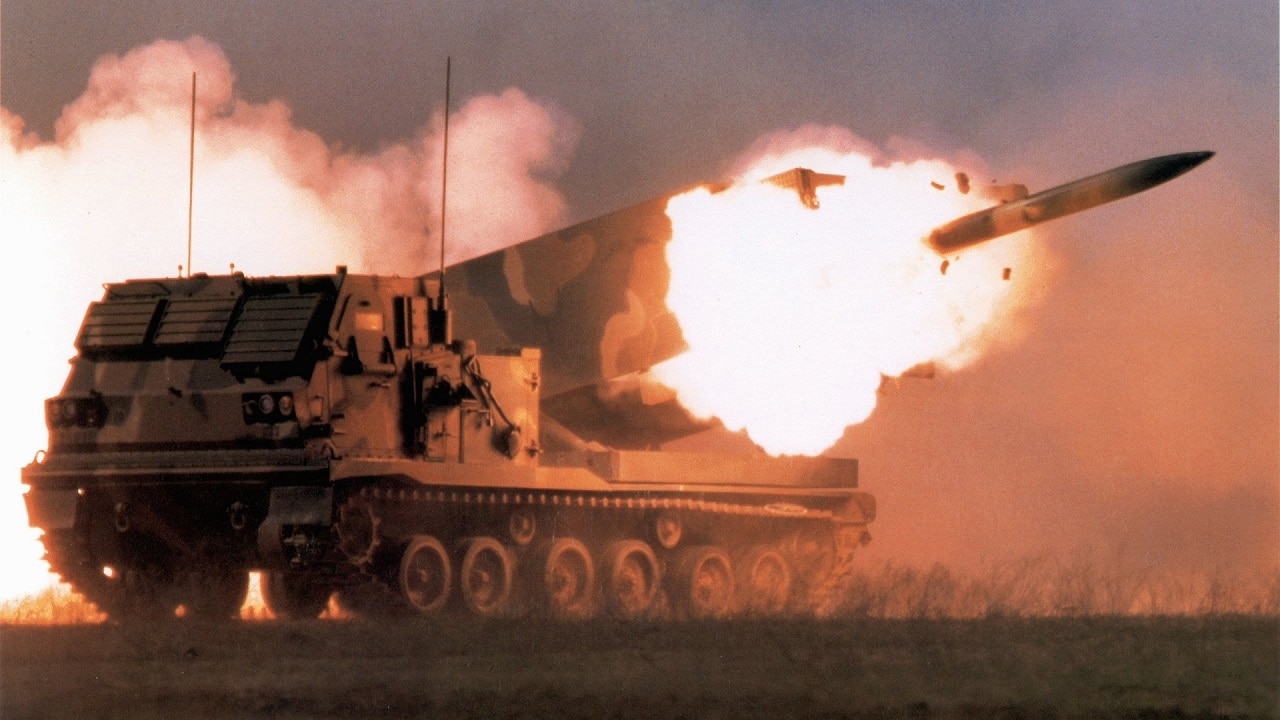
NATO M270 MLRS. Image Credit: Creative Commons.
-Because neither Moscow nor Kyiv is prepared to make the reciprocal concessions required, “peace” is more likely to take the form of a Korea-style armistice—an uneasy ceasefire that freezes lines and grievances rather than resolving them.
-It’s unsatisfying, but it may be the least bad option.
The “Mar-a-Lago Ukraine Peace Deal” Isn’t Peace—It’s a Political Performance
The world wants to believe a Ukraine peace deal is finally in sight. After nearly four years of war, headlines grasp at every rumour of negotiation, every handshake photo, every Washington–Kyiv communiqué that uses the word “settlement”.
But when the hope is scraped away, what remains is fantasy.
What resulted from the weekend’s Mar-a-Lago talks is not a peace deal. It is, at best, an agreement between Donald Trump and Volodymyr Zelensky—and even that is being charitable. The hard truths driving this conflict remain untouched: profound disagreements between Kyiv and Moscow regarding territory, security guarantees, and control of the Zaporizhzhia nuclear plant. Until those are resolved between the principals, not merely discussed between Washington and Kyiv, there will never be peace, only performance.
There is an understandable fatigue across capitals. Europe is wary of open-ended commitments. Ukraine is physically, financially, and demographically exhausted. Russia, bloodied but dug in, is playing for time. The Trump Administration, entering another election cycle, wants to claim progress.
Everyone, in different ways, wants the war off the front page. But wars do not end because the non-belligerents are tired of them. They end when the belligerents themselves accept terms they can live with. By that measure, the distance between Moscow and Kyiv remains as wide as it was at the outset.
The Sticking Points Remain the Sticking Points
Territory is the immovable object. Moscow now demands legal recognition not only of Crimea and the territory it currently occupies, but of all of Donetsk and Luhansk, including areas still held by Ukraine. Kyiv, for its part, insists sovereignty means the restoration of the 1991 borders and refuses to concede additional land.
The Ukrainian constitution prohibits the surrender of territory, and politically, any such concession would leave the country with nothing but a rump state. Ukrainian commanders also view the contested eastern regions, the so-called “fortress belt“, as essential to the country’s defence.
Giving this up would expose Ukraine’s interior to future Russian assaults. These positions are rational on both sides, but they collide head-on. Moral arguments run deep; strategic logic runs deeper. Maps, once changed by war, rarely snap back without enormous force.
Security guarantees are no easier. Kyiv wants real binding promises, something more concrete than mere press-conference promises. Any deal that leaves Ukraine neutralized and exposed is thus unacceptable to Bankova Street.
Moscow sees any such security guarantee as an existential threat. Any deal that leaves Ukraine tied militarily to NATO, or even the West more nebulously, is thus unacceptable in the Kremlin. Both sides believe compromise is riskier than fighting on.
Control of Zaporizhzhia sits in the same category of insoluble problems. Europe’s largest nuclear plant is no bargaining chip; it is leverage, insurance, and potential catastrophe rolled into one. No Ukrainian government can yield it lightly. No Russian government will offer it up without something substantial in return. When nuclear infrastructure becomes hostage to war, the margin for error vanishes.
These are not matters settled through creative phrasing in a communiqué. They require reciprocal concessions that neither side is willing to make.
A Korean War Outcome by Another Name
This is why the quiet talk in policy circles has turned to the vocabulary of stalemate. Not victory. Not peace. An armistice—that ambiguous zone between war and peace, where fighting stops, but the war remains alive in law.
It resembles Korea in 1953: front lines harden, guns fall silent, diplomats talk, economies recover behind fortified borders, and grievances burn on low heat. Conflict becomes a scar rather than a wound, but the scar remains raw.
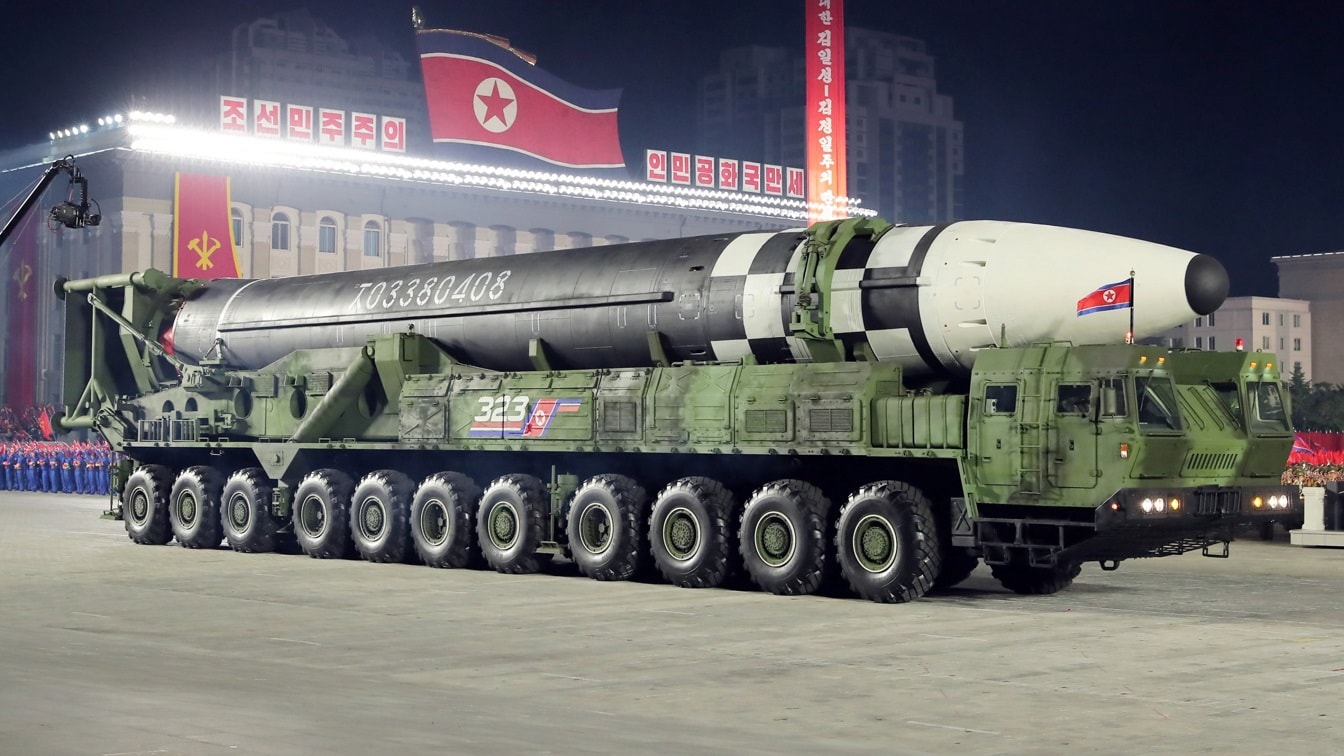
Image of North Korean Road-Mobile ICBM. Image Credit: Creative Commons.
It is a bleak scenario, yet increasingly the only one within reach.
Neither side can achieve maximal goals at an acceptable cost. Ukraine cannot liberate every kilometre under Russian control. Russia cannot extinguish Ukrainian statehood. Both can still bleed the other. Neither can deliver victory. When wars reach equilibrium, they do not conclude with parades. They wind down through exhaustion disguised as diplomacy.
An armistice would satisfy no one. It would lock in Russian control in the east. It would leave millions displaced. It would enshrine a militarised frontier through Europe. It would freeze NATO–Russia hostility for years. But compared to continued attrition, it might be the least bad option on the table.
Why This May Be the “Best” Outcome Available
A frozen conflict could offer Ukraine breathing room. Reconstruction could begin; demographic decline could slow; armed forces could modernise. The West could shift from emergency resupply to long-term sustainment. And Russia could claim its gains and end large-scale operations without conceding defeat. It is not a victory, but it is survivable.
A year from now, the most plausible scenario is not a triumphant treaty but something resembling the Korean Peninsula: a line on a map, guarded by artillery, punctuated by sporadic flare-ups, broadly stable despite unresolved war aims. Formal peace might have to wait a generation. Ceasefire agreements could gather dust until political realities change.
Yet the shooting could stop. In a tragic world, endurance sometimes substitutes for triumph.
The Hard Landing We Don’t Want, But May Need
Peace will not arrive with fanfare. It will seep in through fatigue and calculation. And when leaders speak of a “deal,” we should remember the weight the word carries. What stands today is not a deal between the belligerents. At best, it is an agreement between one of the belligerents and a mediating power.
We may be approaching not Versailles but Panmunjom: soldiers staring across a fortified line, the war legally unfinished, the guns silent enough to build a future behind them.
Imperfect and frustrating, to be certain—but potentially enduring.
If that is the outcome that halts the dying, it may be the closest we come to peace.
About the Author: Dr. Andrew Latham
Andrew Latham is a non-resident fellow at Defense Priorities and a professor of international relations and political theory at Macalester College in Saint Paul, MN. You can follow him on X: @aakatham.