
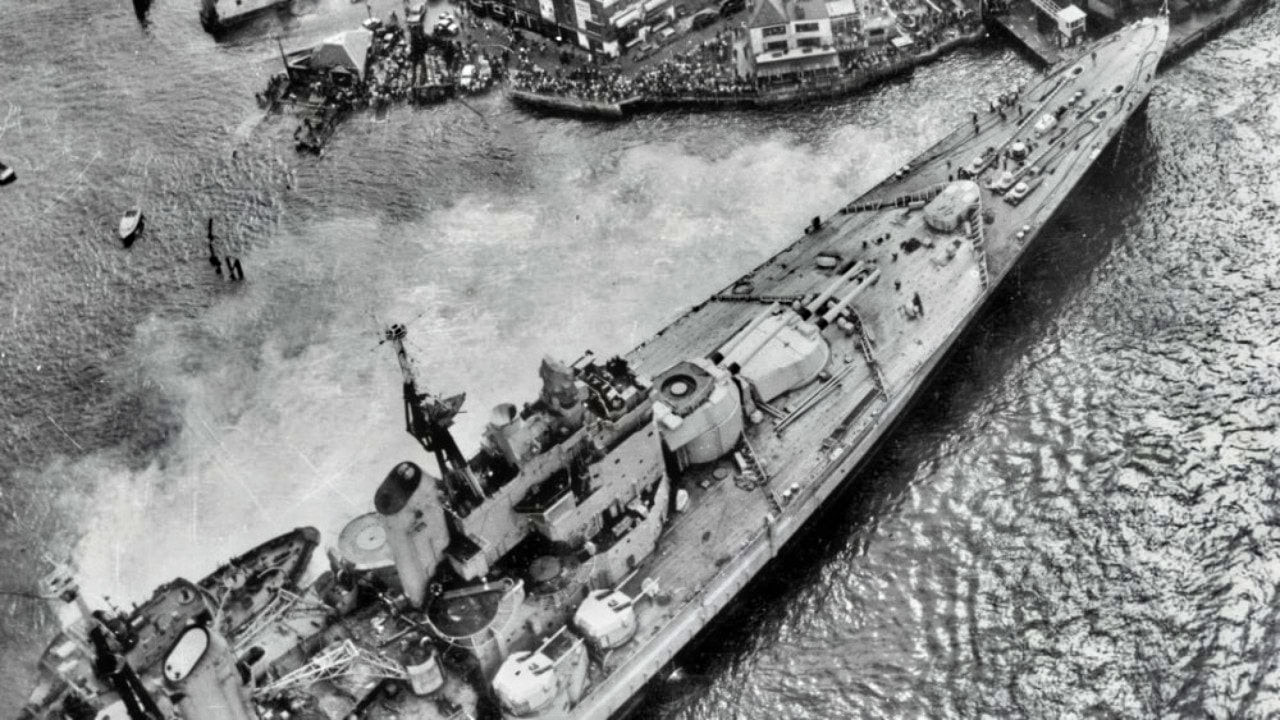
Key Points and Summary – HMS Vanguard was conceived in World War II as Britain’s ultimate battleship, incorporating hard lessons from losses like Prince of Wales.
-Longer and faster than earlier designs, she packed eight 15-inch guns, formidable armor, and a record-breaking anti-aircraft suite.
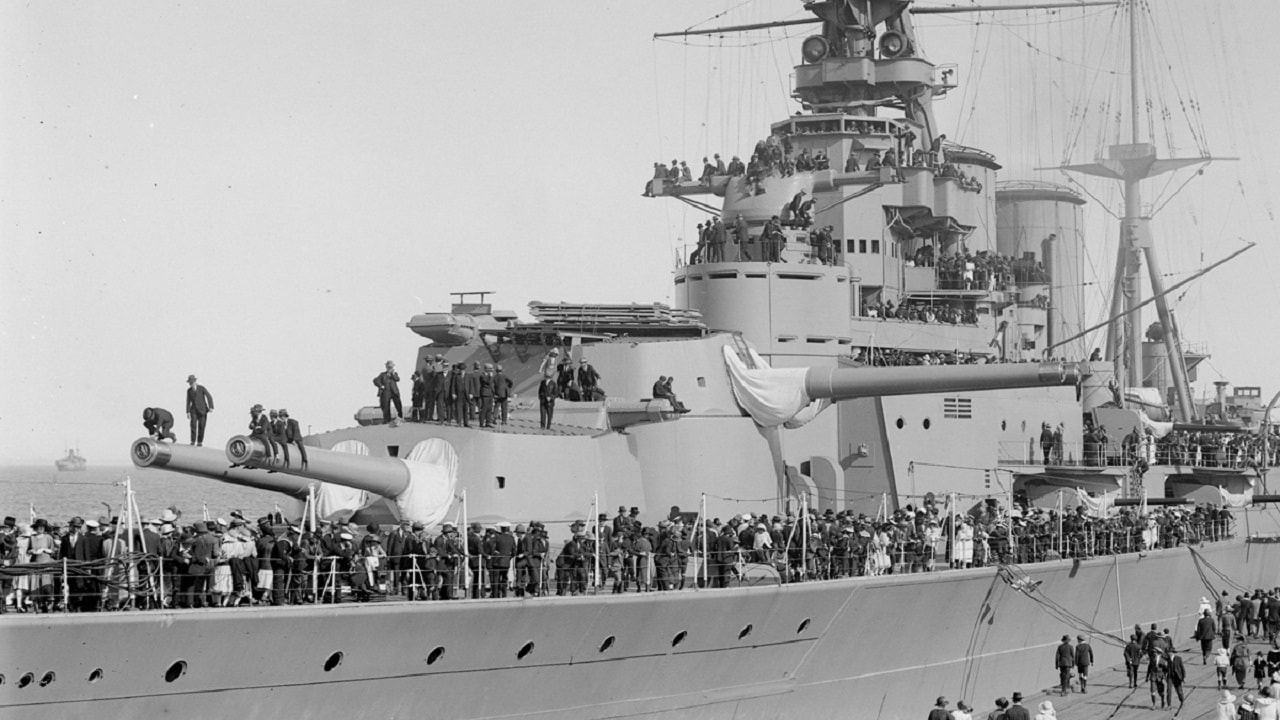
HMS Hood. Image Credit: Royal Navy.
-But construction delays meant Vanguard entered service in 1946, too late for war and too early for a battleship revival in the carrier age.
-She mostly served in peacetime roles, including a Royal Family cruise, before becoming a training ship and finally scrap.
-Vanguard’s story is a case study in superb engineering colliding with strategic and technological change.
The HMS Vanguard Battleship Had a Message for the British Royal Navy
In the early years of World War II, the British Royal Navy was struggling against the Nazi and Japanese fleets. By 1941, the British had lost five large ships.
The Royal Navy needed something new; a powerful ship that could take a hit and dish out some pain against the Germans and Japanese.
In 1941, HMS Vanguard was laid down. It would be the last British battleship ever constructed—and maybe the best. It was better than the King George V-class of dreadnoughts.
Two prior battleships were begun in 1939 but never finished, so Vanguard incorporated some of the innovations meant for those vessels.
After Action Review Called For Better Protection
The British had learned some lessons from the sinking of the King George V-class HMS Prince of Wales in 1941 off the coast of Malaysia. Prince of Wales had ineffective anti-aircraft (AA) guns, and Japanese bombers fatally damaged the battleship.

Image of HMS Prince of Wales Sinking. Image: Creative Commons.
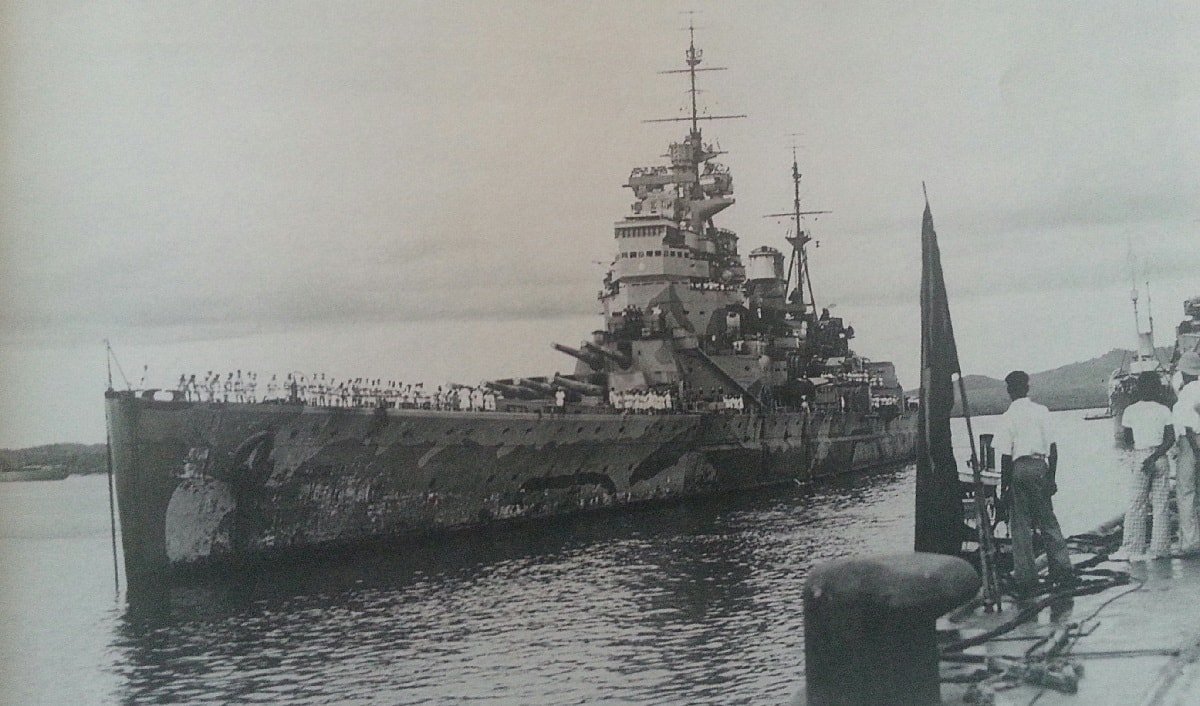
Image: Creative Commons.
British engineers and designers did not want this to happen again, so they decided to equip Vanguard with more powerful 40-mm AA guns, rather than Prince of Wales’ 20-mm guns. When the upgrade was finished, Vanguard had 73 AA units, a record for British battleships.
Big Guns Created an Impressive Floating Beast
The battleship had eight 15-inch 42-caliber Mark I guns.
These were a tad smaller than their counterparts on the U.S. Iowa-class battleships, but they were fast-acting and accurate—likely the best battleship guns the British ever made.
Vanguard’s main guns were deployed in four twin turrets—the shipbuilders extended Vanguard to 814 feet long to accommodate the fourth. It was 69 feet longer than previous British battleships.
“Other noteworthy features included a displacement of 45,116 tons (light load). HMS Vanguard’s machinery had a designed 130,000 ship’s horsepower, which allowed her to attain a top speed of 30 knots,” according to the review of a book about Vanguard. “Her 108-foot beam meant she could pass through the Panama Canal.
Her radius of action was a healthy 7,560 miles at 12 knots. The secondary armament consisted of sixteen 5.25inch dual purpose guns evenly divided between port and starboard. Combined with her array of 40mm mounts, her AA protection was formidable.”
Vanguard Battleship Was Delayed
All these features took a long time to build, and HMS Vanguard was not commissioned until 1946.
The shipyard lacked for workers, as many would-be builders were toiling on anti-submarine ships to protect merchant vessels from German U-boats.
It Had Many Redeeming Features
“Her armor was such that she was one of the best-protected battleships ever built. Vanguard was the only British capital ship to have a transom (flat) stern. Her high flared bow and recessed hawse pipes, which allowed her anchors to be flush with her hull, resulted in a magnificent sea boat,” R.A. Burt wrote in his book The Last British Battleship: HMS Vanguard 1946-1960.
Vanguard could have been a World War II stalwart. The battleship could steam over 30 knots—the propulsion system pushed out 130,000 horsepower. For a vessel that displaced more than 45,000 tons, that was impressive.
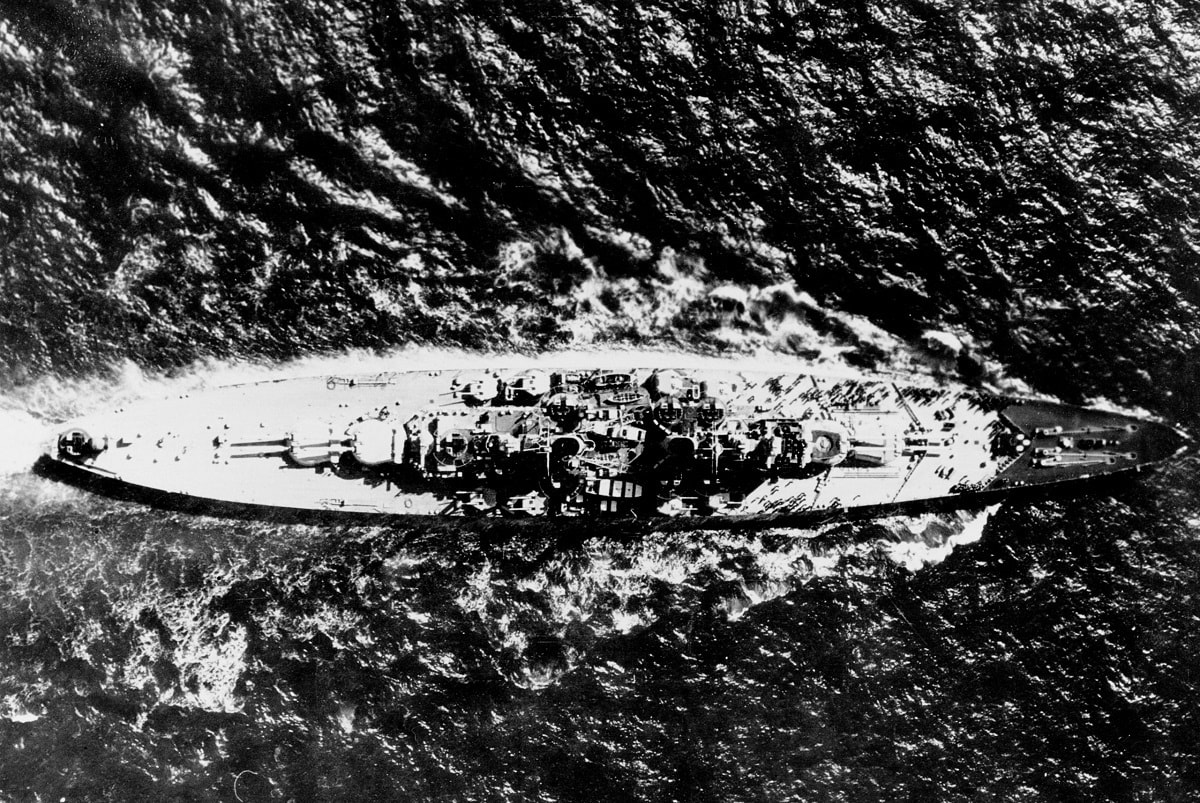
Overhead view of the Royal Navy battleship HMS Vanguard (23) underway.
Not an Impressive Service Record
However, some questioned the wisdom of building such a large ship that never saw combat. Vanguard cost more than 1.5 million pounds—a substantial sum at the time. It was still considered the best battleship in the history of the Royal Navy.
But its only real achievement was to transport the Royal Family to South Africa in 1947.
With no war to fight, Vanguard was sent to reserve duty and served as a training ship for new sailors in 1955. The battleship was seen as an obsolete platform by then, because carrier aviation ruled the day.
The Cold War showed that submarines and faster frigates and destroyers would be more effective against the Soviets.
When the British government decided to scrap Vanguard in 1959, the author R.A. Burt wondered if the battleship could be preserved as a museum ship. However, the First Sea Lord at the time did not think Vanguard would be a big tourist draw, since it had faced no combat.
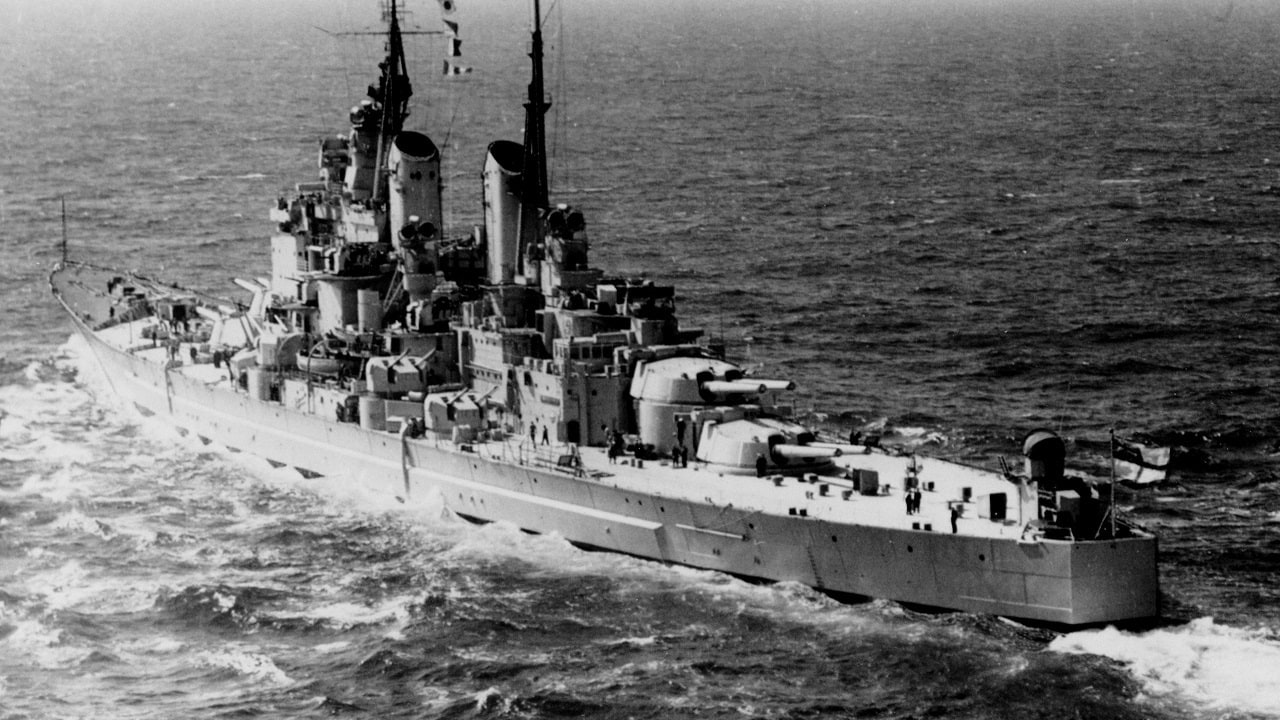
HMS Vanguard. Image Credit: Creative Commons.
Preservation funding would have been substantial as well.
This was a disappointing end for Britain’s last and best battleship.
We will never know how HMS Vanguard would have performed in combat. The ship was certainly well-designed, and it could have dominated.
Perhaps the British should have given it a chance during the Cold War.
The extra firepower and admirable speed could have made it an intimidating escort alongside aircraft carriers. But the Royal Navy had other plans. The last battleship was expendable.
About the Author: Dr. Brent M. Eastwood
Author of now over 3,000 articles on defense issues, Brent M. Eastwood, PhD is the author of Don’t Turn Your Back On the World: a Conservative Foreign Policy and Humans, Machines, and Data: Future Trends in Warfare plus two other books. Brent was the founder and CEO of a tech firm that predicted world events using artificial intelligence. He served as a legislative fellow for US Senator Tim Scott and advised the senator on defense and foreign policy issues. He has taught at American University, George Washington University, and George Mason University. Brent is a former US Army Infantry officer. He can be followed on X @BMEastwood.