
Synopsis: Alexander the Great’s famous quote about “sheep led by a lion” isn’t just a meme—it’s a field manual on leadership.
-Raised in Macedon, educated by Aristotle, and thrust into power at 20 after Philip II’s assassination, Alexander built an empire with speed, discipline, and relentless initiative.
-From Asia Minor to Egypt and Persia, he kept momentum, demanded excellence, and inspired troops to do more than their reputations suggested.
-His death at 32 shattered the empire into rival successor states, but the lesson endured: capable command multiplies combat power, while timid leadership wastes it.
-For modern militaries, morale, tempo, and trust still hinge on who leads.

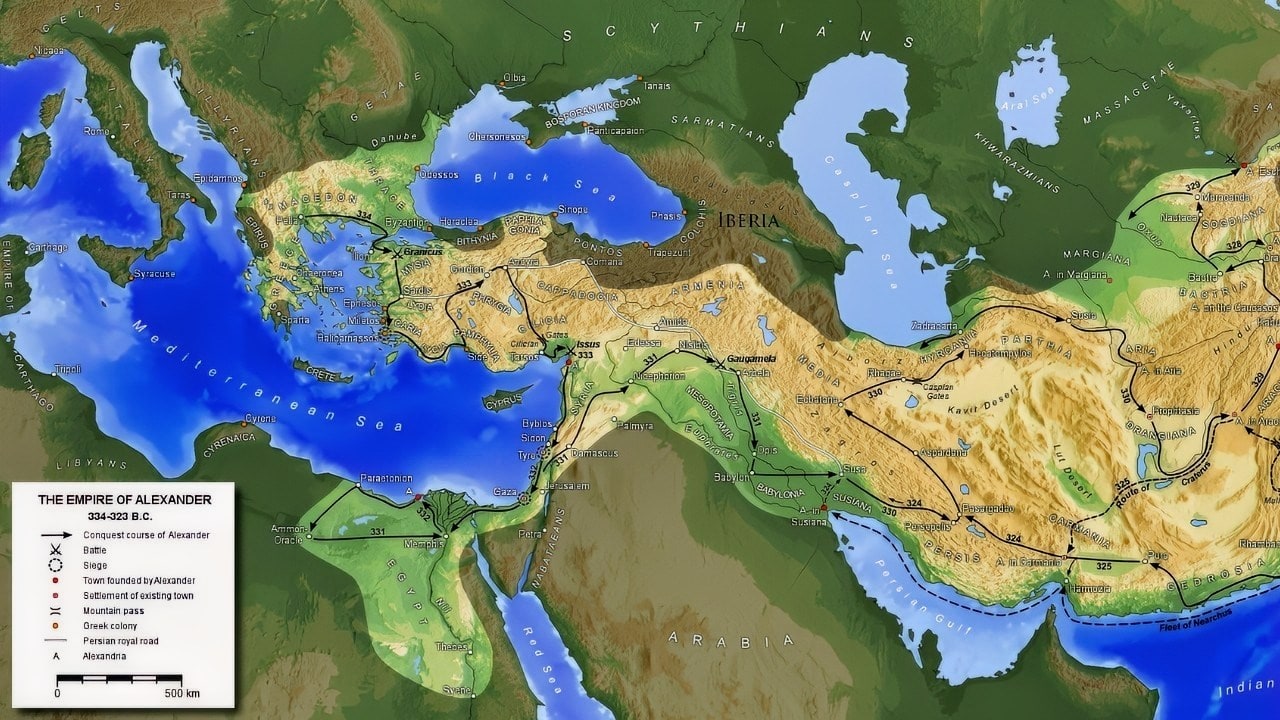
Alexander the Great Map of Conquest Quote of the Day. Image Credit: Creative Commons.
Alexander the Great’s Leadership Lesson Still Matters in 2026 Warfare
“I am not afraid of an army of lions led by a sheep; I am afraid of an army of sheep led by a lion.”—That quote belongs to Alexander III, better known as Alexander the Great, the king of Macedonia or Ancient Greece, and it drives home the importance of proper leadership in determining the effectiveness of a military unit.
Military leaders would do well to heed Alexander’s words, as he’s considered one of the greatest military commanders in history (ancient and modern alike).
Early Life
Alexander III was born in Pella, the capital of the Kingdom of Macedon, circa July 20/21, 356 BC, the son of the king of Macedon, Philip II of the Argead dynasty, and his fourth wife, Olympias (daughter of Neoptolemus I, Aeacid king of Epirus). (Philip II had a total of seven or eight wives, but Olympias had the lofty status of principal wife, thanks in no small part to birthing Alexander). According to urban legend, he was related to the Greek heroes Hercules from his father’s side and Achilles from his mother’s side.
Phillip II made sure that his son received the best possible education, hiring no less than the great Greek philosopher Aristotle as a tutor when Alexander was 13 years old. When Alexander was 16, his father left the country to do battle, leaving the teenage son as regent, or temporary ruler of Macedonia.
Circa October 25, 336 BC, Philip II was assassinated the captain of his bodyguards, Pausanias. Alexander was proclaimed on the spot as his father’s successor to the throne at the age of 20. The state was set for him to embark upon his path of conquest and thus immortalize himself as Alexander the Great.
Undefeated In Battle
Yes, that’s correct, Alexander the Great never lost a single battle. As noted by his Ducksters mini-bio:
“Here is the order of his conquests:
-First, he moved through Asia Minor, which is today’s Turkey.
-He took over Syria, defeating the Persian Army at Issus and then laying siege to Tyre.
-Next, he conquered Egypt and established Alexandria as the capital.
-After Egypt came Babylonia and Persia, including the city of Susa.
-Then he moved through Persia and began to prepare for a campaign in India.”
From Overnight Success to Overnight Death
Incredibly, he had created this massive empire by the time he was a mere 30 years old. But nothing lasts forever, and a mere two years later, circa June 10/11, 323 BC, Alexander the Great died in the palace of Nebuchadnezzar II, in Babylon (within the present day city of Hillah, Babil Governorate, Iraq; on a night of enjoying fine wine, he suddenly developed a fatal fever. Some historians suspect that he was poisoned, but that remains in dispute to this day.
His empire fell apart shortly thereafter, as his generals, called the Diadochi, degenerated into internecine warfare.
Alexander the Great’s Lasting Legacy
He certainly wouldn’t qualify for the title of “the Great” if he didn’t have a long-lasting legacy, eh?
The most obvious example is the Egyptian city of Alexandria, which still maintains that name despite its “heathen,” “infidel” origins.
From a personal standpoint, this writer can vouch for “Warrior on a Horse ,” the Alexander the Great statue in Skopje, the capital of the Balkan country of North Macedonia, which previously had been known as the Former Yugoslav Republic of Macedonia (FYROM) before the name was changed to heal a public relations spat with Greece over the naming conventions.
I got to see the statue quite frequently during my visits to Skopje when I was a dirty stinkin’ mercenary, er, privateer, er, private military contractor in neighboring Kosovo in service to the KFOR (Kosovo Force) peacekeeping force in 2014 and again in 2021.
The horse in that Skopje statue is Bucephalus, a wild horse that Alexander had tamed when he was a mere lad. Bucephalus would remain his faithful warhorse until the animal died of old age. Alexander adored Bucephalus so much that he named a city in India in honor of the beast.
(I also visited Skopje Alexander the Great Airport [ICAO: LWSK] during the 2014 stint, but by the time of my 2021 stint, Alexander’s name had been removed from the airport, which was also part of that semantic makeup session with the Greeks.)

Alexander the Great Statue. Image Credit: Christian D. Orr.
Moving over to the realm of pop culture, in the original 1988 “Die Hard” film (which anybody with half an iota of common sense knows **is** a Christmas movie!!!), Hans Gruber (the late great Alan Rickman, gone but not forgotten) pays this oral tribute: “When Alexander saw the breadth of his domain, he wept, for there were no more worlds to conquer.”
Last but not least, there’s the opening verse of “The British Grenadiers,” which this military veteran considers to be the second-greatest military marching song ever (next to “Scotland the Brave,” of course): “Some talk of Alexander and some of Hercules/Of Hector and Lysander, and such great names as these/But of all the world’s brave heroes, there’s none that can compare/With a tow-row-row-row-row-row, to the British Grenadiers.”
About the Author: Christian D. Orr, Defense Expert
Christian D. Orr is a Senior Defense Editor. He is a former Air Force Security Forces officer, Federal law enforcement officer, and private military contractor (with assignments worked in Iraq, the United Arab Emirates, Kosovo, Japan, Germany, and the Pentagon). Chris holds a B.A. in International Relations from the University of Southern California (USC) and an M.A. in Intelligence Studies (concentration in Terrorism Studies) from American Military University (AMU). He is also the author of the newly published book “Five Decades of a Fabulous Firearm: Celebrating the 50th Anniversary of the Beretta 92 Pistol Series.”