

Key Points and Summary – General George S. Patton is often remembered for his fierce WWII leadership, but his early life was defined by overcoming internal struggles and pioneering new warfare.
-Despite battling dyslexia and failing math at West Point, Patton graduated to become the first U.S. officer assigned to the Tank Corps.
-From his “blooding” in the Pancho Villa Expedition with his famous ivory-handled revolver to leading tanks from the front in WWI—even after taking a bullet—Patton proved his maxim that “untutored courage is useless,” blending bravery with intellectual innovation.
The First Tank Officer: How George Patton Transitioned from Horses to Armor in World War I
“Untutored courage is useless in the face of educated bullets.” Yes, that’s right, yet another quote from General George Smith Patton Jr., because after all, one good Patton quote deserves another. This particular quote stands out because it shows that, fierce warrior though he was, Gen. Patton was no proponent of “tombstone courage” and firmly believed in brains to go with brawn.
Accordingly, this time we’ll focus on George Patton’s youth, from the time he overcame a childhood learning disorder to earn his own educational pedigree to his time as an ambitious and forward-thinking young tank commander.
Overcoming Dyslexia
George Patton’s first major battle wasn’t with an external enemy, but rather an internal adversary.
Unbeknownst to many, young Georgie was dyslexic, which initially made learning to read and write very difficult. (I myself didn’t know about his affliction until my 8th grade year at Walter Reed Junior High School in North Hollywood, California, whereupon I read Martin Blumenthal’s 1987 book “Patton: The Man Behind the Legend, 1885-1945” for an audiovisual project that my then-bestie and I presented at USC—my future undergrad alma mater—for History Day L.A.)
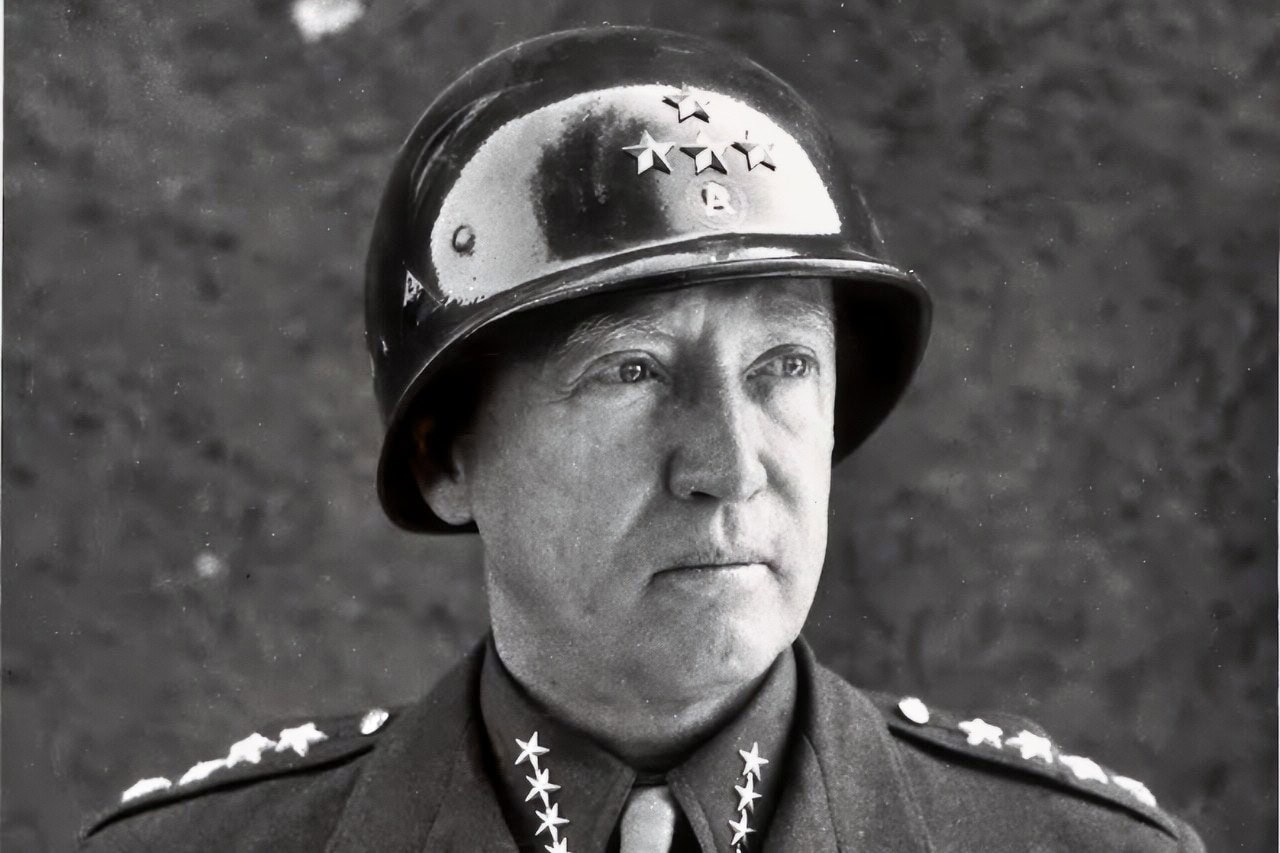
U.S. Army General George Patton
However, thanks to his innate intelligence, drive, and determination, Georgie adapted, improvised, and overcame. He took to heart his father’s exhortation to “Do your damnedest always;”. However, George Sr. didn’t actually serve in the military, he did graduate from the Virginia Military Institute (VMI) in 1877, and in turn George Sr.’s father and uncle were both officers in the Confederate Army during the American Civil War, losing their lives at Battle of Opequon (Third Battle of Winchester) and the Battle of Gettysburg (during Pickett’s Charge no less), respectively.
George Jr. followed in his father’s footsteps at VMI, attending his father’s alma mater from 1903 to 1904 before receiving a nomination to West Point by Senator Thomas R. Bard (R-CA; the “Father of Port Hueneme“).
At West Point, lingering struggles with dyslexia forced Cadet Patton to repeat the miserable first year after failing mathematics. (One could say that “math” was Patton’s least-favorite four-letter word.)
However, he continued to persevere, eventually graduating number 46 out of 103 cadets on June 11, 1909, earning a commission as a second lieutenant in the Cavalry branch.
The following year, his perseverance was further rewarded when he married his beloved Beatrice Banning Ayer, with whom he had two daughters and one son.
From Fighting on Horseback …
2LT Patton’s commissioning took place eight years before the United States entered World War I, but he didn’t have to wait quite that long to see the action that he craved.
On May 14, 1916, one week shy of his promotion to 1LT, he got his “blooding” during General John “Black Jack” Pershing’s Pancho Villa Expedition, wherein Patton wielded his Colt Single Action Army (SAA) “Peacemaker” .45 Colt revolver, which later ended up as one of his two famous ivory-handled (most emphatically NOT pearl-handled) revolvers (along with a double-action Smith & Wesson Model 27 .357 Magnum).
As described in morbid detail by Michael Haskew for Warfare History Network, “It was a burial, but certainly not a funeral. One soldier who looked on muttered, ‘Ashes to ashes, dust to dust…If Villa won’t bury you, Uncle Sam must … The three dead men, whose bodies were unceremoniously laid in hastily dug desert graves, had ridden with the revolutionary Pancho Villa, and one of them, Julio Cardenas, was the commander of his personal bodyguard. The men who killed them were U.S. soldiers and their accompanying interpreters, members of a detachment under 2nd Lieutenant George S. Patton, Jr.
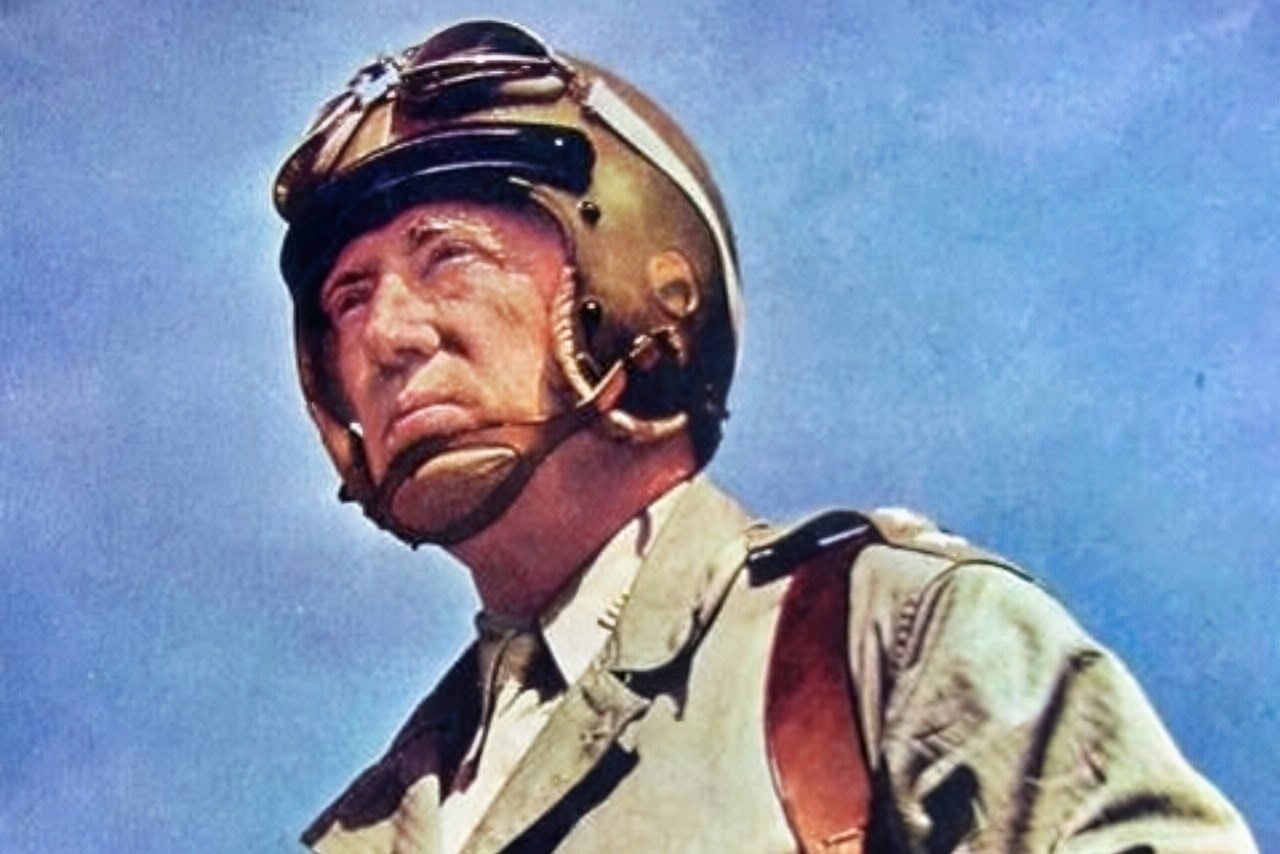
General George Patton of the U.S. Army. Image Credit: Creative Commons.
… To Fighting with Iron Horses
Two years later, during the “Great War, now-LTC Patton successfully transitioned from flesh-and-blood horses to iron horses, i.e., tanks.
Indeed, he became the first officer—or soldier of any rank — in the United States Army assigned to the Tank Corps, whereupon he was charged with establishing the First Army Tank School.
Soon enough, he shipped off to the trenches of Western Europe, and, just like he had done in Mexico, he took to the battlefield like a fish to water, first during the St. Mihiel Offensive (September 12–15, 1918) and again during the Meuse-Argonne Offensive (September 26 – November 11, 1918).
Regarding St. Mihiel, LTC Patton’s orders were to send his tanks forward, while he stayed behind in the American trenches.
However, this did not suit his “Lead from the front, not from the rear” leadership style, so he disobeyed the order and advanced with his tanks towards their objectives.
The primary aim of the American tanks was to advance with the infantry.
The 32-year-old lieutenant colonel’s tanks did exceptionally well for their first time in combat, but he also drew from that battle a hard-earned lesson that infantry was unable to support a tank advance.
This reinforced Patton’s belief that tanks deserved to be their own branch of the army, rather than being relegated to mere infantry support.
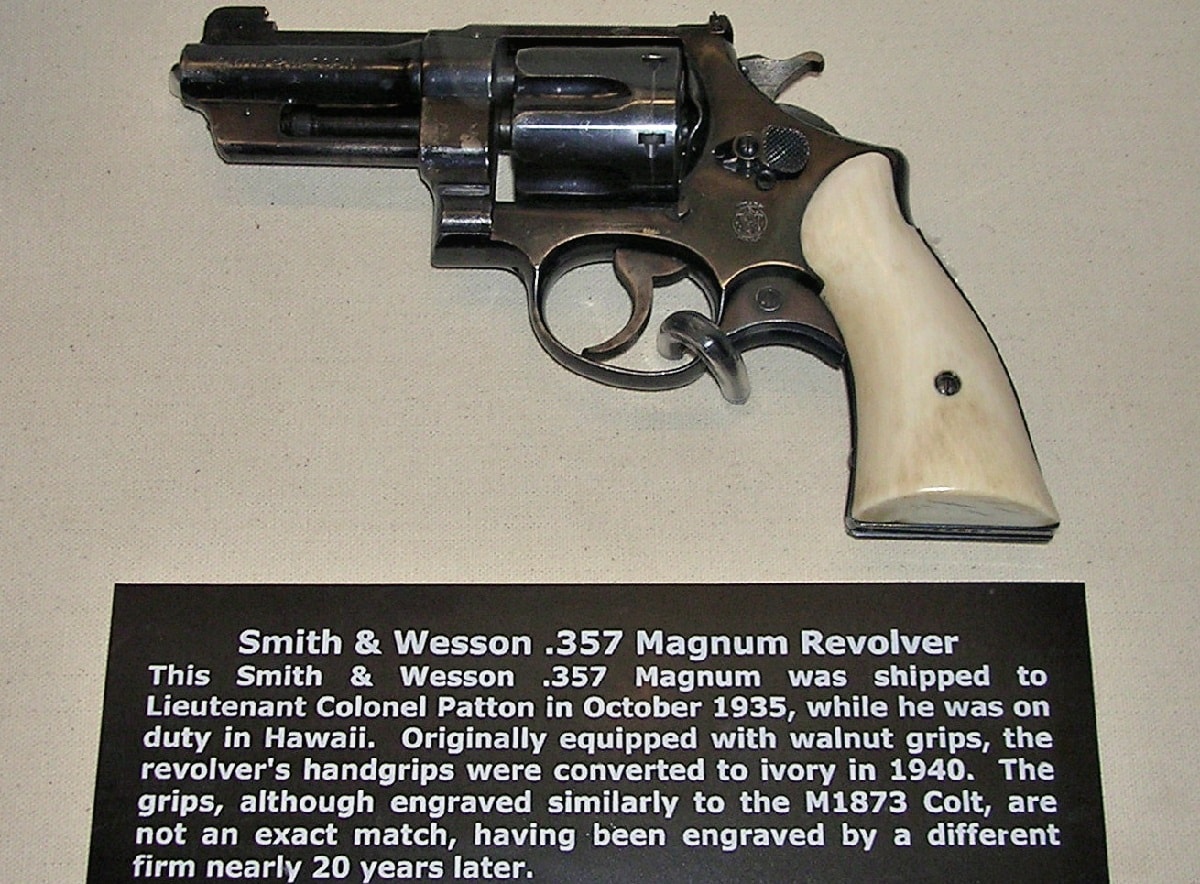
Patton’s well-known custom ivory-handled revolver.
During Meuse-Argonne, CPT Patton, true to form, chose to lead from the front; when the infantry stalled outside the commune of Cheppy, he took charge and rallied the troops to advance. In the process, he was wounded by a German machine gun and was taken from the front.
Not content to lie in a hospital bed, he stole a car and attempted to return to the front lines, but it was too late: the Armistice came on his thirty-third birthday. However, instead of being demoted for car theft, Patton was promoted to Colonel for his troubles.
Between the World Wars
Shortly after the war’s end, Col. Patton was sent to Fort Meade, befriending Dwight David Eisenhower and introducing Ike to MG Fox Conner, who in turn became a great intellectual mentor to the eventual 5-star general and U.S. President.
In the years leading up to World War II, Patton further developed tank warfare tactics and strategy, continuing to advocate for tanks as an independent fighting force. During that next war, Patton’s efforts would be vindicated big-time.
About the Author: Air Force Officer (Retired) Christian D. Orr, Defense Expert
Christian D. Orr is a Senior Defense Editor. He is a former Air Force Security Forces officer, Federal law enforcement officer, and private military contractor (with assignments worked in Iraq, the United Arab Emirates, Kosovo, Japan, Germany, and the Pentagon). Chris holds a B.A. in International Relations from the University of Southern California (USC) and an M.A. in Intelligence Studies (concentration in Terrorism Studies) from American Military University (AMU). He is also the author of the newly published book “Five Decades of a Fabulous Firearm: Celebrating the 50th Anniversary of the Beretta 92 Pistol Series.”