
Key Points and Summary – In a major move to counter growing threats from China and Russia, President Donald Trump signed the “Ensuring American Space Superiority” Executive Order just before Christmas.
-The directive outlines four key priorities: leading in space exploration, defending national security interests, growing the commercial space economy, and deploying advanced capabilities.

X-37B. Image Credit: NASA YouTube/Screenshot.
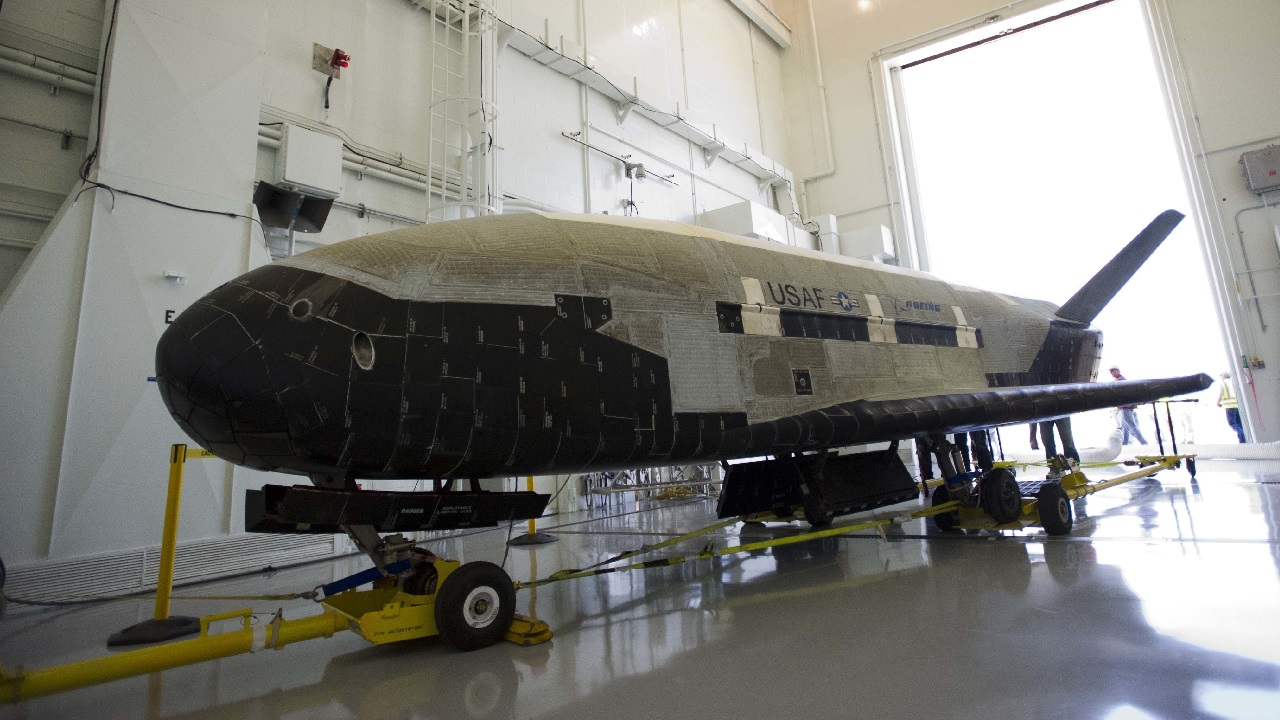
The X-37B Orbital Test Vehicle (OTV), the Air Force’s unmanned, reusable space plane, landed at Vandenberg Air Force Base at 5:48 a.m. (PDT) June 16. OTV-2, which launched from Cape Canaveral Air Force Station, Fla., March 5, 2011, conducted on-orbit experiments for 469 days during its mission. The X-37B is the newest and most advanced re-entry spacecraft. Managed by the Air Force Rapid Capabilities Office, the X-37B program performs risk reduction, experimentation and concept of operations development for reusable space vehicle technologies. (photo credit: Boeing)
-Michael Kratsios, Director of the Office of Science and Technology Policy, has been tasked with coordinating the effort.
-However, Heritage Foundation fellow Shawn Barnes warns that success will require overcoming significant hurdles, including “herding interagency cats,” managing budgetary constraints despite the recent passage of the “One Big Beautiful Bill Act,” and navigating partisan political headwinds.
-The EO calls for urgent action to modernize spaceports, resource the U.S. Space Force for cis-lunar operations, and critically review the Artemis program’s ability to return Americans to the Moon by 2028.
Michael Kratsios Tapped to Lead Trump’s Bold New Strategy for Space Dominance and Exploration
United States President Donald Trump signed his latest Executive Order (EO) just a week before December 25. For Americans concerned about maintaining our nation’s competitive edge over China and Russia, it’s like an early Christmas present.
-“Ensuring American Space Superiority” documents the administration’s priorities for civil, commercial, national security, and international space activities. These priorities include:
-“Leading the world in space exploration and expanding human reach and American presence in space.”
-“Securing and defending American vital national and economic security interests in, from, and to space.”
-“Growing a vibrant commercial space economy through the power of American free enterprise.”
-“Developing and deploying advanced space capabilities and approaches to enable the next century of space achievements.”
The administration should be commended for identifying these vital priorities and specifying the subordinate goals and objectives. Both China and Russia are aggressively developing and fielding space capabilities designed to deny our advantages across all domains.
China has an arsenal of ground and space-based capabilities developed to deny the advantages space provides the United States. It has also tested a system designed to de-orbit a hypersonic weapon that could strike anywhere in the US. Russia has fielded a satellite that is assessed as capable of carrying a nuclear weapon. The US cannot afford to leave these developments unchecked.
Achieving the President’s vision, however, will be no simple task. Michael Kratsios, the Director of the Office of Science and Technology Policy, is responsible for “coordinating the overall implementation of this order…”
Mr. Kratsios will face many challenges to achieve this audacious effort, including:
-Herding the Interagency cats. In President Trump’s first administration, Vice President Pence led the National Space Council. As the Vice President, Pence had the necessary authority and backing of the President to ensure a renewed focus on space, including the stand-up of a combatant command (US Space Command) and military service (US Space Force), initiation of the Artemis Program and related Artemis Accords, significant regulatory reform, and many other accomplishments. Mr. Kratsios will require tremendous collaboration and support from the Secretaries of War, Commerce, Transportation, and Energy, as well as the NASA Administrator and the Director of OMB, if he is to succeed. The President and Vice President must help ensure Mr. Kratsios’s success.
-Budgetary constraints. The EO makes clear that the priorities are to be achieved “within available funding.” The One Big Beautiful Bill Act added substantial resources to the national security and civil space budgets. However, the nation’s growing debt and budget deficit, combined with myriad competing priorities, raise doubts that such resources can be sustained in the coming years. Achieving the numerous civil and national security goals will require sustained, robust budgets, significant reprioritization of existing space programs, reform of space acquisition, significant private-sector investment, streamlining of current regulations, and a bias toward adopting commercial space capabilities and services.
-Political headwinds. All Americans should embrace the President’s soaring space priorities. American leadership in civil and national security space was foundational to US dominance in the 20th century. If the US is to remain the dominant power throughout the 21st century, we must ensure American space superiority. Our national security and economic vitality depend on it. This should not be a partisan issue. Unfortunately, today’s political climate suggests otherwise. Nonetheless, the administration should seek bipartisan support for the priorities. Unless both political parties support this effort, few of the goals will be achieved if the partisan complexion of Congress shifts.
Moving forward, Mr. Kratsios and the administration should:
-Fill the need for increased space launch and payload processing capacity. The current spaceports at Kennedy Space Center, Cape Canaveral Space Force Station, and Vandenberg Space Force Base require significant modernization. Unless immediate actions are taken to increase launch and payload processing, civil, commercial, and national security space requirements cannot be met. The nation must also increase launch and payload processing on other spaceports, including Virginia’s Wallops Island, Alaska’s Kodiak Island, and potential inland spaceports in Texas, New Mexico, Oklahoma, Arizona, and elsewhere.
-Resource the US Space Force and US Space Command to control the domain, enable the Joint Warfighter, and protect the increasingly important commercial sector in very low Earth orbit through cis-lunar altitudes. US space forces must counter adversary threats to US space capabilities AND have the ability, capacity, and authority to hold our adversaries’ space capabilities at risk. Additionally, future US military space capabilities must include missions traditionally conducted by terrestrial forces, such as tactical ISR, battlefield command and control, and even strike. Finally, the operational space domain is extending to both lower and much higher altitudes. Our military space forces must be organized, trained, and equipped to operate in all of them. China is currently operating in cis-lunar orbits and aims to control this territory for its own economic and security benefit. We cannot allow these aims to be achieved.
-Acknowledge that the current plans to return a sustained US presence on the Moon and eventually to Mars are inadequate. The goal of returning Americans to the Moon by 2028 is in grave jeopardy. Although some of the necessary pieces are in place, the US does not have a lunar lander capability. The NASA Administrator must critically review and rapidly adjust course if the US is to achieve this goal.
The Bottomline: America Must Dominate in Space
President Trump’s renewed emphasis on—to quote the title of the new EO —Ensuring American Space Superiority is an excellent and welcome development. Industry, capital, government, and political parties must support us if we are to remain the dominant space power. To do otherwise would be malpractice.
About the Author:
Shawn Barnes is a Visiting Defense Fellow with the Allison Center for National Security at The Heritage Foundation.