China’s Island-Building Looks Active Again—New Work Seen in the Paracel Islands
Newly acquired satellite images hitting the internet this month show China’s long-running island-dredging campaign is ongoing, with new activity spotted at Antelope Reef, part of the Paracel Islands, a disputed archipelago claimed by Vietnam, Taiwan, and China, though effectively controlled by Beijing.
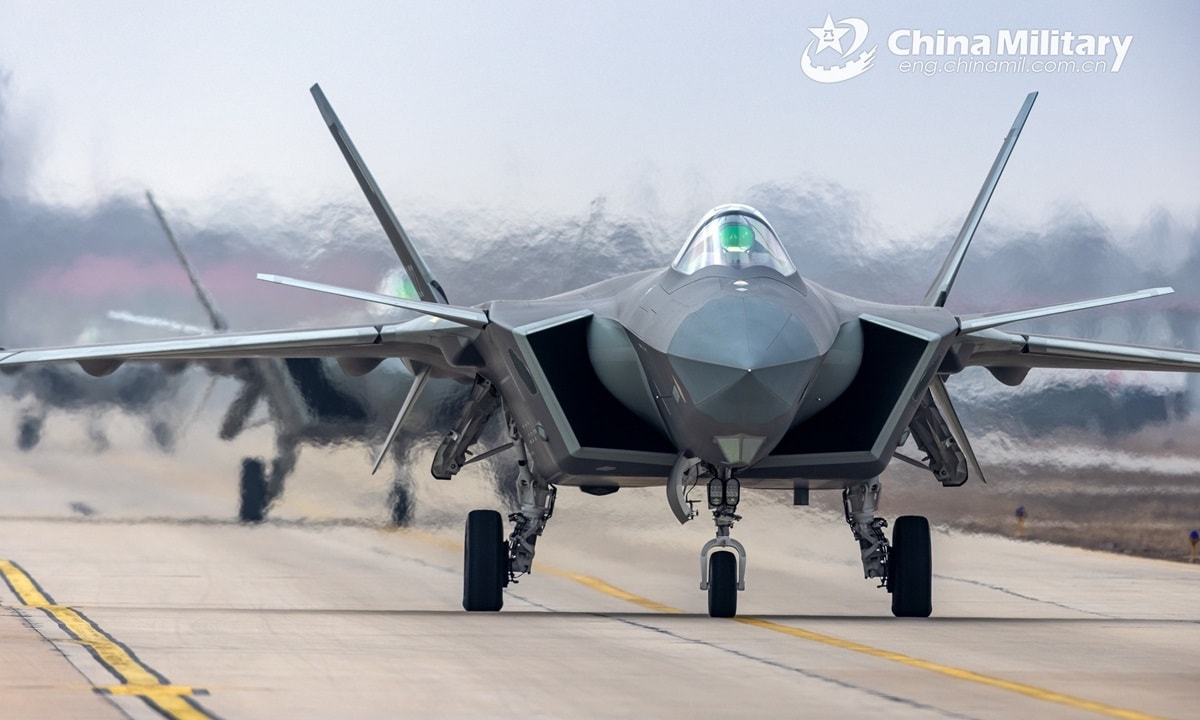
J-20 fighter. Image Credit: Chinese military.
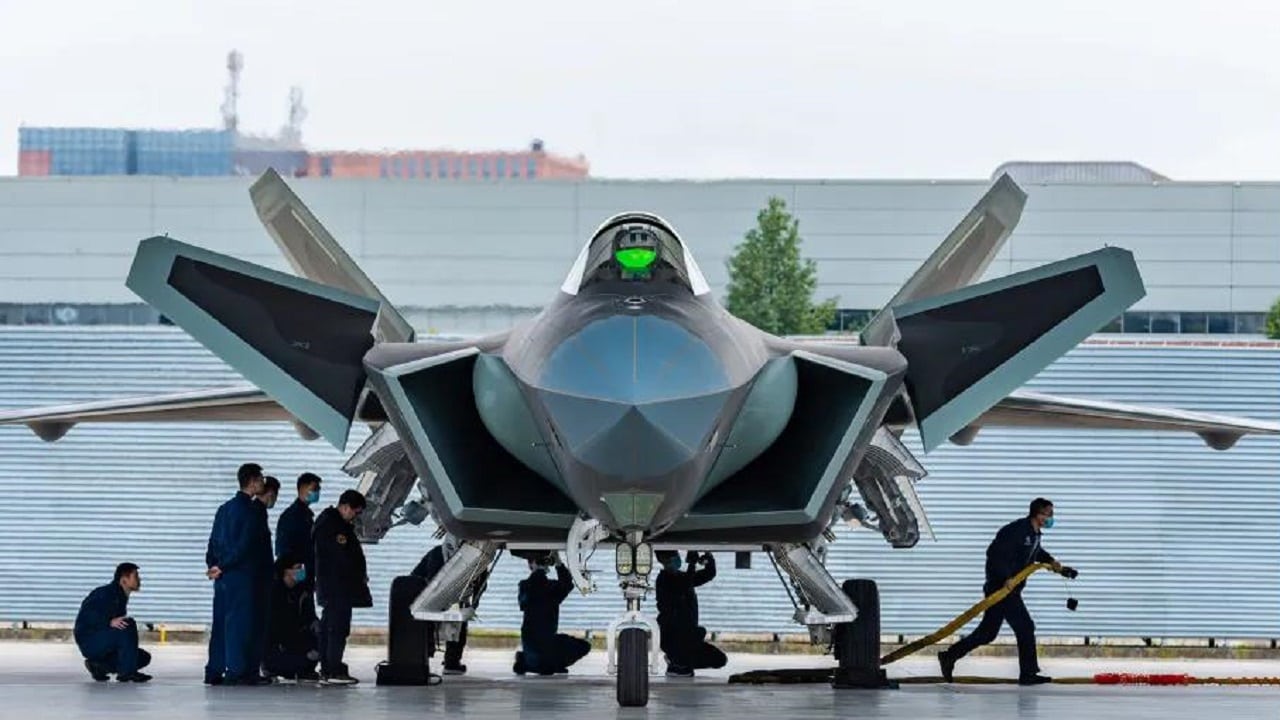
J-20. Image Credit: Chinese Internet.
The images, picked up by the European Space Agency’s Sentinel-2 satellites, show that additional Chinese activity on the reef happened sometime after October 15 of last year, as reported by Newsweek.
The reef is located in the South China Sea, south and east of Hainan.
China’s island-building and expansion campaign began around 2013 and accelerated rapidly until about 2017, after which work tapered off. China’s efforts to militarize the island transformed remote and low-lying atolls, islands, and other features into installations that could host Chinese forces.
The work, in essence, raised the islands enough to build infrastructure that would not be submerged during high tide, with some of the artificially augmented islands capable of supporting aircraft via the construction of landing strips, and the expansion of port facilities for ships, radar installations, and troop support infrastructure.
The majority of China’s island-building took place in the Spratly Islands, a dispersed and disputed archipelago claimed by several countries in the area, including Brunei, China, the Philippines, Taiwan, and Vietnam.
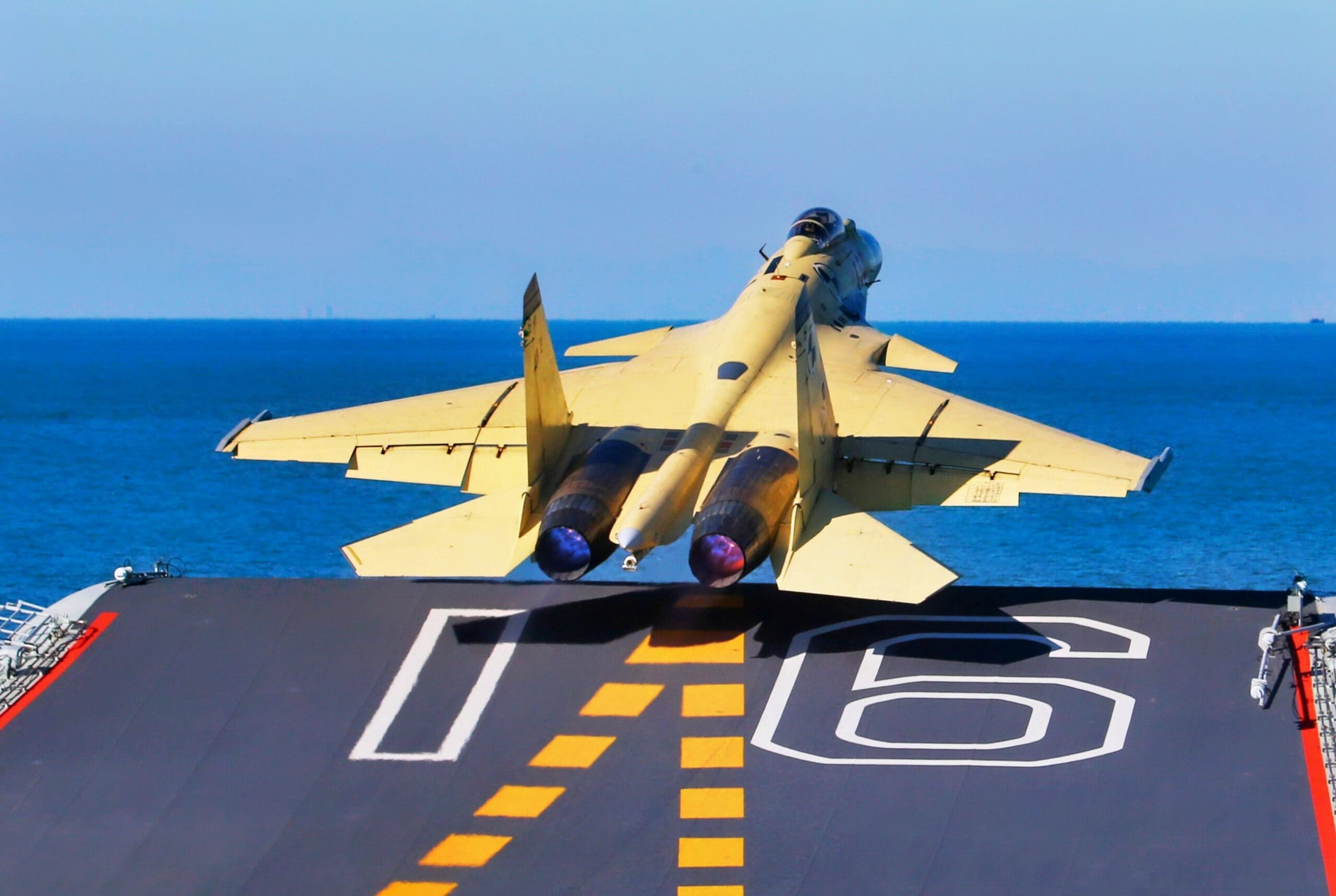
J-15 Fighter from China. Image Credit: Creative Commons.
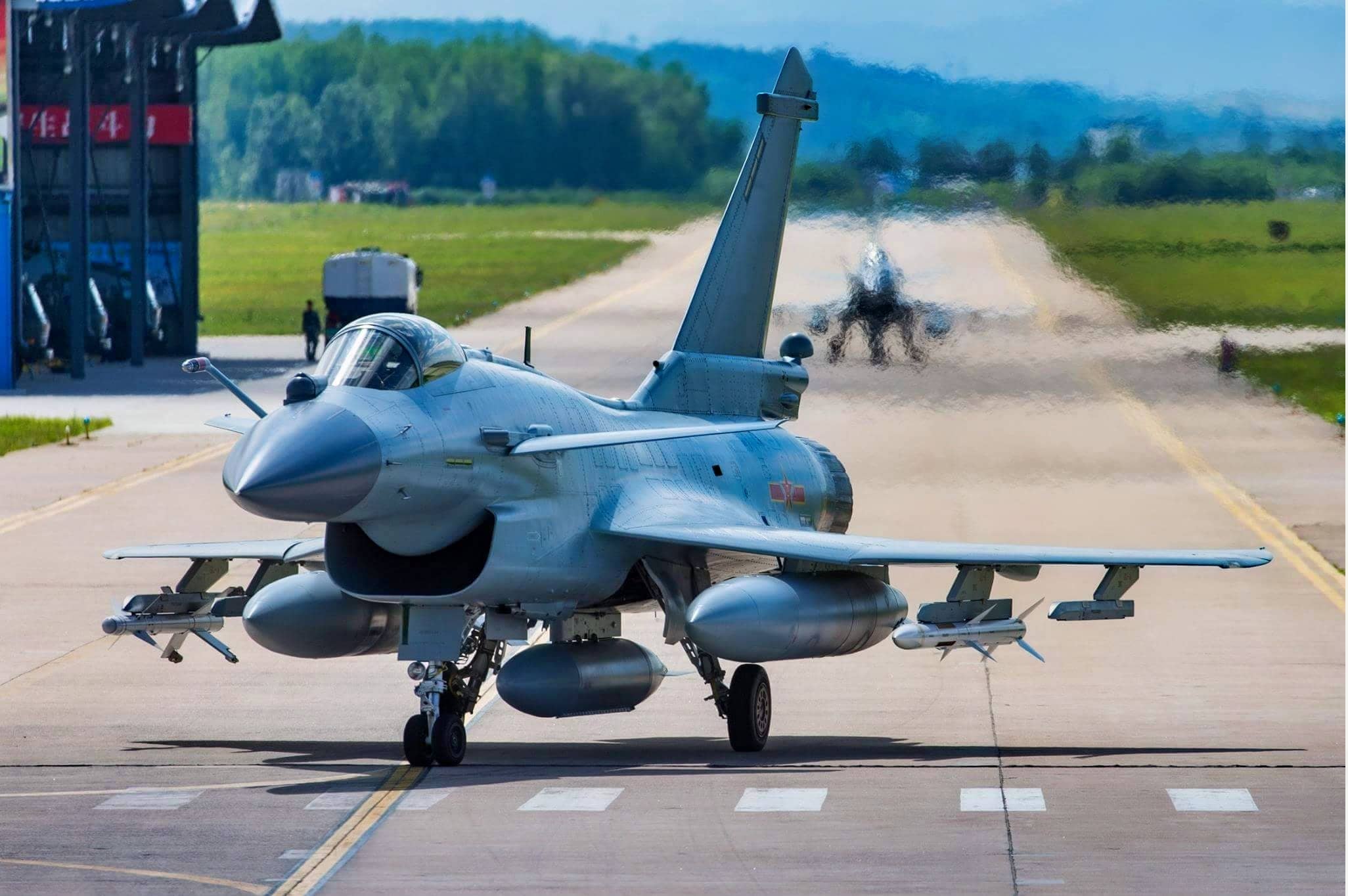
J-10C Fighter from China. Image Credit: Creative Commons.
During the peak of China’s activity, large dredging equipment was used to suction sand, rocks, and coral from the surrounding seafloor, which was then dumped onto the reefs to expand their footprint.
Much of China’s dredging and building centered on Fiery Cross Reef, Subi Island, and Mischief Reef.
Notional Claims, Real Impact
China officially claims that its island-building is essentially civilian in nature and focused on aiding navigation and safety, improving search-and-rescue infrastructure, and scientific research. In actuality, however, the truth is militant in nature.
Several of China’s expanded islands have runways long enough to host not only fighter jets but also larger cargo and transport aircraft, with hardened aircraft hangars to protect them.
Some deep-water piers are also optimized for use with naval ships and submarines, including large fuel and ammunition dumps.
The islands are protected, too, and host radar installations, surface-to-air missiles, anti-ship weaponry, electronic warfare assets, and the military personnel needed to operate these systems.
This island-building also dovetails with China’s “nine-dash line,” a territorial claim that covers the majority of the South China Sea and encroaches on the exclusive economic zones of China’s neighbors.
This claim has not been recognized internationally and is contrary to a 2016 South China Sea ruling by a United Nations maritime tribunal under the auspices of the UN Convention on the Law of the Sea, or UNCLOS. That suit was brought against China by the Philippines, though China openly disregarded the ruling and continues to expand its island-building.
Strategic Impacts
The effect of China’s dredging campaign has been very significant.
The built-up islands expand and extend China’s surveillance capabilities as well as its military reach hundreds of miles farther east — and, importantly, away from the Chinese mainland — and closer to China’s neighbors, particularly Vietnam, the Philippines, South Korea, and Japan.
China’s expanded ability to monitor both sea and air traffic has profound implications for regional security — and, in particular, for the United States and its allies.
China’s military buildup complicates military planning by, in essence, expanding China’s military perimeter and pushing that line farther away from the mainland.
“These upgrades underscore the fact that a major function of China’s bases is to provide unparallelled ISR coverage of the South China Sea, supporting the operations of China’s coastguard and navy in peacetime and allowing Beijing to contest the use of the electromagnetic spectrum by others in the event of a conflict,” the Asia Maritime Transparency Initiate wrote, commenting on other recent Chinese developments in the area.
“As Vietnam installs infrastructure on its own newly expanded outposts, it will be worth watching whether it also follows in China’s footsteps in this regard—though Hanoi may find it easier to match the scale of Beijing’s dredging than its ISR and EW footprint.”
Vietnam and the rest of China’s neighbors will no doubt lodge protests against Beijing’s island-building, particularly as that building, in tandem with China’s harassment of coast guard and fishing vessels, pushes out neighboring countries completely.
But China’s neighbors will also have to consider how they calibrate their protests, given their interest in maintaining diplomatic and trade ties with their large neighbor and the steep disparity in maritime power between them.
About the Author: Caleb Larson
Caleb Larson is an American multiformat journalist based in Berlin, Germany. His work covers the intersection of conflict and society, focusing on American foreign policy and European security. He has reported from Germany, Russia, and the United States. Most recently, he covered the war in Ukraine, reporting extensively on the war’s shifting battle lines from Donbas and writing on the war’s civilian and humanitarian toll. Previously, he worked as a Defense Reporter for POLITICO Europe. You can follow his latest work on X.