
What Is Trump’s Real Strategy on Iran?
Much of the commentary on Donald Trump’s approach to Iran begins from a familiar assumption: that he is bent on toppling the Islamic Republic—the reading mistakes both his instincts and his record. Trump has little interest in regime change and even less appetite for nation-building.
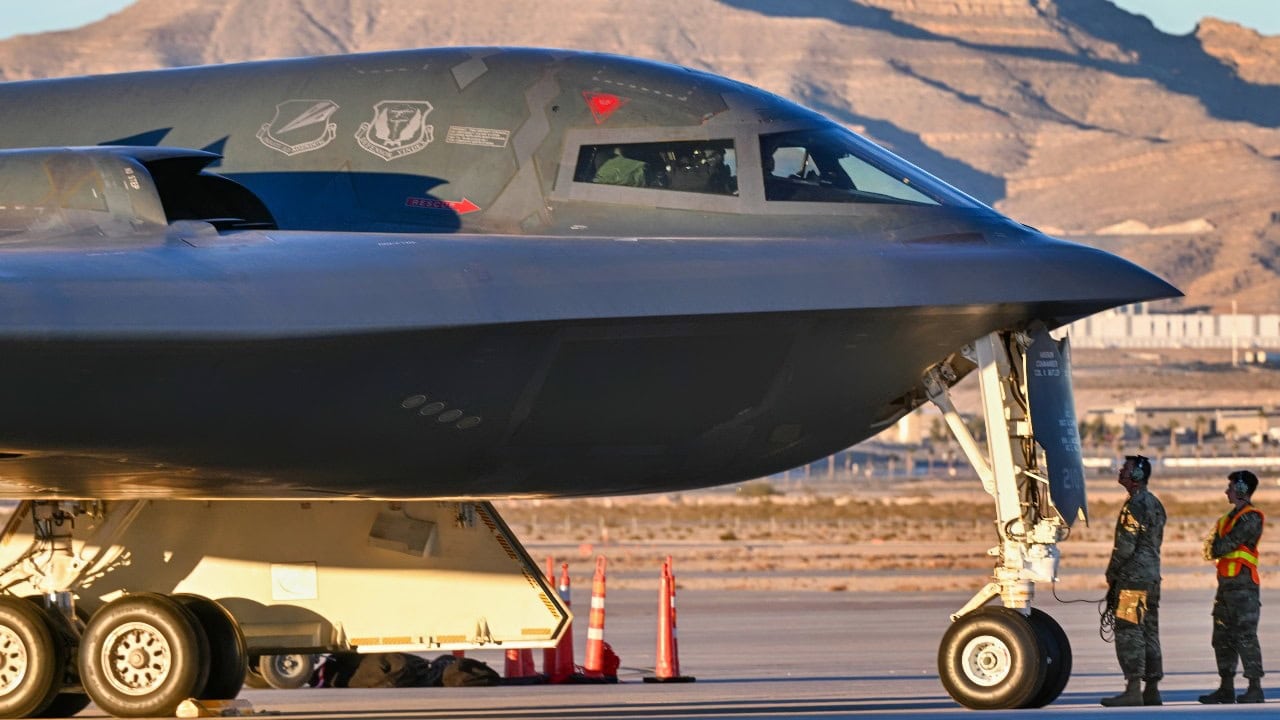
A B-2 Spirit prepares to take-off from Nellis Air Force Base, Nev. during Bamboo Eagle, Jan. 29, 2024. Bamboo Eagle provides Airmen, allies, and partners with a multidimensional, combat-representative battle-space to conduct advanced training in support of U.S. national interests. (U.S. Air Force photo by Senior Airman Bryson Britt)
He does, however, have a very real interest in bending adversarial regimes to his will. His objective with Iran can therefore best be characterized as “regime reorientation”—that is, forcing the existing machinery of rule to adjust its external behavior and strategic alignments so that they no longer collide with American interests. The model here is Venezuela. In that case, Trump left the regime essentially untouched—minus Maduro, to be sure, but in place and functioning—while sharply curtailing its freedom of action regarding energy access and its geopolitical alignment with US rivals.
Strategic Ends: Reorientation, Not Regime Change
Trump’s desired end-state, then, is not a post-theocratic Iran. It is an Iran that still governs itself internally but no longer treats nuclear escalation, proxy warfare, or strategic alignment with Russia and China as viable strategic options. He wants a Tehran that understands its external behavior will be conditioned by American power and pressure, not by Iranian ambitions or anxieties.
This is why Trump’s rallying cry ought to be “regime change if necessary, but not necessarily regime change.” Trump does not need new rulers in Tehran to achieve his objectives. He needs the current ones to govern differently. The persistent suggestion that regime survival is conditional is meant to concentrate attention inside the system, not to provoke collapse. As in Venezuela, the regime remains in place, but its strategic autonomy is steadily reduced. It can rule, but only within boundaries it did not set.
This being the case, how is Trump going about setting those boundaries?
Economic Pressure as Strategic Constraint
From a regime-reorientation perspective, economic pressure is the first and most obvious arrow in Trump’s quiver. Restricting Iran’s oil and petrochemical exports, isolating its financial system, weakening its currency, disrupting supply chains, deterring foreign investment, and cracking down on “shadow fleet” sanctions evasion are not instruments for reshaping Iranian society or engineering internal reform. Nor is their use motivated by any humanitarian impulse or desire to export democracy. Rather, they are levers intended to shape the regime’s decision-making, pressuring it to embrace strategic and economic policies deemed acceptable or attractive to Washington and to forego all others.
The Venezuela parallel matters here. Caracas retained formal sovereignty and internal control, but its ability to limit access to its oil and critical mineral reserves and to maintain strategic ties with Russia, China, and Iran is being progressively eroded by Washington.
Iran confronts a similar dynamic. Washington is not seeking complete subordination or ideological convergence. It is signaling that continued resistance will carry escalating costs – the most extreme of which is the possibility of its overthrow by increasingly disenchanted internal political forces.
Gray-Zone Operations
Trump also has hybrid weapons at his disposal. In the gray zone, hybrid weapons and tactics are used to both penetrate military command-and-control systems and degrade confidence in intra-regime lines of communication. Such weapons and tactics are also used to manipulate the broader political environment by amplifying dissenting voices, pushing anti-regime messages, and highlighting the costs of adventurism abroad. The goal is to slowly corrode both unity at the top and confidence among the general population, thus building pressure for strategic reorientation without provoking open conflict or decisively toppling the regime.
The goal of these hybrid weapons and tactics is neither covert regime change nor destabilization for destabilization’s sake. It is to deprive the regime of its strategic comfort zone and degrade its sense of impunity. These efforts should convince Iranian leaders that their lines of communication are always compromised, their logistic networks are exposed, and their illicit activities will either be discovered or disrupted. And that should make a difference. That pervasive skepticism should lead the regime to change its calculus, proceeding with caution when it once embraced risk and pulling back when it once might have escalated.
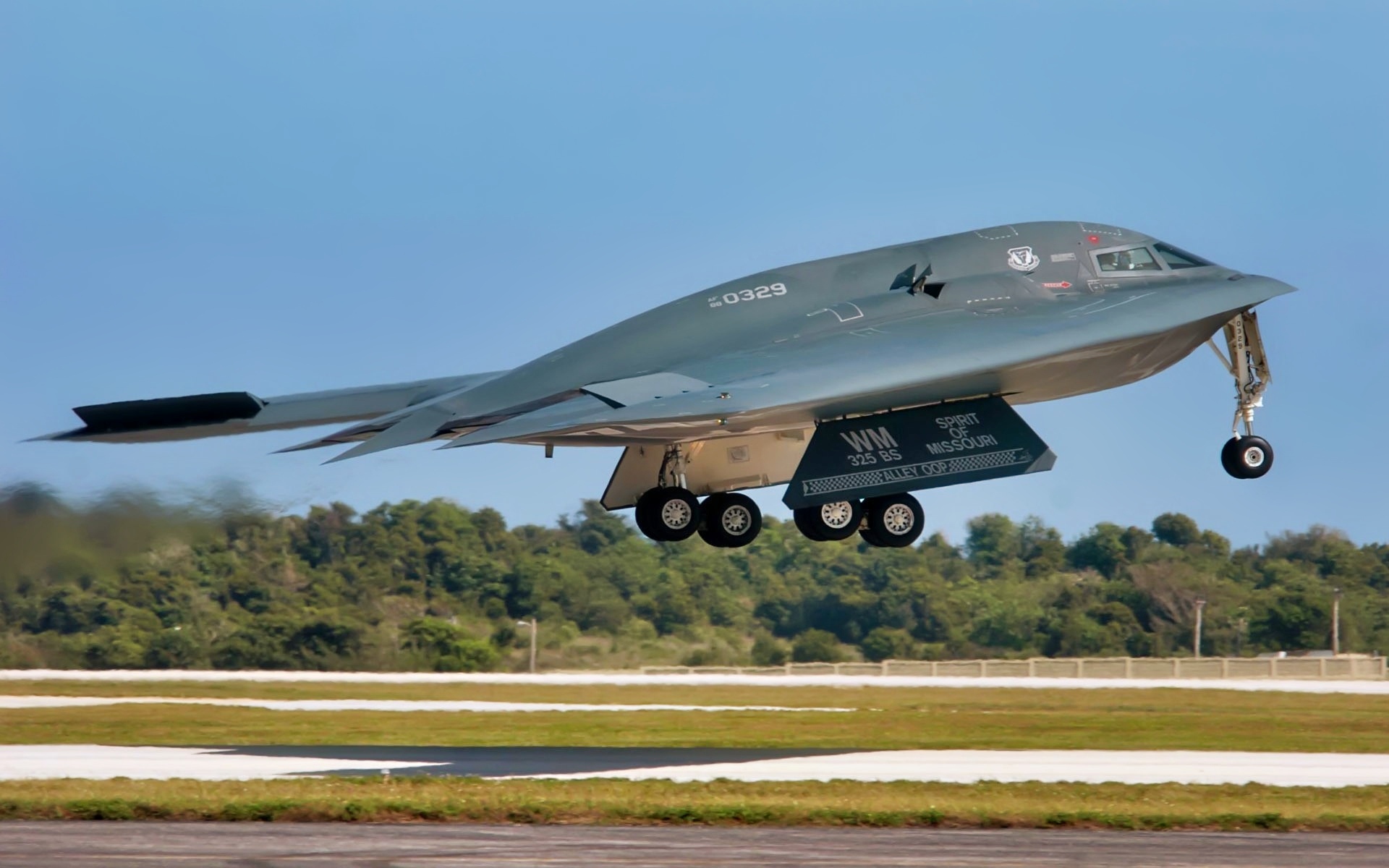
B-2 Bomber. Image Credit: Creative Commons.
Military Force as a Tool of Reorientation
Military force is obviously the most kinetic tool available to Trump. Again, from a regime reorientation perspective, the point of launching this arrow is not to topple the regime but to shape its behavior. The military options at hand, therefore, do not realistically include invasion – boots-on-the-ground, as it were. Instead, they include measures such as strikes against air defense nodes, missile launch infrastructure, drone production facilities, and command-and-control systems tied to regional operations. They also include maritime enforcement actions in key waterways, interdiction of weapons transfers, and limited naval operations to reinforce freedom of navigation. These actions are meant to demonstrate American reach, expose vulnerability, and degrade the specific capabilities that enable Iranian defiance.
What matters is the cumulative effect. Each operation narrows Iran’s options without obliging Washington to occupy territory or manage the after-action internal consequences. The regime survives, but it survives under constraint, aware that further defiance will bring additional losses.
Diplomacy as Instrument, Not Destination
In this strategy, American diplomacy is aimed at shaping the environment around it. Trump uses diplomacy to align partners, limit Iran’s room to maneuver, and prevent Tehran from exploiting divisions among outside powers. The target is not Iranian opinion, but Iranian options.
Washington’s priority is convergence rather than consensus. European allies, regional partners, and key Asian states are being pressed to align around shared red lines on nuclear risk, proxy warfare, and regional escalation. The goal is to deny Iran the ability to trade restraint in one capital for indulgence in another.
Diplomacy is also used to constrain Iran’s external alignments. Pressure is applied to deepen political cooperation with Iran, making it politically costly for Russia, China, and regional actors, even where economic ties persist. The message is consistent: association with Iranian coercion carries reputational and strategic costs that outweigh short-term gains.
Employed in this fashion, diplomacy increases the leverage of every other pressure tool. Sanctions hurt more when options are constrained. Gray-zone operations can have a greater impact when coordinated discreetly with partners. Military warnings ring louder when other allies echo them. Diplomacy is less a mechanism for reconciling differences than for pressuring Iran to change course without being burdened with responsibility for its domestic outcome.
Coercion Without Ownership
What distinguishes Trump’s approach from earlier episodes of US pressure is its refusal to assume responsibility for outcomes inside Iran. Trump is not offering a vision of Iranian transformation. He is imposing boundaries. The burden of adjustment rests entirely with Tehran.
This posture mirrors Venezuela, where the United States applied sustained pressure without committing to regime replacement or reconstruction. The regime adapted where it had to and absorbed costs where it chose not to. Iran faces a similar calculus, but on a larger and more consequential scale.
Regime Change?
Trump’s approach to Iran is neither impulsive nor aimless. It is a strategy built around constraint rather than conquest. Economic pressure narrows options. Diplomacy locks in limits. Gray-zone operations unsettle confidence and coherence. Military force underwrites those boundaries by degrading Iran’s capabilities to test them. Each instrument works to reduce Iran’s strategic freedom of action while stopping short of collapse or occupation.
About the Author: Dr. Andrew Latham
Andrew Latham is a non-resident fellow at Defense Priorities and a professor of international relations and political theory at Macalester College in Saint Paul, MN. You can follow him on X: @aakatham.