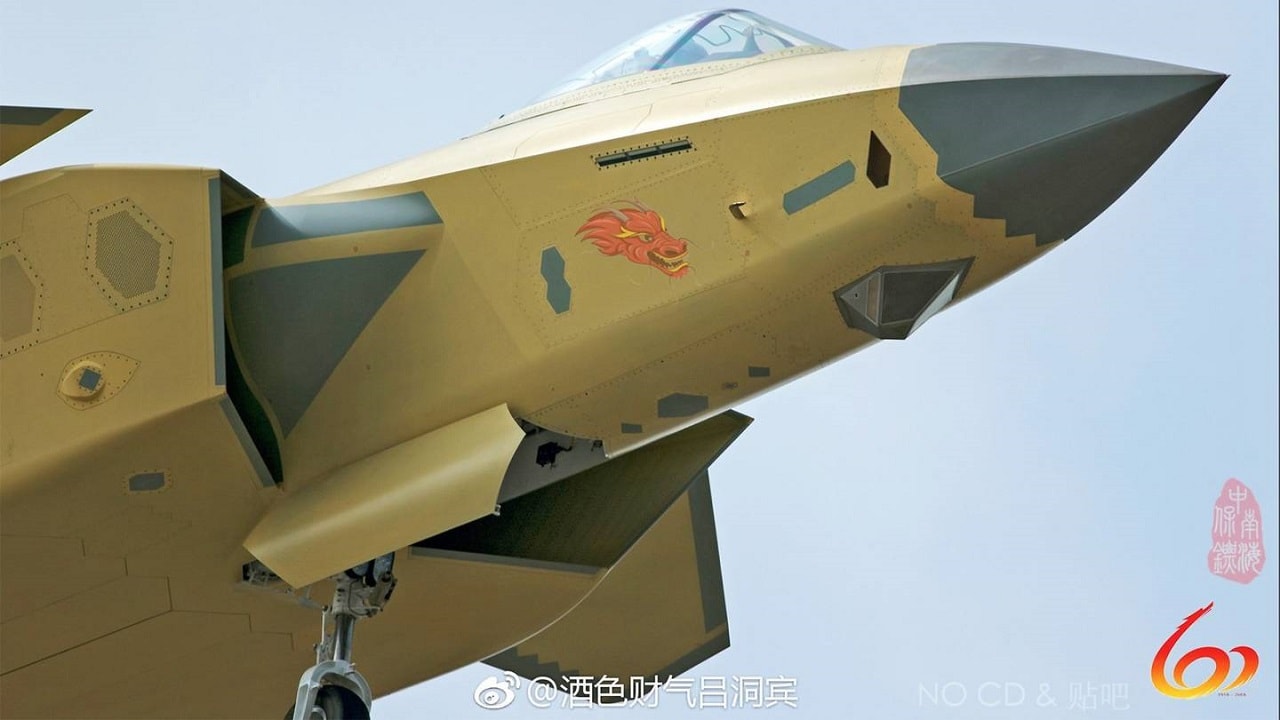
China’s J-20 Upgrade Has a Taiwan Message: New Radar, New Engines, and AI Warfighting
Recent reports about intended upgrades to the People’s Liberation Army Air Force’s (PLAAF’s) Chengdu J-20 stealth fighters may have serious implications for the defense of Taiwan. As an assessment published today reads, “China’s decision to upgrade the J-20 with advanced radar, engines and AI signals a shift from platform competition to system-level air warfare as it prepares for a Taiwan contingency.”
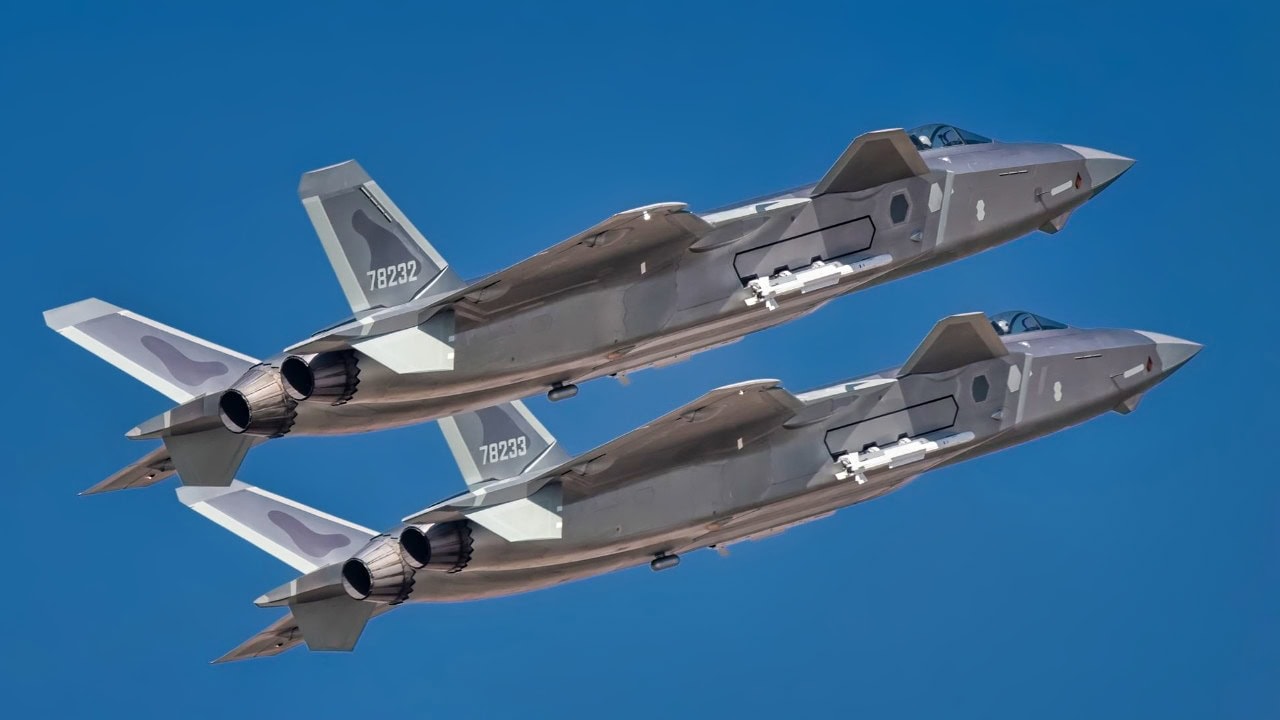
J-20 Mighty Dragon. Image Credit: Creative Commons
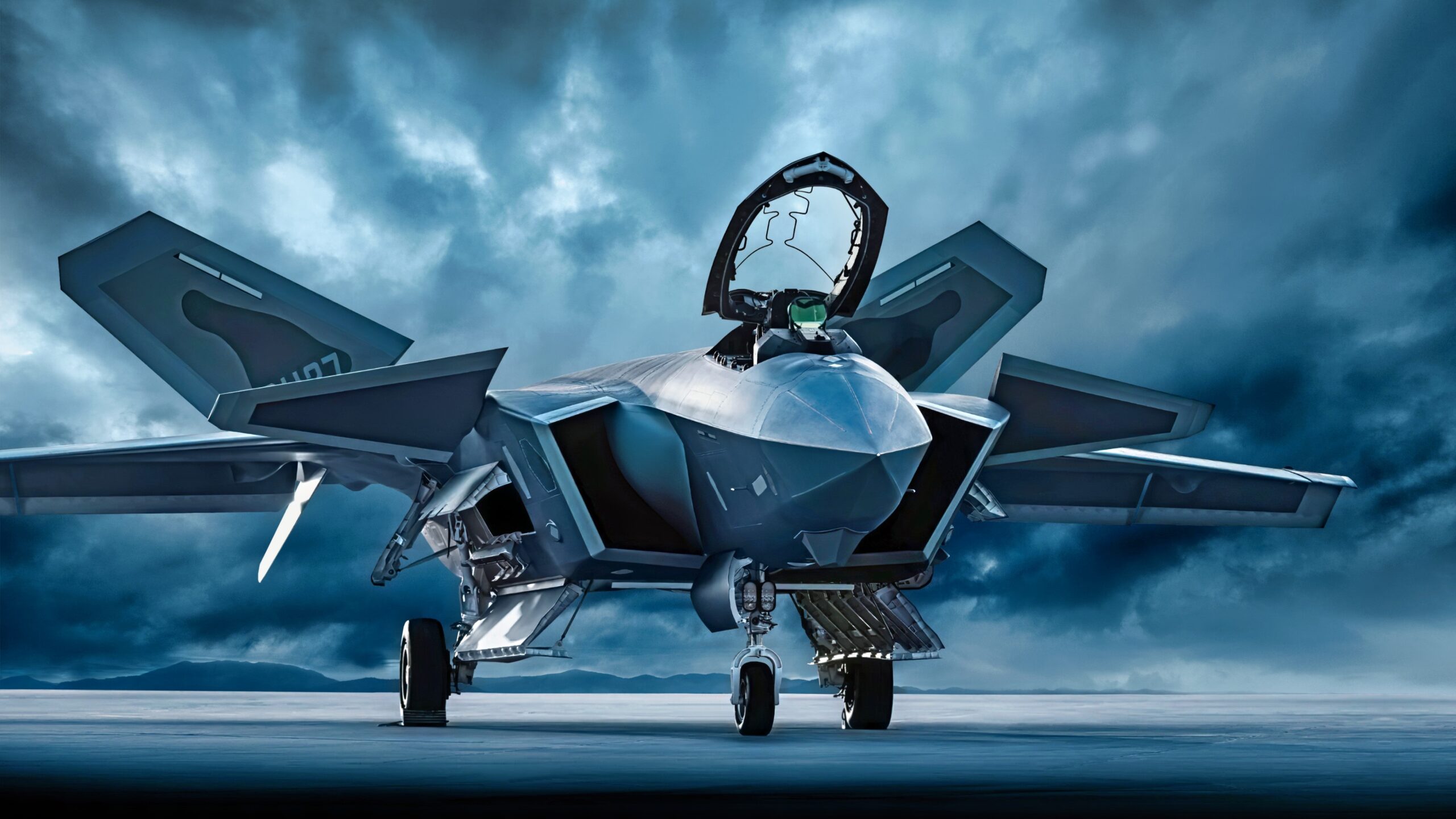
J-20 Fighter 2025 Artist Rendition. Image Credit: Creative Commons.
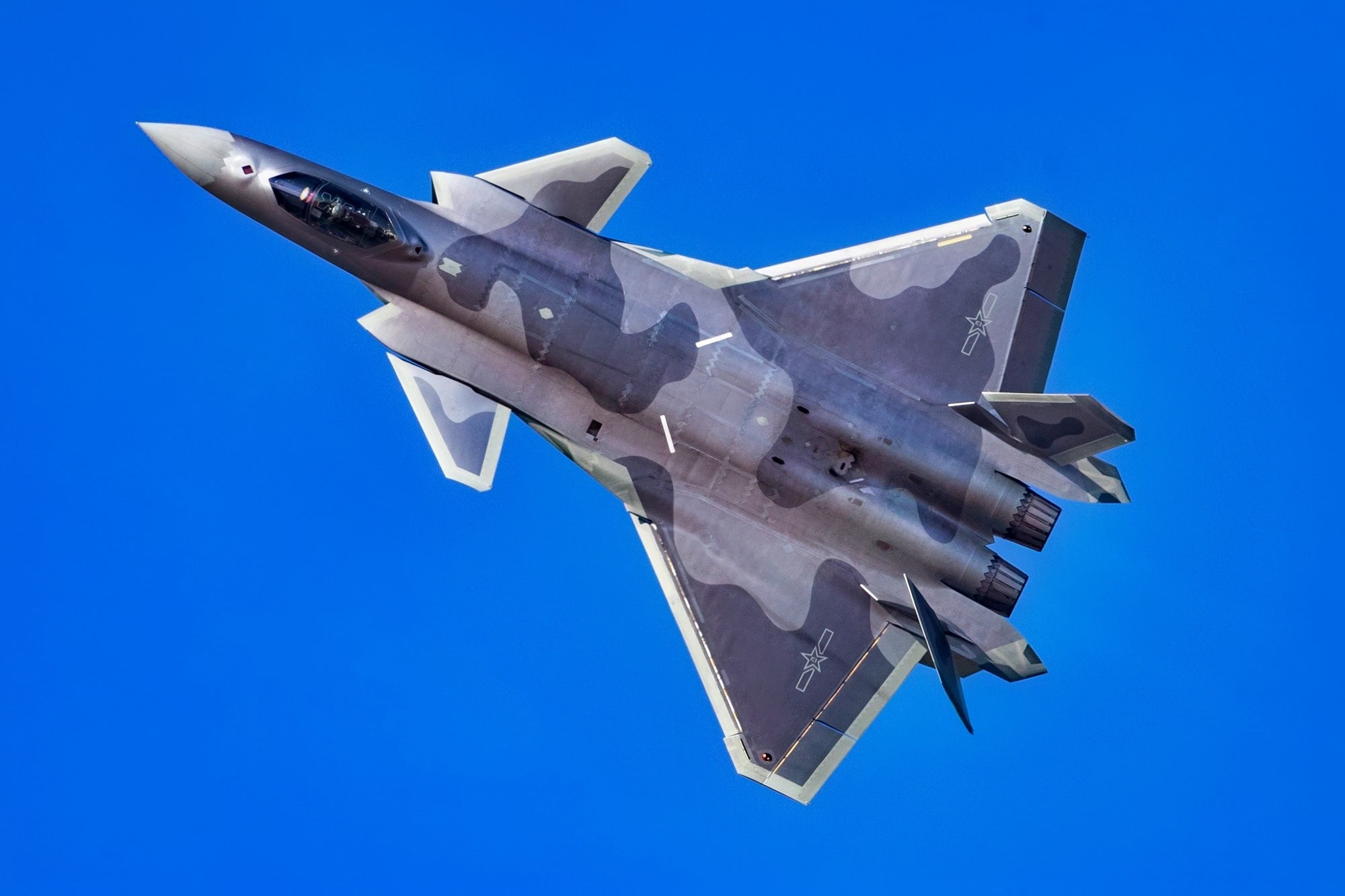
J-20 Fighter from China. Image Credit: Creative Commons.
Earlier this month, the South China Morning Post detailed plans for the upgrade of the J-20. Major upgrade elements would include newer engines and enhanced radar.
Changes and additions to the aircraft’s on-board systems would include extensive use of AI to enhance the J-20’s role as the lead element in future PLAAF combat operations, according to a military analyst who was interviewed on China’s state-controlled national television network.
Speaking on China Central Television (CCTV), the analyst, Zhang Xuefeng, explained that the J-20, which the PLAAF categorizes as a fifth-generation jet, is already operating in conjunction with stealthy Chinese analogues to what the U.S. Air Force calls Collaborative Combat Aircraft (CCA).
The J-20, which was developed by Chengdu Aircraft Corporation in Sichuan province, has also engaged in exercises to align its operations with Airborne Early Warning and Control (AEW&C) aircraft.
Battlespace Architecture
Sources with experience in China tell 19FortyFive that it is no coincidence that announcements about the aircraft’s expanded mission capabilities arrive at the same time Chengdu celebrates the 15th anniversary of the J-20’s first flight, in January 2011.
As one long-time observer of China’s military and political leadership pointed out, “the Chinese system works remarkably like the Soviet system that they learned from.
That is to say nothing as high profile and priority as the revelation of a new-age ‘makeover’ of the J-20 that just happens by accident.”
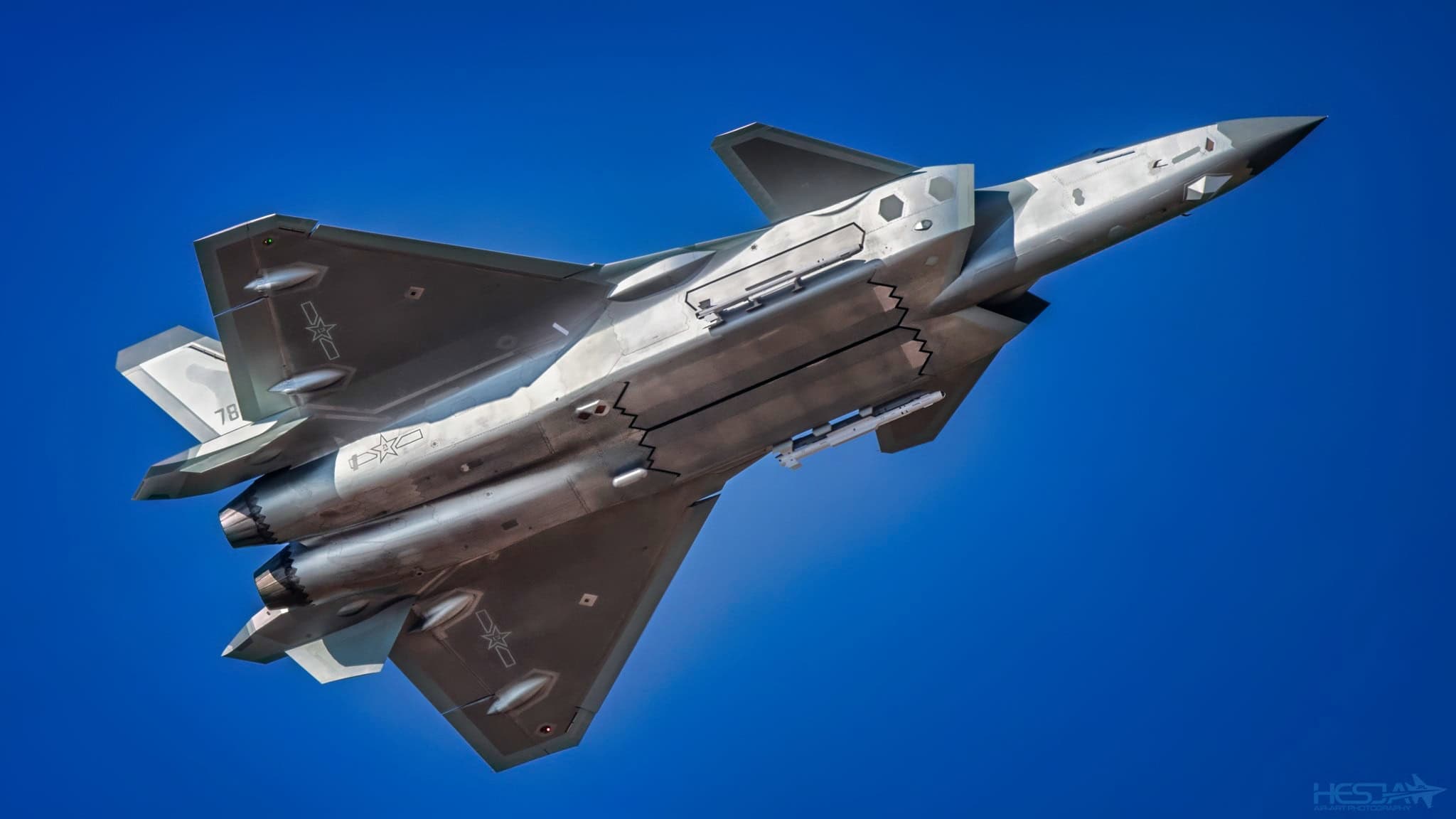
J-20 Fighter from China. Image Credit: Creative Commons.

J-20 Fighter. Image Credit: Chinese CCTV.
The aircraft first entered active service in 2017 and is now the most-produced twin-engine fighter in the world. It also accounts for the largest fleet of fifth-generation fighters outside the United States.
The PLAAF is also developing a new AEW&C aircraft, the KJ-3000, that is designed on the platform of the Xi’an Y-20B strategic cargo-lifting aircraft. The KJ-3000 is, as a recent article describes, intended to “act as the People’s Liberation Army Air Force’s (PLAAF) mobile eyes and ears in the sky.”
BVR and Combat Operations
There are two goals to the J-20 upgrades. One is to improve its performance in a system-of-systems architecture, thanks to longer radar detection ranges and the addition of new air-launched weapons.
More resilient air-to-air missiles (which usually means they have better jamming immunity) are supported by not only more capable radar, but also infrared sensors.
The second goal, as Zhang told CCTV, is that AI would be a primary factor in improving J-20’s performance and that it will support the pilots in the sensor-to-shoot cycle in any beyond-visual-range combat and during multi-platform engagements.
The Chengdu design team has developed several different versions of the J-20. One is a tandem two-seat J-20S optimized as the control node for a swarm of drones.
Zhang also discussed how the aircraft would likely be employed in an operation against Taiwan. After an initial round of missile strikes takes out radar stations and air defense assets, the J-20 would use its low-observable design to penetrate what remained of Taiwanese defenses and enter the fight.
The J-20 would be used to degrade what was left of the island’s air defense network, and then neutralize Taiwan’s fleet of F-16 aircraft. Taiwan’s F-16s are mostly older versions from the 1970s but have been improved to be survivable in the combat scenarios they would likely face.
But Zhang regards the J-20 v. F-16 matchup as one in which the Chinese aircraft is a generation beyond the F-16 in design.
Lastly, a J-20 capable of datalink with other platforms and penetrating radar networks could clear a path for older Shenyang J-11s and J-16s. These are available in such large numbers that they would likely overwhelm any remaining Taiwanese defenses.
About the Author: Reuben F. Johnson
Reuben F. Johnson has thirty-six years of experience analyzing and reporting on foreign weapons systems, defense technologies, and international arms export policy. Johnson is the Director of Research at the Casimir Pulaski Foundation. He is also a survivor of the Russian invasion of Ukraine in February 2022. He worked for years in the American defense industry as a foreign technology analyst and later as a consultant for the U.S. Department of Defense, the Departments of the Navy and Air Force, and the governments of the United Kingdom and Australia. In 2022-2023, he won two awards in a row for his defense reporting. He holds a bachelor’s degree from DePauw University and a master’s degree from Miami University in Ohio, specializing in Soviet and Russian studies. He lives in Warsaw.