

Synopsis and Key Points: Steve Jobs famously defined business success as “survival,” warning that winning individual battles matters little if you run out of money before the product ships.
-Defense expert Christian D. Orr applies this mindset to military history, drawing a parallel between Jobs’ three major career wins—founding Apple, building Pixar, and saving Apple in 1997—and the United States’ defeat in the Vietnam War.
-Orr argues that while the U.S. won nearly every tactical engagement from the Ia Drang Valley to the Tet Offensive, it ultimately lost the war because it lacked the financial and political endurance to see the conflict through.
-Jobs’ “don’t run out of money before the product ships” mindset also offers a blunt lesson for strategy: tactics matter, but endurance decides outcomes.
‘The War Is Called Survival’: Steve Jobs’ Brutal Lesson on Why Tactics Alone Don’t Win Wars
“It would be a shame to have lost the war because we won a few battles … The war is called survival. The war is called not running out of money [before] we get the product on the market.”—That quote belongs to the late great Steve Jobs, one of the most successful and famous business executives and entrepreneurs of all time.
His well-known wealth notwithstanding, Steve Jobs (like any mere mortal) had his fair share of losses as well as wins. But in the spirit of emphasizing the positive, we’re now going to focus on the biggest wins of Mr. Job’s storied career in business and technology.=
Big Win #1: Founding Apple
Might as well start with the earliest and most famous example, right?
Along with his childhood friend Steve Wozniak (AKA “Woz”), Steve Jobs founded Apple Computer. He was born on April 1, 1976.” This was no mere April Fool’s joke, and just as 1976 marked the 200th anniversary of America’s Declaration of Independence, the foundation of Apple would set the two Steves on the path to financial independence:
-In January 1977, Jobs sweet-talked business angel Mike Markkula to invest in Apple to the tune of $250,000 (roughly equivalent to $1 million in today’s dollars), and three months later, the Apple II computer was officially introduced at the West Coast Computer Faire
-In December 1980, Apple went public via IPO, boosting Steve Jobs’s net worth to over $200 million at the age of 25 (to put things in perspective, that’s the minimum age to run for the U.S. House of Representatives, and the average age of a first lieutenant/lieutenant (junior grade) in the U.S. Armed Forces who didn’t previously serve in the prior enlisted ranks.
Big Win #2: Pixar
After Mr. Jobs was unceremoniously stripped of operational duties at Apple by the board of directors in mid-1985, his first attempt at a career comeback, NeXT, didn’t catch on, and he took some time off to focus on his wife Laurene (whom he married in 1991) and his newborn son, Reed.
Fortunately, Steve still had millions of dollars left in his bank account. He used a chunk of that money to: (1) hire a small group of computer scientists who needed a new employer when George Lucas sold the computer graphics division of his Lucasfilm empire; and (2) incorporate a new company called Pixar, which had been founded by Ed Catmull and Alvy Ray Smith back in the late 1970s.
Suffice to say that Pixar proved much more successful than NeXT; as of July 2023, Pixar’s feature films had earned over $15 billion USD in worldwide box office receipts with an average gross of $589 million per flick.
Big Win #3: Returning to (and Saving) Apple
As the saying goes, “What goes around, comes around.” By 1997, Apple was floundering & flailing, and the board of directors approached Jobs, hat in hand. Steve decided to let bygones be bygones, and on September 16, 1997, he graciously accepted Apple’s offer to become its interim CEO, and, for good measure, he brought his executive team from NeXT with him and installed them in key positions.
As noted by Romain Moisescot of All About Steve Jobs.com, “Critics started to believe in Steve Jobs’s ability to run Apple when he unveiled his first great product, the iMac. Introduced in May 1998, it was Apple’s first truly innovative product since the original Macintosh of 1984 … After three years in charge, Steve Jobs had brought Apple back to its status of cool tech icon … After two more years of development, the iPhone was introduced at Macworld on January 9, 2007. This keynote is often considered the pinnacle of Steve Jobs’ career.”
Historic Military Applicability
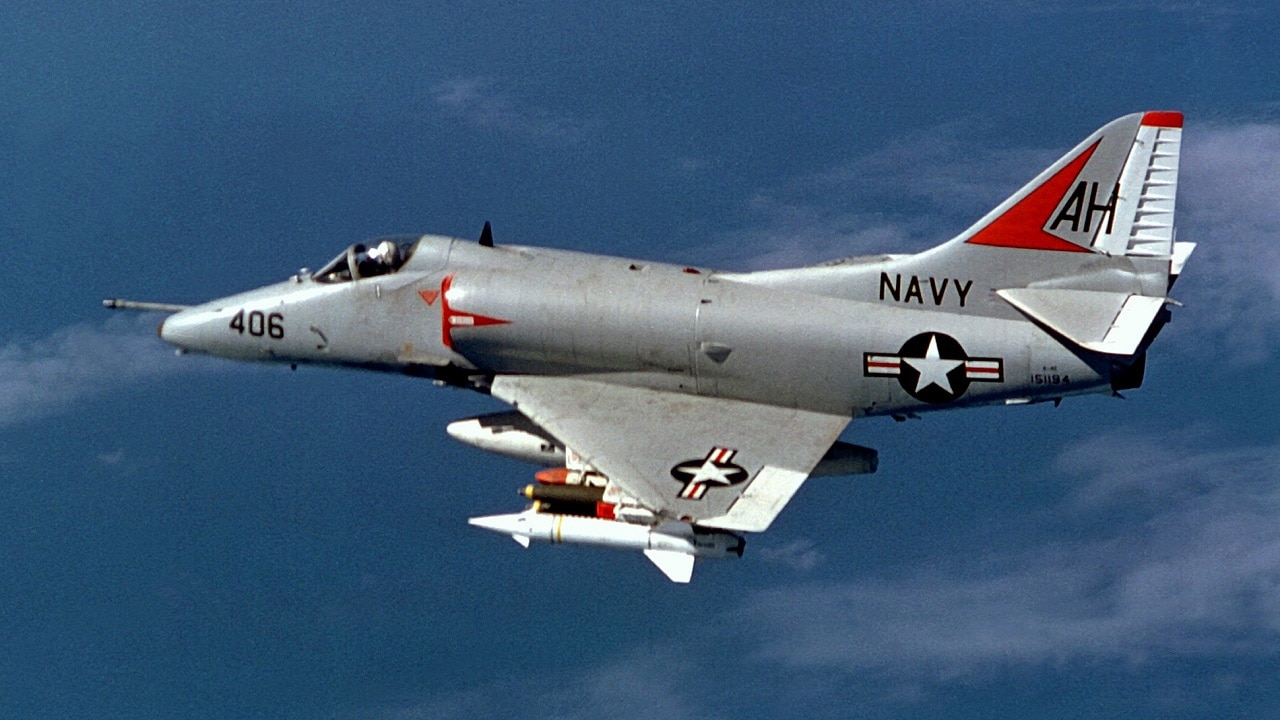
A U.S. Navy Douglas A-4E Skyhawk (BuNo 151194) from Attack Squadron 164 (VA-164) “Ghost Riders” en route to a target in North Vietnam on 21 November 1967. VA-164 was assigned Attack Carrier Air Wing 16 (CVW-16) aboard the aircraft carrier USS Oriskany (CVA-34) for a deployment to Vietnam from 16 June 1967 to 31 January 1968. The aircraft was piloted by Cmdr. William F. Span, executive officer of VA-164 and was armed with six Mk 82 500 lb (227 kg) bombs and two AGM-12 Bullpup missiles. The A-4E 151194 is today on display at Pacific Coast Air Museum, California (USA), painted in the colours of Marine Attack Squadron 131 (VMA-131) “Diamondbacks”.

A camouflaged U.S. Navy Douglas RA-3B Skywarrior aircraft of reconnaissance squadron VAP-61 World Recorders (BuNo 144846) at Naval Air Station (NAS) Agana, Guam. Standing beside it are PH1c R. Laurie, LTJG D. Schwikert and LCDR Chas. D. Litford. On the ground in front of them are twelve cameras. VAP-61 was performed reconnaissance missions over Vietnam until it was disestablished on 1 July 1971. 144846 became an ERA-3B in 1982. It was later sold to Hughes Aircraft, inherited by Raytheon, (civil registration N547HA) and finally srcapped in 1999.
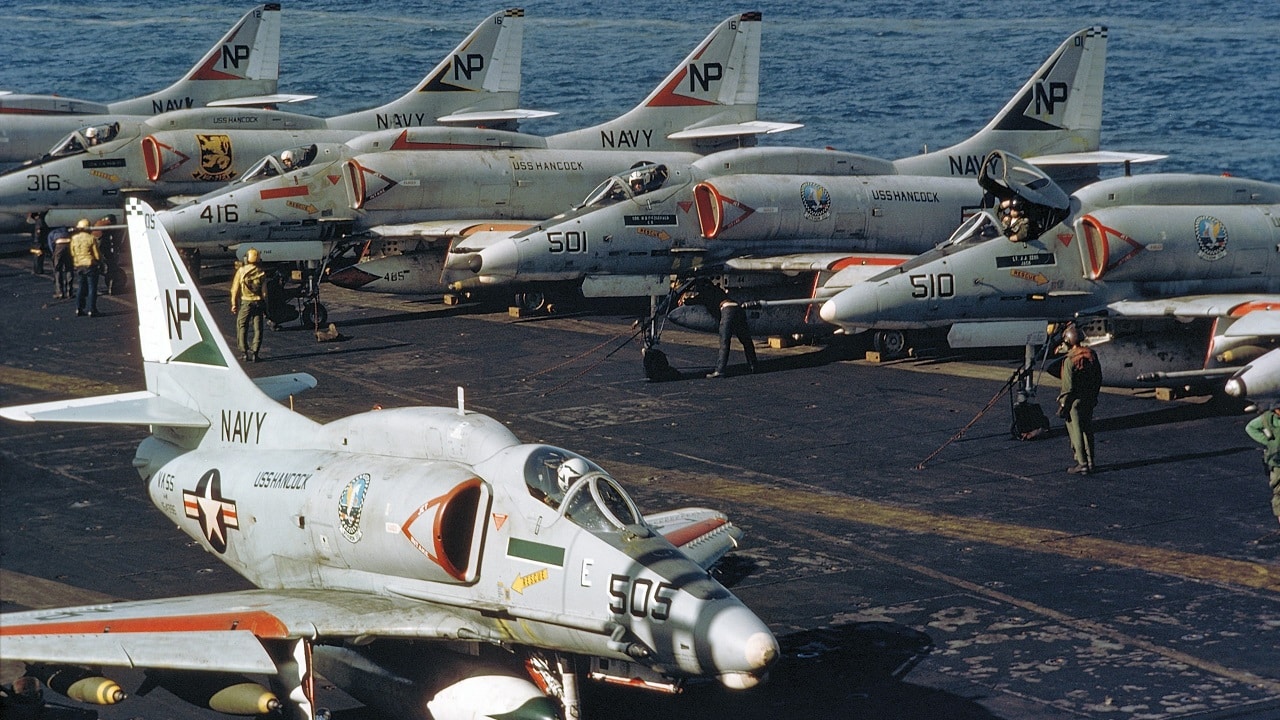
U.S. Navy Douglas A-4F Skyhawk of Attack Carrier Air Wing 21 (CVW-21) are parked on the flight deck of the attack aircraft carrier USS Hancock (CVA-19), armed for a mission over Vietnam on 25 May 1972. Skyhawks NP-501 (BuNo 155046), -505 (BuNo 154996), and -510 were assigned to Attack Squadron 55 (VA-55) “Warhorses”, NP-316 to VA-212 “Rampant Raiders”, NP-412 and NP-416 to VA-164 “Ghost Riders”. The aircraft are armed with Mk 82 (500 lb/227 kg) and Mk 83 (1000 lb/454 kg) bombs. CVW-21 was assigned to the Hancock for a deployment to Vietnam from 7 January to 3 October 1972.
Granted, corporate-to-military analogies tend to be overdone (as do sports-to-military analogies), but Steve’s words of wisdom are definitely applicable to the military. They ring especially true when we examine the Vietnam War.
The United States of America won nearly every significant engagement of the Vietnam War, from Ia Drang Valley to the Tet Offensive to the North Vietnamese Army’s Easter offensive of 1972 to Operation Linebacker II (the “Christmas bombing” of Hanoi), yet lost the war, mainly due to lack of political will, but with “running out of the money” playing a factor as well.
Lyndon Baines Johnson’s criminally negligent micromanagement of the war is infamous among Vietnam veterans. But even that doesn’t tell the whole story. In his 1966 State of the Union address (three years before he left the White House in disgrace), LBJ argued that the country could have both “guns and butter,” i.e., both defense investment and civilian economic investment. Well, whilst the “guns” part failed due to his micromanagement and outright political cowardice, his “butter” part failed miserably too, as his so-called “War on Poverty” was also a total loss. (LBJ was also a sworn enemy of “guns” in private American citizens’ hands, but that’s a different story.)
Fast-forward to 1975, two years after the U.S. had already withdrawn combat troops from South Vietnam, and Congress arbitrarily cut off aid to South Vietnam, which not only made it logistically and financially impossible for Saigon to defeat the North Vietnamese Army (NVA), but also encouraged Hanoi to begin an effective military offensive against South Vietnam, which tragically culminated on April 30, 1975.
As noted by Lauren Zanolli of History News Network (HNN), “Given the monetary and military investment in Vietnam, former Assistant Secretary of State Richard Armitage compared the American withdrawal to ‘a pregnant lady, abandoned by her lover to face her fate.’ Historian Lewis Fanning went so far as to say that ‘it was not the Hanoi communists who won the war, but rather the American Congress that lost it.'”
About the Author: Christian D. Orr, Defense Expert
Christian D. Orr is a Senior Defense Editor. He is a former Air Force Security Forces officer, Federal law enforcement officer, and private military contractor (with assignments worked in Iraq, the United Arab Emirates, Kosovo, Japan, Germany, and the Pentagon). Chris holds a B.A. in International Relations from the University of Southern California (USC) and an M.A. in Intelligence Studies (concentration in Terrorism Studies) from American Military University (AMU). He is also the author of the newly published book “Five Decades of a Fabulous Firearm: Celebrating the 50th Anniversary of the Beretta 92 Pistol Series.”