
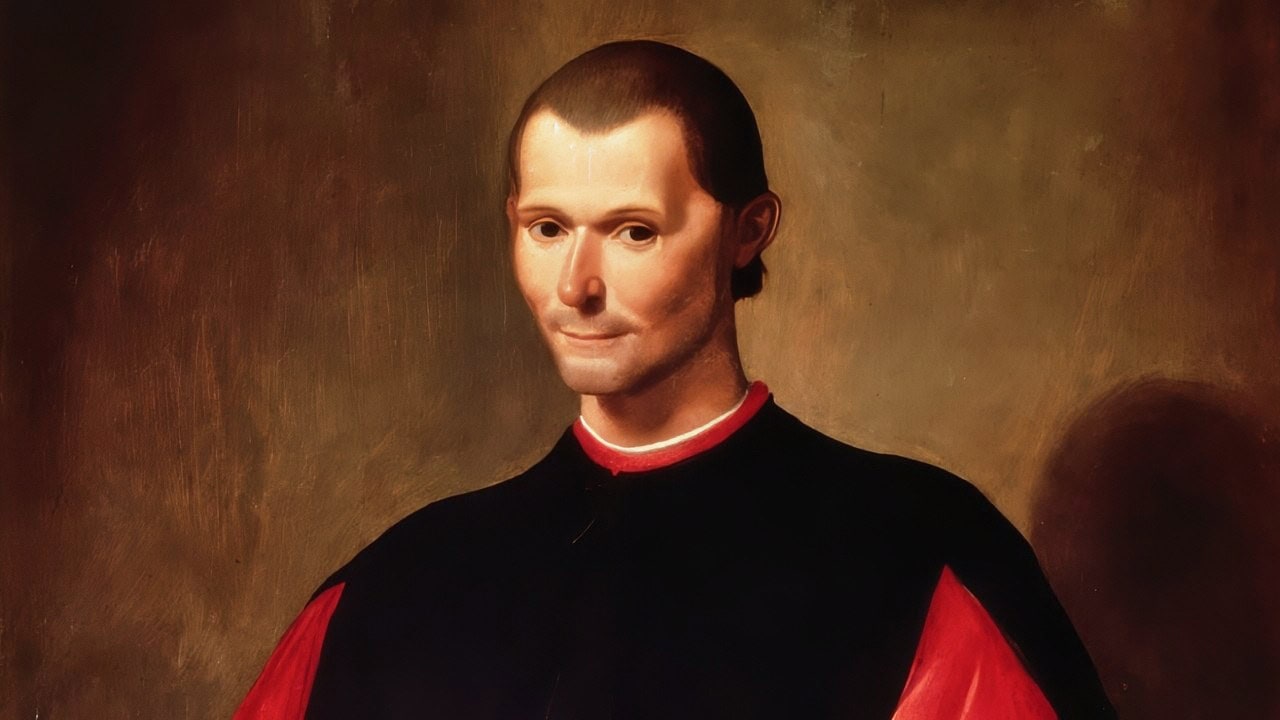
Quote Of The Day: Machiavelli Warned Leaders How Easily People Can Be Deceived
“Men are so stupid and concerned with their present needs, they will always let themselves be deceived”- Niccolo Machiavelli
Niccolo Machiavelli was born in the Republic of Florence in May of 1469. According to his History Channel biography, Machiavelli was a “lifelong patriot and diehard proponent of a unified Italy,” who went on to become “one of the fathers of modern political theory.”
At the time of his birth, the unified Italy had not yet been established, so his initial service was to the Republic of Florence. He entered service while still in his 20s and ended up as defense secretary, “executing policies that strengthened Florence politically.”
“He soon found himself assigned diplomatic missions for his principality, through which he met such luminaries as Louis XII of France, Pope Julius II, the Holy Roman Emperor Maximilian I, and, perhaps most importantly for Machiavelli, a prince of the Papal States named Cesare Borgia,” the History Channel bio said.
After falling out of favor with the Medici family, Machiavelli was “accused of conspiracy, imprisoned, tortured, and temporarily exiled.”
It was at that point that Machiavelli authored “The Prince,” which was inspired by that prince of the Papal States, Cesare Borgia.
The Prince
“The Prince” was published as a pamphlet in 1513, although it didn’t emerge in book form until after Machiavelli’s death.
“Machiavelli outlined his vision of an ideal leader: an amoral, calculating tyrant for whom the end justifies the means,” the History Channel biography said of “The Prince.”
As described by the Stanford Encyclopedia of Philosophy, Machiavelli stood opposite a tradition in which philosophers often believed that there was “a special relationship between moral goodness and legitimate authority,” and the frequent assertion that “the use of political power was only rightful if it was exercised by a ruler whose personal moral character was strictly virtuous.”
Machiavelli, it’s clear, felt differently.
“For Machiavelli, there is no moral basis on which to judge the difference between legitimate and illegitimate uses of power. Rather, authority and power are essentially coequal: whoever has power has the right to command; but goodness does not ensure power and the ruler has no more authority on account of being good,” the Stanford Encyclopedia said.
“Thus, in direct opposition to morally derived theories of politics, Machiavelli says that the only real concern in politics is the acquisition and maintenance of power (although he talks less about power per se than about “maintaining the state”).”
On this, he drew from his own experience.
“The Prince purports to reflect the self-conscious political realism of an author who is fully aware—on the basis of direct experience in the service of the Florentine government—that goodness and right are not sufficient to win and maintain political supremacy,” the Stanford Encyclopedia said.
“Machiavelli’s political theory, then, excludes issues of moral authority and legitimacy from consideration in the discussion of political decision-making and political judgment,” the Stanford Encyclopedia says. “Nowhere does this come out more clearly than in his treatment of the relationship between law and force. Machiavelli acknowledges that good laws and good arms constitute the dual foundations of a well-ordered political system. But he immediately adds that since coercion creates legality, he will concentrate his attention on force.”
What Machiavelli Stood For
More broadly, according to the Stanford Encyclopedia of Philosophy’s page about him, Machiavelli “contributed to a large number of important discourses in Western thought—political theory most notably, but also history and historiography, Italian literature, the principles of warfare, and diplomacy.”
“But Machiavelli never seems to have considered himself a philosopher—indeed, he often overtly rejected philosophical inquiry as beside the point—nor do his credentials suggest that he fits comfortably into standard models of academic philosophy,” the Stanford Encyclopedia said. “His writings are maddeningly and notoriously unsystematic, inconsistent, and sometimes self-contradictory. He tends to appeal to experience and example in the place of rigorous logical analysis.”
The Quote
“Men are so stupid and concerned with their present needs, they will always let themselves be deceived,” is an oft-cited Machiavelli quote, which comes from “The Prince.” It’s a very, well, Machiavellian quote, both encouraging leaders to consider the future, while also taking advantage of the stupidity of others.
Machiavelli’s End and Legacy
The publication of the pamphlet did not regain the Medicis’ favor, as he had hoped.
“Machiavelli was never truly welcomed back into politics, and when the Florentine Republic was reestablished in 1527, Machiavelli was an object of great suspicion,” the History Channel bio said. The philosopher died that same year.
However, Machiavelli’s legacy has far outlasted him, nearly 500 years after his death.
As noted in a Medium article from 2024, numerous leaders of the past, some of them leaning towards the despotic, have been influenced by the work of Machiavelli. This includes Hitler, Stalin, and Mussolini.
In 2021, Michael Giles wrote an article about Hitler’s reading of Machiavelli.
“Hitler told me he had read and reread The Prince of the Great Florentine. To his mind, the book is indispensable to every political man. For a long time, it did not leave Hitler’s side. The reading of those unequaled pages, he said, was like a cleansing of the mind. It has disencumbered him from plenty of false ideas and prejudices. It is only after having read The Prince that Hitler understood what politics really is,” German politician Hermann Rauschning wrote in 1940, per the Giles article.
Benito Mussolini, meanwhile, considered himself a full-on admirer of Machiavelli, per a Modern Diplomacy article.
“Mussolini himself even claimed that Niccoló Machiavelli and his realist approach were an inspiration to him and that his book The Prince had an influence on him since he aspired of being the great leader for Italy that would restore the glory of the Roman Empire,” that article said. “Secondly, the idea of the state’s wellbeing being above any form of individualism. In that sense, the famous quote of Machiavelli ‘the end justifies the means.’, can be found in the fascist doctrine.”
About the Author: Stephen Silver
Stephen Silver is an award-winning journalist, essayist, and film critic, and contributor to the Philadelphia Inquirer, the Jewish Telegraphic Agency, Broad Street Review, and Splice Today. The co-founder of the Philadelphia Film Critics Circle, Stephen lives in suburban Philadelphia with his wife and two sons. For over a decade, Stephen has authored thousands of articles that focus on politics, national security, technology, and the economy. Follow him on X (formerly Twitter) at @StephenSilver, and subscribe to his Substack newsletter.