
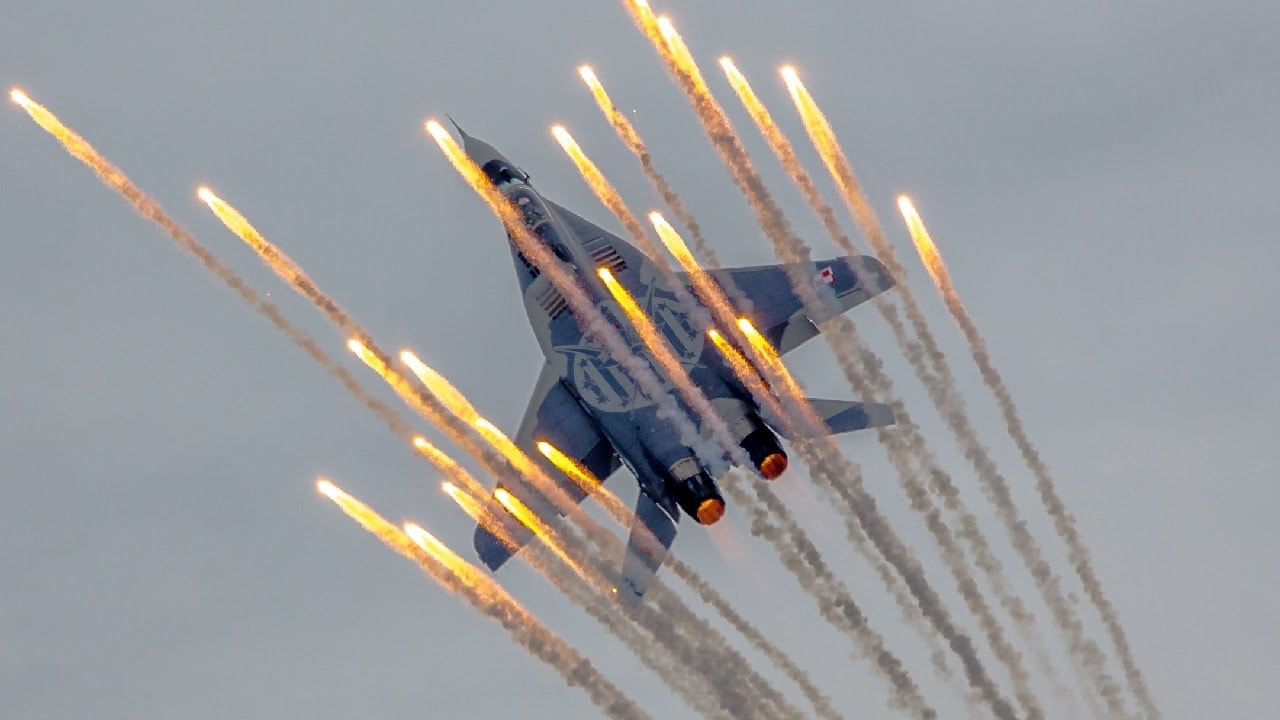
MiG-29 Fulcrum: The Soviet Fighter That Refuses To Retire
The Soviet Union thankfully collapsed in 1991, thus bringing about the end of the Cold War. Yet plenty of Soviet-designed weapon systems have far outlived the nation that designed them.
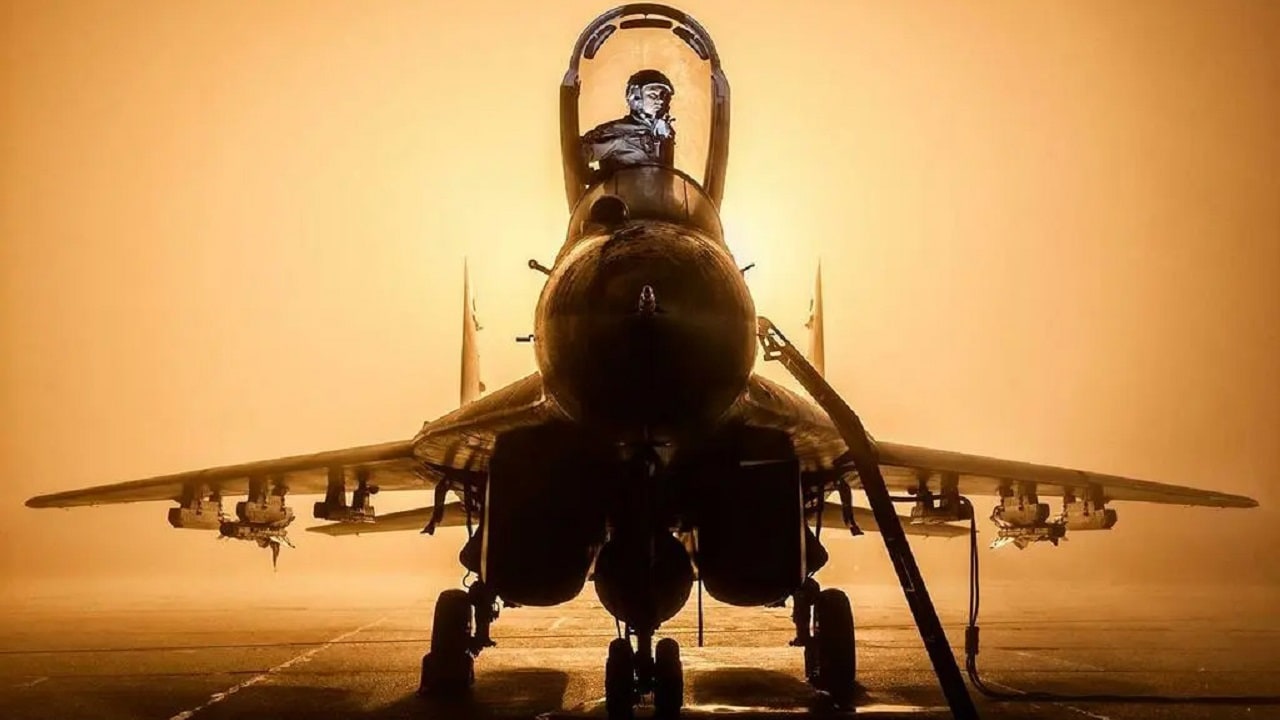
MiG-29 fighter. Image Credit: Creative Commons.
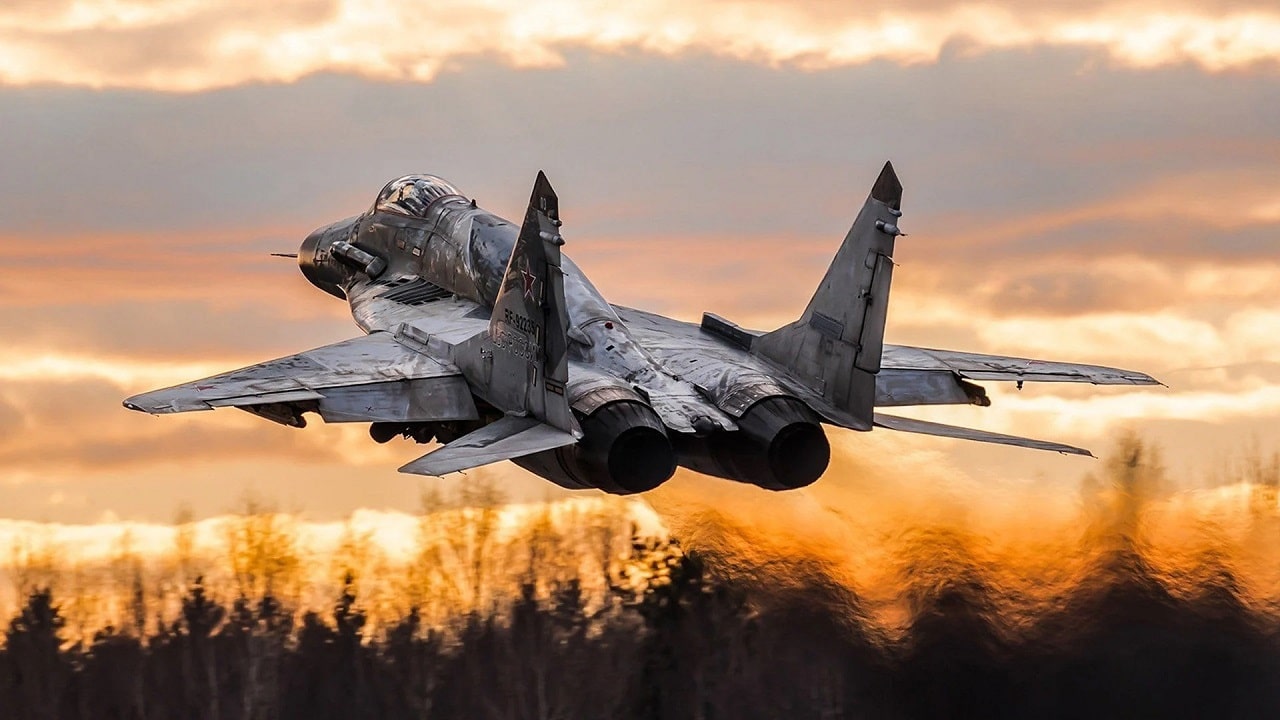
MiG-29 fighter jet. Image Credit: Creative Commons.
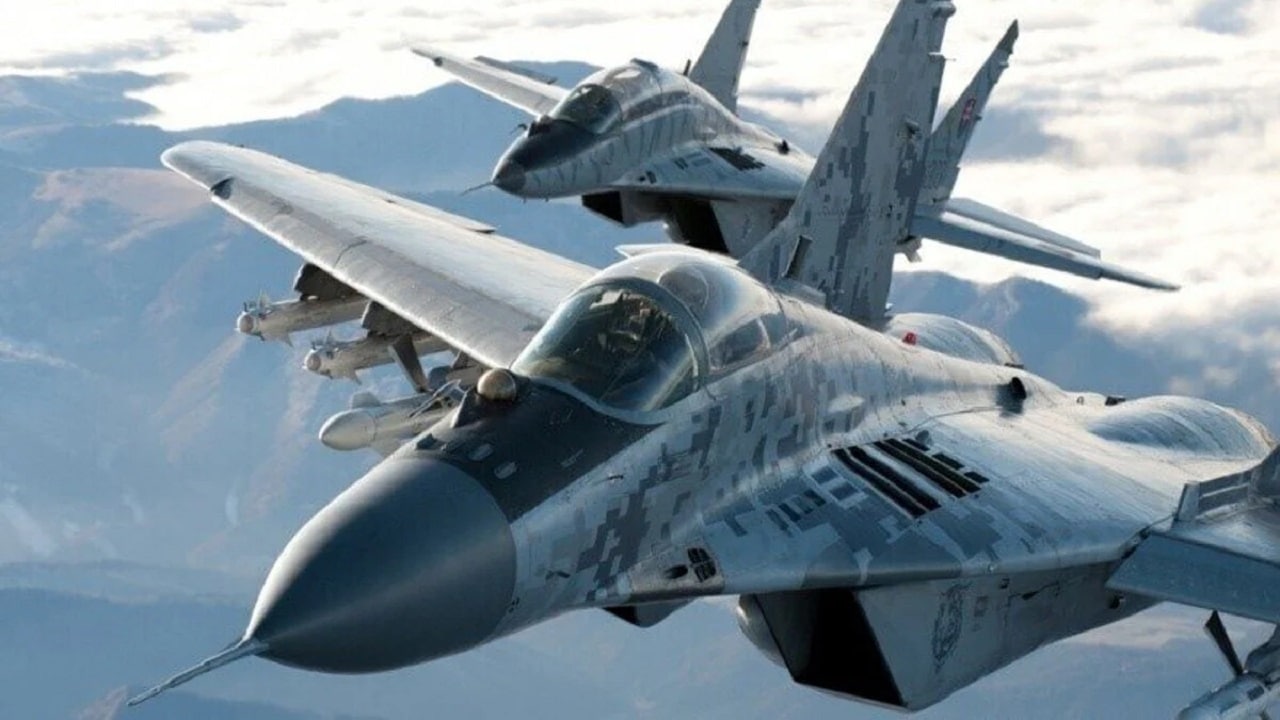
MiG-29. Image Credit: Creative Commons.
A prime category is jet fighters, as exemplified by the MiG-21 “Balalaika” (NATO reporting name “Fishbed”). Overlapping the second and third generation of fighter jets, the Fishbed debuted in 1959, had its heyday tangling with U.S.-made F-4 Phantom IIs during the Vietnam War, and was obsolescent by the 1991 Persian Gulf War. Still, the post-Warsaw Pact Romanian Air Force kept it in service until 2023, while the Indian Air Force didn’t finally retire it until last year.
Another outstanding Soviet aircraft is the fourth-generation MiG-29 “Fulcrum.” Making its maiden flight on October 6, 1977, in theory it was supposed to be the equal of the U.S.-made F-15 Eagle and F-16 Fighting Falcon. Yet in practice, it was totally dominated by the former in Desert Storm and by the latter (flown by U.S. Air Force and Royal Netherlands Air Force fighter jockeys) during 1999’s Operation Allied Force.
Yet the Fulcrum keeps soldiering on. The venerable old warbird continues to be upgraded, which makes one wonder whether it will have a lifespan equal to or exceeding that of the Fishbed.
MiG-29 Fulcrum Upgrade Example #1: India (with a Little Bit of Help from America)
The Indian Air Force (IAF) is among the leading users not only hanging on to the MiG-29, but doggedly upgrading it across the years.
The IAF adopted the MiG-29 in 1986, and as noted by Jay Menon for Aerospace Global News, “Over the years, the fleet has undergone significant enhancements through the MiG-29UPG programme, which added in-flight refuelling, new radar and electronic warfare systems, and compatibility with modern missile systems…However, with the platform’s certified life expectancy beginning to expire from 2025, India now aims to extend the airframe’s life into the 2030s. This life-extension effort comes at a critical time, as delays in the induction of next-generation fighters continue to strain fleet strength.”
If that ambitious life extension program indeed succeeds, the Indian Fulcrums will be at least quinquagenarians before they are done.
The centerpiece of the IAF MiG-29 upgrade is the High Speed Low Drag HSLD Mk-II precision-guided bomb, which has a strike range exceeding 180 kilometers, thus making the Fulcrum more versatile. Rather than a pure air-superiority fighter, it has true multirole capability, much like the F-15E Strike Eagle and its F-15EX successor, as well as the F-16 and the F-35. The HSLD is already used on the IAF’s Sukhoi Su-30MKI “Flanker-C” and its aging SEPECAT Jaguar fleet.
As one IAF official stated, “’Initially, 24 aircraft will be upgraded to deploy the HSLD Mk-II. This includes modifications such as custom-designed bomb racks, software-defined mission computers, and avionics integration; a tailored overhaul aimed at ensuring precision capability while preserving flight safety and agility.”
What’s more, despite India’s longtime reliance on Russian arms technology and the country’s strained relations with the United States since Donald Trump returned to office, there will be a U.S. company applying its knowhow to the MiG-29UPG program. On June 30, 2025, the Indian company Reliance Defence entered into a strategic partnership with Coastal Mechanics Inc. (CMI), a US Department of Defense-authorized contractor headquartered in Houston, Texas, to jointly address India’s military Maintenance, Repair, and Overhaul needs. The Fulcrum is among the key weapon systems covered in that new partnership.
MiG-29 Fulcrum Upgrade Example #2: Ukraine
Apocryphal urban legends about the Ghost of Kyiv notwithstanding, it still makes perfect sense that the Ukrainians are another prime example of a nation conducting a major upgrade of their Fulcrums, seeing as how their ongoing fight for survival against Russian autocrat Vladimir Putin’s “special operation in Ukraine” has raged on for nearly four years already.
Similar to what the IAF has done with the MiG-29UPG program, the Air Forces of the Armed Forces of Ukraine are looking to bolster their MiG-29s’ air-to-ground abilities. The Ukrainians call their improved variant the MiG-29MU2.
As Thomas Newdick of The War Zone elaborated in 2022: “The MiG-29MU2, however, differs from other Ukrainian MiG-29s in that it has a precision-guided munitions capability.
“In early 2020 a photo surfaced of a Ukrainian MiG-29 armed with a Kh-29T (AS-14 Kedge) TV-guided air-to-surface missile that was almost certainly related to the MiG-29MU2 upgrade.
“Later in 2020, a photo appeared showing a MiG-29 carrying another of the types of precision-guided munitions intended to be added under the MiG-29MU2, this time a pair of 500-kilogram (1,102-pound) KAB-500Kr TV-guided bombs.”
The Way Forward for the Fulcrum
According to MiGFlug, the MiG-29 has a highly unimpressive air-to-air kill ratio of 6:18— and two of those kills were against unarmed civilian aircraft during the Brothers to the Rescue incident over Cuba in February 1996. In fairness to the Fulcrum, however, MiGFlug hasn’t yet been updated to reflect on the kill tally attained during the Russia-Ukraine War.
In any event, time will tell if the latest MiG-29 upgrades enable the fighter to improve on its current numbers.
About the Author: Christian D. Orr, Defense Expert
Christian D. Orr is a Senior Defense Editor. He is a former Air Force Security Forces officer, Federal law enforcement officer, and private military contractor (with assignments worked in Iraq, the United Arab Emirates, Kosovo, Japan, Germany, and the Pentagon). Chris holds a B.A. in International Relations from the University of Southern California (USC) and an M.A. in Intelligence Studies (concentration in Terrorism Studies) from American Military University (AMU). He is also the author of the newly published book “Five Decades of a Fabulous Firearm: Celebrating the 50th Anniversary of the Beretta 92 Pistol Series.”