
M1E3 vs. T-90M: Why America’s Next Abrams Could Outclass Russia’s Best Tank
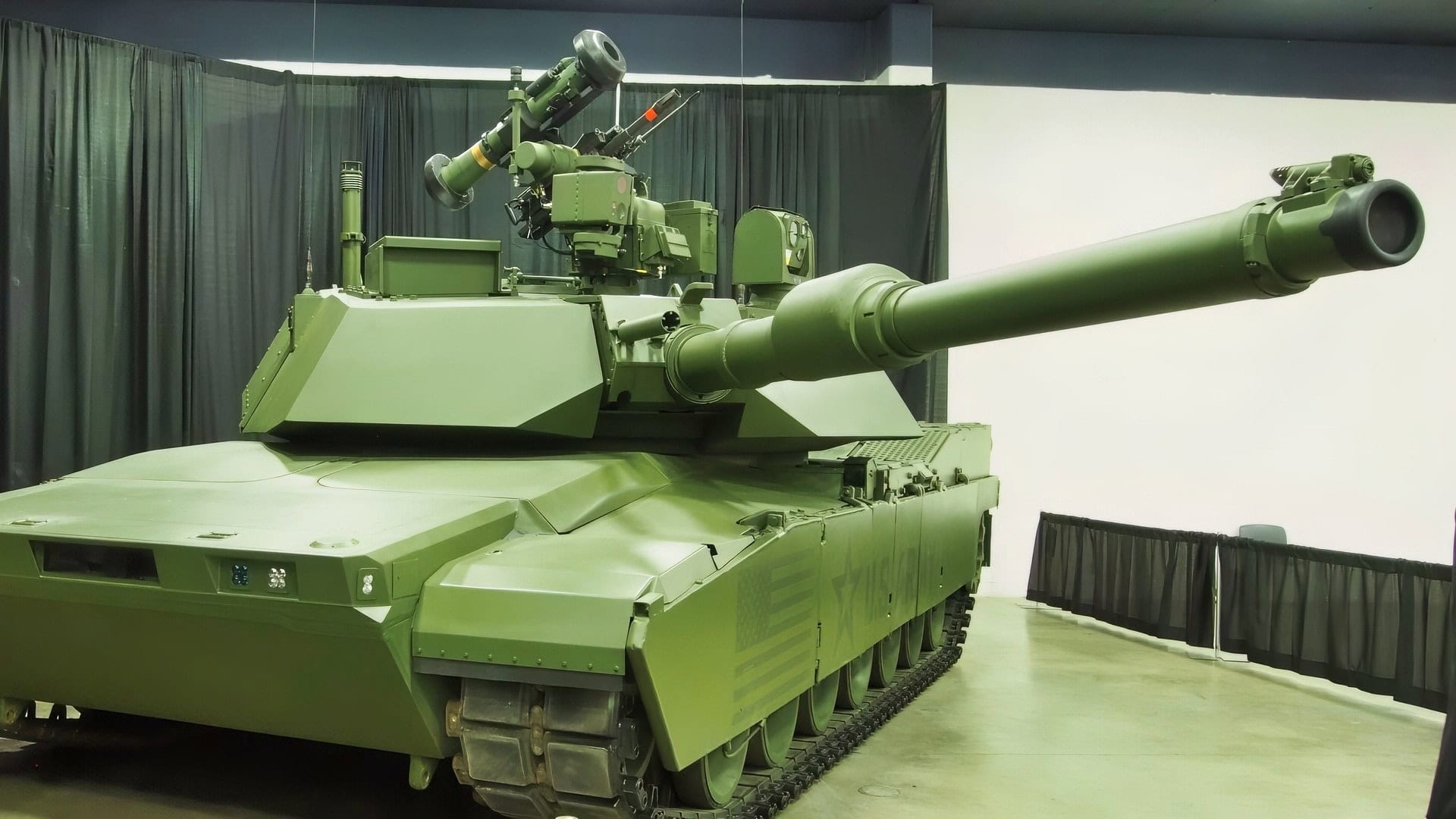
The M1E3 is currently in development to become the U.S.’ next generation main battle tank. This new tank is designed to remove some of the limitations of the Abrams line while also improving its survivability and digital systems. As the Army’s newest tank, the M1E3 will have to contend with some of the strongest tanks from Russia and China. Currently, the T-90M is the strongest tank that the Russians are currently fielding (excluding the T-14).
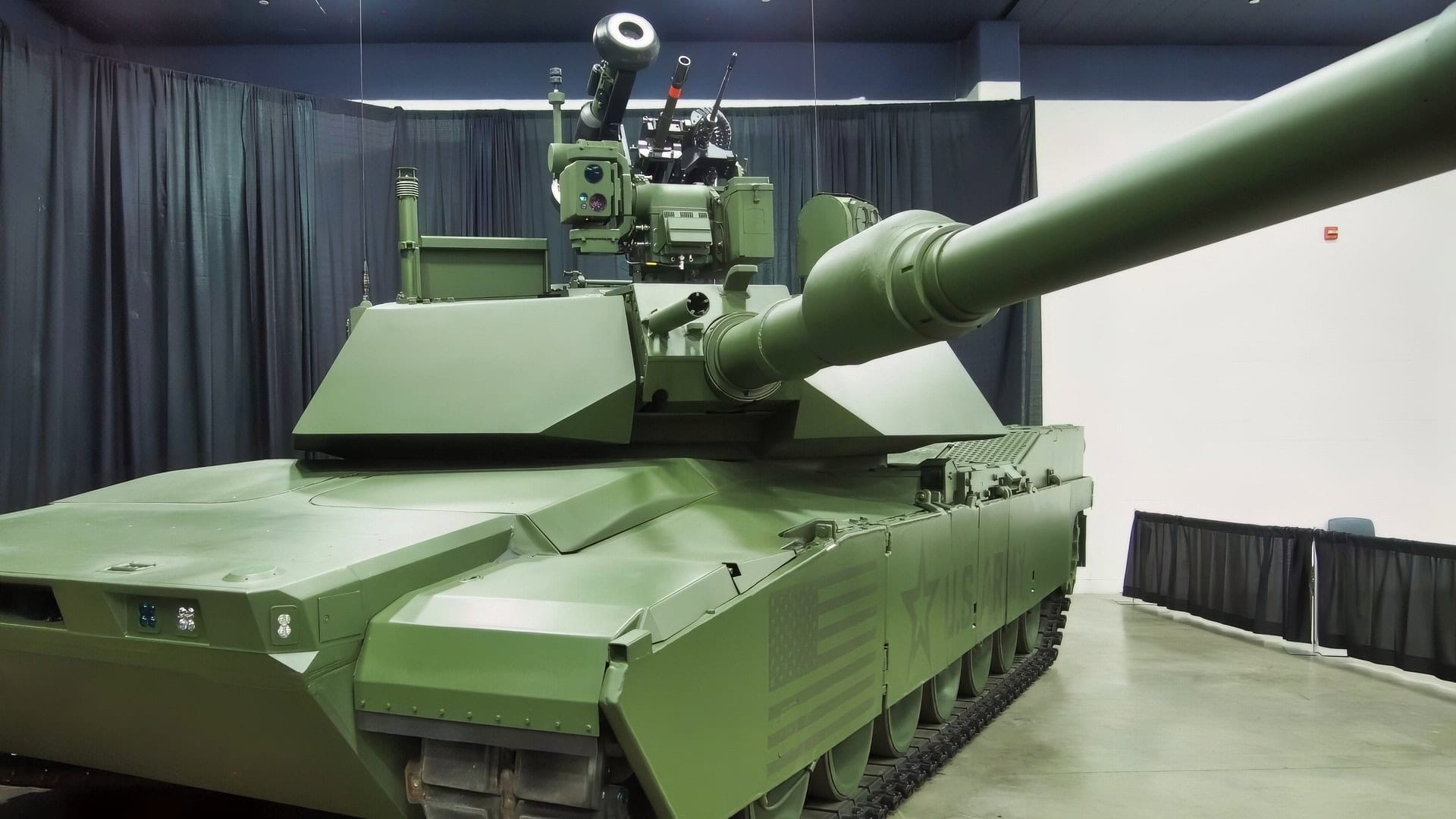
At the Detroit Auto Show, 19FortyFive visited the new M1E3 tank. Image Credit: 19FortyFive.com.
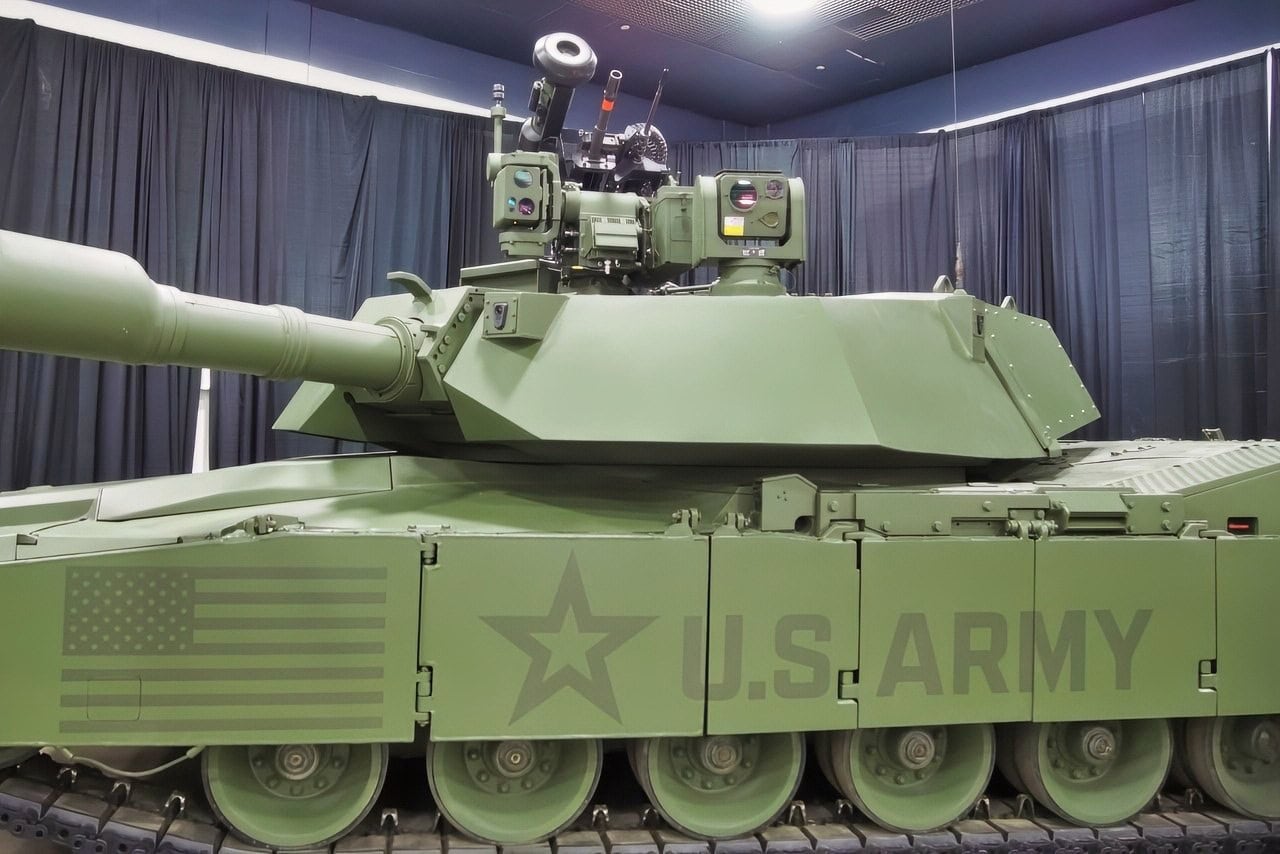
M1E3 from the Detroit Auto Show. Taken by 19FortyFive.com on 1/17/2026.
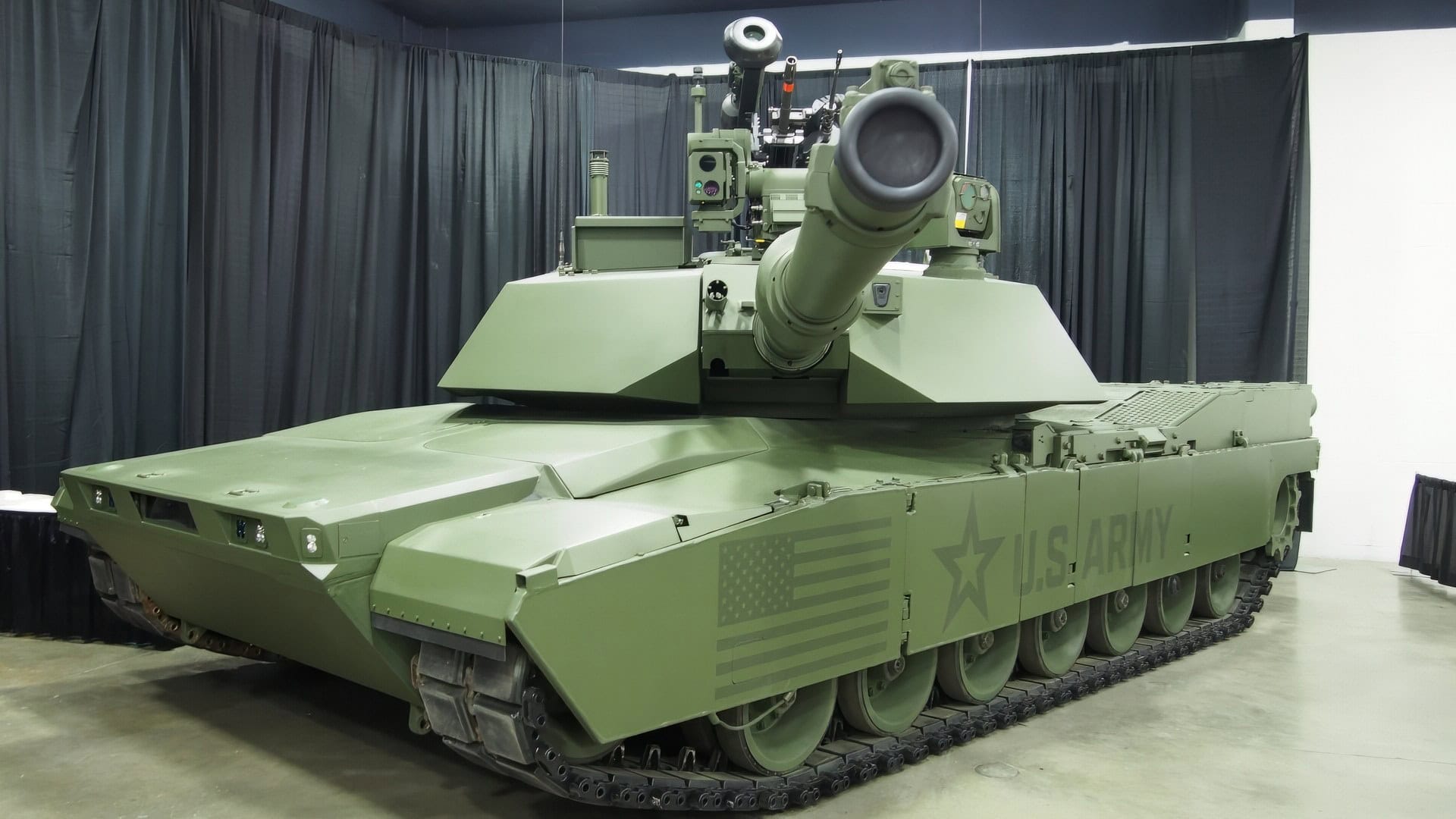
Photo taken on 1/17/2026 of the M1E3 Tank at the Detroit Auto Show. Image by 19FortyFive, All Rights Reserved.
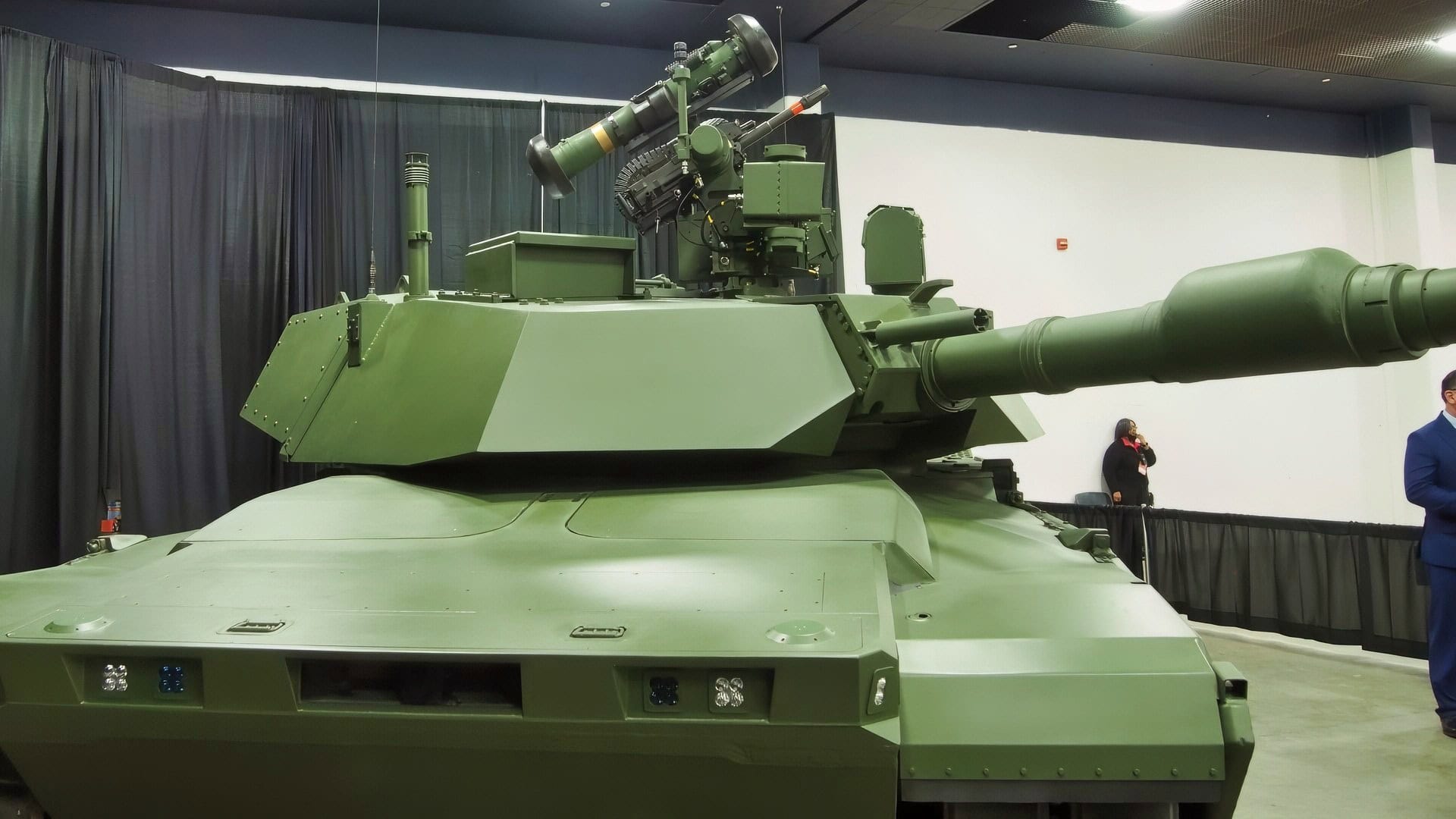
M1E3 Tank from the Detroit Auto Show. Photo Taken By 19FortyFive Staff on 1/17/2026.
The Russians have touted the T-90M as one of the world’s strongest tanks, but how well does it hold up against the M1E3?
Note: All M1E3 tank images come from a recent 19FortyFive visit with this platform at the Detroit Auto Show last weekend.
M1E3 vs. T-90: The Comparisions
On the American side, the Army completed the M1A2 SEPv4 path in 2023 and pivoted to a new engineering change proposal, designated M1E3.
The intent is not a cosmetic refresh but a lighter tank with a smaller logistical footprint, built around open systems architecture so sensors, software, and defenses can be swapped or upgraded quickly.
The Army publicly unveiled an early prototype in Detroit in January 2026, noting that soldier testing would begin in early spring 2026. The E3 is a response to lessons from Ukraine: integrate protections from the start rather than keep bolting on weight.
In other words, the E3 is meant to preserve Abrams-class lethality while rebalancing for a battlefield where survivability is as much about signatures, software, and counter-UAS as it is about sheer armor mass. Initial operational capability is not expected until the early 2030s, and the overall look of the tank is subject to change.
Russia’s T-90M takes the opposite route: evolutionary improvements to a fielded platform. It replaces the older cast turret with a welded design, layers Relikt explosive reactive armor across frontal arcs, and adds slat- and mesh-based protection in vulnerable sectors.
The 125 mm 2A46M-5 smoothbore, stabilized with an automatic loader, can fire conventional APFSDS/HEAT/HE ammunition as well as the 9M119M “Refleks” gun-launched ATGM out to about five kilometers. Power comes from the 1,130 hp V-92S2F diesel, keeping the combat weight in the high-40-ton class, which is light by Western standards, with the traditional Russian emphasis on compact, lower-profile hulls that are easier to bridge and transport.
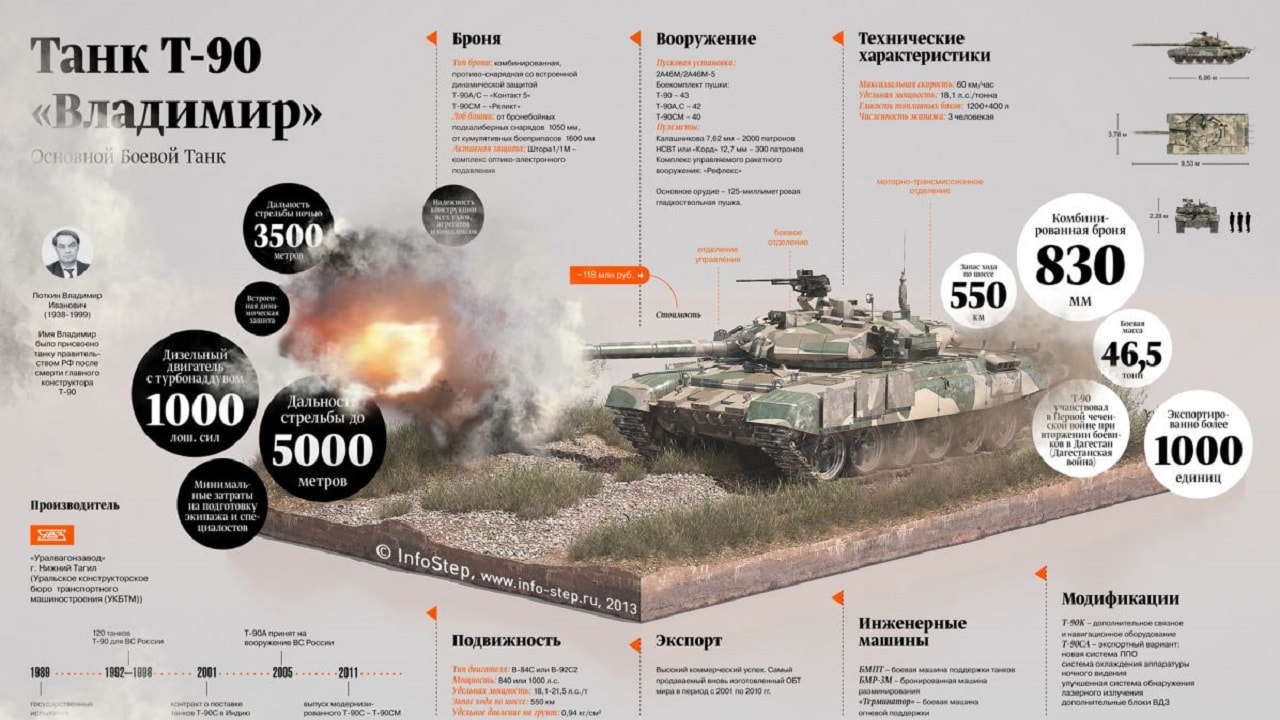
T-90 tank diagram. Image Credit: Creative Commons.
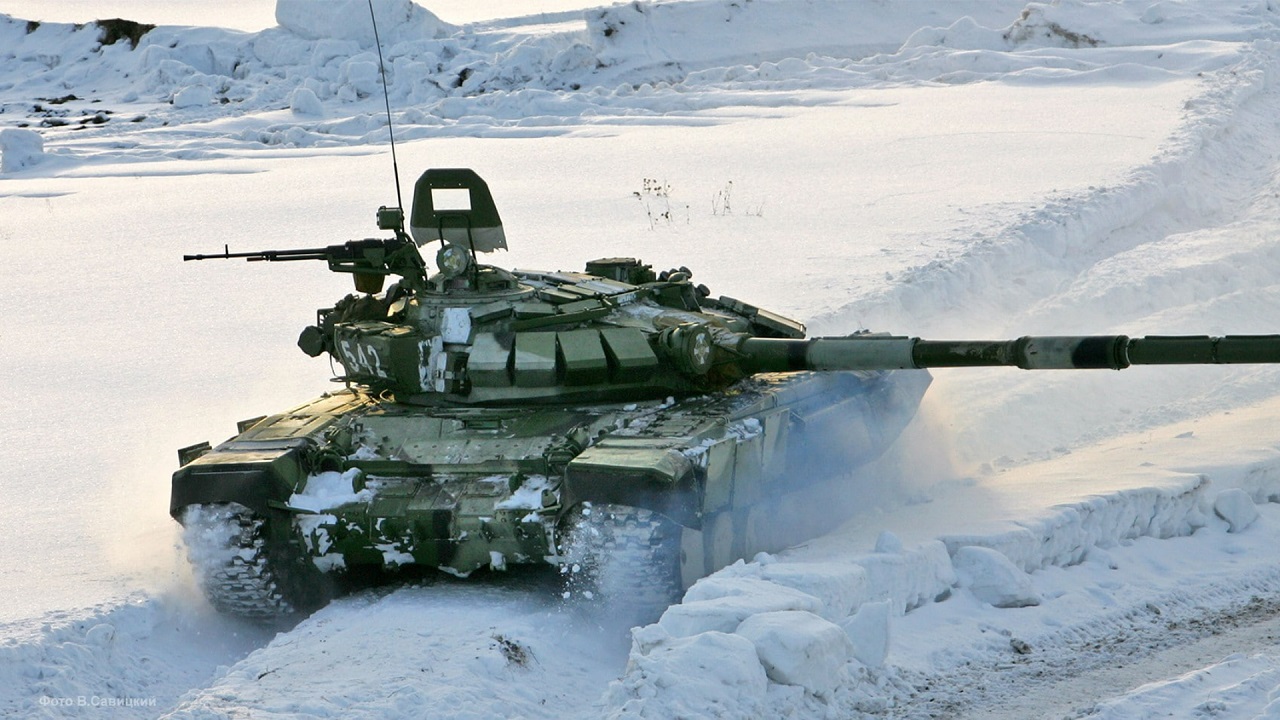
T-90 tank in the snow. Image Credit: Creative Commons.
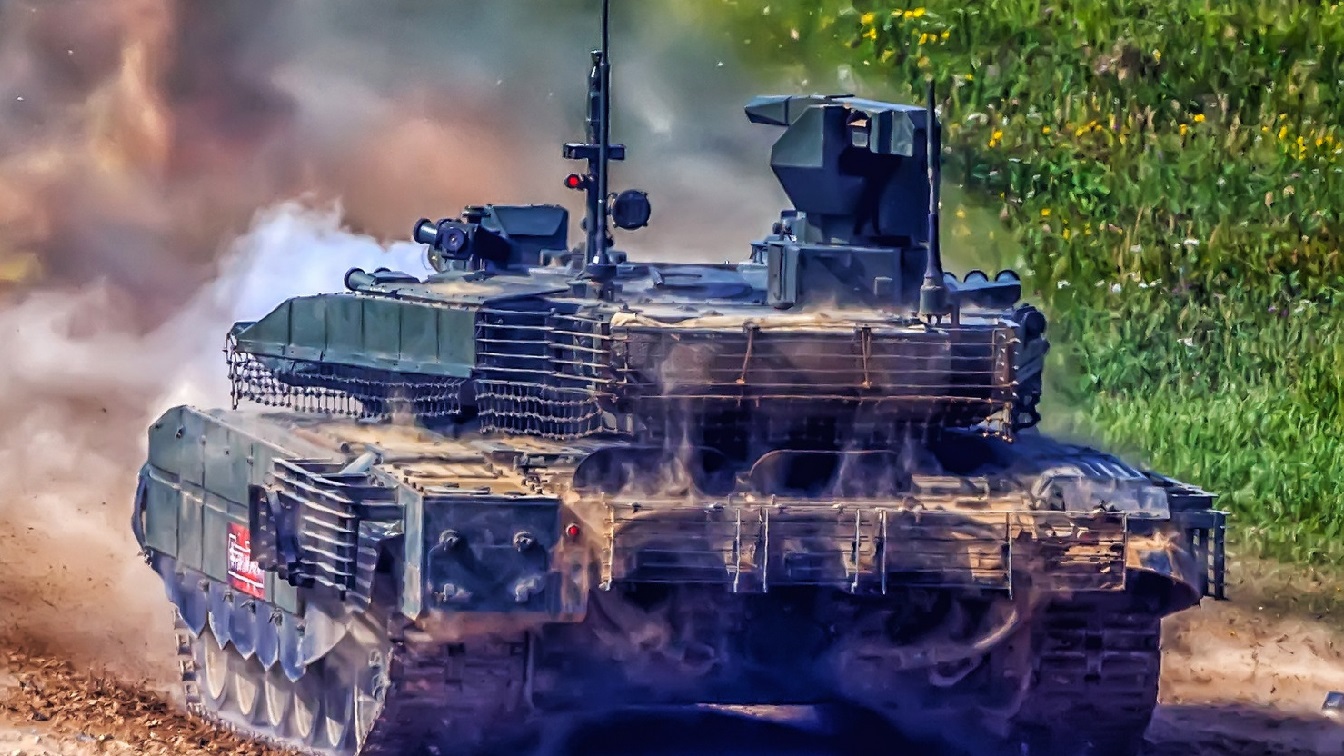
T-90M. Image Credit: Creative Commons.
Most importantly, the “Kalina” fire-control system and Sosna-U thermal sight give the T-90M the hunter-killer workflow and night-fighting competence missing from many earlier Russian tanks. The result is a tank that is far more credible than the late-Cold-War T-72.
Survivability is the first of many areas where the M1E3 and the T-90M diverge significantly. The Abrams series was already praised for its thick armor and high levels of survivability, and the M1E3 promises to take this even further.
The turret is completely unmanned, with all the ammo stored in an isolated compartment. Much like Russia’s T-14, the crew is in an armored capsule that is heavily protected and safe from any potential ammunition cook-offs. The tank will also reportedly integrate active and passive protection systems to increase its survivability against drones and anti-tank missiles.
The T-90M, on the other hand, retains the same layout as past soviet tanks, but with a few measures implemented to increase survivability.
The tank mitigates some risk by moving part of its excess ammunition to a turret bustle (which the Soviets found was responsible for most disastrous detonations in the T-72), but its autoloader still holds 22 rounds in a carousel under the turret floor. The carrousel autoloader is a simple and reliable system, but it creates a huge safety hazard for the crew, as any ammunition cook-off can kill the crew instantly.
The T-90M can be fitted with the Arena-M APS, along with a number of laser warning systems, to increase situational awareness and safety. These measures put the T-90M head and shoulders above older Soviet tanks, but still nowhere near the survivability offered by the M1A3.
Mobility and sustainment show a similar fork in the road. The U.S. Army’s complaint about the SEPv4 path was not that Abrams lacked combat punch, but that every incremental add-on pushed weight higher and logistics into the red.
M1E3 therefore puts weight reduction and a smaller sustainment profile at the center, with open-architecture electronics to simplify maintenance and tech refresh. In terms of propulsion, the M1E3 uses a hybrid diesel-electric power plant, which reduces the tank’s fuel requirements and makes it more efficient overall, thus lowering maintenance and sustainment costs.
The T-90M is slower than the typical Abrams (the M1E3’s top speed is unknown), but the tank’s lighter weight does give it a few advantages in the realm of logistics. The T-90M is equipped with a V-92S2F diesel engine with an output of around 1130 hp.
Like its Soviet predecessors, the T-90 was built with a smaller profile to make it harder to spot on the battlefield (which is no longer a relevant advantage in the age of thermal sights) and much easier to transport over railways. The T-90M also retains the gearbox from the older T-72 family, which means its maneuverability is overall lower than that of more modern Western tanks, and it still retains the pathetic reverse speed inherent in Soviet designs.
Who Wins in Three Words: M1E3 Clearly Wins
With all this in mind, it is clear which tank is better. While I am of the opinion that the T-90M is a good tank overall, it is nowhere near the level of a base M1 Abrams, let alone the M1E3. The only definitive advantage the T-90M has over the M1E3 is its simpler, cheaper design, which makes it much easier to mass-produce.
While estimates range widely, even conservative figures from Western analysts suggest that Russian factories can produce hundreds of T-90Ms per year, more than the U.S. currently produces.
Is this advantage enough to make up for the T-90’s numerous other shortcomings?
Perhaps not.
About the Author: Isaac Seitz
Isaac Seitz, a Defense Columnist, graduated from Patrick Henry College’s Strategic Intelligence and National Security program. He has also studied Russian at Middlebury Language Schools and has worked as an intelligence Analyst in the private sector.