
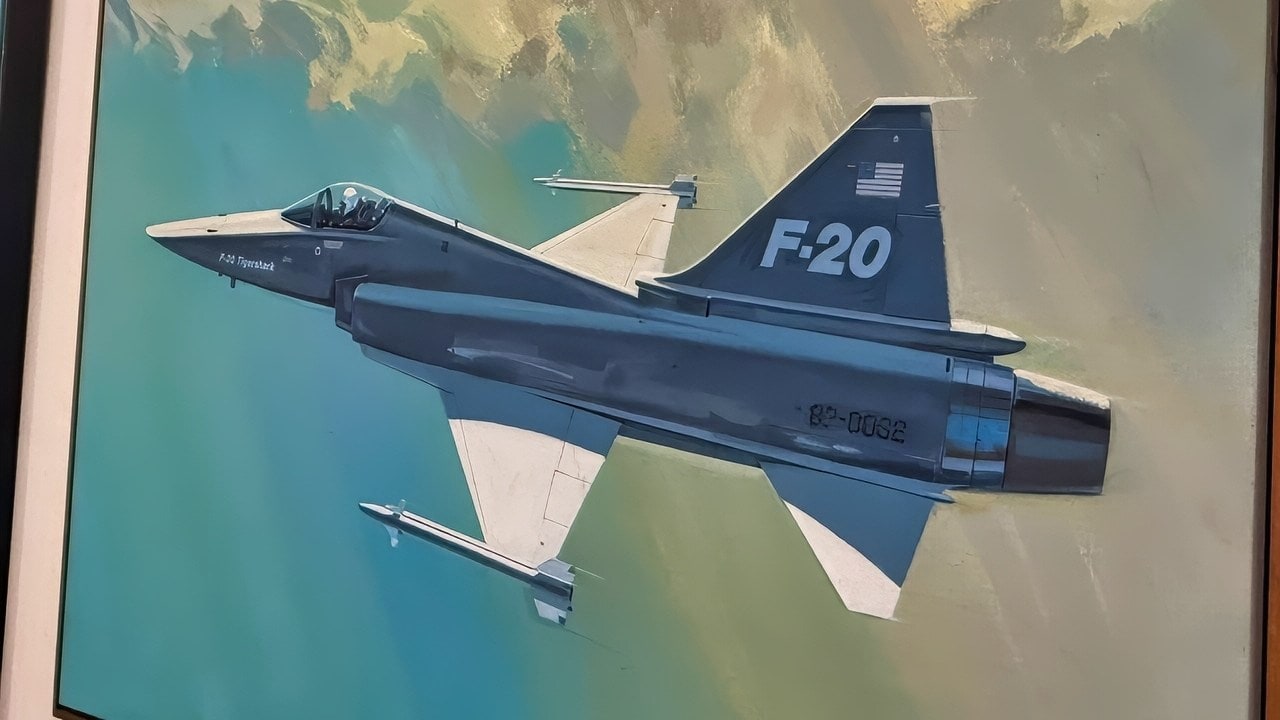
Summary and Key Points: Chuck Yeager reportedly loved the F-20 Tigershark, a privately funded Northrop upgrade of the F-5E that aimed to dominate the export market.
-First launched as the F-5G in 1975, it promised Mach 2.1 performance, improved engines, beyond-visual-range potential, and straightforward maintenance—ideal for partners seeking capability without top-tier complexity.

F-20 Tigershark Model at Western Museum of Flight. Image by Harry J. Kazianis/19FortyFive.com Image.
-But the program collided with politics and procurement reality as Washington prioritized the F-16 and limited Taiwan-related options.
-Two fatal crashes, tied to pilot loss of consciousness during high-G maneuvers, compounded uncertainty. In the end, the Tigershark became a “right aircraft, wrong time” story.
The Mach 2.1 F-20 Tigershark Was Built for Exports—Then Politics Killed It
Chuck Yeager, the famed pilot who broke the sound barrier, once had a favorite airplane to fly in the mid-1970s. This was known as the F-20 Tigershark, but it never made it past the “death valley” of defense acquisition, despite having fans like Yeager. The F-20 did not enter serial production and was privately funded, so the government never took a loss. The F-20 was an interesting and historical warbird that later flew as a “bandit” red team airplane in the Hollywood blockbuster Top Gun.
It Could Have Made the Air Forces in Several Countries Happy
The Tigershark program dates back to 1975. Its official designation was then the F-5G, a further development of the fighter known as the Northrop F-5E Tiger II.
Northrop had high hopes for the F-20 since the F-5E was a hit on the export market. Brazil, Ethiopia, Switzerland, South Korea, and Taiwan valued the F-5E’s low price and high performance.
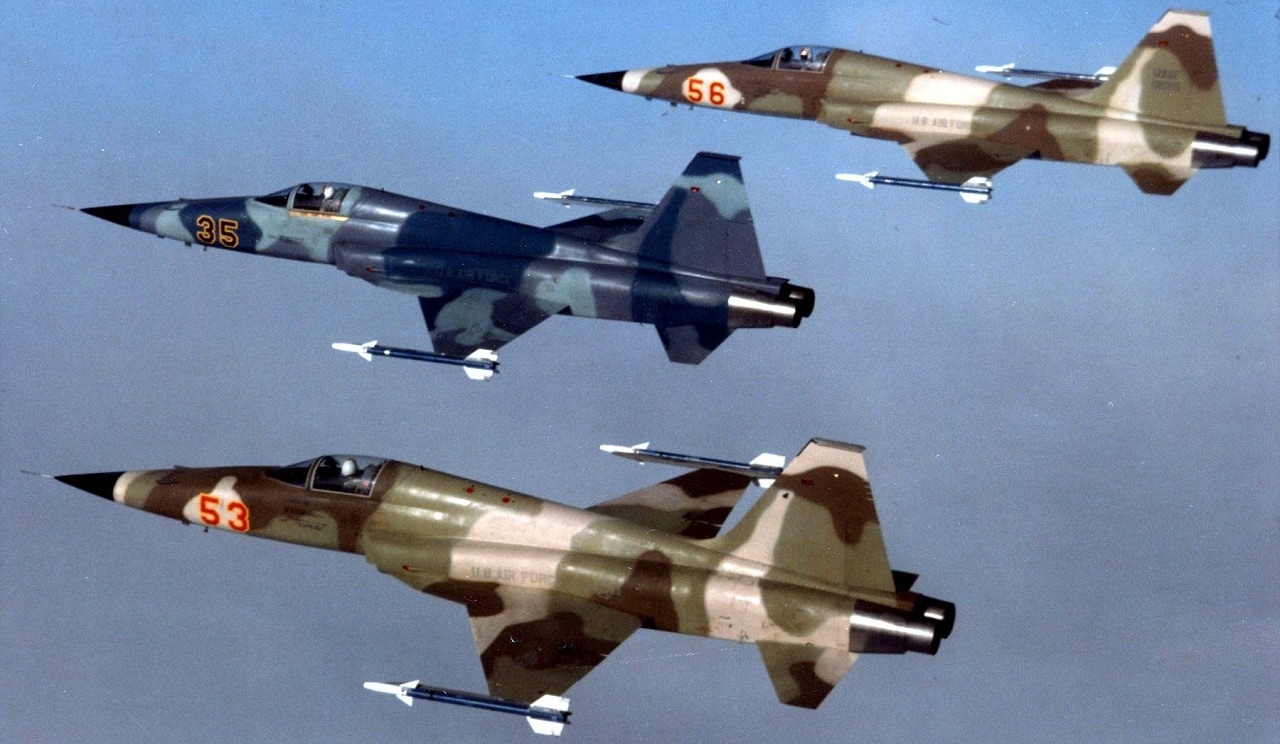
F-5. Image Credit: Creative Commons.
President Jimmy Carter’s national security team believed the F-20 would be especially popular in Taiwan, which was always concerned about Chinese aggression.
The Tigershark was not stealthy, and there were no radar-evading innovations that could fall into the Soviet Union’s hands. This effort became known as the “FX” program.
The Technology Was Advanced for the Times
“The Northrup decision to build the Tigershark was a reasonable one. Two lines of argument stood out in support of a new F-5 type fighter. The first was that a new plane was needed to service the still-viable F-5 market. Secondly, it was argued that the emergence of new technologies underlined the need for a more advanced aircraft. The Tigershark was designed to meet these needs,” according to an analysis by the RAND Corporation.
Sleek Design Gave the Airplane a “Wow” Factor
Northrop designers were inspired by the “transonic area rule” to reduce drag and increase lift at supersonic speeds, a new and thoroughly engineered aspect of flight for the era. The F-20 also had a newfangled “wasp waist.”
The best move by technicians was to install a different engine that would be even more powerful than the Tiger II’s powerplant.
This could reach a top speed of MACH 2.1. Yeager fell in love with the new speedy airplane. The F-20 could potentially fire weapons beyond visual range, which was another selling point.
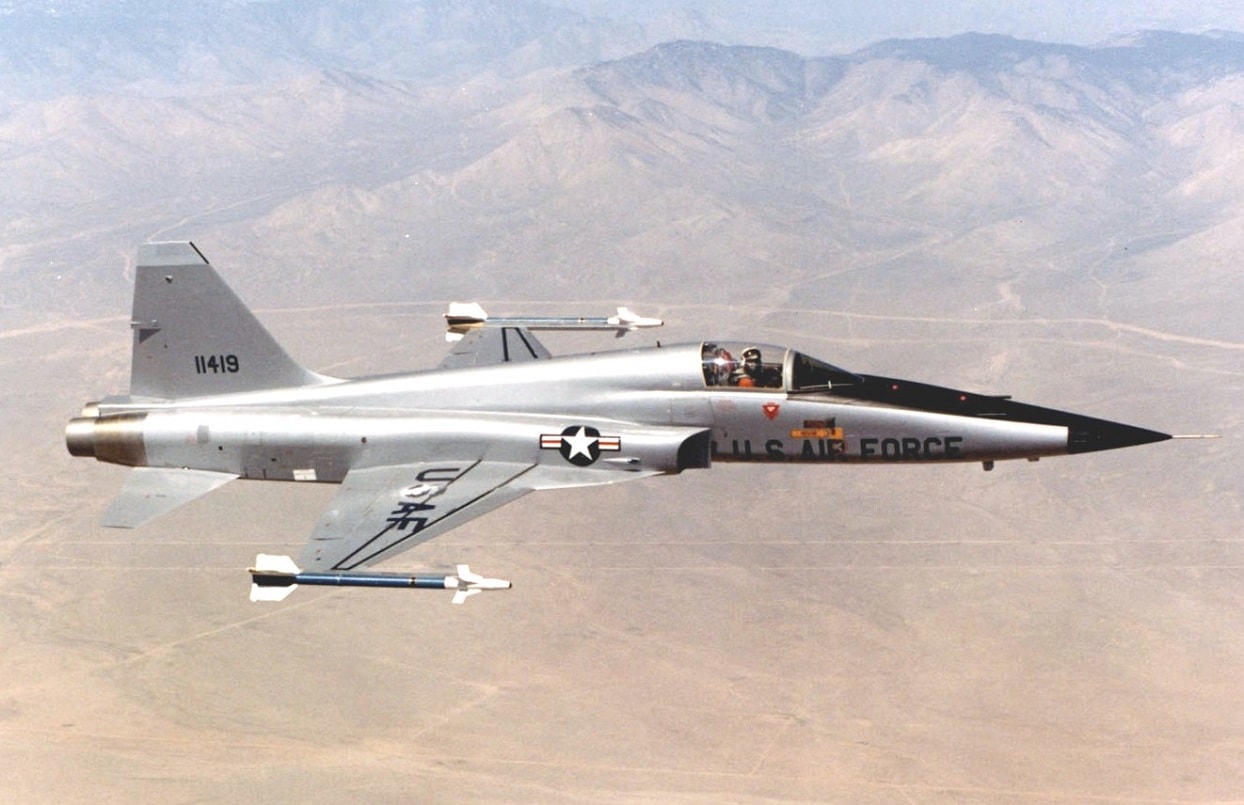
F-5: Image: Creative Commons.
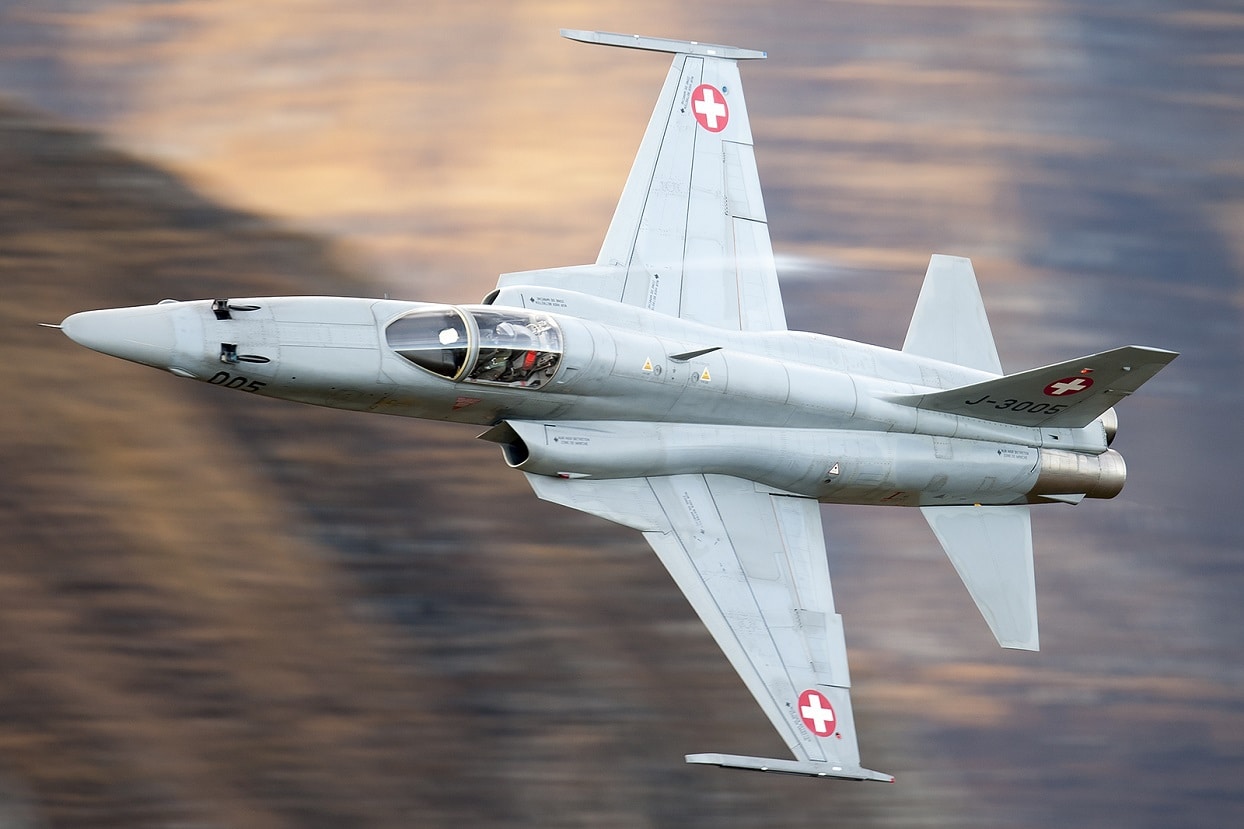
F-5 fighter, or, better known as the MiG-28 in Top Gun. Image: Creative Commons.
The Tigershark was armed with two Pontiac M39A2 20mm autocannons. Four AIM-9 Sidewinder air-to-air missiles adorned its wingtips.
Pilot-Friendly Tigershark Got Off to a Great Start
By 1982, the F-20 was ready to rip, and test pilots salivated. The first flight of the Tigershark lasted 40 minutes and achieved an altitude of 40,000 feet over Edwards Air Force Base in California. Designers and engineers thought the F-20 could be another F-16 Fighting Falcon, but especially designed for foreign military sales. The F-20 was going to be more cost-effective and easier to fly than the F-16.
However, the F-20 languished with the Americans due to the Reagan administration, which was not enamored of the new airplane. There was an agreement with China, signed in 1982, that curtailed the sale of new fighter jets to Taiwan.
Taipei was disappointed and desperately wanted the Tigershark. Reagan’s Department of Defense preferred that the Air Force focus on the F-16 instead, as each new F-16 build reduced the unit price at the margins. The F-20 needed to find a new customer, or the project would be cancelled.
Then Tragedy Struck
Unfortunately, the F-20 program had further disappointments.
There were two crashes. In 1984, at an air show in South Korea, tragedy struck when an aviator went down. The pilot was killed. Then a test flight in Canada went awry, and another pilot died.
Investigations revealed no mechanical failures; the pilots lost consciousness during high-G maneuvers.
The F-20′ Tried to Do Too Many Things’
Aviation writer Robert F. Dorr summed it up nicely. “The F-20A Tigershark was fast, maneuverable, lethal, easy to fly, and easy to maintain. But Northrop was never truly able to compete with the F-16 on cost, and the Tigershark ultimately failed because it tried to be too many things. Too heavy to be a lightweight, lacking the stealth properties then being developed in super-secret ‘black’ programs, the F-20A was also too light to be a robust, globe-girdling warplane like the F-15E Strike Eagle.It was an outstanding fighter, but in the end, the Northrop F-20A Tigershark was the right aircraft at the wrong time.”
The Tigershark Did Not Check the ‘Lucky’ Box
Too bad for such an airplane that had dynamic potential. Sometimes new airplanes are unlucky. Engineers and designers did their jobs well, but politics and testing woes doomed the program.
The F-20 was unable to compete with the F-16, and international sales efforts did not go according to plan.
We’ll never know if the Tigershark could have performed well for Taiwan and other countries.
The lack of stealthiness was one of the program’s most significant problems.
The airplane responded well to daring pilots at the controls, but it just did not have enough momentum after Reagan was elected.
A “new broom sweeps clean,” and the F-20 Tigershark could not compete in the 1980s, as the F-16 eclipsed it.
About the Author: Brent M. Eastwood
Author of now over 3,000 articles on defense issues, Brent M. Eastwood, PhD is the author of Don’t Turn Your Back On the World: a Conservative Foreign Policy and Humans, Machines, and Data: Future Trends in Warfare plus two other books. Brent was the founder and CEO of a tech firm that predicted world events using artificial intelligence. He served as a legislative fellow for US Senator Tim Scott and advised the senator on defense and foreign policy issues. He has taught at American University, George Washington University, and George Mason University. Brent is a former US Army Infantry officer. He can be followed on X @BMEastwood.