
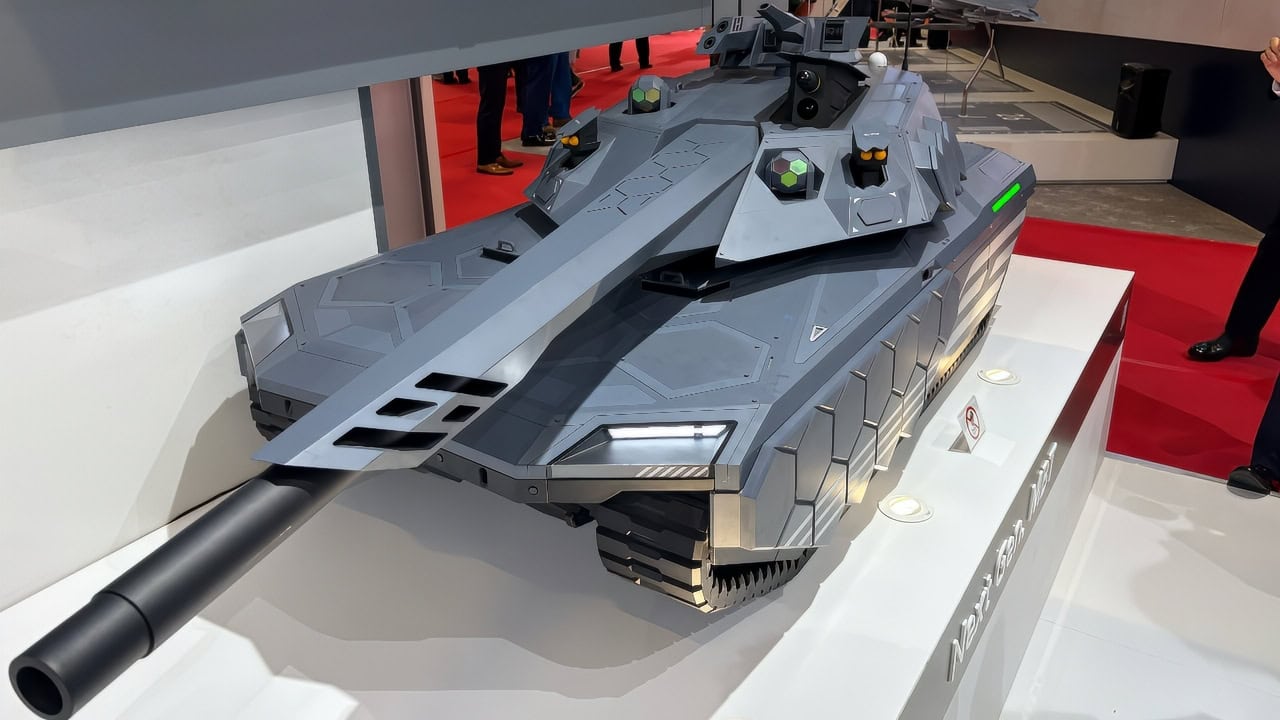
Key Points and Summary – South Korea’s Hyundai Rotem is developing the K3, a “sixth-generation” main battle tank concept that breaks from traditional design with a revolutionary hydrogen fuel-cell propulsion system.
-Aiming to leapfrog Western models like the M1 Abrams and Leopard 2, the K3 features stealthy hybrid-electric drive, AI-assisted fire control, and integrated drone swarms, all while weighing significantly less than its predecessors.
-This radical shift prioritizes silence, sensor integration, and mobility over raw armor, potentially redefining armored warfare for the 21st century and cementing South Korea as a global leader in defense innovation.
Inside South Korea’s ‘Radical’ K3 Tank Concept That Could Change War
Main battle tanks (MBTs) have developed through the years, becoming a key part of warfare that serves as the backbone of modern ground forces, combining heavy firepower, thick armor, and mobility to lead assaults, destroy enemy defenses, and provide protected, direct fire support for infantry, enabling offensive breakthroughs and decisive engagement in complex, multi-threat environments.
They function as versatile, frontline vehicles, overwhelming threats with their powerful main guns while their advanced protection counters anti-tank missiles, mines, and CBRN hazards; rarely operating alone, they always rely on coordinated support from infantry, air, and other vehicles.
The Republic of Korea (ROK) is well known for its outstanding tank design. Korea’s K2 Black Panther is an outstanding MBT and is used by the ROK Army and the Polish Land Forces. And their newest concept is a massive leap in tank development.
Meet The Hydrogen-Powered K3, South Korean Stealth Tank
South Korea’s K3 is a conceptual, next-generation hydrogen-powered stealth tank under development by Hyundai Rotem.
The K3 features a silent hybrid powertrain, an unmanned turret with a 130mm gun, AI integration, and a stealthy design resembling the B-21 bomber, aiming for dramatically reduced noise/heat signatures for future warfare, with production targeted for around 2040.
The K3 represents a significant leap, moving beyond traditional tank design with its focus on stealth, sustainability (hydrogen), and integration of AI and unmanned systems, potentially redefining future armored warfare.
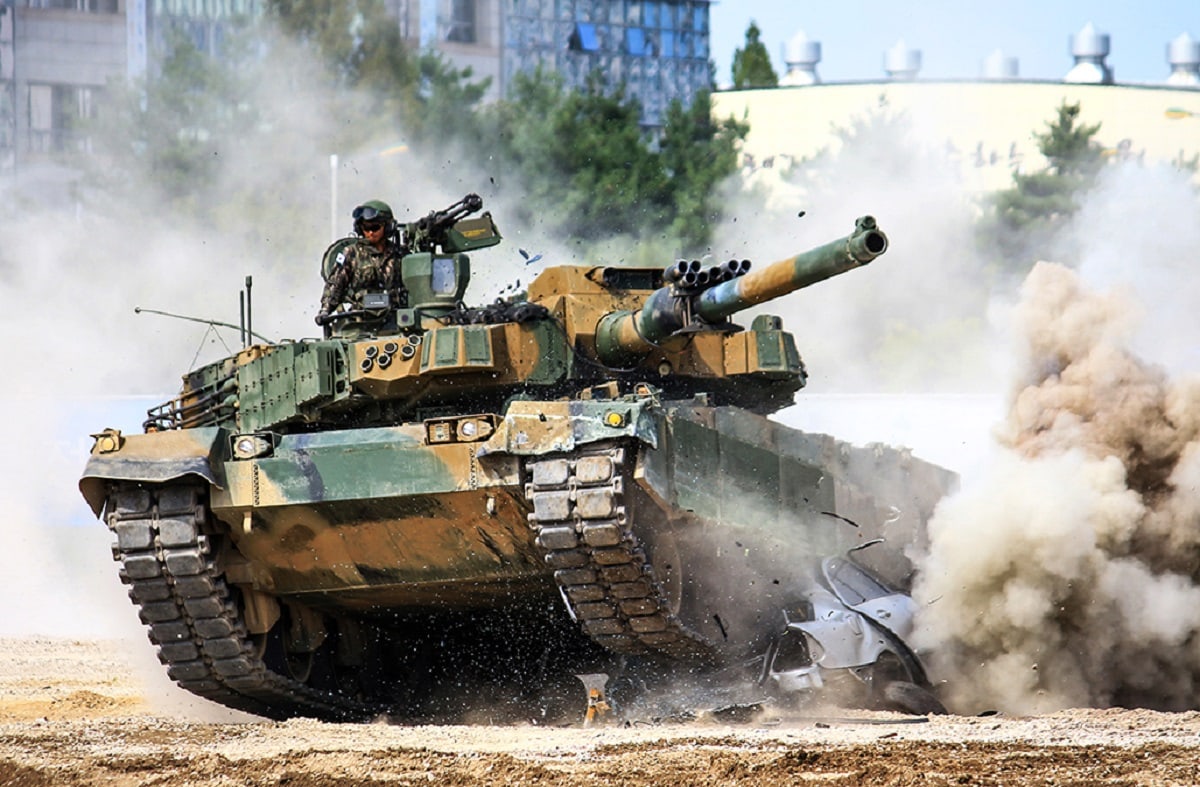
K2 Black Panther. Image: Creative Commons.
“Next-generation main battle tank surpasses all capabilities of today’s MBTs, providing more efficient mission employment with the latest technologies for future warfare. As battlefield conditions change, more changes are required to MBT’s firepower, command and control, and survivability to be more optimized and to create maximum combat synergy,” Hyundai Rotem posted on its website.
Hyundai Rotem and the Agency for Defense Development (ADD) are developing the K3, replacing the outstanding Black Panther with a very ambitious design featuring full-hydrogen fuel-cell propulsion, significantly reduced acoustic and thermal signatures, and a hull/turret profile with blended surfaces that resemble the B-21 Raider stealth bomber.
The K3 Is Designed For The Modern, Drone/Sensor Battlefield
The tank’s concept model appears like something from a futuristic video game. The armor has smoother slopes, far fewer protrusions, and flush panels, giving it a stealth-like appearance akin to a fighter aircraft rather than a traditional tank.
The interior is being designed to accommodate a crew of three within a “capsule-type” compartment that provides additional protection from enemy fire. A wide range of sensors and cameras, including virtual reality, will provide the crew inside the capsule with a 360-degree view of the tank’s surroundings.
The turret is unmanned and will house a 130mm smoothbore main gun; it offers a significant increase in penetrating power over the current 120mm used by NATO forces. This new main gun aligns with Germany’s Rheinmetall 130mm main tank gun.
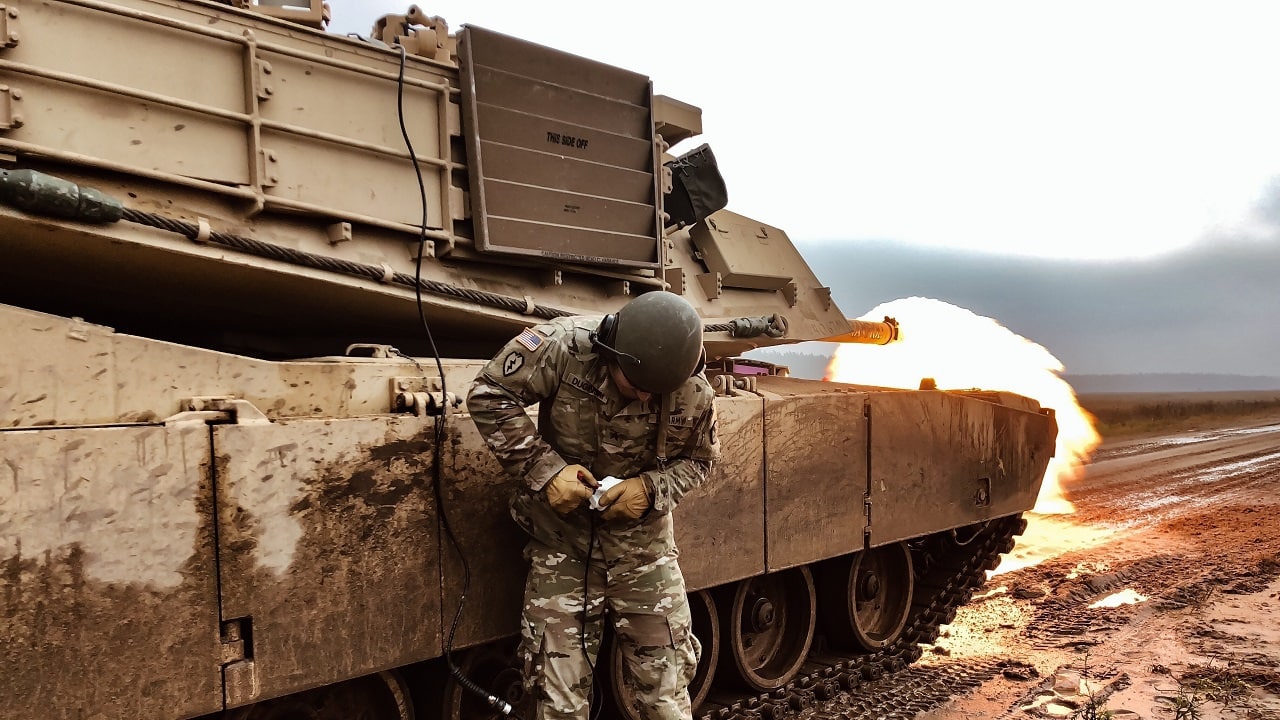
U.S. Army Sgt. Ryan Duginski, M1 Abrams Tank Master Gunner, assigned to Battle Group Poland, performs a tank remote-fire procedure to ensure firing capabilities function properly at Bemowo Piskie Training Area, Poland, Nov. 6. (Photos by U.S. Army 1LT Christina Shoptaw)
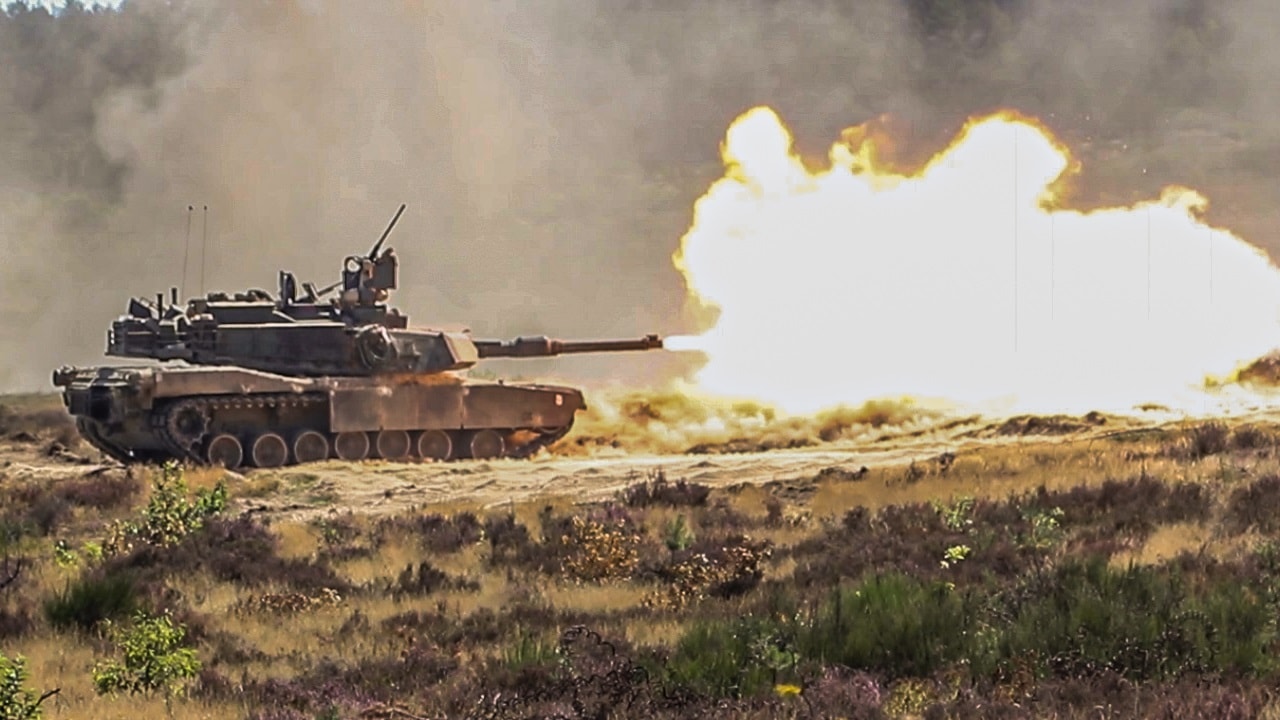
U.S. Army M1 Abrams Main Battle Tank variation fires at a target at Bucierz Range at Drawsko Pomorskie Training Area, Poland, August 11, 2020. DEFENDER-Europe 20 was designed as a deployment exercise to build strategic readiness in support of the U.S. National Defense Strategy and NATO deterrence objectives. In response to COVID-19, DEFENDER-Europe 20 was modified in size and scope. Phase I of the modified DEFENDER-Europe 20 was linked to exercise Allied Spirit, which took place at Drawsko Pomorskie Training Area, Poland, June 5-19 with approximately 6,000 U.S. and Polish Soldiers. In phase II of the modified DEFENDER-Europe 20, a U.S.-based combined arms battalion will conduct an emergency Deployment Readiness Exercise to Europe July 14-Aug. 22.
It is designed to employ next-generation kinetic energy penetrators and high-explosive rounds. The autoloader in the unmanned turret has a 3.5-second reload time.
The armor will consist of steel, ceramics, and composite material, protecting it from tank and armor-piercing ammunition. The K3 will be equipped with a Directional Infrared Countermeasures (DIRCM) and an Active-Protection System (APS) to counter a variety of heat-seeking and other top-attack threats. It will also feature drone jamming technology.
The tank will be able to launch its own multirole reconnaissance drones from the rear of the turret. This allows the tank to conduct its own battlefield reconnaissance and adapt more effectively to circumstances.
Revolutionary Hydrogen-Powered System
The K3 will feature a revolutionary hydrogen-powered drive train. The tank’s hydrogen fuel cells will replace the K-series diesel engines.
This will be accomplished in increments, with the prototypes featuring hybrid hydrogen and diesel engines. South Korea is transitioning its tanks away from combustion engines.
According to Hyundai Rotem, the hydrogen systems will offer reduced acoustic noise, lower thermal output (due to the exhaust being primarily water), and potentially improved fuel efficiency and mobility. With fewer moving parts, it promises easier maintenance and better cross-country performance.
Drawbacks to the Hydrogen Fuel Cells
The K3 tank’s hydrogen power does, however, have drawbacks such as low storage density (requiring large, pressurized tanks), significant gaps in refueling/production infrastructure, high costs for green hydrogen, and logistical challenges for wartime fuel supply, despite potential signature-reduction benefits (less heat/noise).
Hydrogen’s extreme flammability and the need for complex, expensive high-pressure storage systems add layers of difficulty, though its rapid dissipation might mitigate explosion risks compared to liquid fuels.
The South Korean supply chain will have to change dramatically. Their fuel trucks must be specialized. Hydrogen is more expensive than fossil fuels if produced with renewable energy.
We won’t really know how successful this concept is until the South Koreans build some prototypes and begin testing. The benefits will include much cooler exhaust and a quieter powertrain, reducing IR and acoustic detectability. When adversaries use thermal imaging, acoustic sensors, and ISR platforms, this will more than prove its worth.
VPK posted an interesting take on hydrogen fuel cells.
“It is worth saying a few words in defense of the main change in the tank’s power plant, namely, the replacement of the diesel internal combustion engine with an electric one with hydrogen fuel cells. The fact is that these fuel cells may not necessarily be built only on pure hydrogen.
“Fuel cells work perfectly on all liquid carbon and hydrogen compounds. They can use kerosene, gasoline, diesel fuel, but what is even more interesting – even ordinary alcohols, including methanol and ethanol, or carbohydrates, for example, glucose or fructose. In short, a tank that asks you to pour a solution of sugar or alcohol into the fuel neck is much more real than a tank running on inconvenient, expensive, and dangerous hydrogen.”
About the Author: Steve Balestrieri
Steve Balestrieri is a National Security Columnist. He served as a US Army Special Forces NCO and Warrant Officer. In addition to writing on defense, he covers the NFL for PatsFans.com and is a member of the Pro Football Writers of America (PFWA). His work was regularly featured in many military publications.