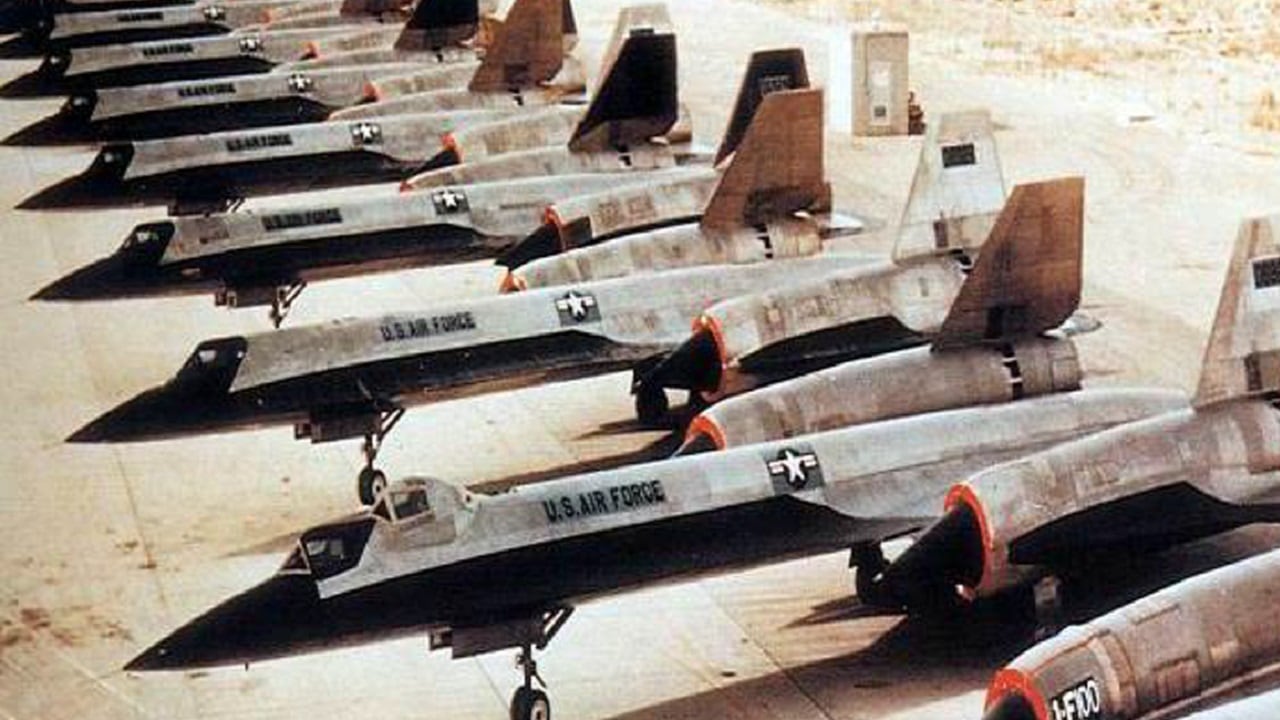
Summary and Key Points: On May 24, 1963, CIA test pilot Ken Collins survived a harrowing flat spin in the A-12 Oxcart, a top-secret Mach 3 reconnaissance jet.
-After his instruments failed at 30,000 feet, the aircraft pitched into an inverted spin, forcing Collins to eject. Upon landing in Utah, he convinced local rescuers the wreckage was a nuclear-armed F-105 to keep them away from the classified debris.
A-12 Oxcart. Image Credit: Creative Commons.
-This event, part of the covert Operation Black Shield, highlights the extreme risks taken by the “Oxcart” pilots, who provided critical intelligence over North Vietnam and North Korea at altitudes of 90,000 feet.
Surviving A Flat Spin In An A-12 Oxcart
Retired Colonel Ken Collins joined the CIA as a test pilot. He later survived ejecting from an A-12 Oxcart spy aircraft, after it went into a flat spin.
Collins was one of six hand-picked Air Force fighter pilots who overflew North Vietnam at Mach 3 on high-altitude photo-reconnaissance missions for the agency.
He flew a spy plane so secret that its operations remained classified for decades. The top-secret project for which Collins had volunteered was code-named Operation Black Shield, and it was based in the Nevada desert.

A-12 Oxcart. Image Credit: Creative Commons.
Operation Black Shield was a covert CIA aerial reconnaissance program (May 1967 – May 1968) using Mach 3+ A-12 Oxcart aircraft to photograph North Vietnam, Cambodia, and North Korea.
Based at Kadena Air Base in Okinawa, the detachment flew 29 missions to provide critical intelligence during the Vietnam War, operating at 90,000 feet.
Deceptively nicknamed “Oxcart,” the supersonic Lockheed A-12 aircraft he piloted was the single-seat predecessor of its ultimately more famous, two-person virtual twin, the SR-71 Blackbird.
Background Of The CIA’s A-12 Oxcart, A Skunk Works Marvel
The CIA and the Air Force teamed up in the 1950s with Clarence “Kelly” Johnson’s Lockheed Skunk Works to develop some of the most successful reconnaissance aircraft in the world. CIA had contacted Johnson to build the first reconnaissance aircraft, the U-2.
Johnson designed the plane in less than 13 months, which was incredible. They began overflights of the Soviet Union in 1956; however, the Russians were able to track the aircraft, even at the edge of space, at 80,000 feet.

A-12 Oxcart. Image Credit: Creative Commons.
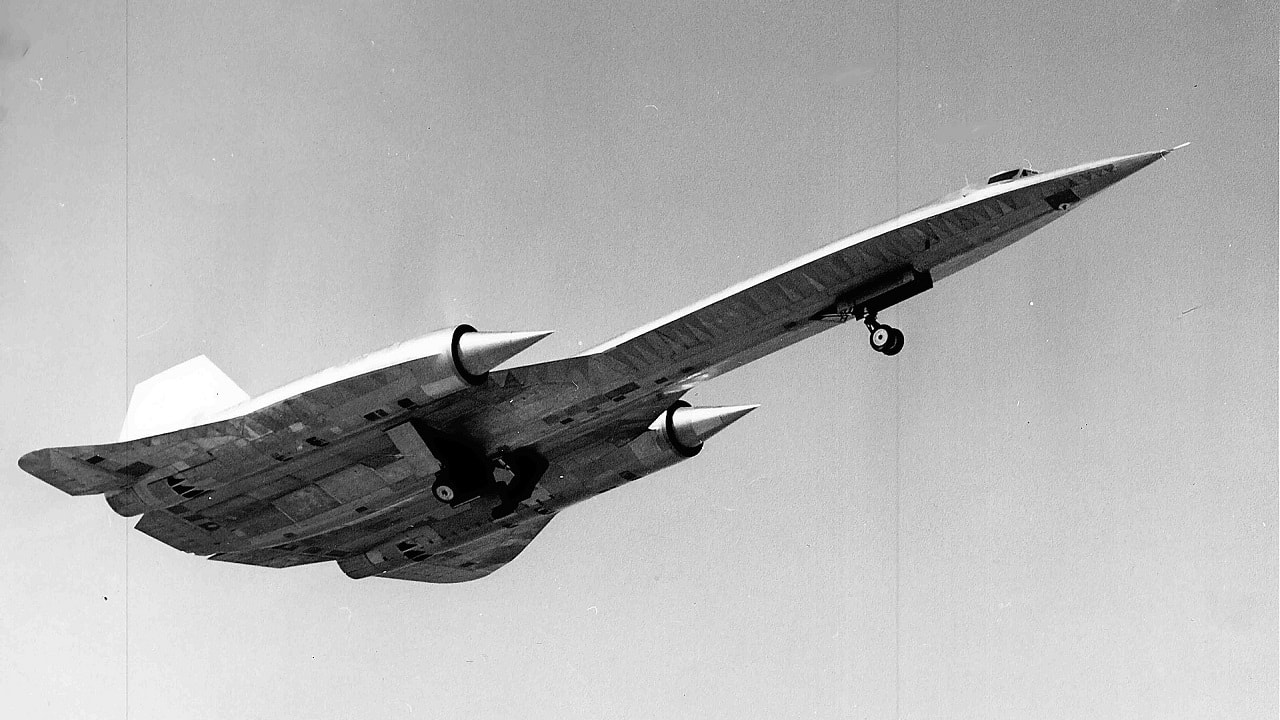
An A-12 (60-6924) takes off from Groom Lake during one of the first test flights, piloted by Louis Schalk. Lockheed Martin dates this image (mouse over) as the maiden flight of the A-12, taken April 26, 1962. Roadrunners Internationale, a reunion website for employees of secret US programs, labels the image as the second Schalk flight, dated May 4, 1962. According to habu.org, this photograph was taken during the official maiden flight on April 30, 1962 (and the April 26 flight was an accidental take-off).
However, the Agency, the Air Force, and Johnson knew they needed a replacement, an aircraft much faster to better protect itself from the missiles they knew would be coming. Under the code name “Oxcart,” Johnson began work on the A-12.
Collins Goes Through A Rigorous Selection Process
Collins told the Smithsonian Magazine that he was told to report to an apartment in Philadelphia, then locked in a room for six hours in complete darkness. A loudspeaker would periodically order him not to doze off. He didn’t. “I can only assume that I must have passed,” Collins said.
More tests, both physical and psychological, were administered. Collins’ wife was even interrogated. Those selected were flown to Washington, D.C., and told they would have to resign their Air Force commissions to fly these missions for the CIA.
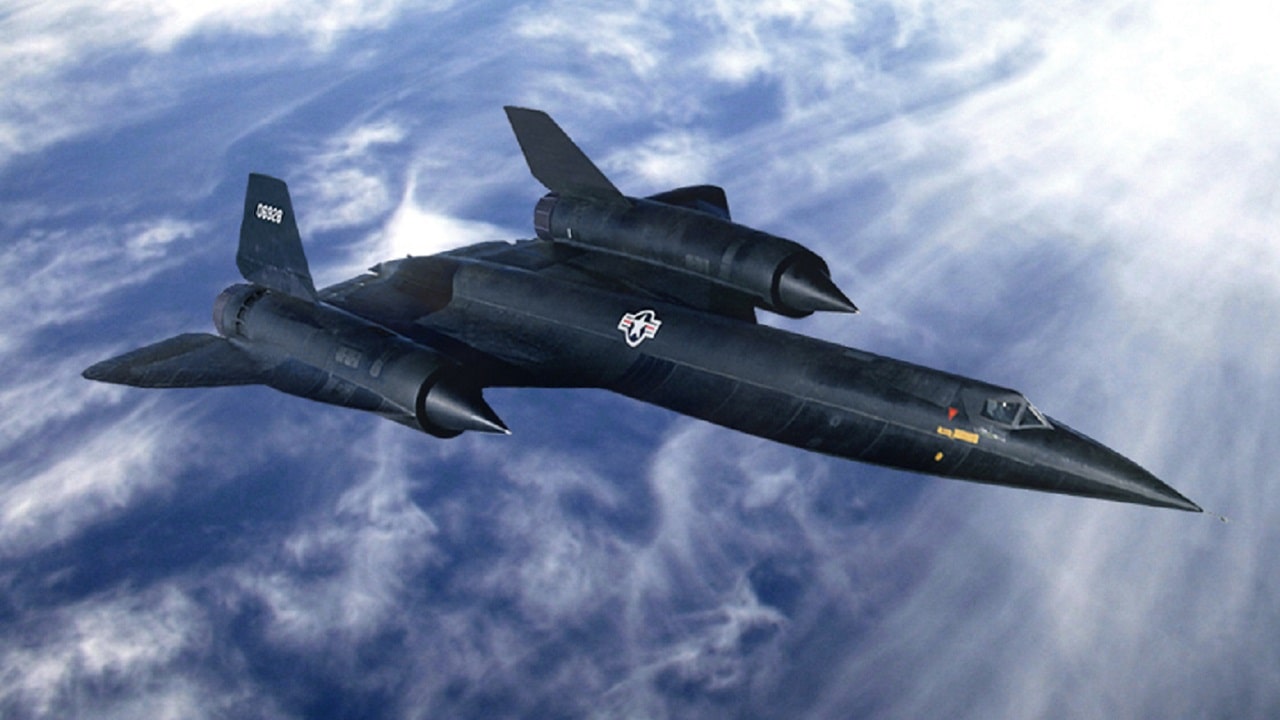
A-12 Oxcart. Image Credit: Creative Commons.
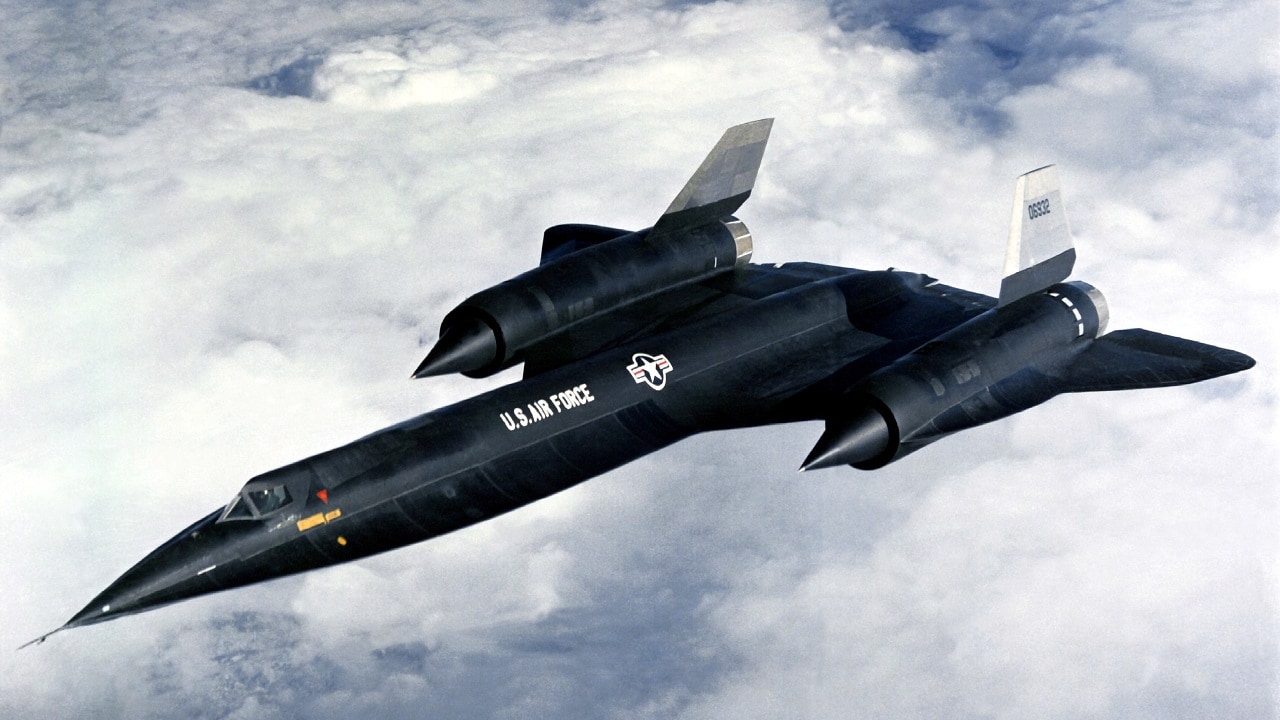
An air-to-air left front view of a A-12 aircraft. Erroneously identified as Y-12 in the source, but Serial Number 06932 is a A-12 (see en:Lockheed A-12). This aircraft was lost over South China Sea on June 6, 1968.
They received a pay bump to $24,000 annually, which is equivalent to slightly more than $250,000 in 2026.
“Nobody knew what we did,” Collins recalled to Smithsonian. “We couldn’t even tell our wives.” Area 51 was never mentioned. To anyone who asked, the pilots and their Air Force-turned-CIA support staff worked as civilian consultants for Hughes Aircraft Company in Culver City, California.
Their cover story came with a requisite Hughes employee ID and business cards. Printed on the cards was a telephone number to a Hughes secretary, who would politely inform callers that the party they were trying to reach was out of the office and ask them to leave a message. Clandestine behavior became routine.
The A-12 Oxcart Program Was Top Secret
Linda Sheffield-Miller, who has written some outstanding stories of the SR-71, mentioned that her dad and Collins couldn’t even discuss the project.
“Later, after the A-12 program was canceled in 1968, he (Collins) was my neighbor at Beale AFB, CA. Ken had rejoined the Air Force and was an SR-71 pilot, then took a staff job. Ken was checked out in the SR-71 with my father, Richard ‘Butch’ Sheffield.
“They flew five flights together. My Dad writes in his unpublished book that he was fully aware that Ken Collins was from the A-12 program. Dad had been briefed on Oxcart at the Skunk Works in 1965. Only the first four crews selected to fly the SR-71 were briefed on A-12. They needed to know because the Pilots used the A-12 trainer.
“The rest of the men in the SR 71 program did not know about it. The fascinating  thing about this is that Dad cannot discuss it with Ken. Ken could not talk about it to Dad. That’s how secret the A- 12 program was! Also, Ken could not tell his wife, Jane.”
Collins’ Crash And A F-105 Nuke Cover Story
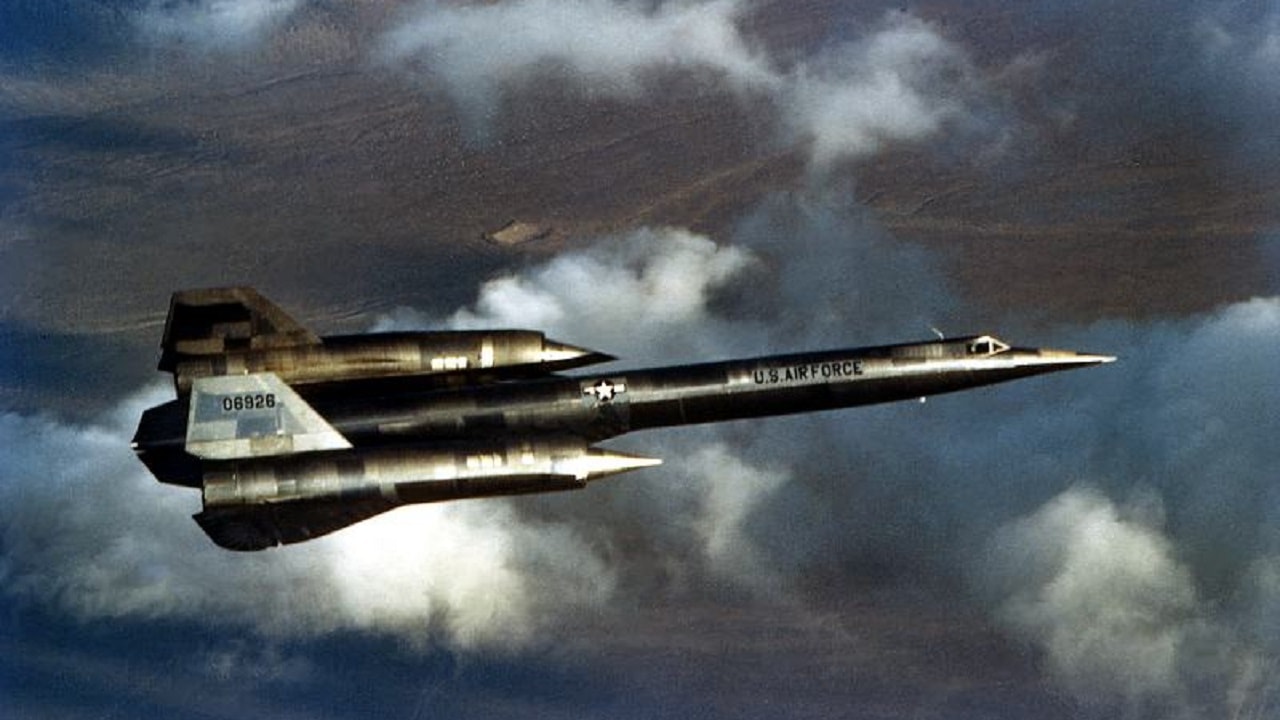
On May 24, 1963, A-12 number 926, piloted by Collins, was involved in a subsonic engine test flight and crashed 14 miles south of Wendover, Utah.
While testing an inertial navigation system, Collins flew into heavy clouds above thirty thousand feet and began noticing erroneous and confusing airspeed and altitude readings just before the A-12 pitched up, stalled, and went into a flat, inverted spin. Collins was unable to regain control of the aircraft; he ejected at around twenty-five thousand feet and was unhurt.
He later retold his story of the incident that the Aviation Geek Club published.
“As we were having a lot of problems with engine fuel controls during acceleration and cruise, I was scheduled for a flight test mission to perform subsonic engine test runs. Jack Weeks was scheduled as my F-101 chase pilot.
Minutes later, Jack signed that we were getting too slow for the F-101. All my A-12 instruments (airspeed and altitude) were showing normal indications. Jack signaled that he could not stay with me. I waved him off, and he cleared to my right and disappeared into the clouds.
“I dedicated my efforts to determining what the real problems were. I engaged the autopilot and reviewed all of the instruments and systems. There were no observable failures or abnormal indications. I then disengaged the autopilot, maintaining my planned airspeed and altitude of 30,000 feet.
“In a matter of seconds, all hell broke out. Without any noticeable change in aircraft attitude or speed, the altimeter rapidly ‘unwinding,’ indicating a rapid loss of altitude. The airspeed indicator was also unwinding, displaying a rapid loss of airspeed.
In heavy clouds, with no visual references and with what felt like a solid platform under me, I advanced the throttle to stop the indicated loss of airspeed, but with no apparent effect. At this point, I could not assume that any of the flight or engine instruments were providing correct data. And I was right! Without any warning, the A-12 pitched up and went into a flat inverted spin.
“Realizing that I had not effective controls, and that the aircraft was unrecoverable from the flat, inverted spin, and that I had no true indication of my actual altitude, it was time to eject… I closed my helmet visor, grabbed the ejection D-ring between my legs, firmly pushed my head back against the ejection seat headrest, and pulled the D-ring. The aircraft canopy flew off instantly, the boot stirrups snapped back into the seat retainers, and the ejection seat rocket shot me downward (remember, I was inverted!) and away from the aircraft.
“During my descent, I saw the A-12 spiraling toward the ground and then a large black column of smoke and flames behind a hill. I had time to look around. I saw a road to the right and a lot of rough terrain covered with rocks and sage.
“Much to my amazement, I saw a pickup truck bouncing across the rocks coming towards me with three men in the cab. When they stopped, I saw they had my aircraft cockpit canopy in the truck bed. They asked me if I wanted a ride. They said that they would take me over to my airplane. I told them that it was an F-105 fighter with a nuclear weapon on board. They got very nervous and said I was going with them to get in quick, because they weren’t staying around here.
“I asked them to drop me off at the nearest highway patrol office, which was in Wendover, Utah. I thanked them, and that was the last I saw of them. I made my ‘secret’ phone call. A Lockheed Constellation loaded with security and aircraft engineers arrived in less than two hours. Kelly Johnson’s jet arrived after the ‘Connie’ to pick me up. Our flight surgeon and I flew directly to Albuquerque, New Mexico, to the Lovelace Clinic for my physical checkup.”
The CIA would inject Collins with sodium penthathol (truth serum) to ensure that he told them everything that unfolded. Afterward, “some men in black suits” dropped a still drugged Collins back home without offering his wife any explanation about where he’d been. His wife assumed that he’d been drinking.
Of the 12 A-12 Oxcarts that were built, five of them crashed. Collins flew more Black Shield missions than any of the pilots in the program. He returned to the Air Force to fly the SR-71.
The A-12 was a technological leap and a worthy predecessor to the SR-71.
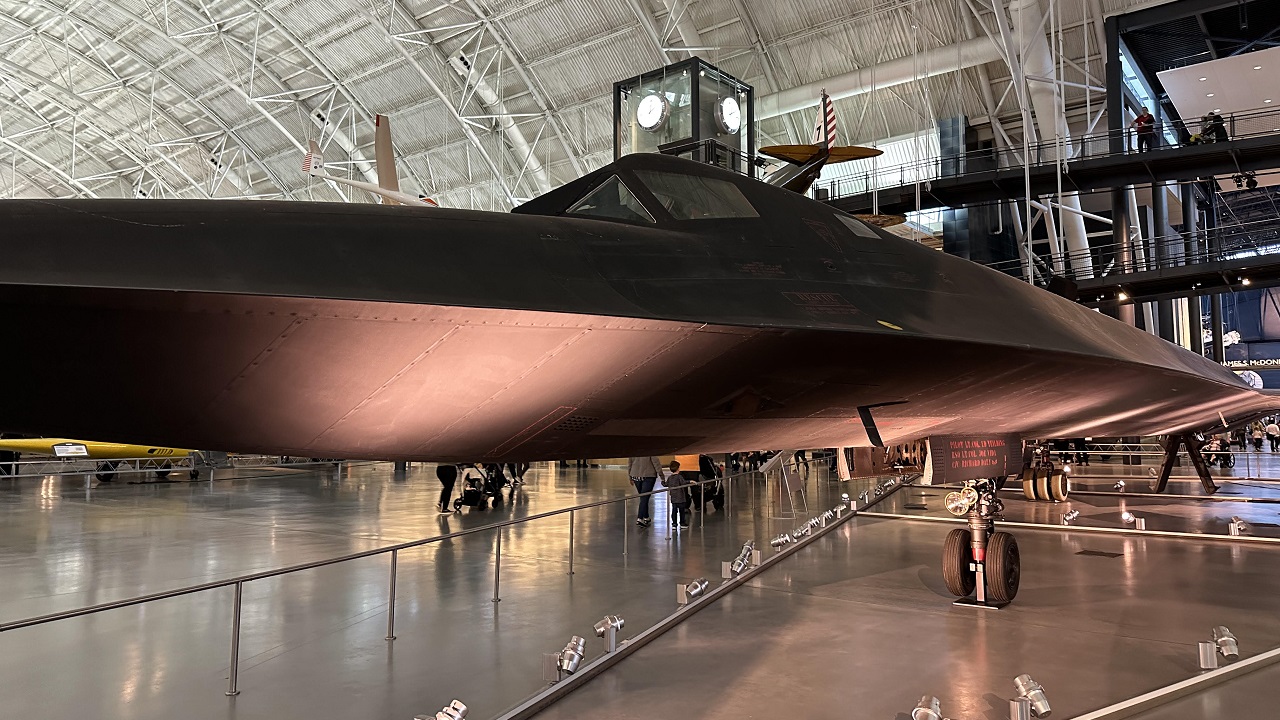
SR-71. SR-71 photo taken at the National Air and Space Museum. Taken by 19FortyFive on 10/1/2022.
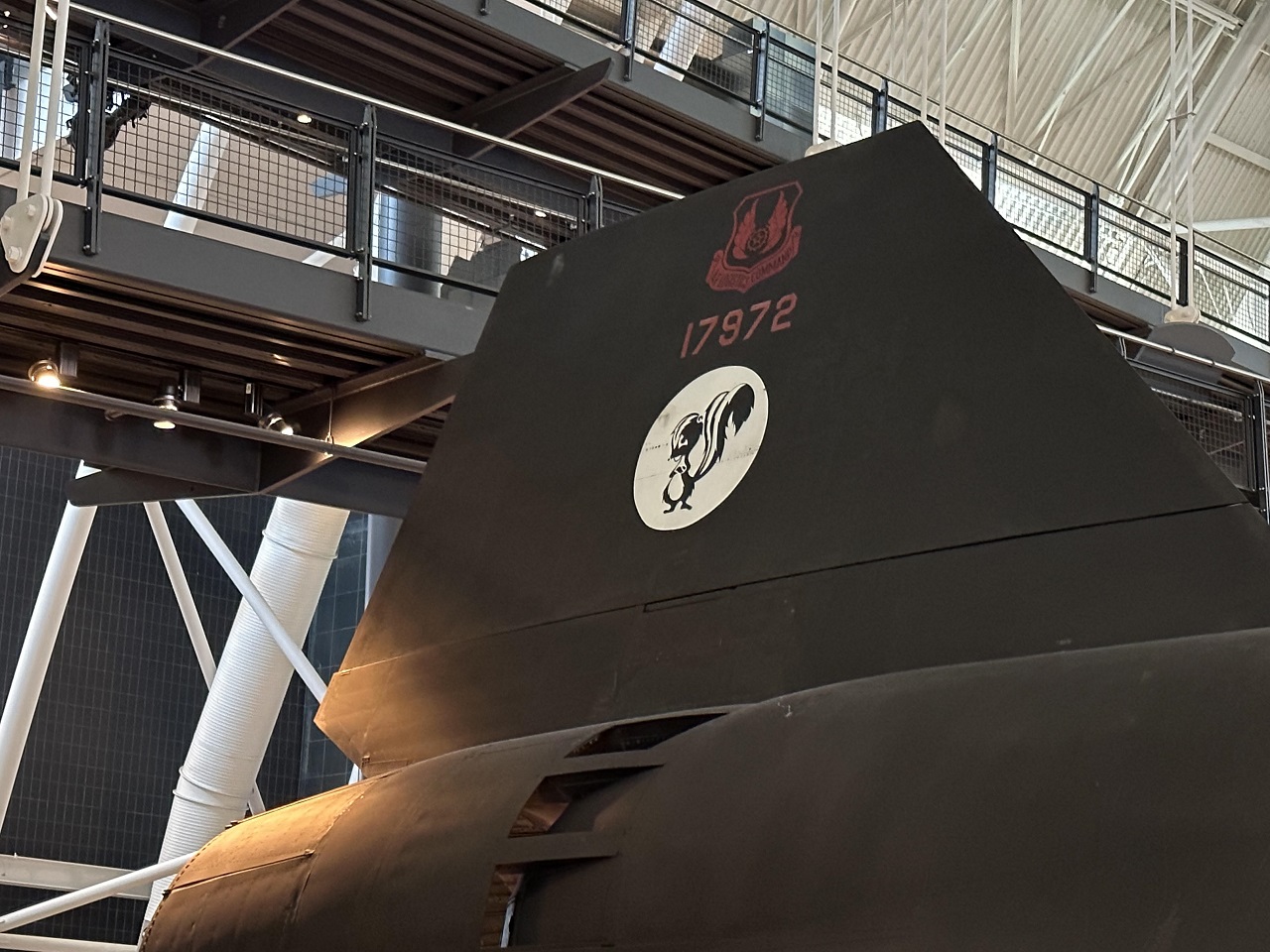
SR-71. SR-71 photo taken at the National Air and Space Museum. Taken by 19FortyFive on 10/1/2022.
The program ended in 1968, in part because the Air Force wanted control over all Mach 3 aircraft and didn’t want the CIA involved in what they perceived as their turf. Plus, the costs of operating the fleet of 15 A-12s and the new SR-71 were prohibitive.
About the Author: Steve Balestrieri
Steve Balestrieri is a National Security Columnist. He served as a US Army Special Forces NCO and Warrant Officer. In addition to writing on defense, he covers the NFL for PatsFans.com and is a member of the Pro Football Writers of America (PFWA). His work was regularly featured in many military publications.