
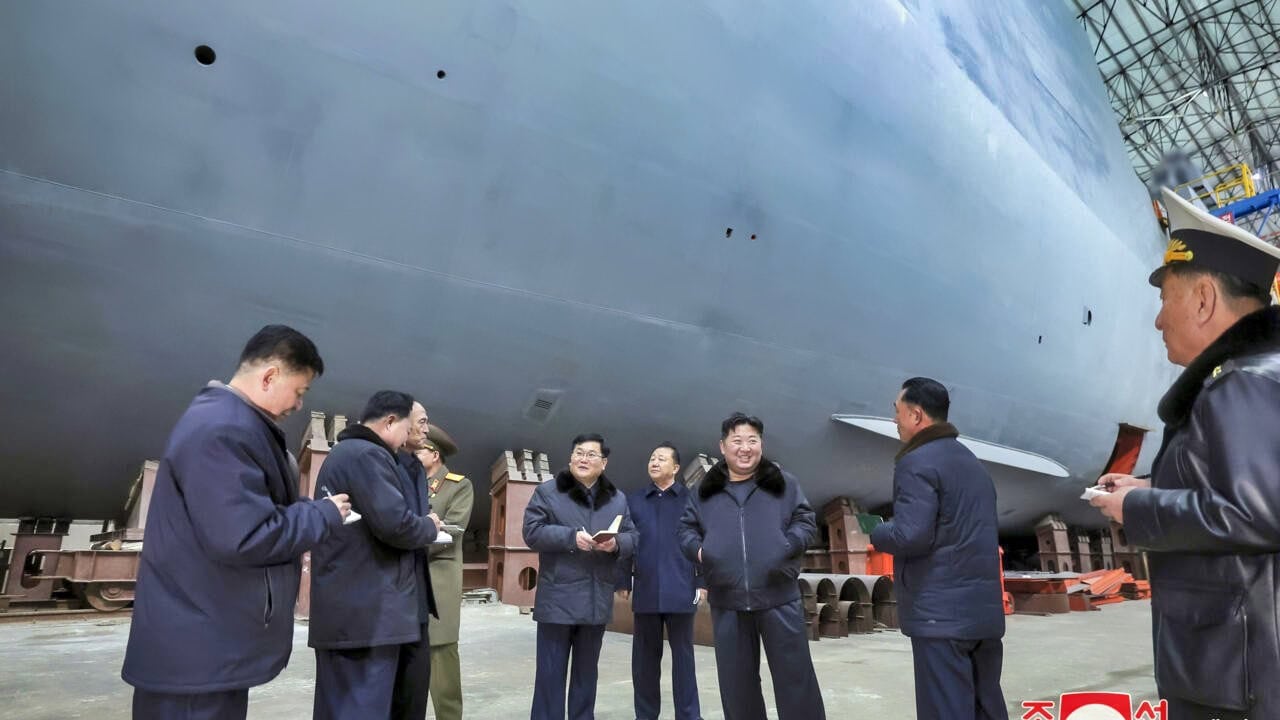
Summary and Key Points: North Korea’s nuclear arsenal is mostly land-based and therefore more trackable and vulnerable than the forces of larger nuclear states.
-That vulnerability can restrain Pyongyang and reduce allied paranoia, but it also incentivizes North Korea to pursue survivable second-strike options—especially submarines.
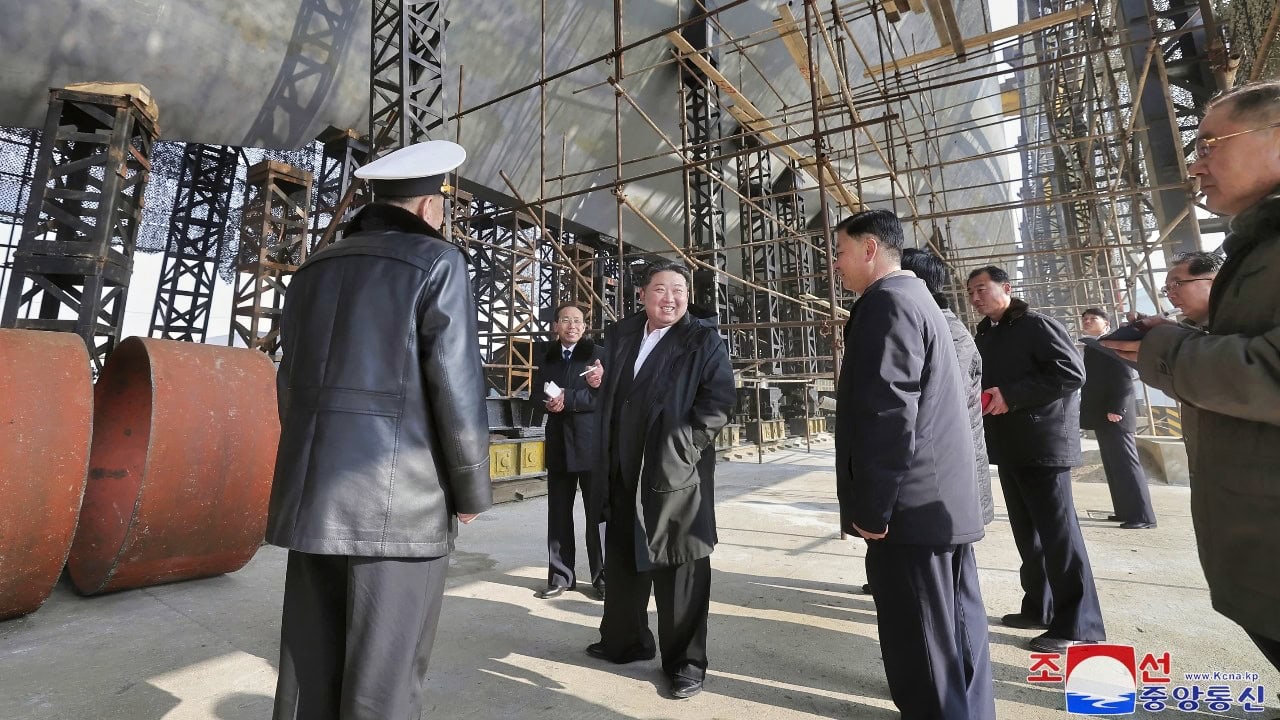
North Korea Nuclear Submarine. Image Credit: KCNA.
-As the regime moves toward nuclear missiles at sea, the logic of deterrence shifts: disarming strikes become harder, crisis stability erodes, and allied leaders may face pressure to act early—potentially even to hit a submarine in port before it sails.
-That “preemption temptation” could turn a regional standoff into an escalation spiral.
North Korea’s Next Step Is Undersea Nukes—and That’s Where Escalation Starts
Last week, fellow 19FortyFive contributor Robert Farley presented a list of five flashpoints for a major war in 2026. All are fair possibilities, each with its own potential to trigger a catastrophic escalation spiral. But another flashpoint is worthy of consideration: North Korea’s drive to put nuclear missiles on a submarine.
North Korea is a well-known source of global instability, and any conflict involving Pyongyang could spiral in the way Farley describes. But to be fair to North Korea, after a series of major crises in the 2010s, it has not engaged in provocations in recent years.
Perhaps the regime feels more secure now that it has developed a serious nuclear arsenal.

North Korea Mini Submarine. Image Credit: Creative Commons.
But North Korea’s arsenal is vulnerable. It only has land-based launchers. These are mobile, but North Korea is a small, poor country—mountainous and forested, with a limited road network. This makes it easier to track the North’s mobile missiles than it is for larger, wealthier nuclear-weapons states such as Russia or China.
Pyongyang is therefore seeking to place nuclear missiles under sea. Submarines significantly improve the survivability of nuclear missiles. The first step for North Korea is to build a quiet nuclear-powered submarine. Steps to do so could trigger North Korea’s opponents to strike it.
Survivability and First Strike
Nuclear weapons significantly improve a country’s security. They are so destructive that no country will attack a nuclear-armed state, out of fear of a nuclear response. Even conventionally dominant states can be deterred by the threat of nuclear retaliation.
In South Asia, Pakistan is far behind its rival, India, in conventional capabilities. Its population and economy are smaller than India, and its government is less stable and capable. India would likely win a strictly conventional conflict, but Pakistan’s nukes help even out the imbalance. North Korea likely perceives its neighborhood the same way.
But to keep their power to deter, nuclear weapons must be survivable. A conventionally dominant state such as India, South Korea, or the United States is tempted to launch a disarming strike against any opponent with a small, vulnerable arsenal.
A fast, thorough, surprise strike could disarm a weak nuclear state—such a state must not only have nukes, but be able to preserve them for retaliation.
Hardening fixed silos is one possibility, but mobility is better.
If an opponent cannot find a country’s nuclear missiles, then launching a disarming strike becomes riskier. Land-based transporters offer some mobility, but not nearly as much as submarines loose in the world’s large oceans. All nuclear powers reach for submarines as their arsenal matures.
Strike a North Korean Nuclear Submarine Before It Launches?
North Korea’s opponents will likely be tempted to strike any such submarines before they can be constructed. During U.S. President Donald Trump’s first term, there was a debate over a similar disarming strike. In 2017, North Korea was pushing to introduce an intercontinental ballistic missile that could hit the United States. Hawks around the president argued for a “bloody nose” strike.
North Korea’s drive to put its weapons to sea will likely spark a similar debate in the U.S., as well as South Korea and Japan. As long as North Korea’s nukes are stuck on land, a disarming strike and other damage-limitation measures are easier.
And as noted above, mobility in North Korea is constrained by geography and cost. Even if air strikes on North Korea did not destroy all its weapons, fewer retaliatory nuclear launches from a degraded North Korean arsenal would be preferable to many launched from a full fleet of submarines.
As long as North Korea’s arsenal remains somewhat vulnerable to U.S., South Korean, and Japanese air power, the North Korean nuclear threat is lower.
That likely improves peninsular stability by reducing allied paranoia. North Korea’s nuclear vulnerability likely explains why Pyongyang has behaved less provocatively recently.
Once Pyongyang has the enhanced survivability of an undersea arsenal, it is reasonable to expect North Korea’s belligerence to resume.
Pre-Empting a North Korean Nuclear Weapons-Carrying Submarine?
In a crisis sliding toward war, a disarming strike could eliminate some of the risk from North Korea.
A nuclear missile-carrying submarine significantly worsens that calculation.
This raises the obvious question of whether the allies should preemptively destroy such a submarine in port before it launches. That could escalate quickly.
Author: Dr. Robert Kelly, Pusan National University
Dr. Robert E. Kelly is a professor of international relations in the Department of Political Science and Diplomacy at Pusan National University in South Korea. His research interests focus on Security in Northeast Asia, U.S. foreign policy, and international financial institutions. He has written for outlets including Foreign Affairs, the European Journal of International Relations, and the Economist, and he has spoken on television news services such as the BBC and CCTV. His personal website/blog is here; his Twitter page is here.