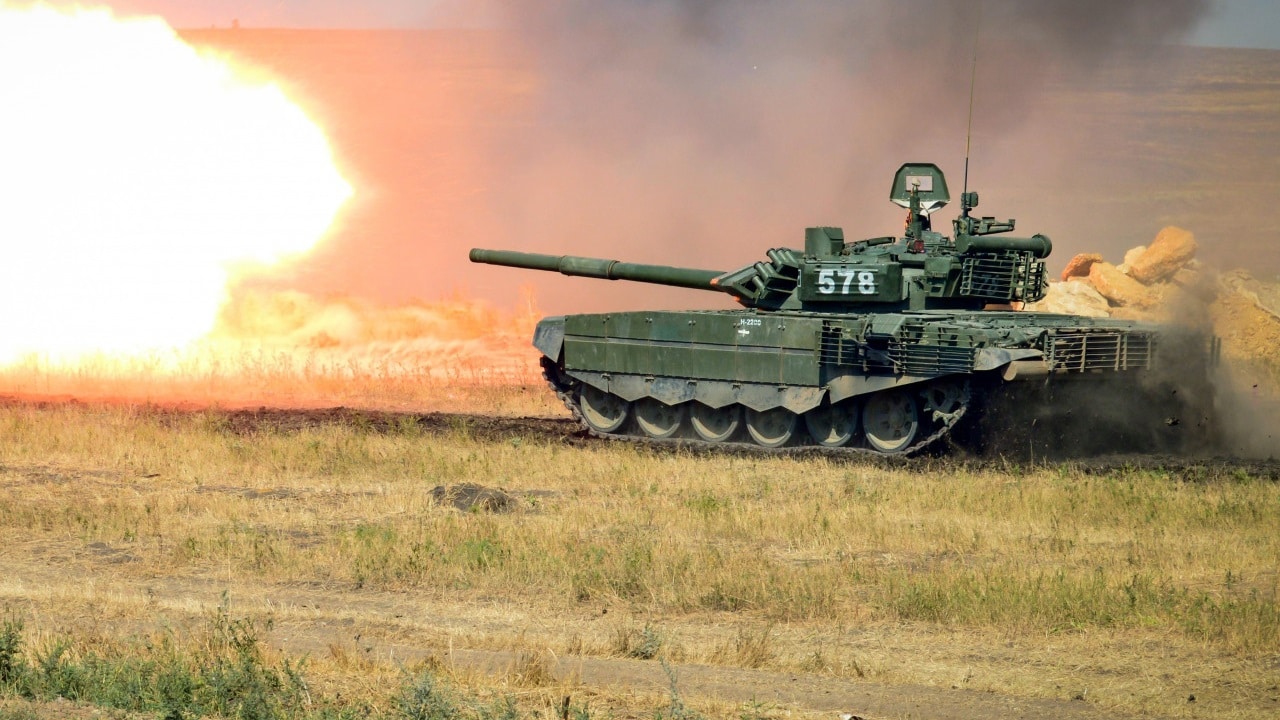
Summary and Key Points: The T-72, in service since 1973 and produced in massive numbers, is portrayed as the defining tank of the Ukraine war not because it is invulnerable, but because it fits an attritional battlefield.
-Russia can field, repair, and replace T-72s faster and cheaper than newer platforms, making losses more tolerable while keeping pressure on Ukrainian lines.
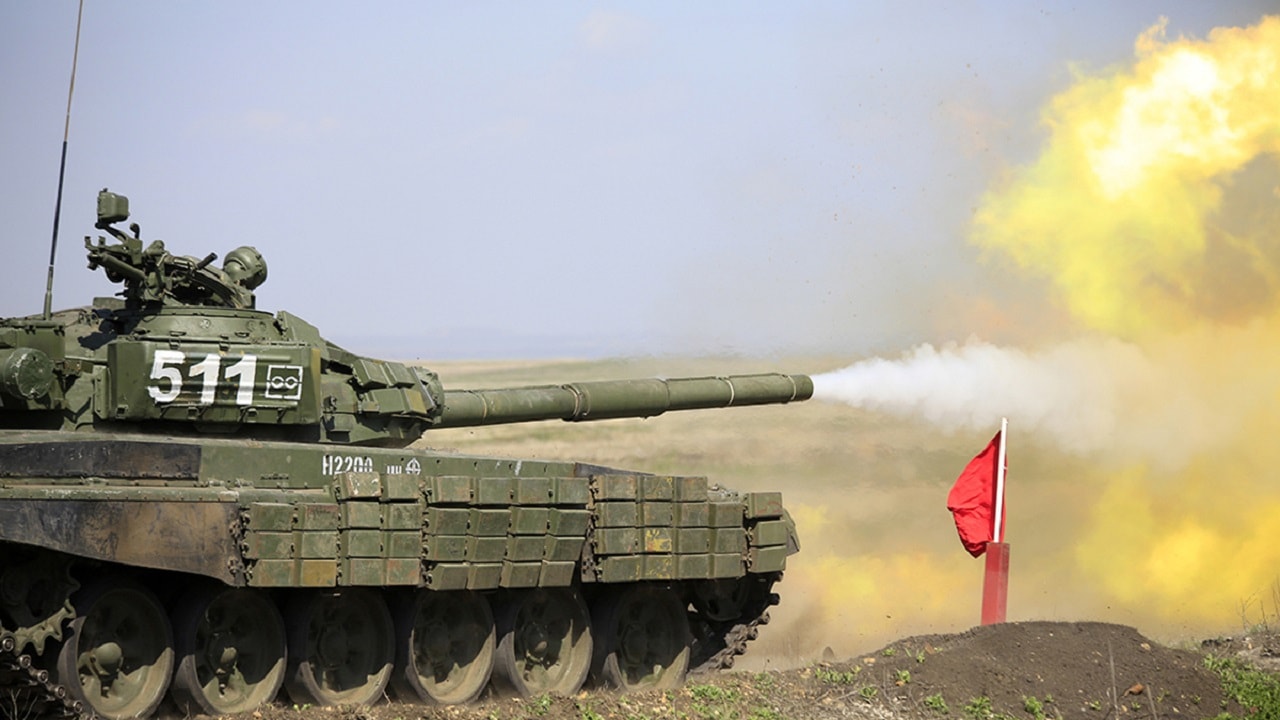
Russian T-72 tank from Ukraine War. Image Credit: Creative Commons.
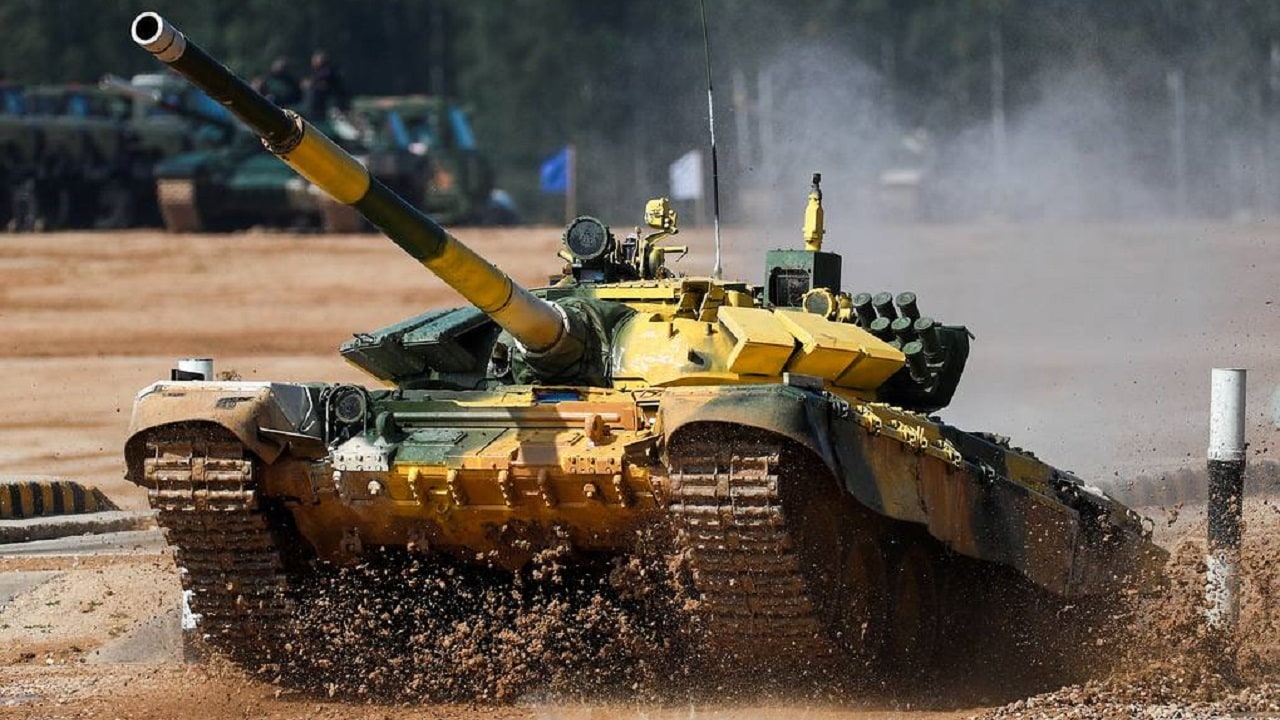
Russian T-72 tank. Image Credit: Creative Commons.
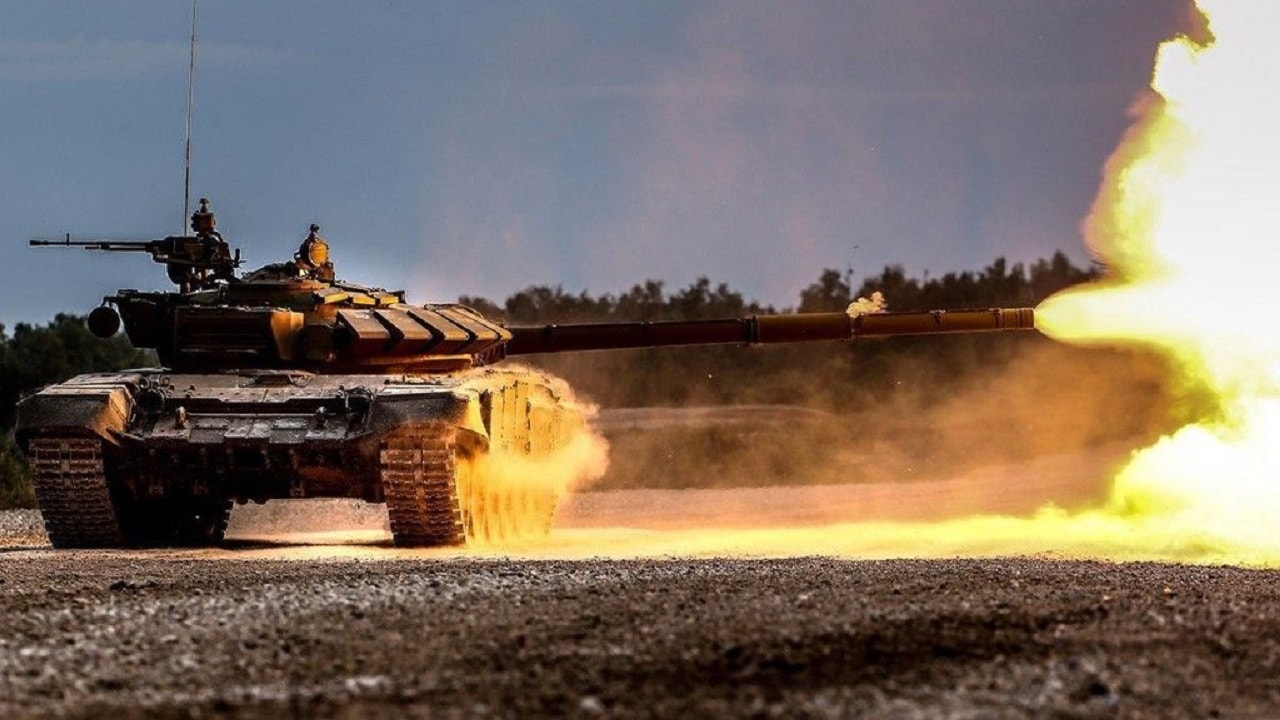
Russian T-72 tank. Image Credit: Creative Commons.
-The tank’s low profile, autoloader-fed 125mm gun, and upgrade path—ERA, improved sights, and improvised anti-drone measures—support continued relevance.
-The argument acknowledges significant vulnerabilities, particularly to top-attack drones, but frames the T-72 as “good enough” at scale.
Here’s Why the “Obsolete” T-72 is the Deadliest Tank in the Ukraine War (And the Best Tank on Earth)
The T-72 Main Battle Tank (MBT) has been in service since 1973, and since that time it has proven itself to be a versatile, highly effective combat vehicle. Since the outbreak of the Ukraine War in February 2022, the T-72, an MBT many experts discarded as being little more than a Soviet-era relic, has found renewed life on the frontline of that conflict.
The Tank Everyone Dismissed
The Russian Army has perfected the use of these older, relatively cheap systems and has continued hammering the Ukrainian lines.
Over 25,000 T-72 MBTs have been built, and they are used by a variety of militaries decades after the then-Soviet Union originally deployed them. Specifically, the T-72 has been used by more than 40 countries. Russia has licensed the T-72 to groups across Eastern Europe, the Middle East, and Asia. Aside from Russia, this tank has seen frontline service in Syria, Iraq, Iran, and elsewhere.
This tank has fought in the Iran-Iraq War, the Gulf War, Chechnya, Syria, and Ukraine.
The platform is renowned for its serious firepower and its maneuverability. Indeed, this MBT has achieved iconic status and is widely regarded as one of the most widely used MBTs in the history of modern warfare.
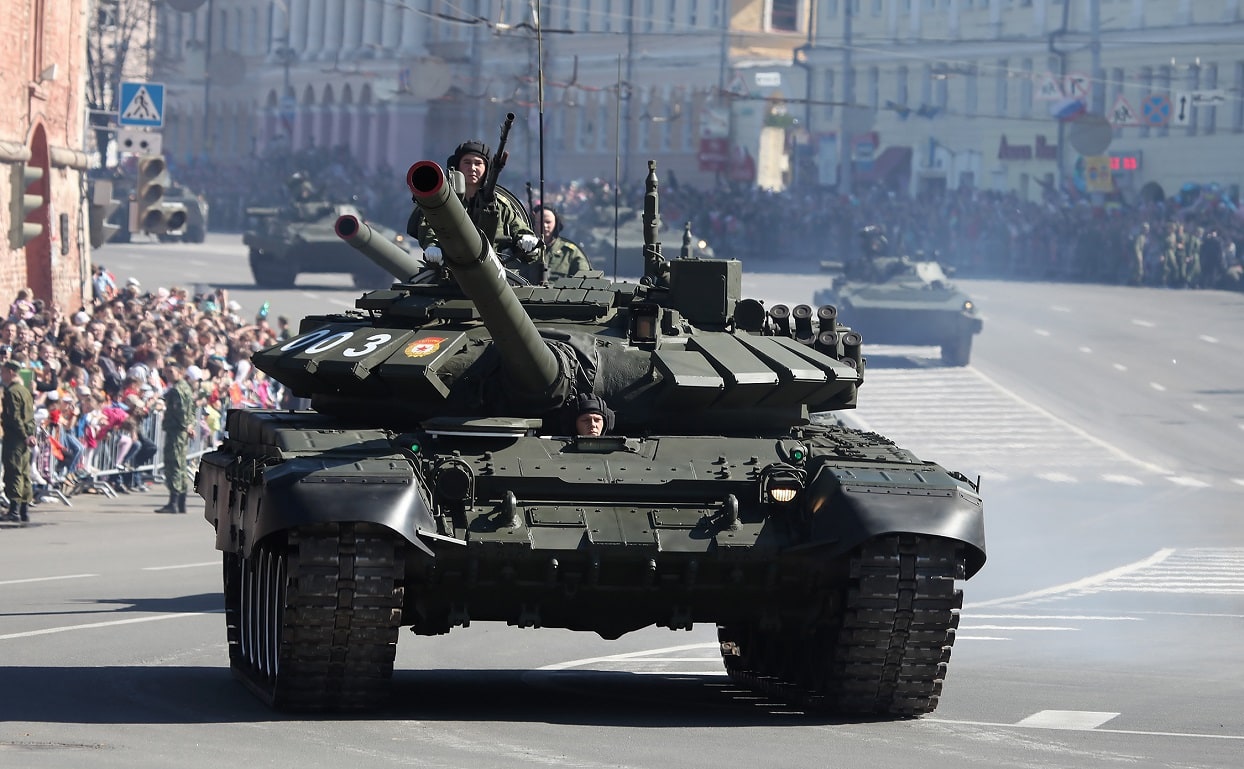
Image Credit: Vitaly Kuzmin/Creative Commons.

T-72. Creative Commons Image.
Indeed, this is not just the most mass-produced MBT in the world. This tank is, without a doubt, the greatest tank ever made. Yes, yes, many will point to the M1 Abrams, which more than proved itself in the lightning war of Desert Storm in 1991. Others will state that the Russian T-14 Armata. But none of these hold a candle to the T-72 today.
Why?
Ukraine Proved The T-72’s Greatness
Because in the Ukraine War, which is the most important conflict occurring in the world today (after all, it is setting the standards for how all future conflicts between major powers will be waged), the T-72 is the king of battle. Of course, critics will point to the large numbers of T-72s that have been damaged or destroyed.
But is that reflective of the tank or the nature of the war in Ukraine?
Consider this: the Russians were smart enough to recognize that Ukrainian anti-tank tactics, involving anti-tank weapons and innovative drone attacks, were more dangerous to their armored forces than they had assumed. So, Russian forces adapted. And rather than risk their more costly T-90, T-90Ms, or T-14 Armata MBTs, the Russians chose to retool their T-72s and send them into the meatgrinder.
Quantity Has a Quality All Its Own
Compared to either the T-90s or the T-14s, the T-72s, while older, are much easier to handle and maintain in the degraded environment that is the Ukrainian frontline, and they are much cheaper than those other systems. In effect, the Russians can afford to lose larger numbers of their T-72s and still maintain their overall combat effectiveness—and potentially replace them easily—than the other, more advanced tanks in their arsenal.
T-72s were developed in the 1960s as an affordable alternative to the Soviet T-64 MBT. It’s no surprise that the T-72 is still widely used decades after its creation. The Soviets built these lethal machines for mass production, ruggedness, and ease of maintenance.
What’s more, these tanks were designed to fight—and win—a sweeping, large-scale battle for the Fulda Gap in Europe during a potential NATO-Soviet war.
Soviet designers of the T-72 prioritized quantity and acceptable quality over expensive technological sophistication. Even though technology has advanced considerably since the T-72 was first designed, the modern battlefield still features a curious blend of high-tech and low-tech.
Indeed, lower-tech systems (at least the simpler ones) tend to perform better than higher-end platforms.
Cheap to Build. Easy to Fix. Fast to Replace—the T-72
The Soviets designed the T-72 also to have a very low profile, making it harder to track and destroy. They further installed heavy frontal armor and paired it with a powerful 125mm smoothbore, autoloader-fed main gun. The main gun fires armor-piercing fin-stabilized rounds (APFSDS), High-Explosive Anti-Tank (HEAT), High-explosive fragmentation, and even some variants of the T-72 will deploy gun-launched anti-tank guided missiles (ATGMs).
Thanks to the autoloader, the T-72 can fire seven to eight rounds per minute without a human loader. There is a secondary weapon: a 7.62mm coax MG and a 12.7mm HMG.
The engine is a 780 hp diesel (up to 1,130 hp on modern upgrades) and has a top speed of 37 miles per hour.
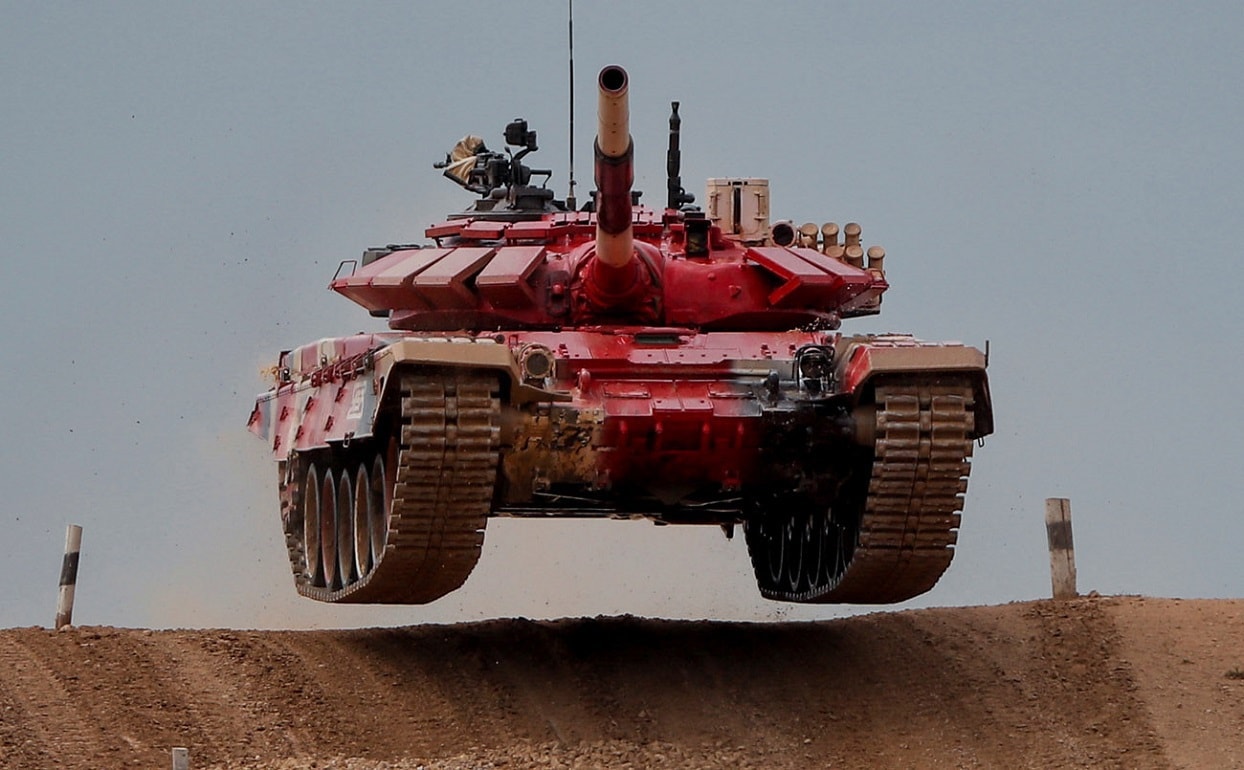
A T-72 B3 tank operated by a crew from Russia jumps during the Tank Biathlon competition at the International Army Games 2020 in Alabino, outside Moscow, Russia September 2, 2020. REUTERS/Maxim Shemetov
As for the armor, early models had composite armor, but later variants incorporated Explosive Reactive Armor (ERA), such as the Kontakt-1, Kontakt-5, or Relikt systems. There are more modern upgrades to the newer models, such as thermal sights, laser warning receivers, and soft-kill active protection. The Russians have also added cages and other anti-drone capabilities onto their tanks, including their ubiquitous T-72s.
The T-72 is not perfect. Like so many Russian platforms, though, it is good enough—and numerous enough—to make it a truly potent system. The downsides include poor crew survivability compared to Western tanks, especially in earlier T-72 models. Many older versions also have older optics, and they are highly vulnerable to the kind of top-down attacks that modern drones subject MBTs to.
A Perfect Tank
Still, the size of the production line, the use in more than 40 countries, its presence in multiple major hotspots in the world, and the fact that Russia has clearly prioritized the T-72 as their primary tank in the Ukraine War over much more sophisticated ones clearly indicates that the T-72 is the perfect mix of affordable, easily mass producible, simple to operate, and replaceable.
In a war of attrition, such as the Ukraine War, that is what the Russians need more than anything else. That’s why the T-72 is the greatest tank around today. Let us not forget that the T-72 has outperformed any of the various more advanced Western MBTs that have been wasted in the killing fields of Ukraine.
About the Author: Brandon J. Weichert
Brandon J. Weichert is the Senior National Security Editor at 19FortyFive.com. He was previously the senior national security editor at The National Interest. Weichert is the host of The National Security Hour on iHeartRadio, where he discusses national security policy every Wednesday at 8 pm Eastern. He hosts a companion show on Rumble entitled “National Security Talk.” Weichert consults regularly with various government institutions and private organizations on geopolitical issues. His writings have appeared in numerous publications, among them Popular Mechanics, National Review, MSN, and The American Spectator. And his books include Winning Space: How America Remains a Superpower, Biohacked: China’s Race to Control Life, and The Shadow War: Iran’s Quest for Supremacy. Weichert’s newest book, A Disaster of Our Own Making: How the West Lost Ukraine, is available for purchase wherever books are sold. He can be followed on Twitter/X at @WeTheBrandon.