
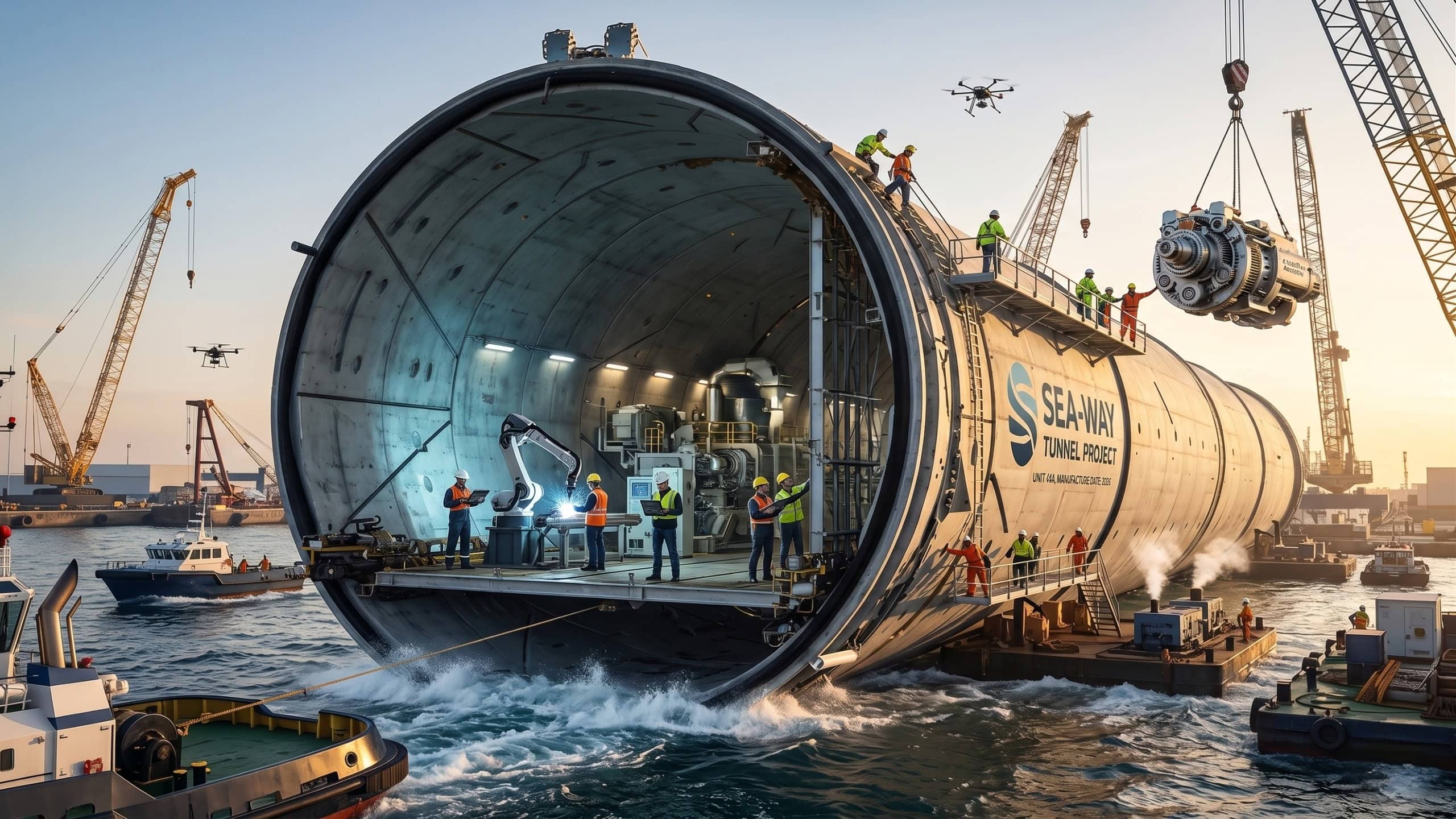
A new study has uncovered a deeply troubling problem in the world’s network of undersea commercial tunnels: rubber GINA gaskets are degrading 35% faster than engineers predicted. The gaskets lost 67.66% of their sealing force in tests. Vehicle and rail tunnels worldwide may be at risk of leakage.
Leakage Is Coming? We Have an Undersea Tunnel Problem
There is a vast network of undersea commercial tunnels that most people are unaware of. This infrastructure separates parts of oceans, rivers, straits, and bays. Vehicles and trains can pass through these tunnels, but the engineering is difficult. The tunnels have to “withstand extreme hydrostatic pressure and complex geological conditions beneath the sea,” according to Daidung, a structural engineering provider.
Now, some of these tunnels are experiencing difficulty. Evelyn Hart of the Indian Defense Review has an excellent expose describing how these tunnels have seen better days. Hart wrote that rubber seals are at risk of leaking water, which could be dangerous to this network of infrastructure.
The Rubber Is Not Working at Optimum Levels
Hart explained how there is a “strip of rubber” at the bottom of the ocean that could break. Each tunnel has steel joints that hold it together. Designers had hoped that many of these pipes would last 100 years. That may not happen given their current strength.
The Seals Are Losing Their Force
The author examined a recent study by Tunneling and Underground Space Technology. The scientists found inconsistencies in many tunnel networks. It turns out that the connectors that keep tunnels together and water out around the world, called the GINA gasket, have lost “sealing force 35 percent faster than earlier models predicted.”
The seawater is damaging the GINA gaskets. Designers did not account for the adverse actions of compression that would last for decades. “When researchers at Shijiazhuang Tiedao University in China tested both together, the gasket lost 67.66 percent of its sealing force across the simulated service period,” Hart explained.
Will This Show Up In Other Tunnels?
There is now concern that many tunnels worldwide could be compromised. The tunnel system is built as follows. “Immersed tunnels are not drilled. Prefabricated concrete sections are floated out, sunk into a seabed trench, and drawn together underwater. At every joint, a GINA gasket is compressed between steel end shells. That compression generates the sustained outward force that keeps water from finding a path through. The seal stays under load from the day the tunnel closes,” Hart wrote.
Scientists tested some of the gasket materials. They focused on the Yuliangzhou tunnel in China. “Earlier projections estimated the gasket would retain 2.32 megapascals of sealing pressure for 100 years. The updated model, with compression included, put that figure at 1.51 megapascals,” the scientists found.
The Problem Could Be Worsening Worldwide
This measurement could become worse as seawater corrodes and sediment shifts. Some engineers have measured the tunnels’ strength and found they are holding up. But there is still a problem.
The polymer network that gives rubber its malleability was breaking at the molecular level. “The temperature at which the material stiffened shifted by about 5.8 degrees Fahrenheit. The aging essence of the GINA gasket is material degradation caused by structural degradation,” the researchers revealed. “Sealing force dropped while surface hardness climbed. The two indicators moved in opposite directions, which is precisely why hardness alone is an unreliable guide,” the study suggests.
These aging tests were alarming, and in 90 days, there were measurable changes for the worse. More damage has been found. The GINA gasket has a lower edge, and this could be compromised. The waterproofing could break down. To prevent this, engineers must measure the effects more thoroughly. The “lower edge of each joint” should be the area of concern.
Engineers Have Their Work Cut Out for Them
“For future projects, the researchers recommend calibrating rubber compound formulations and initial compression targets using combined compression and seawater aging data. Current design models that rely on chemical exposure alone may be quietly giving away safety margin before a tunnel ever opens,” Hart concluded.
These Studies Raise Important Questions
These findings should be better publicized because they have revealed a potential global problem. The research raises more problems. How can this be fixed? What is the timeline for repair? How much money needs to be sunk into solving this problem?
Work Together for the Common Good
It would not be possible for a group of divers to make repairs. The tunnels are too deep and too expensive. More testing must be conducted on other tunnels in regions outside China. The risks are too great of potential leakage. This might be an opportunity for researchers in the United States to collaborate with those from China. That would be an example of scientific diplomacy and cooperation that could improve relations between Beijing and Washington.
More Research Is Needed
The tunnels will not improve without concerted effort. These initial studies should be replicated by scientists in the West to ensure research methods are consistent with those of other tunnel networks. This problem is not going away, and it will require more involved studies that can test tunnels near the United States and Europe. This could become a NATO project as the alliance seeks to improve relations with China. The Europeans may also be affected by future leaks from tunnels. This line of research should get more funding so more studies can be conducted. The risk of leakage is high, and further damage would have disastrous consequences that would reverberate worldwide.
About the Author: Brent M. Eastwood, PhD
Author of now over 3,500 articles on defense issues, Brent M. Eastwood, PhD, is the author of Don’t Turn Your Back On the World: A Conservative Foreign Policy and Humans, Machines, and Data: Future Trends in Warfare, plus two other books. Brent was the founder and CEO of a tech firm that predicted world events using artificial intelligence. He served as a legislative fellow for US Senator Tim Scott and advised the senator on defense and foreign policy issues. He has taught at American University, George Washington University, and George Mason University. Brent is a former US Army Infantry officer. He can be followed on X @BMEastwood.