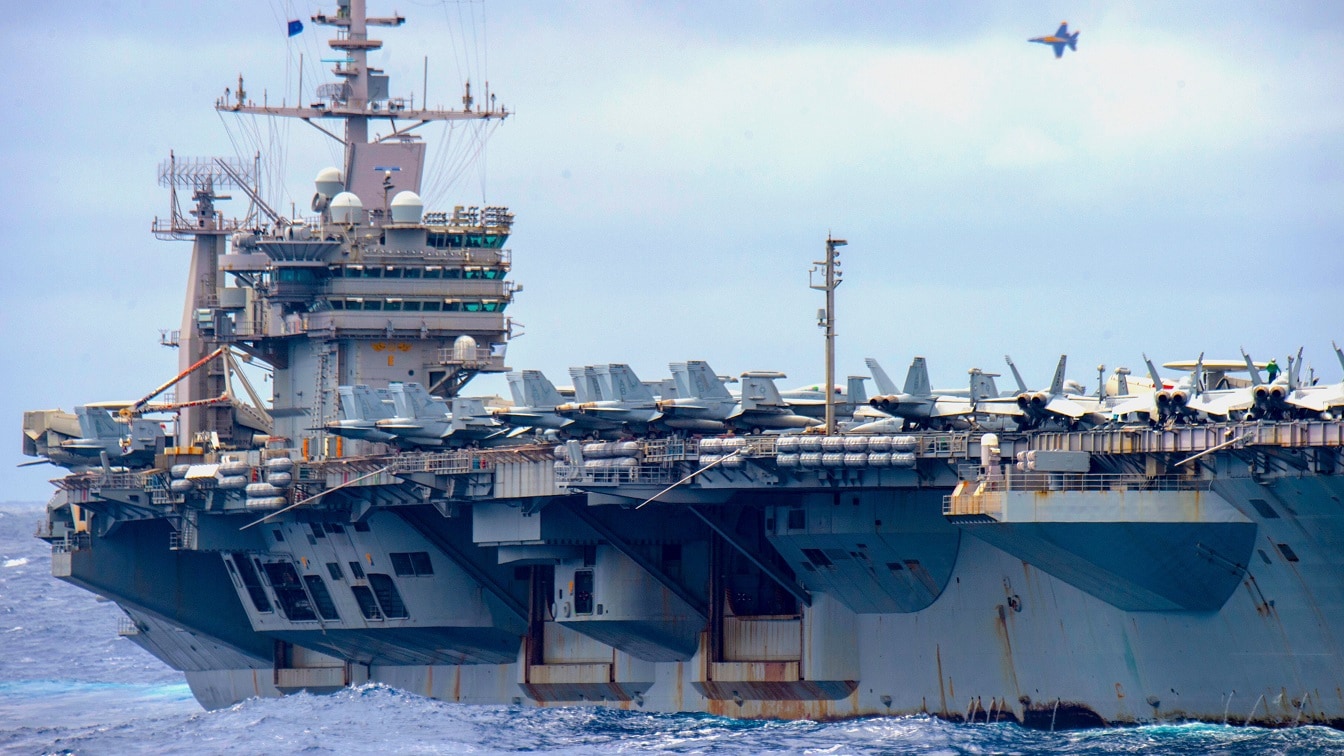
Summary and Key Points: With USS Nimitz nearing retirement and USS John F. Kennedy still not fully ready, the U.S. Navy risks a dangerous carrier shortfall during a period of widening commitments.
-Even as A2/AD systems push flattops farther from contested zones, carriers remain America’s fastest power-projection tool—and Nimitz is already built and paid for.
-One alternative to decommissioning is conversion: repurpose Nimitz into a drone mothership that launches and manages large numbers of unmanned air, surface, and undersea systems.
-With its nuclear power supporting heavy electrical demand, Nimitz could become a mobile command node for swarms, ISR, electronic warfare, and standoff strike.
Don’t Retire USS Nimitz: Turn It Into a Drone “Mothership” Instead
Naval warfare has moved away from the era in which the carrier was the capital ship. The rise of potent anti-access/area-denial (A2/AD) systems has stunted the utility of aircraft carriers by pushing them to stay well outside of the range of these systems.
Still, the carrier remains the primary power projection platform for the U.S. Navy.
This will not change overnight.
With the United States engaged in hostilities with multiple rival states, the Navy’s surface warfare fleet is staring down a critical capability gap due to the pending retirement of the USS Nimitz (CVN-68), the namesake of the iconic Nimitz-class nuclear-powered aircraft carrier.
The Navy Faces a Dangerous Capability Gap
The Nimitz is slated to be replaced by the Ford-class aircraft carrier USS John F. Kennedy (CVN-79), but that is still a ways off. In the meanwhile, the Navy has decided to continue with their long-time plan to decommission the Nimitz.
But the platform is still needed.
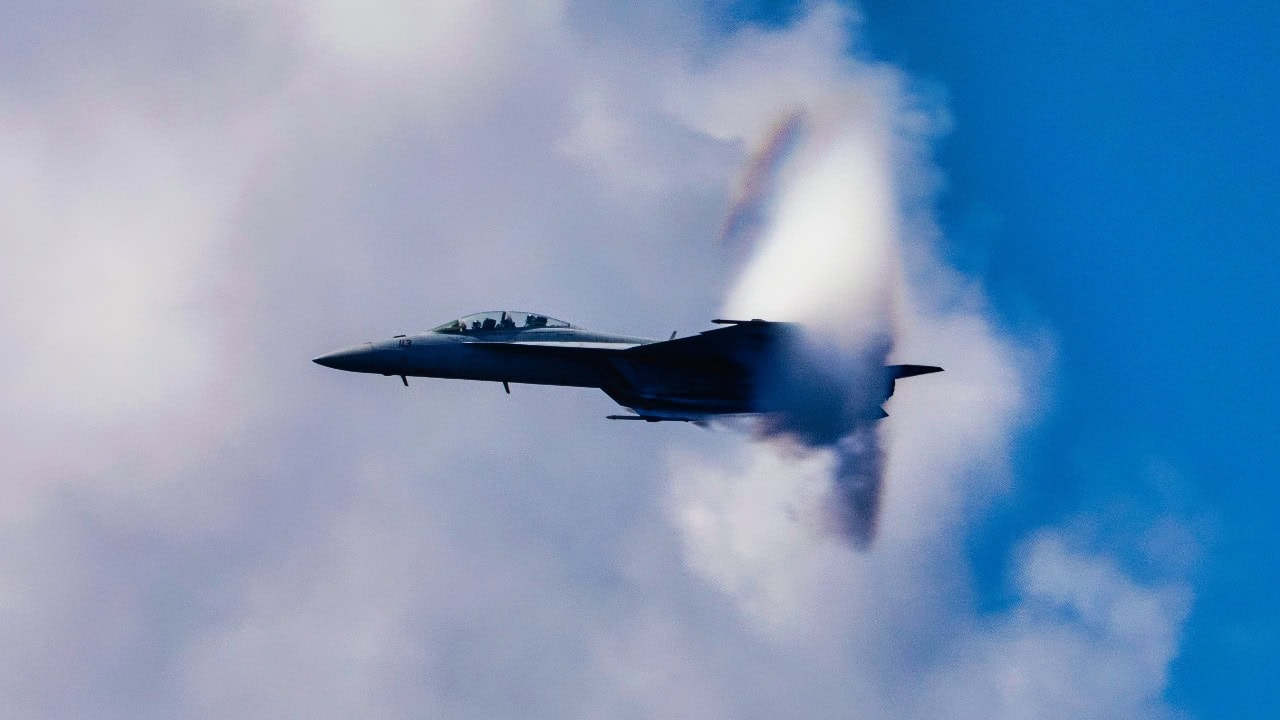
(June 18, 2023) An F/A-18F Super Hornet from the “Fighting Redcocks” of Strike Fighter Squadron (VFA) 22 breaks the sound barrier during flight operations near the aircraft carrier USS Nimitz (CVN 68). Nimitz is underway conducting routine operations. (U.S. Navy photo by Mass Communication Specialist 3rd Class Kevin Tang)
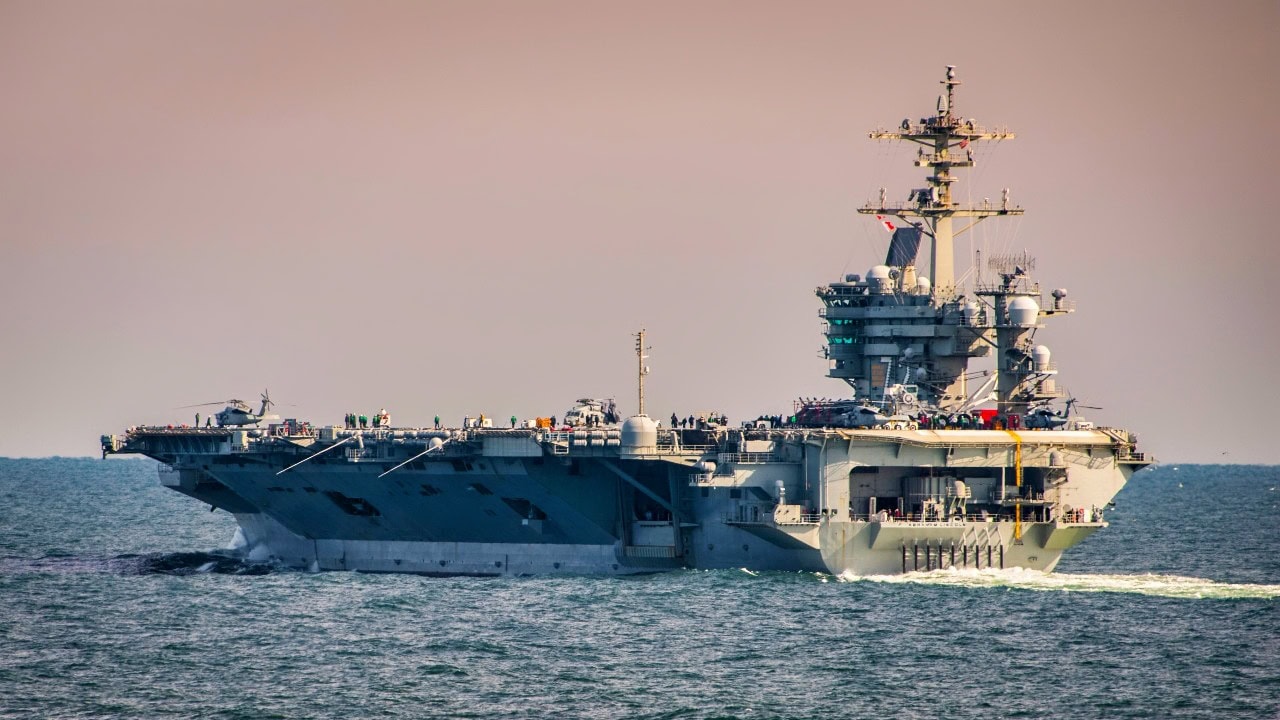
Nimitz-Class Aircraft Carrier
For decades, the United States has continued to increase its overseas commitments far beyond what is strategically necessary or constitutionally allowed. At the same time, the U.S. Navy is currently going through a resource crisis. Its fleet is diminishing and its shipyards cannot reliably meet demand.
What’s more, there is a congressionally mandated rule that requires the U.S. Navy to maintain a fleet of at least 11 aircraft carriers. So if the Navy goes forward with plans to decommission the Nimitz, there will be fewer carriers than what that law allows for at least another year or more.
The Navy is legally required to maintain the Nimitz until at least the JFK is online and fully integrated into the fleet.
Stop Treating the Nimitz Like a Relic to Be Discarded
Why not use this as a chance to put the Navy ahead of the global competition?
The Nimitz is already paid for. The Navy thinks the boat is too old to be of strategic utility. That’s fine.
Can we convert the carrier into a giant mothership for unmanned systems?
The future of naval warfare is not manned systems and large warships chugging across the High Seas.
It’s warships launching swarms of cheap drones. Imagine a platform like a carrier that could deploy a fleet of unmanned underwater vehicles (UUVs) and unmanned aerial vehicles (UAVs)?
What a Drone Mothership Actually Looks Like
Turning the USS Nimitz into a drone mothership would require a major transformation. It’d go from manned aviation strike carrier to a networked hub for large numbers of unmanned air, surface, and undersea systems.
Naval designers would have to redesign the interior of the legendary carrier by reducing or outright eliminating spaces dedicated to large, crewed aircraft squadrons. They’d need to create modular UAV parking grids and automated handling lanes.
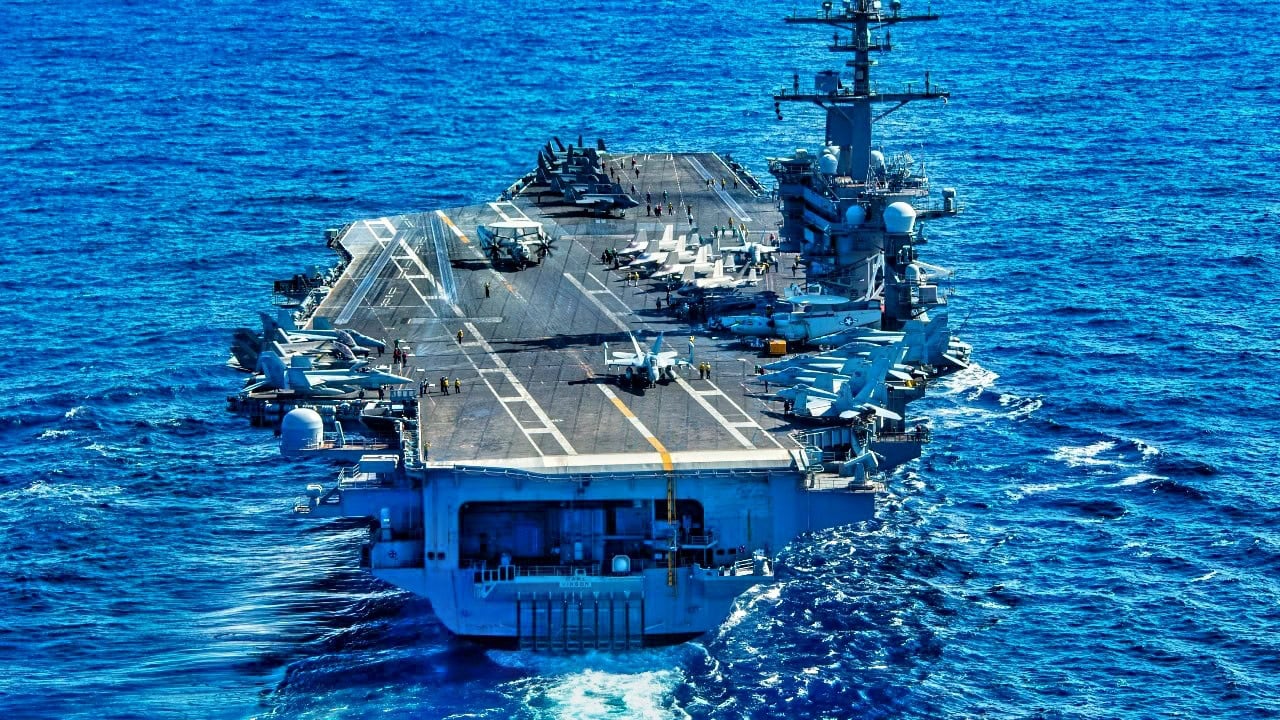
The Nimitz-class aircraft carrier USS Carl Vinson (CVN 70) transits the Philippine Sea with six additional F-35C Lightning II aircraft assigned to the “Argonauts” of Strike Fighter Squadron (VFA) 147, part of Carrier Air Wing FIVE, Dec. 13, 2024. VFA-147 operates from Marine Corps Air Station Iwakuni, Japan. U.S. Indo-Pacific Command forces perform operations in and around critical sea passages and trade thoroughfares to deter threats that create regional instability and impinge on the free flow of goods, people, and ideas. (U.S. Navy photo by Mass Communication Specialist Seaman Apprentice Pablo Chavez)
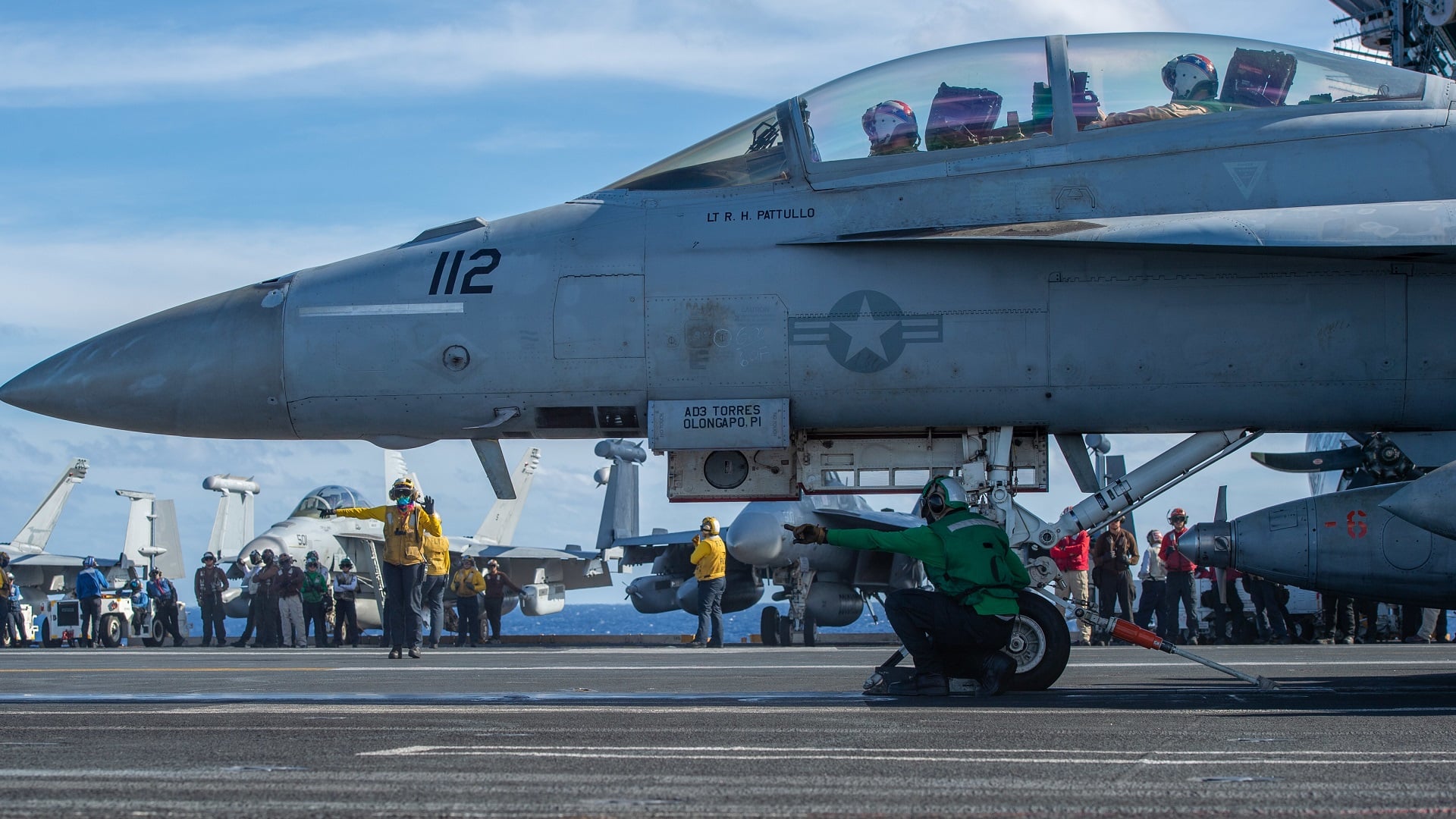
221227-N-DU622-1227 PHILIPPINE SEA (Dec. 27, 2022) An F/A-18F Super Hornet from the “Fighting Redcocks” of Strike Fighter Squadron (VFA) 22 prepares to launch from the flight deck of the aircraft carrier USS Nimitz (CVN 68). Nimitz is in 7th fleet conducting routine operations. 7th Fleet is the U.S. Navy’s largest forward-deployed numbered fleet, and routinely interacts and operates with 35 maritime nations in preserving a free and open Indo-Pacific region. (U.S. Navy photo by Mass Communication Specialist 2nd Class Justin McTaggart)
Next, the Navy would have to tailor drone-specific launch and recovery systems. They could install either electromagnetic (EM) or more likely, rail-assisted short catapults optimized for lighter UAVs. Then there would need to be vertical recovery pads for vertical takeoff and landing (VTOL) drones. After that, arresting gear specifically designed for unmanned airframes would be essential.
Onboard the carrier you would find hundreds of medium UAVs, for intelligence, surveillance, and reconnaissance (ISR), electronic warfare, and strike missions. There’d be dozens of large combat UAVs too (such as those being designed for the Collaborative Combat Aircraft program).
Those large UAVs could even ultimately be flying drone motherships themselves. Just as a Persian commanders during the Battle of Thermopylae antagonized their Spartan rivals by saying that the Persian “arrows will blot out the sun,” future American commanders of the drone carrier USS Nimitz could similarly decree that, “our drones will blot out the sun.”
Arsenal Ship in the Sky
As noted above, a true drone mothership survives or dies by networking. Therefore, the U.S. would need to install fleet-scale artificial intelligence (AI) battle management. These systems would be responsible for mission planning, deconfliction, and dynamic re-tasking. Human operators supervise rather than “fly” drones.
The ship would need hardened datalinks.
Systems such as multiband satellite communication, line-of-sight mesh networks, and optical/laser communications. Naval designers would then need to integrate the revamped Nimitz with existing unmanned ecosystems. Essentially, the USS Nimitz would become a floating data center and command node.
Consider that the Nimitz’s nuclear reactor would be perfect for sustaining the kind of electrical demand that an AI-powered aircraft carrier requires.
Naval engineers would then need to expand power distribution trunks onboard and additional chilled-water plants would be necessary.
USS Nimitz and Surviving in a Missile-Saturated Battlespace
Meanwhile, dedicated racks for AI computer clusters would ensure the AI systems onboard worked as advertised. And the Navy would need to ensure there was reserve capacity for future directed-energy weapons (DEWs).
Also, instead of loading primarily bombs and missiles for manned aircraft, the Nimitz would need to stockpile containerized loitering munitions, modular missile canisters for drone launchers, and spare drone airframes (and propulsion modules). This makes the Nimitz closer to a missile arsenal ship—only with airborne assets.
Of course, the fundamental problem of the carrier remains: it is a big target. So, the Navy would require layered defenses including high-energy lasers, high-power microwave systems, expanded EW suites, and additional point-defense interceptors. Unmanned systems, however, could be made to have extended ranges beyond what carrier-launched manned aircraft possess.
What the U.S. Navy Gains
And, if there are flying drone motherships aboard, they could be used to haul smaller drone swarms, adding range beyond even what the carrier provides (which would be useful, if the carrier had to stay out of the range of A2/AD systems).
Traditionally the Nimitz carries a crew of around 5,000 sailors. But a drone mothership would need only 2,500-3,000 sailors. There would be fewer deck crews, since the planes would be unmanned, and a greater number of software engineers, data technicians, and EW specialists on board. There would also be large numbers of cyber and signals intelligence detachments.
You would have a carrier that enjoys persistent ISR over thousands of miles, massive first-day strike capacity (without risking pilots), swarm saturation against enemy air defenses, and rapid reconstitution, because drones are replaced faster than regular manned aircraft. The Navy would be turning the old bucket of bolts, USS Nimitz, into a floating, unmanned strike continent that could be repositioned to anywhere in the world.
Give the USS Nimitz a Second Life—and the Navy a Future
Converting the USS Nimitz into a drone mothership is technically feasible, strategically powerful, but it would be costly. But unlike the waste that is the Ford-class carrier, the drone carrier Nimitz would propel US Navy doctrine into the 21st century while expediting the drone revolution.
Plus, the Nimitz is iconic enough of a ship that it deserves a renewed lease on life.
About the Author: Brandon J. Weichert
Brandon J. Weichert is the Senior National Security Editor at 19FortyFive.com. He was previously the senior national security editor at The National Interest. Weichert is the host of The National Security Hour on iHeartRadio, where he discusses national security policy every Wednesday at 8pm Eastern. He hosts a companion show on Rumble entitled “National Security Talk.” Weichert consults regularly with various government institutions and private organizations on geopolitical issues. His writings have appeared in numerous publications, among them Popular Mechanics, National Review, MSN, and The American Spectator. And his books include Winning Space: How America Remains a Superpower, Biohacked: China’s Race to Control Life, and The Shadow War: Iran’s Quest for Supremacy. Weichert’s newest book, A Disaster of Our Own Making: How the West Lost Ukraine, is available for purchase wherever books are sold. He can be followed via Twitter/X @WeTheBrandon.