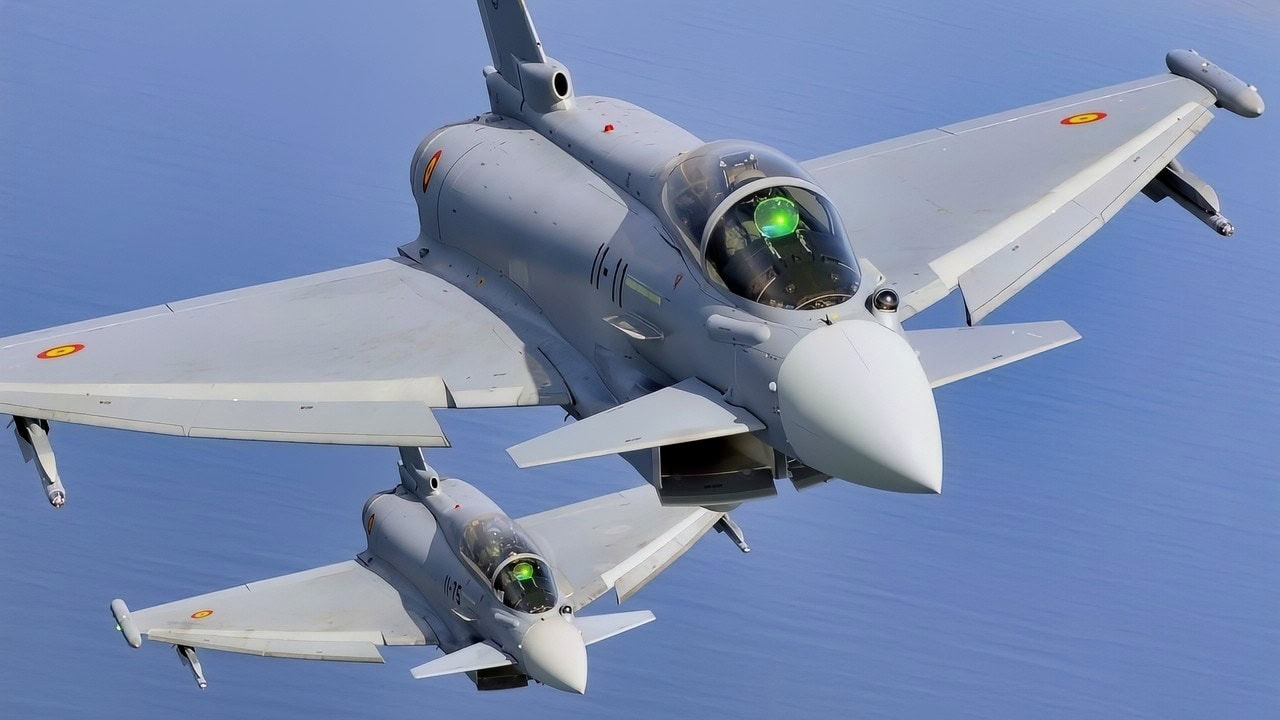
Summary and Key Points: Caleb Larson, a Berlin-based security journalist, evaluates the Eurofighter Typhoon fighter’s strategic pivot in a 5th-generation world.
-Facing threats from Russia’s Su-57 and China’s J-20, the Eurofighter consortium—led by Germany, Italy, Spain, and the UK—is rolling out the P4E Enhancement package.
-This 19FortyFive report analyzes the integration of multispectral sensor fusion, AESA radar, and DASS upgrades, exploring how the Typhoon could adopt the F-15EX “payload-first” model to operate alongside Loyal Wingmen and F-35s in contested NATO airspace through the 2060s.
Eurofighter Typhoon vs. the Stealth Era: Why a 4th-Gen Fighter Now Faces Its Hardest Test
At the moment, the United States is the world leader in stealth aircraft. Not only does it have two fifth-generation stealth fighters in service—the multi-role F-35 and the F-22 Raptor air-superiority fighter—but it also flies the world’s only stealthy strategic bomber, the B-2 Spirit. In the near future, sixth-generation aircraft will join and eventually replace the Raptor and Spirit. The upcoming F-47 fighter and B-21 Raider bomber will be the first.
Russia also operates the Su-57, a large two-engined fighter that incorporates some fifth-generation technologies, and China counts several stealthy fighters in its air fleets, with their own fifth-generation bomber in development as well.
And while European countries operate the F-35, the continent’s own home-grown fighters lack stealth-mitigating features. European fourth-generation aircraft are increasingly being left behind by aerospace advancements during the stealth era. Take, for example, one of the more successful European fighters, the aptly named Eurofighter Typhoon. It has proven to be an incredibly adaptable and successful platform, successfully bridging the Cold War and remaining in service today with several leading European powers, as well as four Middle Eastern countries. More than 680 Eurofighters have been built. But new threats threaten to end the Eurofighter’s longevity.
In the Beginning for Eurofighter Typhoon
The Eurofighter story starts during the late years of the Cold War, when NATO member-state planners and personnel recognized the pressing need for an advanced, high-tech aircraft that could survive even in highly contested aerial environments. It was not only increasingly sophisticated Soviet air defenses that NATO planners feared—it was the Soviet Union’s newest crop of advanced fighter jets.
Fourth-generation Soviet aircraft such as the Su-27 Flanker and the MiG-29 Fulcrum were highly capable, with relatively modern sensor suites, robust radars, and high-thrust power plants. In a hypothetical conflict between NATO and the Warsaw Pact, these fighter jets would have pushed the scales of power toward the Kremlin. In Europe, some of the continent’s biggest aerospace companies sought to answer the challenge.
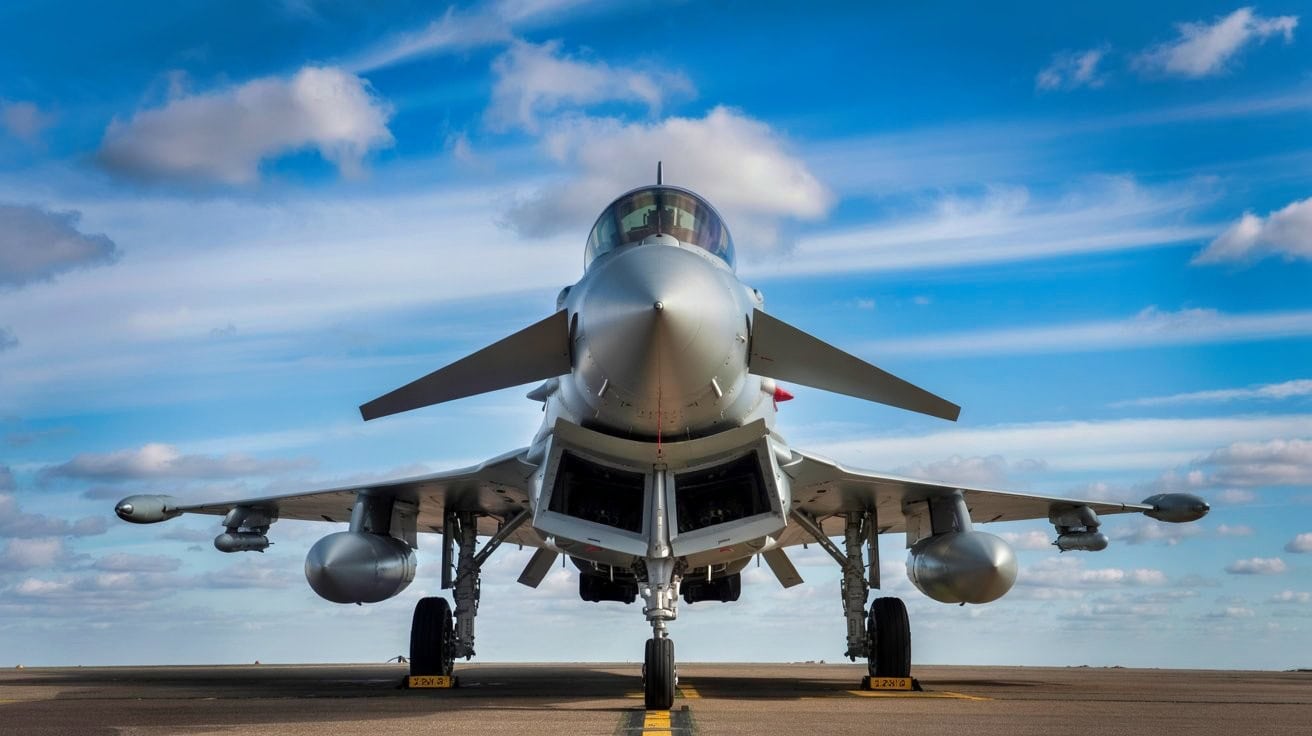
Eurofighter Typhoon. Image Created by Ideogram.
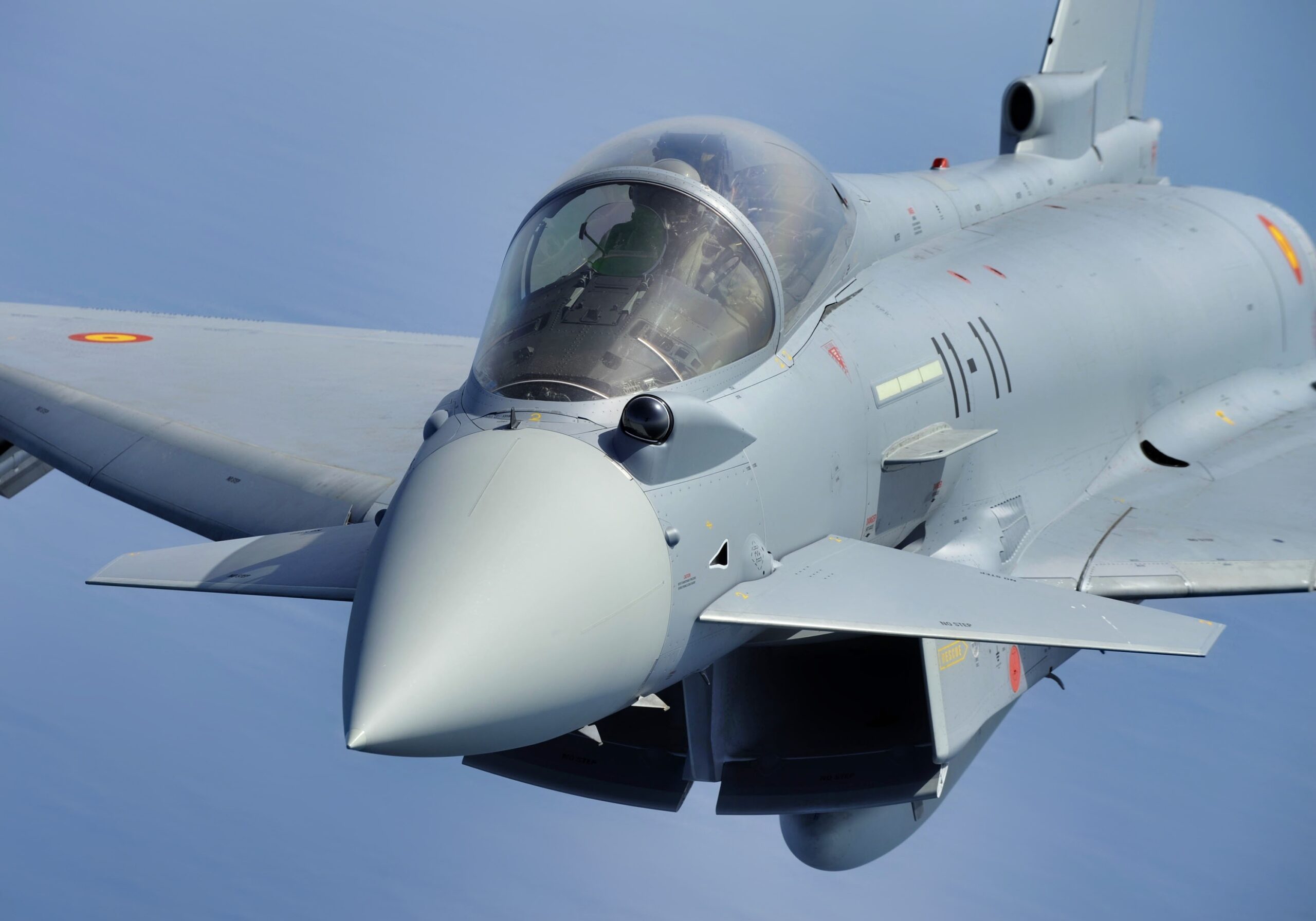
Eurofighter Typhoon Fighter. Image Credit: Creative Commons.
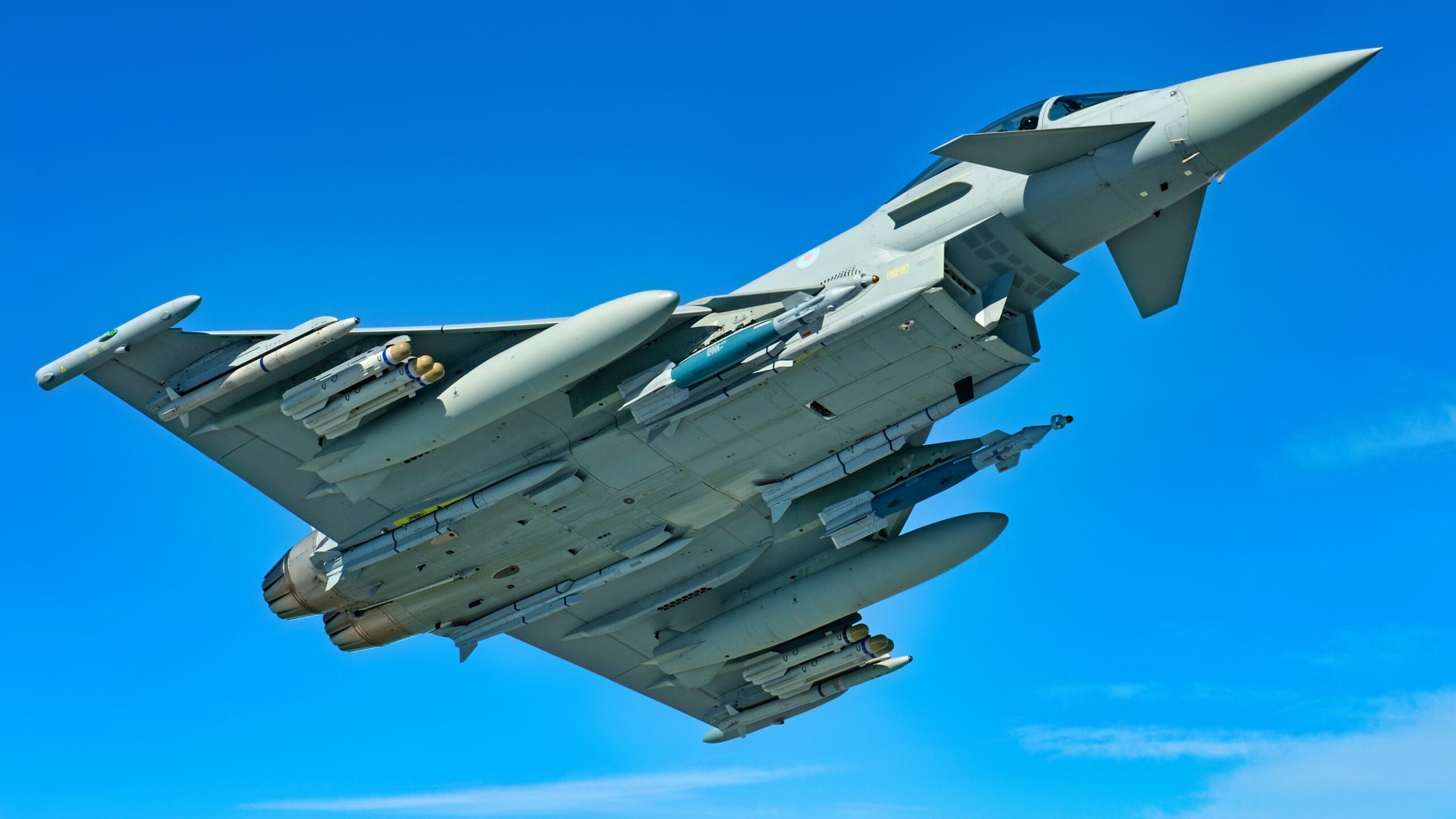
Eurofighter Typhoon. Image Credit: Creative Commons.
Germany, Italy, Spain, and the United Kingdom joined together in the 1980s and stood up the Eurofighter program, with one goal in mind: Build and design a highly agile air superiority fighter that could defeat any Soviet aircraft. To that end, their jet would incorporate fly-by-wire controls, advanced aerodynamics, and potent air-to-air missiles, as well as a sustained, Mach 2-plus supercruise capability to hold and defend NATO airspace against the Soviet threat.
Then came a twist: The Soviet Union collapsed.
With the Cold War over, Western Europe threat environment evaporated almost overnight. Instead of facing the might of the Soviet Union, capitals across the continent contended with very different challenges: air policing missions, peacekeeping, humanitarian missions, and expeditionary operations. But those kinds of operations needed more than just a capable air superiority fighter.
Those kinds of missions would require a fighter capable of performing reconnaissance, close air support, and strikes. As a result, the Eurofighter evolved into a multi-role fighter, far more than had originally been intended. It incorporated several alterations, including electronic warfare components, an upgraded radar, and precision munitions. And while the jet initiated a successful pivot to post-Cold War relevance, another era change is once again forcing difficult questions onto the European fighter.
A New Threat Environment — Again
With Russia’s full-scale invasion of Ukraine in 2022, the continent’s sleepy peacefulness ended overnight. And as Russia leverages its total-war economy to revamp its military machine and rearm, the rest of Europe is also rearming, albeit more slowly.
But in contrast to the Cold War era, today’s threat environment is increasingly turning toward fifth-generation stealth fighters, such as the U.S.-led F-35 program, and toward increasingly sophisticated aircraft emanating from China and Russia. Russia’s Su-57, notionally a fifth-generation fighter, challenges not only the Eurofighter Typhoon, but also other platforms in Europe.
Firmly rooted in fourth-generation fighter technologies, the Eurofighter Typhoon lacks the radar-defeating stealth technologies found on fifth-generation aircraft: radar-absorbing coatings, and careful wing and fuselage contouring that deflects radar away from adversaries. To survive, an upgraded Eurofighter would need a combination of technical upgrades, updated operational concepts, and integration with more advanced systems.
Change is in the Air for Eurofighter Typhoon
A number of upgrades are upcoming for the Eurofighter. One of the most important will be multispectral sensor fusion, which means integrating radar, infrared search-and-track, and other passive sensors to paint a rich picture of the threat environment for Eurofighter pilots.
But the aircraft would have to become more survivable, too. What that means specifically for the Eurofighter is hard to say.
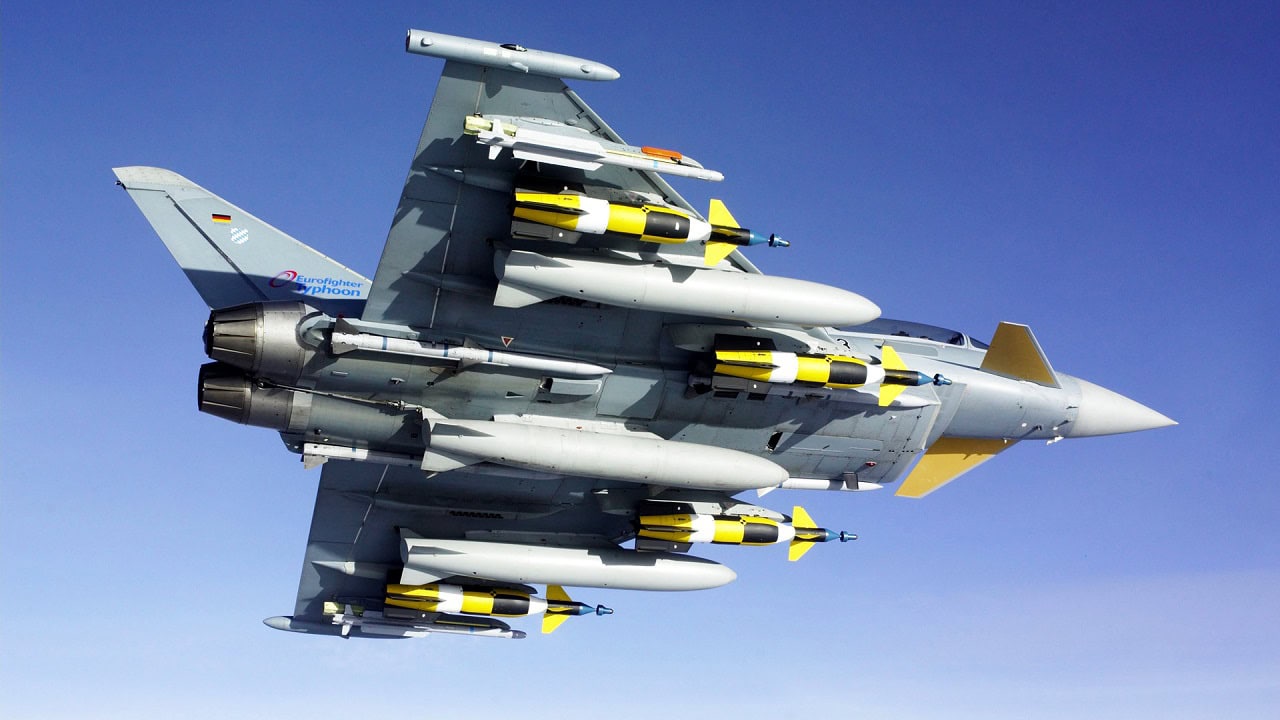
Eurofighter Typhoon. Image Credit: Creative Commons.
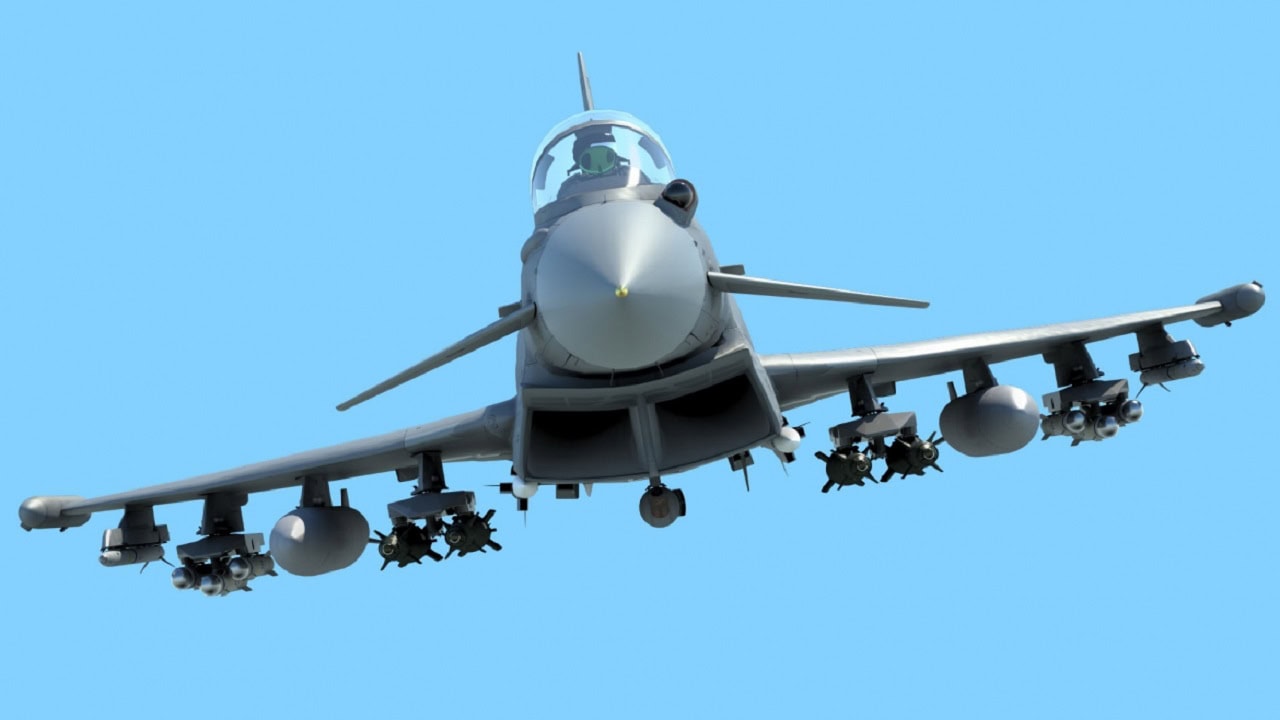
Typhoon fitted with the common launcher (computer generated image: for illustrative purposes only)
“All of the maturing technologies above increase Eurofighter Typhoons survivability and superiority in the future battlespace,” the Eurofighter Typhoon website explains. “Additionally, improved defensive aid subsystems and enhanced data connections allow direct updates to the airframe and with full control over mission data the Eurofighter Typhoon will reach higher levels of survivability.”
One more concrete improvement is the P4E Enhancement, an upgrade package that “contains a number of new developments, including an automated sensor management capability for all Typhoon radars.” This update “allows the user to exploit the capabilities of the AESA (Active Electronically Scanned Array) radar to complete multiple simultaneous tasks, while reducing the pilot workload required as they manage different sensors,” according to a Eurofighter press release outlining the details of P4E.
The press release adds that this “includes an improved cockpit interface and enhanced Radio Frequency Interoperability (RFIO). This will improve survivability and lethality. In addition to the automated sensor management capability, P4E will introduce DASS (Defensive Aids Sub-System) upgrades for all customers and includes the German IOC (Initial Operating Capability) additional electronic warfare capability.”
The Israeli Example
The Eurofighter could be reinvisioned not as a frontline fighter, but as a mature, reliable, and sustainable fighter that operates in tandem with more advanced aircraft as a secondary support fighter. This would be somewhat akin to the role of modernized F-15EX Eagles and F-16 Block 70/72 fighters in the U.S. National Guard or the Israeli Air Force (IAF).
Israel has successfully deployed the fourth-generation F-15 as a highly capable fighter-bomber, leveraging its dual engines and high-payload capacity to strike high-value targets after suppressing or destroying enemy air defenses—most recently during the Twelve Day War against Iran. During that conflict, Israeli F-35Is successfully destroyed Iranian air defense assets, paving the way for IAF F-15s and F-16s to fly with near total impunity throughout the country. A similar strategy could be one way forward for the Eurofighter.
The Eurofighter also could be outfitted with extended-range stand-off munitions to fill an operational role like that of Russian warplanes in their war against Ukraine. Instead of going head-to-head against other aircraft, those Russian jets are essentially missile-toting platforms that launch glide bombs, cruise missiles, and other long-range weaponry against Ukrainian targets. Weapons such as the Meteor missile, could help ensure the Eurofighter retains a measure of combat relevance.
The ability to operate alongside Loyal Wingmen-type unmanned aircraft could also keep the Eurofighter relevant. Such future unmanned platforms, both armed and unarmed, promise to keep human pilots farther out of harm’s way.
Into the Horizon
Ultimately, the Eurofighter can only be upgraded so far, and its future as a frontline fighter diminishes as time goes on and the threat environment intensifies. To remain combat-relevant in the near- and medium-term, the Eurofighter would have to augment its sensor fusion and networking capabilities, and potentially integrate more sophisticated electronic warfare technology.
Despite the challenges that lie ahead, Eurofighter CEO Jorge Tamarit Degenhardt said that orders for new Eurofighters are sufficient to increase production to 20 aircraft per year. He added that “we’re already eyeing 30 or more if these export orders materialise.”
“These deliveries will happen over the next decade, which means increased throughput, further investment in manufacturing technologies and the strengthening of our supply chain,” Degenhardt added, and said that the Typhoon will fly “well into the 2060s.” Despite headwinds, the sun has not yet set on one of the continent’s most successful pan-European fighters.
About the Author: Caleb Larson
Caleb Larson is an American multiformat journalist based in Berlin, Germany. His work covers the intersection of conflict and society, focusing on American foreign policy and European security. He has reported from Germany, Russia, and the United States. Most recently, he covered the war in Ukraine, reporting extensively on the war’s shifting battle lines from Donbas and writing on the war’s civilian and humanitarian toll. Previously, he worked as a Defense Reporter for POLITICO Europe. You can follow his latest work on X.