
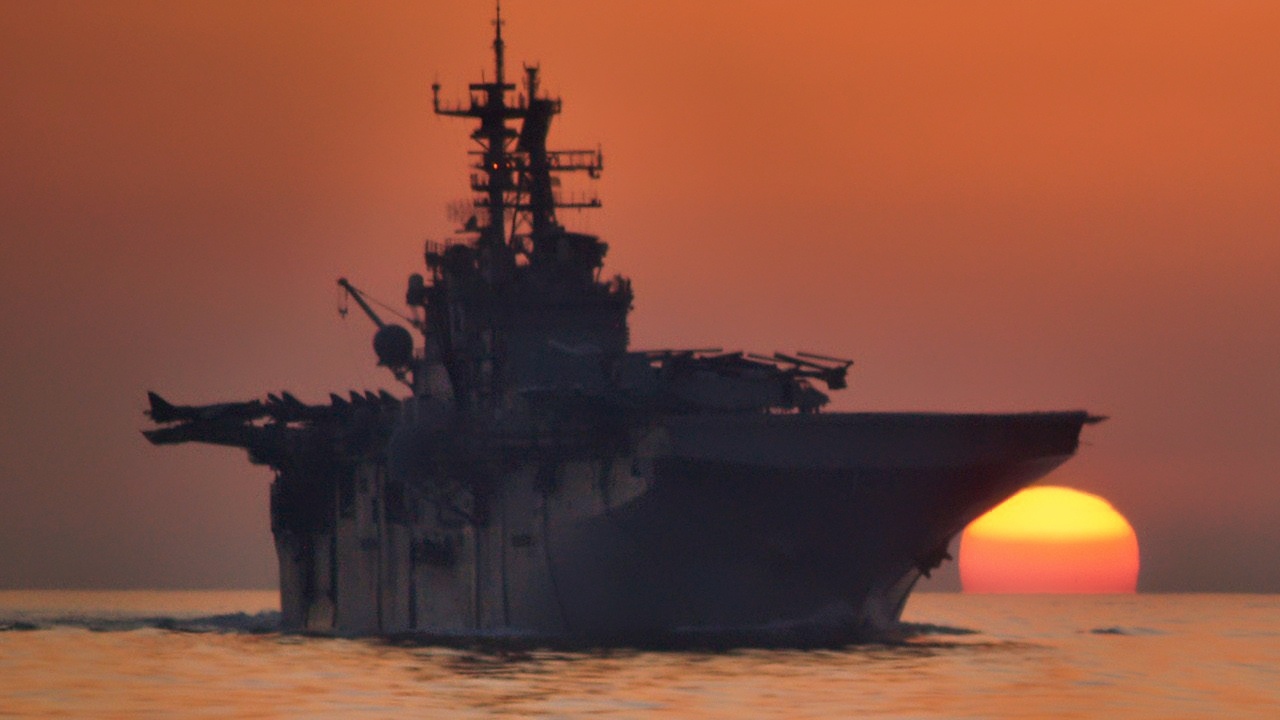
Summary and Key Points: USS Iwo Jima (LHD-7), a Wasp-class amphibious assault ship, is slated for a major maintenance period after its recent deployment, with BAE Systems awarded a roughly $204.1 million to $255.8 million contract for repairs, overhauls, and upgrades.
-The work is expected to run until February 2028, potentially sidelining a ship that can support amphibious assaults, crisis response, and even a “Lightning Carrier” configuration with up to 20 F-35Bs.
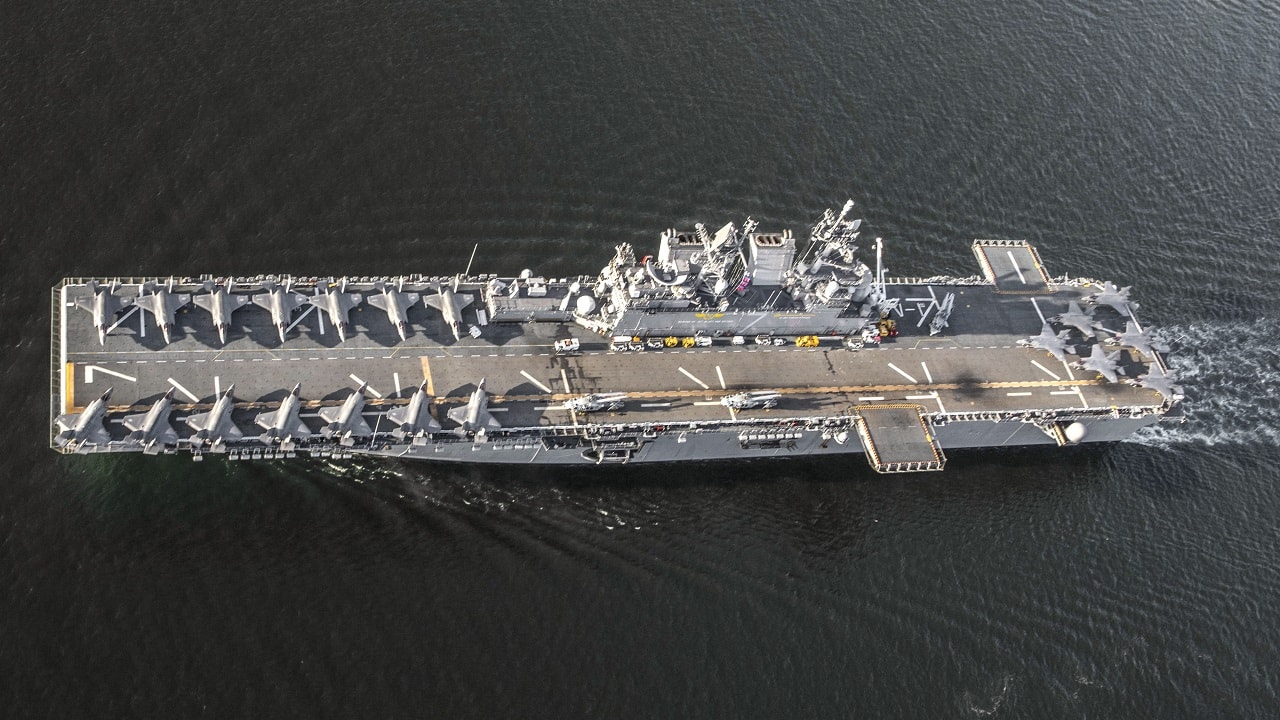
Amphibious assault ship USS Tripoli (LHA- 7) , departs Naval Air Station North Island, Calif., April 7, 2022. Tripoli completed flight deck operations with 20 F-35B Lightning II jets from Marine Fighter Attack Squadrons 211 and 225, Marine Aircraft Group 13, and 3rd Marine Aircraft Wing, as well as Marine Operational Test and Evaluation Squadron 1, as part of the U.S. Marine Corps’ Lightning carrier concept demonstration. The Lightning carrier concept demonstration shows Tripoli and other amphibious assault ships are capable of operating as dedicated fixed-wing strike platforms when needed, capable of bringing fifth generation Short Takeoff/Vertical Landing aircraft wherever they are required. (U.S. Marine Corps photo by Sgt. Samuel Ruiz)
-While Iwo Jima and the 22nd MEU have been operating in the Caribbean, rising pressure on Iran could revive talk of retasking—at the cost of delaying needed readiness work.
Amphibious Assault Ship Iwo Jima To Be Sidelined For Two Years
One of the ships that could be tasked to provide the US Navy with a second aircraft carrier strike group in the seas off Iran may be undergoing much-needed maintenance for the next two years.
The Wasp-class amphibious assault ship Iwo Jima (LHD-7), which was used in the Caribbean during the capture of Venezuelan strongman Nicolas Maduro, is scheduled to undergo a planned $204.1M to $255.8M contract that covers critical repairs, system overhauls, and upgrades to ensure the Wasp-class amphibious assault ship remains operational.
BAE Systems was awarded the contract to perform the maintenance.
The Iwo Jima left its home port of Norfolk, VA, in August for its current deployment, which ended an eight-month gap in the Navy and Marine Corps’ Amphibious Ready Group and Marine Expeditionary Unit presence at sea.
“I want to maximize the availability of our amphibious ships, and I’ve done poorly in that, particularly in [USS Wasp (LHD-1)] and Boxer deployments,” acting chief of naval operations Admiral Jim Kilby told the House Armed Services Committee in June.
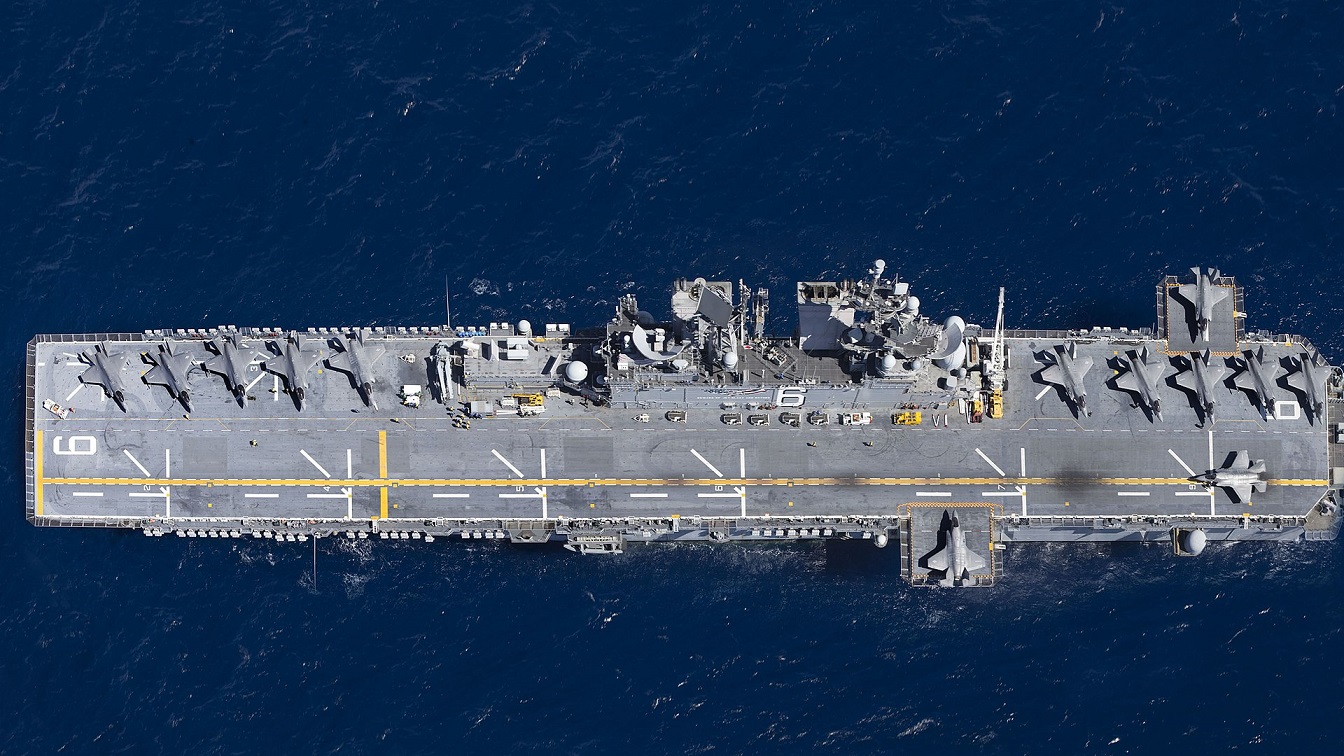
Thirteen U.S. Marine Corps F-35B Lightning II with Marine Fighter Attack Squadron (VMFA) 122, Marine Aircraft Group 13, 3rd Marine Aircraft Wing (MAW), are staged aboard the amphibious assault ship USS America (LHA 6) as part of routine training in the eastern Pacific, Oct. 8, 2019. Integrating 3rd MAW’s combat power and capabilities while conducting realistic training is essential to generate readiness and lethality in our units. (U.S. Marine Corps photo illustration by Lance Cpl. Juan Anaya)
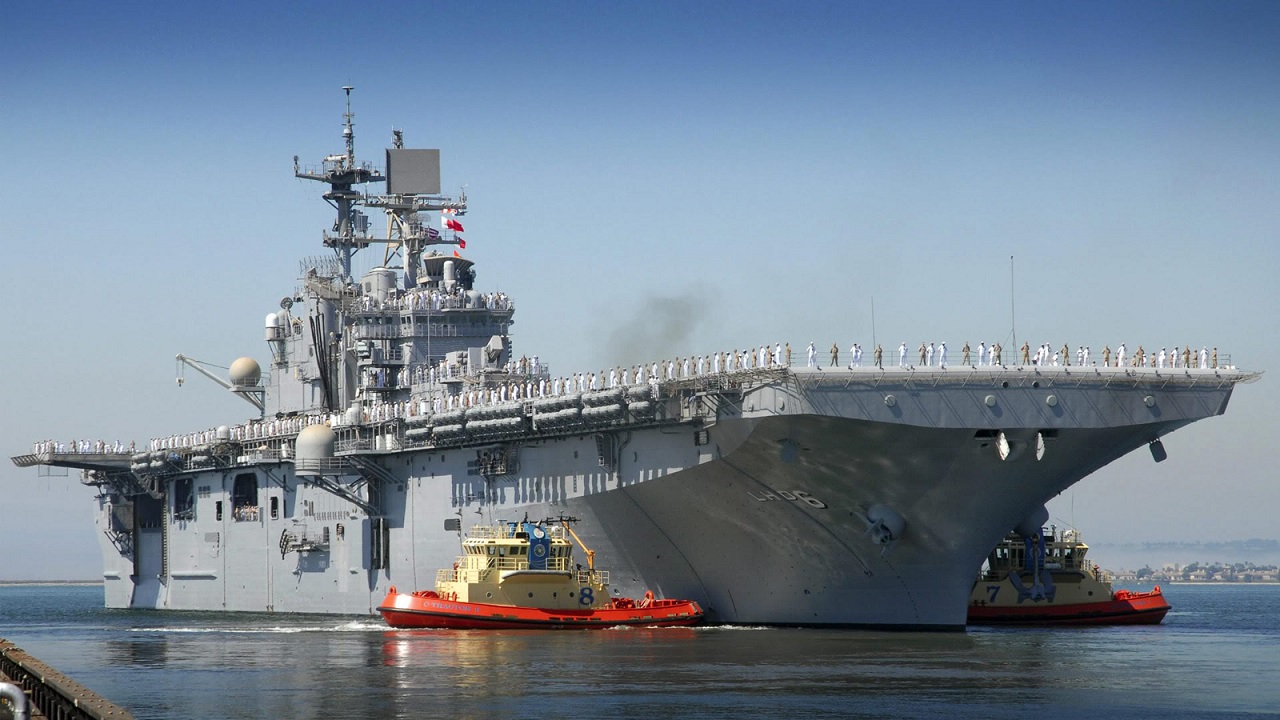
U.S. Navy Assault Ship. Image Credit: Creative Commons.
“I’m committed to getting our amphibious maintenance done on time so the Marines can embark and we can deploy as scheduled for the global force management process.”
The mission of the Iwo Jima is to provide a rapid-response force for maritime interdiction, amphibious assault, special operations, and crisis response.
The work is scheduled for completion by February 2028.
With President Trump sending another aircraft carrier towards Iran, the Iwo Jima and its readiness group could be an option for the president to have even more presence. If so, then its maintenance program may be delayed.
Earlier Repairs Were Done At Sea During Its Deployment
Forbes reported that some repairs were made during its deployment to the Caribbean off the coast of Venezuela.
“In December, a sailor and civilian team from the Mid-Atlantic Regional Maintenance Center completed a two-week assignment that included a series of planned repairs essential to the safety and mission readiness aboard USS Iwo Jima and the amphibious transport dock USS San Antonio (LPD 17),” Forbes reported.
“According to the Naval Sea Systems Command, the work included repairs to a plenum bulkhead, bolted access points, and bulwark door access, as well as multiple structural repairs on the warships. The team further carried out “non-destructive testing” and completed associated repairs on one of LHD-7’s level decks, ensuring structural integrity and continued compliance with Fleet standards.”

CORAL SEA (July 27, 2021) The forward-deployed amphibious assault ship USS America (LHA 6) conducts a fueling-at-sea with the Royal Australian Navy frigate HMAS Ballarat (FFH 155) in support of flight deck operations during Exercise Talisman Sabre 21. Australian and U.S. Forces combine biannually for Talisman Sabre, a month-long multi-domain exercise that strengthens allied and partner capabilities to respond to the full range of Indo-Pacific security concerns. (U.S. Navy photo by Mass Communication Specialist 3rd Class Matthew Cavenaile)

U.S. Sailors watch from a landing craft as they pull away from the forward-deployed amphibious assault ship USS Essex (LHD 2) off the coast of Cambodia in the Gulf of Thailand, March 2, 2011. Essex is the lead ship of the Essex Amphibious Ready Group and was participating in Maritime Exercise 11, a theater security cooperation visit to improve capabilities of the United States and Royal Cambodian Armed Forces. (DoD photo by Mass Communication Specialist 3rd Class Adam M. Bennett, U.S. Navy/Released).
Iwo Jima Has Been In the Caribbean, Not The Middle East
Since early 2026, the USS Iwo Jima (LHD-7) and its Amphibious Readiness Group (ARG) have been operating in the Caribbean, not the Middle East, with some reports indicating the ship is concluding a deployment that began in August 2025.
The Iwo Jima last deployed to the U.S. 5th Fleet (Persian Gulf/Iran region) in 2021 and 2018.
The Iwo Jima ARG (including USS Fort Lauderdale and San Antonio) is currently deployed with the 22nd Marine Expeditionary Unit in the Caribbean, supporting US Southern Command.
While there are reports of other U.S. forces massing in the Middle East in 2026, the Iwo Jima is currently assigned to the Caribbean, though reports note it could theoretically be re-tasked.
The Iwo Jima can carry as many as 20 F-35B short-takeoff and landing fighters when configured for specialized “Lightning Carrier” sea-control missions.
Currently, the US has the USS Abraham Lincoln carrier strike group in the Arabian Sea off the coast of Iran. The strike group is comprised of the USS Abraham Lincoln, the guided-missile cruiser USS Mobile Bay (CG 53), and destroyers from Destroyer Squadron 21 (DESRON 21), including USS O’Kane (DDG-77), USS Frank E. Petersen Jr. (DDG-121), USS Spruance (DDG-111), and USS Michael Murphy (DDG-112).
The Arleigh Burke class guided missile destroyer USS Delbert D. Black just joined that force, a Navy official told TWZ.
Iwo Jima Carries A USO Recharge Center
The Navy announced last July that the Iwo Jima was the first Navy amphibious warship to carry a USO recharge center.
“The afloat centers include many of the same amenities as a land-based center, such as comfortable seating, TVs, video and board games, and snacks. Equipping the ship with these centers creates a home away from home for Sailors and embarked Marines while on deployment, the Navy said.
“Onboard Iwo Jima, we have 2,200 Sailors and Marines, warfighters who are being prepared and are ready to support our nation’s business when we deploy,” Capt. Kathryn Wijnaldum, executive officer of Iwo Jima, announced.
“Our intent for its [centers] use is that they will provide an opportunity to support the warfighter—to help them reset, recharge, and de-stress—so that they can resume their duties that enable us to accomplish our mission and get the job done when our nation calls upon us.”
About the Author: Steve Balestrieri
Steve Balestrieri is a National Security Columnist. He served as a US Army Special Forces NCO and Warrant Officer. In addition to writing on defense, he covers the NFL for PatsFans.com and is a member of the Pro Football Writers of America (PFWA). His work was regularly featured in many military publications.