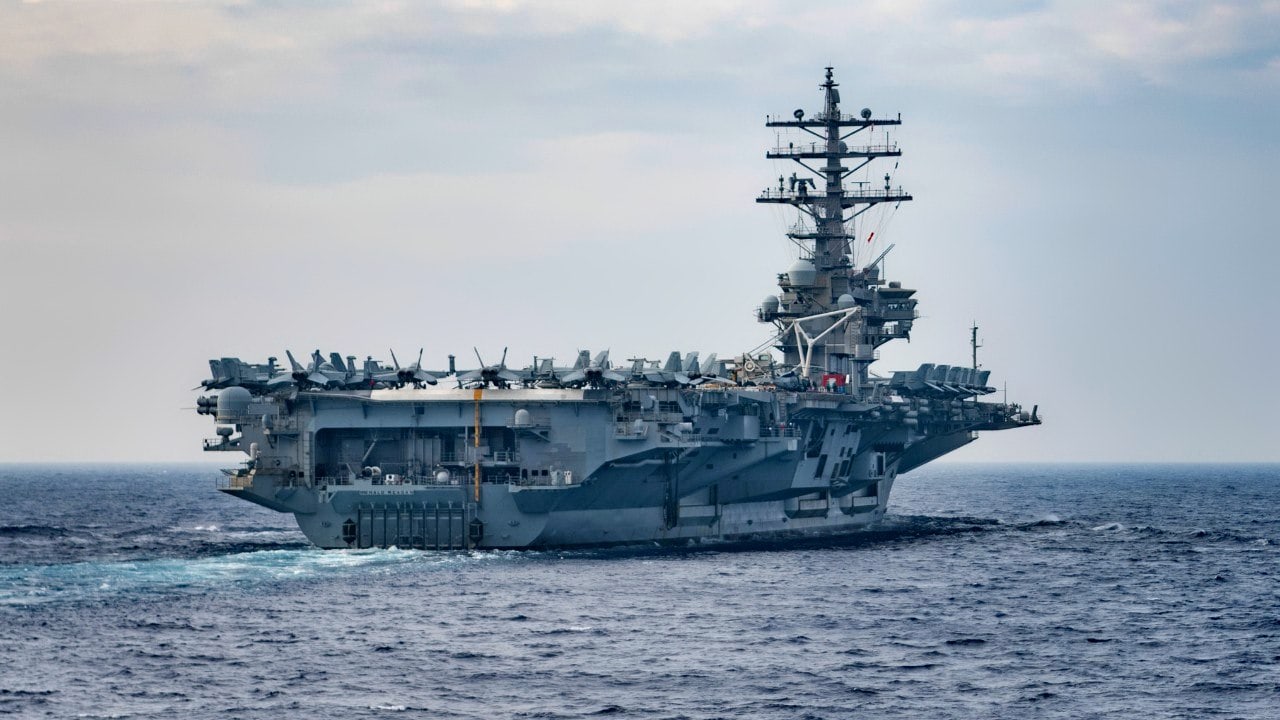
Summary and Key Points: As Washington sends a second carrier group to the Middle East, the key question isn’t negotiations with Iran but whether China’s satellite tracking could help Iran’s anti-ship ballistic missiles build a real targeting picture on a U.S. flattop.
-The argument is that Iran functions as a live-fire laboratory for Beijing’s broader A2/AD playbook—satellite cueing, missile salvos, ISR disruption, and layered air defenses—designed to keep U.S. forces out of the First Island Chain.
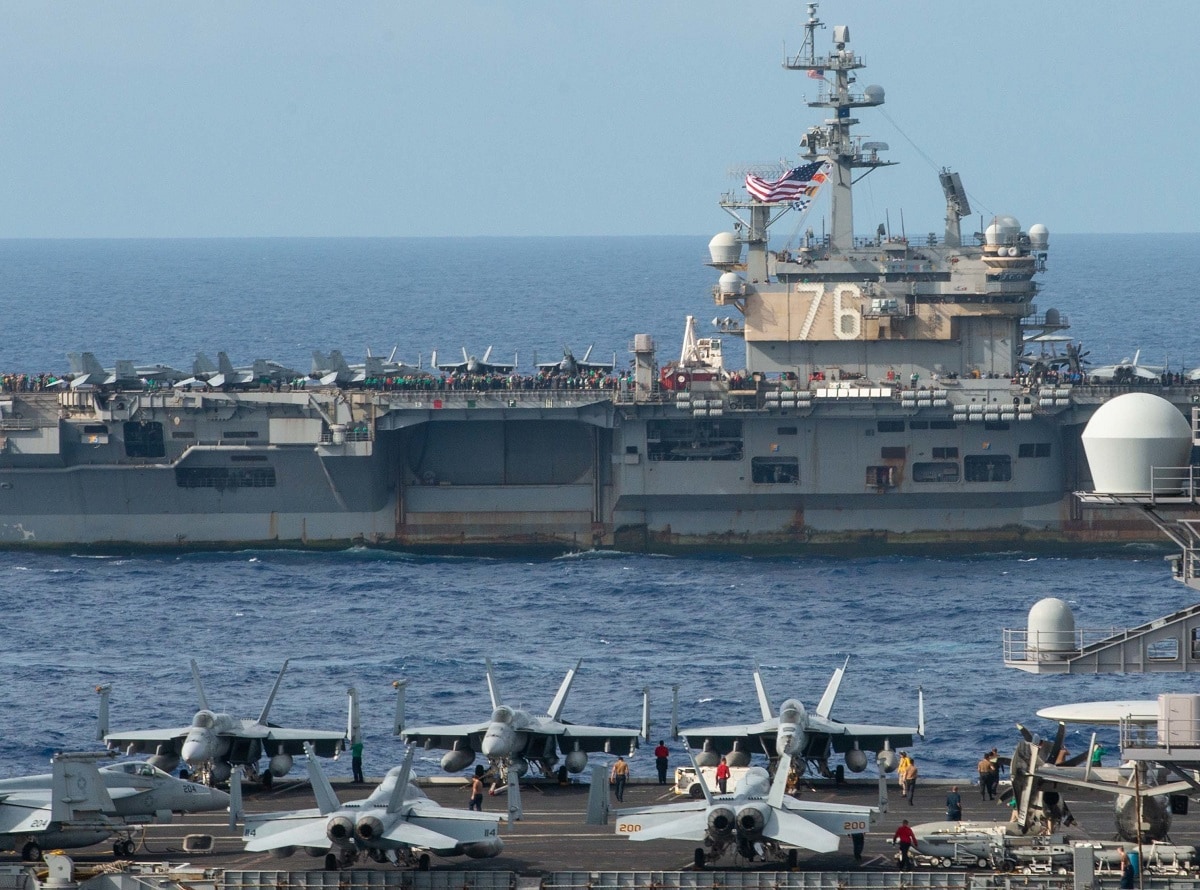
The U.S. Navy Nimitz-class aircraft carriers USS Carl Vinson (CVN 70) and USS Ronald Reagan (CVN 76) transit the Philippine Sea during a photo exercise with multiple carrier strike groups, Oct. 3, 2021. The integrated at-sea operations brought together more than 15,000 Sailors across six nations, and demonstrates the U.S. Navy’s ability to work closely with its unmatched network of alliances and partnerships in support of a free and open Indo-Pacific. (U.S. Navy photo by Mass Communication Specialist 2nd Class Michael B. Jarmiolowski) 211003-N-LI114-1208.
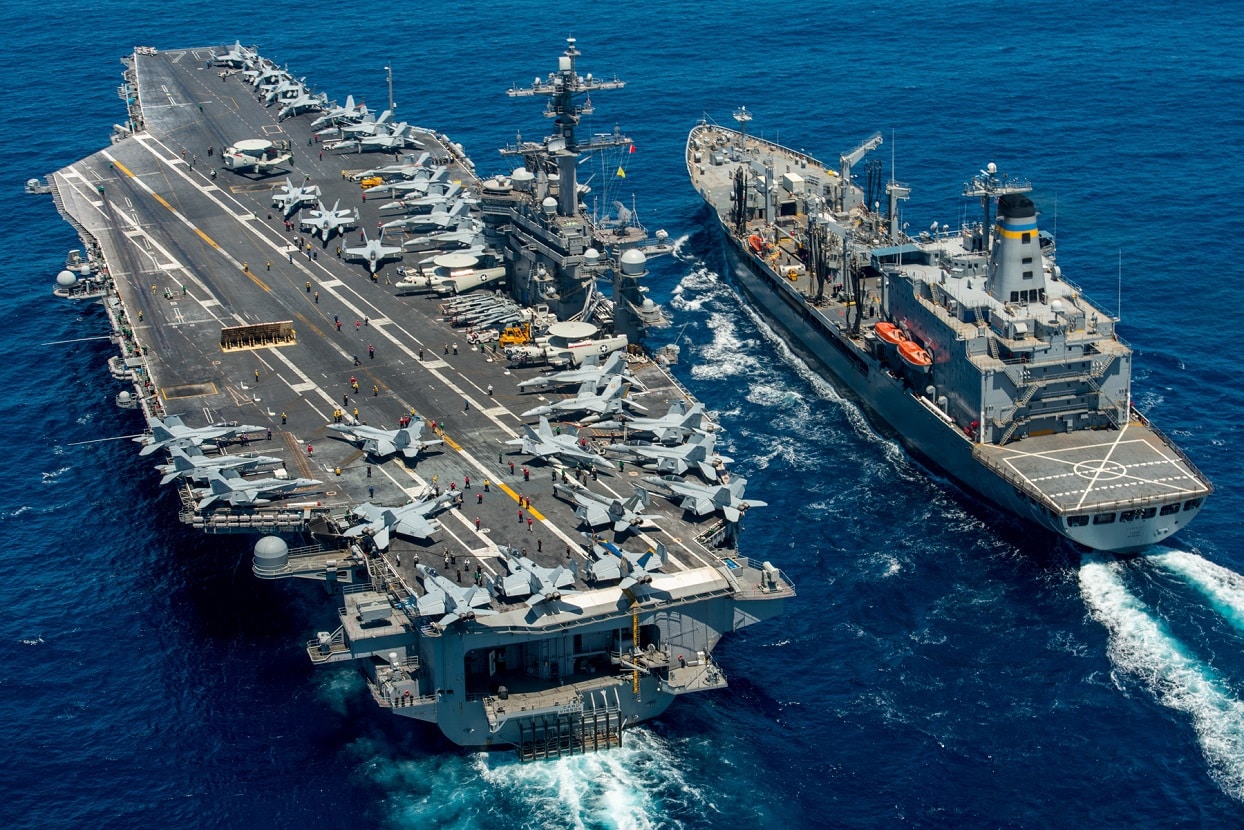
PACIFIC OCEAN (July 26, 2016) The aircraft carrier USS Carl Vinson (CVN 70) conducts a replenishment-at-sea with the fleet replenishment oiler USNS Yukon (T-AO 202). Carl Vinson is underway with embarked Carrier Air Wing 2 and Destroyer Squadron 1 conducting the Tailored Ship’s Training Availability (TSTA) and Final Evaluation Problem in preparation for their upcoming deployment. During TSTA, Afloat Training Group Pacific evaluates training drills and real-world scenarios, while placing an emphasis on damage control, flight deck operations and simulated combat. (U.S. Navy photo by Mass Communication Specialist 2nd Class Patrick W. Menah Jr./Released) 160726-N-LQ653-108
-Adding aircraft carriers may look like deterrence, but it could also create a higher-value test case that accelerates China’s learning curve for a Taiwan fight.
The Aircraft Carrier Obsolescence Debate: A Middle East “Dress Rehearsal” for Taiwan
As the Trump administration sends a second aircraft carrier group to the Middle East, ostensibly part of its immense pressure campaign on the Islamic Republic of Iran, it is important to understand what has gone on in the last few weeks, since January 15, when it seemed that the US president was about to order airstrikes on Iran.
Two Aircraft Carriers to the Middle East? That’s Exactly the Test China Wants
One of the possible reasons why Trump has pulled back in what seems like a few occasions has less to do with his trust that negotiations with the mullahs will succeed and more to do with something else: what I would argue is the likely assistance that China’s advanced satellites could be providing to Iran’s robust anti-ship ballistic missile (ASBM) arsenal that would be used to attack the USS Abraham Lincoln.
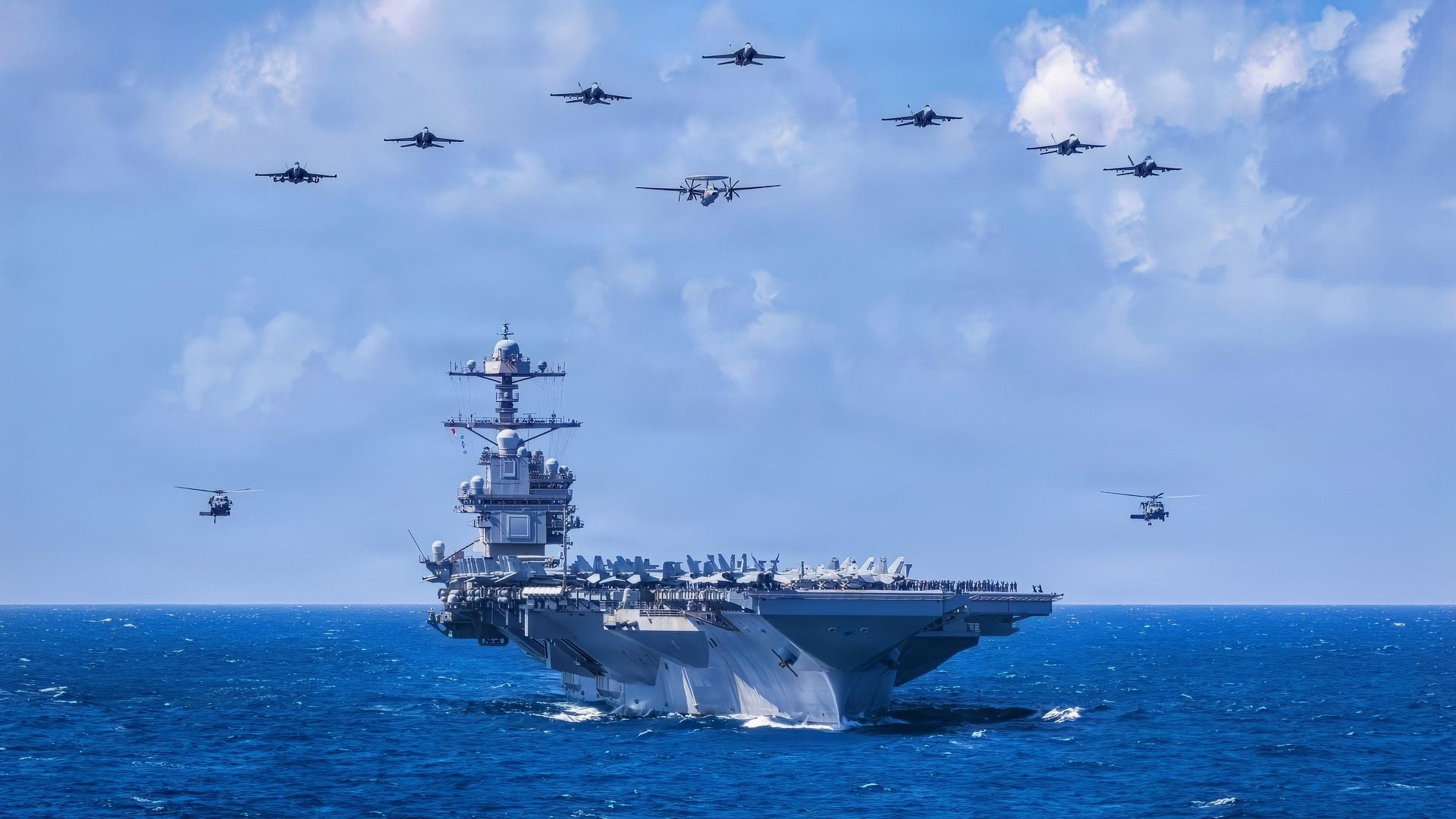
USS Ford Supercarrier U.S. Navy. Image Credit: U.S. Navy.
Trump pulled back. China might have doubled down, and both continued what I would argue is their satellite coverage of the US aircraft carrier in the Mideast and added maybe even more intelligence-gathering capabilities to assist Iran’s possible targeting.
Trump is now deploying a second carrier group to the region to support the first, the USS Gerald R. Ford. This is because the White House surely believes that the Iranian ASBM threat will be less difficult to handle with two aircraft carriers rather than one.
Iran is Beijing’s Live-Fire Laboratory Against Aircraft Carriers
But this assertion misses the larger point.
China has led the world in perfecting what is known as anti-access/area-denial (A2/AD) capabilities. They’re using Iran today as a testing ground for perfecting these weapons against America’s primary surface warfare combatant, the aircraft carrier.
Even though losing Iran as a source of 14-15 percent of China’s oil will be damaging to China’s economy, the chance to surreptitiously test these ASBM missiles and possible satellite tracking systems against a live American target is more than appealing to Beijing, which is preparing for a strike on Taiwan.
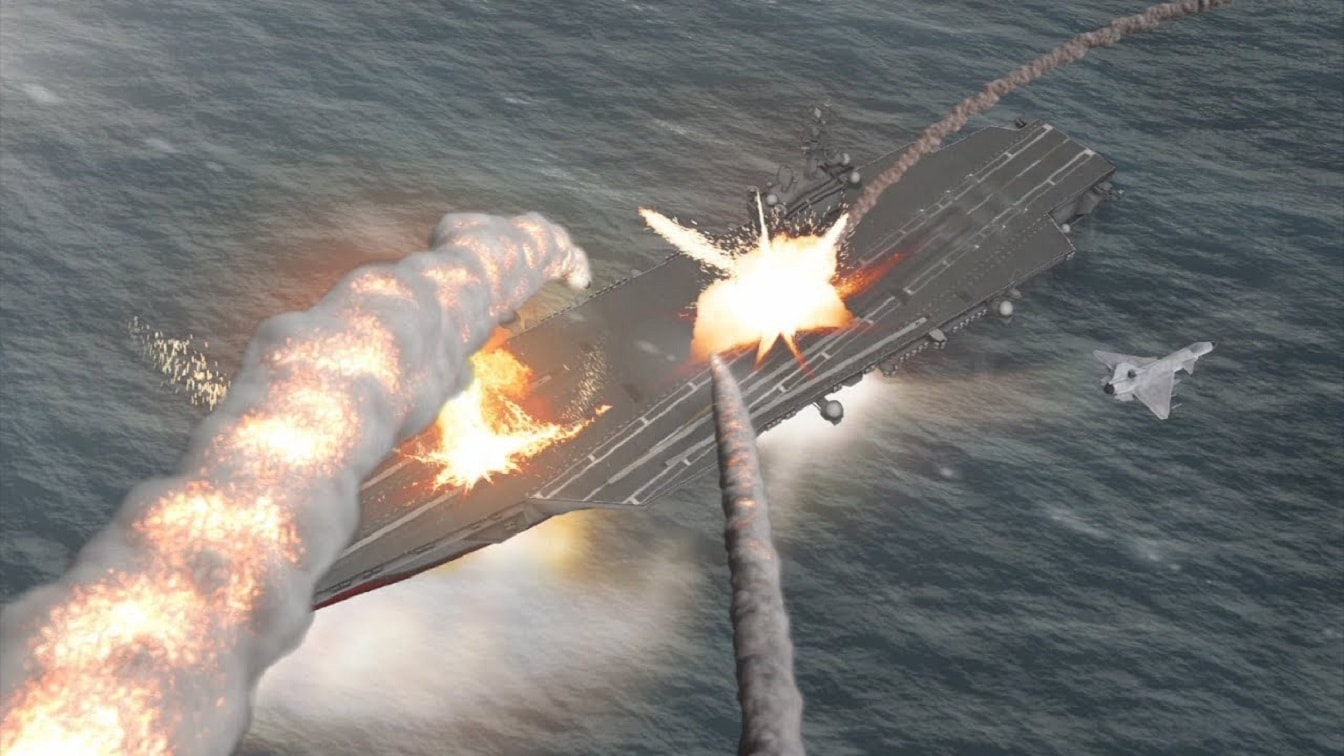
YouTube Screenshot of a Simulation of China Firing a DF-21 ASBM.
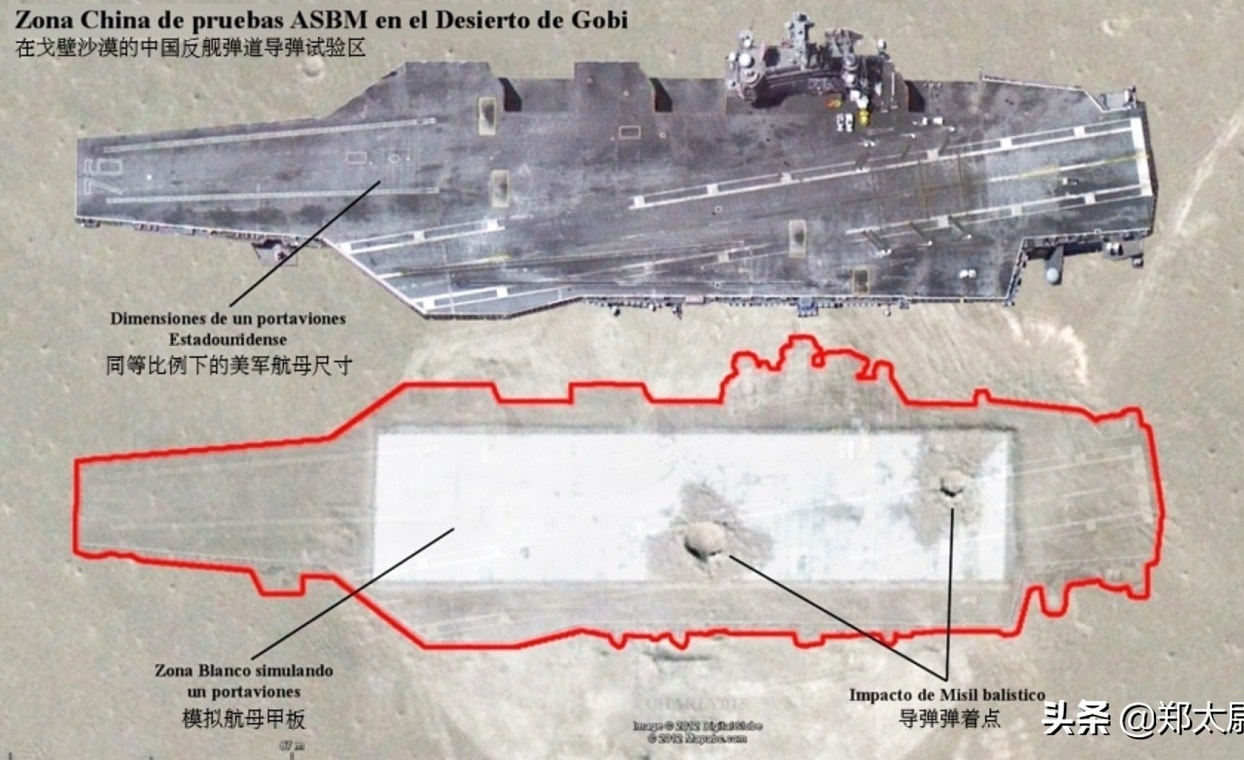
Image from the now closed WantChinaTimes. This shows a mock attack on a U.S. Navy aircraft carrier.
The Real Battlefield: The First Island Chain
That brings us to what many (should) consider the primary zone of geostrategic competition and the likely focus of a major great-power conflict—the Indo-Pacific. There, in what’s known as the First Island Chain (of three), China has spent the better part of a decade building a comprehensive, vast array of A2/AD networks all aimed at one thing: denying the United States Navy and Air Force of their abilities to project power into that First Island Chain.
China’s A2/AD network is even more dangerous to US carriers (and other surface warships) than Iran’s ASBM arsenal. If President Trump held back because of fears surrounding those Iranian ASBMs, and if China’s A2/AD systems are more robust and advanced than Iran’s, it stands to reason that China has already achieved significant overmatch over the United States in the First Island Chain.
As time progresses, China will solidify and expand this overmatch. That’s not just me saying this. Last year, the New York Times confirmed that the Pentagon’s most recent Overmatch Briefing determined that any fight between the United States and China that occurred near Chinese shores—in that First Island Chain, specifically over Taiwan—would result in a US military defeat.
Inside China’s A2/AD Kill Zone
China’s impressive A2/AD network includes systems such as the Dongfeng (DF) series of missiles. These form the foundation of the A2/AD network arrayed across the First Island Chain. This network of DF-series missiles includes the DF-26 “carrier-killer” anti-ship ballistic missiles (ASBMs), which, as their nickname suggests, are specifically designed to target US aircraft carriers.
Then there’s the extensive use of land-attack and anti-ship cruise missiles launched from ships, aircraft, and ground launchers, all part of this integrated A2/AD network.
Meanwhile, China has established man-made islands scattered throughout the South China Sea (SCS), along some of the world’s most important waterways. They have established an entire ecosystem of advanced radars, missile launchers, and aviation facilities on such manmade islands, allowing for Chinese forces to project power throughout the First Island Chain—and to deny access to that critical First Island Chain to US forces.
Fortress South China Sea vs. U.S. Navy Supercarriers
That’s the anti-access part.
The Area-Denial bit includes air defense systems such as the Russian-made S-300 and S-400, as well as indigenously produced HQ-9 or HHQ-9 systems. Together, these systems create a dense layer of anti-air bubbles—meaning that enemy forces will have difficulty retaliating against the anti-access weapons these air defense layers protect.
Electronic warfare (EW) and cyber warfare components are also essential elements of China’s A2/AD. Chinese forces are training to disable or destroy American surveillance, reconnaissance, and communication networks (ISR) either through EW, cyberattacks, or even counterspace attacks. Cyberattacks would be used to destroy logistics, command, and control infrastructure to stymie US military power projection.
Think of this as throwing sand in an opponent’s eye right before engaging in a fist fight. The opponent will be dazed and confused, flailing about the mat spasmodically, allowing you to exact killing blows early in the fight.
The Strategic Warning Washington Can’t Ignore (But Is)
As you can see, what is unfolding presently in the Middle East is not merely another chapter in America’s long confrontation with Iran.
It is a dress rehearsal for a far larger, more devastating war that Washington seems unwilling to fully acknowledge. Iran is merely the laboratory.
The aircraft carrier is the test subject.
And China is the quiet architect of this dangerous experiment, observing every data point, refining every targeting solution, and preparing to replicate the same playbook (on a much larger scale) in the Western Pacific.
Sending more carriers into contested waters may signal resolve, but it also paints a massive target on them.
America’s most iconic instruments of power projection, the costly carriers, are increasingly vulnerable in the very environments where they matter most.
The carrier is obsolete. Until Washington accepts this reality, the United States is going to get trounced in a war with China (or possibly in the opening phases of a war with Iran).
About the Author: Brandon J. Weichert
Brandon J. Weichert is the Senior National Security Editor at 19FortyFive.com. He was previously the senior national security editor at The National Interest. Weichert is the host of The National Security Hour on iHeartRadio, where he discusses national security policy every Wednesday at 8 pm Eastern. He hosts a companion show on Rumble entitled “National Security Talk.” Weichert consults regularly with various government institutions and private organizations on geopolitical issues. His writings have appeared in numerous publications, among them Popular Mechanics, National Review, MSN, and The American Spectator. And his books include Winning Space: How America Remains a Superpower, Biohacked: China’s Race to Control Life, and The Shadow War: Iran’s Quest for Supremacy. Weichert’s newest book, A Disaster of Our Own Making: How the West Lost Ukraine, is available for purchase wherever books are sold. He can be followed via Twitter/X @WeTheBrandon.