
Iran’s “Swarm” Challenge: Why Tehran Is Obsessed With U.S. Supercarriers
Summary and Key Points: Iran’s persistent fixation on destroying U.S. aircraft carriers isn’t just theatrical propaganda—it is a calculated asymmetric strategy designed to target a “psychological center of gravity.”
-While sinking a Nimitz-class supercarrier is operationally near-impossible due to layered U.S. defenses, Tehran understands that even minor damage would trigger massive political fallout and global energy market panic.
-By utilizing “swarm warfare”—massed drones, fast-attack craft, and missiles—Iran aims to create a “manufactured vulnerability,” eroding the perception of American invulnerability without needing to achieve total destruction.
The U.S. Navy’s Aircraft Carriers Have a “Psychological” Problem Iran Is Exploiting
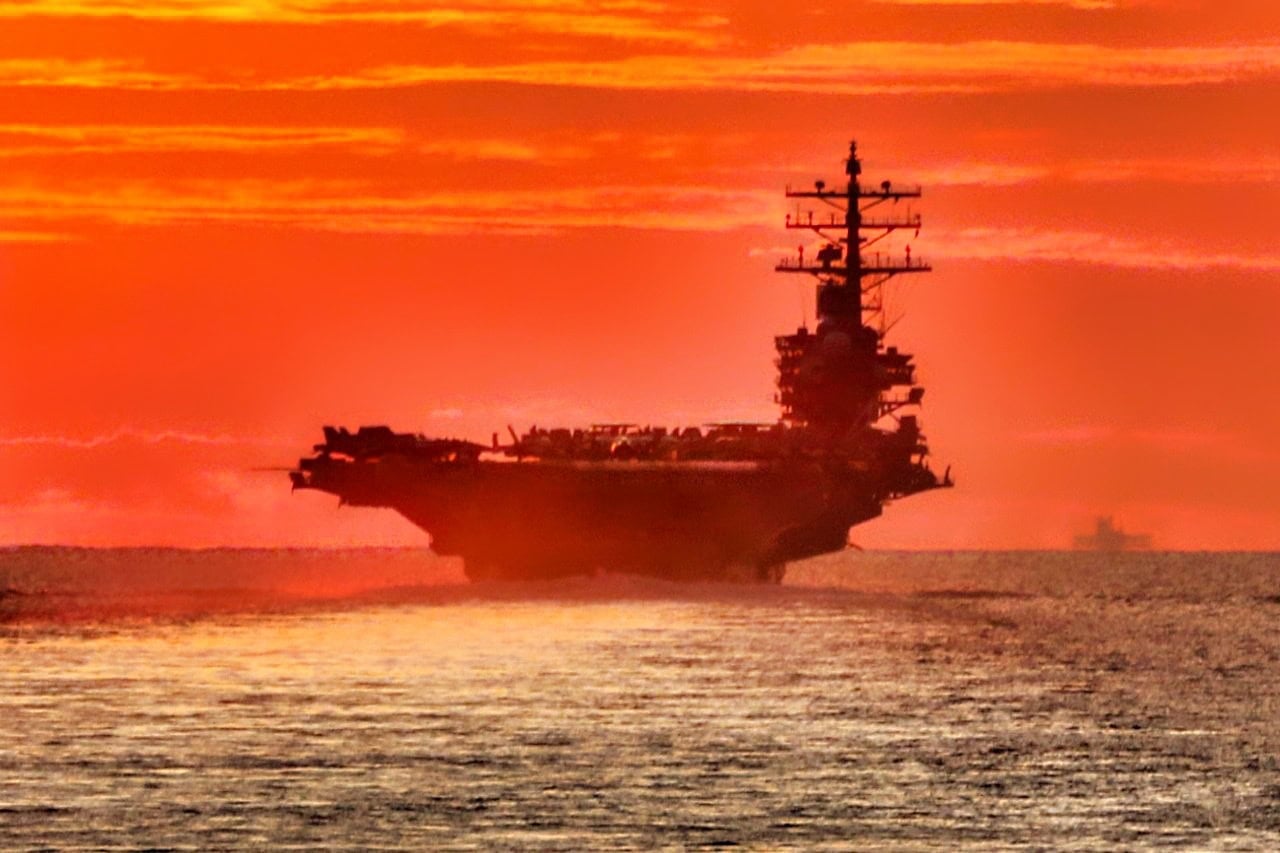
Iran speaks about U.S. aircraft carriers with unusual intensity. Official commentary, military exercises, and state-aligned media narratives circle back to the same image with striking persistence — a U.S. supercarrier disabled in Gulf waters.
Missile units are presented as tools built for that purpose. Drone formations are staged in ways meant to evoke converging pressure on flight decks. Fast-attack craft operate in choreographed proximity to large hull silhouettes during naval drills.
The repetition is not a theatrical excess. It reflects a deliberate strategic fixation.
Carriers remain the most visible instruments of American force projection. Their arrival off a contested coastline communicates political commitment without diplomatic preface. They provide sustained strike capacity within the operational range while signaling tolerance for escalation. Regional actors read their presence as both a military posture and a political message.
That dual meaning explains Tehran’s focus. The relevant analytical question is often framed narrowly around feasibility — whether Iran could sink one.
The more revealing inquiry concerns why the scenario occupies such prominence in the Iranian strategic imagination and what that fixation suggests about the evolving character of naval deterrence.
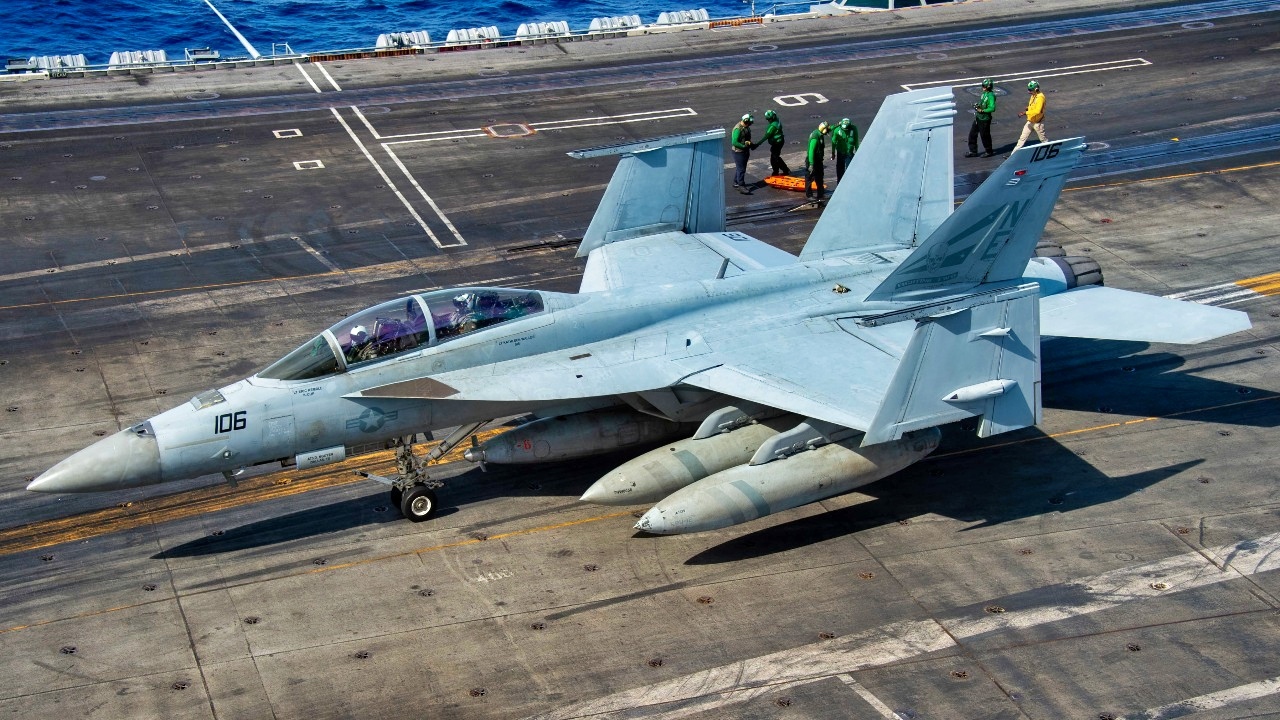
(Dec. 30, 2021) An F/A-18F Super Hornet, assigned to the “Bounty Hunters” of Strike Fighter Squadron (VFA) 2, taxis on the flight deck of Nimitz-class aircraft carrier USS Carl Vinson (CVN 70), Dec. 30, 2021. Carl Vinson Carrier Strike Group is on a scheduled deployment in the U.S. 7th Fleet area of operations to enhance interoperability through alliances and partnerships while serving as a ready-response force in support of a free and open Indo-Pacific region. (U.S. Navy photo by Mass Communication Specialist 3rd Class Jeff D. Kempton)
Hard Targets at Sea
From an operational perspective, U.S. supercarriers remain extraordinarily difficult to neutralize. They deploy within layered defensive architectures designed to absorb and defeat complex attack profiles. Guided-missile escorts operate as outer defensive screens.
Submarines patrol forward approaches. Airborne radar platforms extend surveillance coverage well beyond the horizon. Electronic warfare assets complicate targeting processes. Fighter patrols maintain a continuous aerial presence around the formation.
Targeting such a force at sea involves multiple sequential challenges. Detection must occur first. Continuous tracking must follow under contested conditions. Target-quality data must then be generated in real time despite countermeasures designed to degrade sensor inputs.
Even successful weapon penetration does not guarantee a decisive effect. Supercarriers are constructed with internal redundancy and extensive damage-control design features meant to sustain combat functionality under severe stress.
This operational resilience remains intact. Yet survivability alone does not determine strategic consequence. Military durability and political vulnerability now coexist within the same platform.
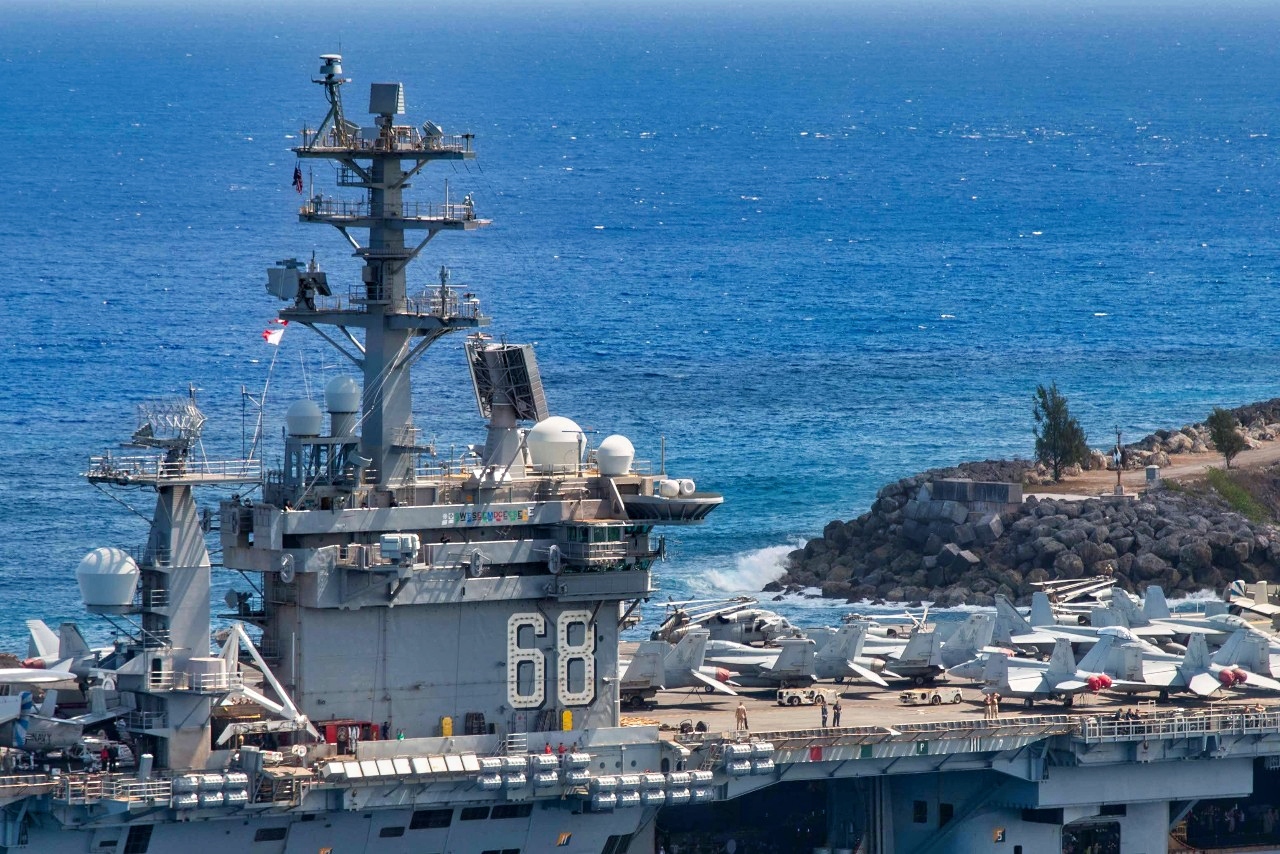
APRA HARBOR, Guam (April 18, 2025) Nimitz-class aircraft carrier USS Nimitz (CVN 68) arrived in Guam for a scheduled port visit, April 18. Nimitz is underway in the U.S. 7th Fleet area of operations on a scheduled deployment, demonstrating the U.S. Navy’s unwavering commitment to a free and open Indo-Pacific. (U.S. Navy Photos by Mass Communication Specialist 1st Class Samantha Jetzer)

Aircraft Carrier. Image Credit: U.S. Navy.
The Psychological Center of Gravity
Aircraft carriers project meaning alongside firepower. Their symbolic weight travels with them wherever they deploy. Each hull carries thousands of personnel, a full tactical air wing, and the visible embodiment of U.S. escalation capacity. Their presence communicates commitment in ways that no communiqué can replicate.
Damage inflicted upon such a vessel would reverberate well beyond the immediate battlespace. Media saturation would be immediate. Energy markets would respond within hours. Domestic political pressure would intensify rapidly.
Demands for retaliatory action would gather momentum before the tactical situation had even stabilized. The platform’s physical scale amplifies the psychological scale of harm inflicted upon it.
For that reason, the carrier functions as a psychological center of gravity as much as a warfighting asset. Tehran’s fixation reflects an understanding that visible damage could generate a strategic shock disproportionate to operational loss. The analytical question, therefore, shifts from destruction to perception. The issue is whether the platform can be made to appear exposed under combat pressure.
Swarm Warfare and Manufactured Vulnerability
Iran’s doctrinal evolution reflects this perception-driven logic. Rather than concentrate on a single decisive strike concept, Tehran has developed layered saturation tools designed to stress defensive systems cumulatively. Unmanned aerial vehicles can be fielded in dense formations launched from dispersed points.
Coastal missile batteries extend anti-ship reach into contested waters. Anti-ship ballistic missiles introduce high-velocity descent profiles that complicate interception timelines. Fast-attack craft operate in constrained maritime environments where maneuver space is limited. Naval mines impose a persistent navigational risk that cannot be neutralized instantly.
No single system in Iran’s arsenal guarantees catastrophic success against a U.S. carrier. That has never really been the point. The operational logic rests on cumulative pressure rather than decisive penetration. Layered salvos, repeated probing, and sustained contact are intended to force defenders into a constant expenditure cycle.
Interceptors cannot be fired indefinitely, and reload constraints at sea impose hard limits on how long high-intensity defense can be maintained. Over time, saturation begins to stress the defensive architecture not by breaking it outright but by forcing difficult allocation decisions under combat conditions.
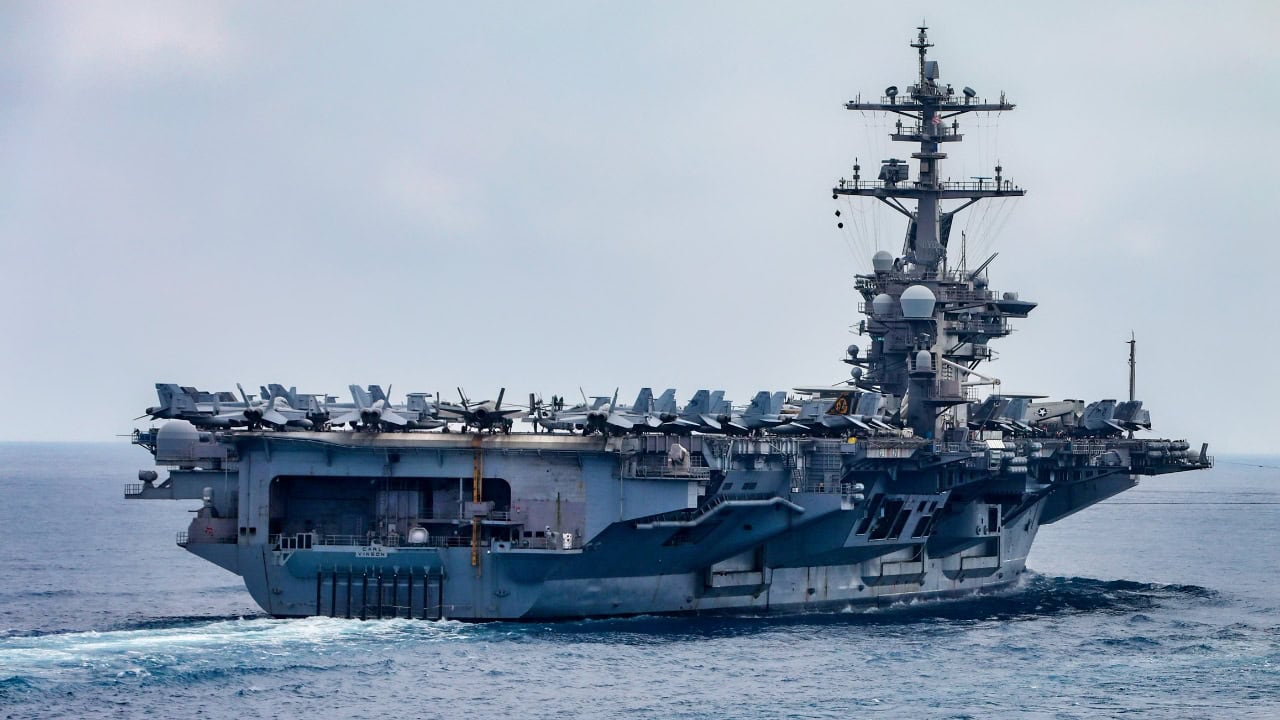
SOUTH CHINA SEA (Feb. 2, 2025) The Nimitz-class aircraft carrier USS Carl Vinson (CVN 70) conducts a replenishment-at-sea with the dry cargo and ammunition ship USNS Carl Brashear (T-AKE 7) Feb. 2, 2025. The Carl Vinson Carrier Strike Group is underway conducting routine operations in the U.S. 7th Fleet area of operations. (U.S. Navy photo by Mass Communication Specialist 1st Class Jacob I. Allison)
Geography compounds the problem. Constricted waterways reduce maneuver space and compress detection timelines in ways that favor the attacker’s density over the defender’s reaction time. Under those circumstances, saturation functions less as a kill mechanism than as an exposure mechanism. It aims to create a battlespace in which the carrier’s vulnerability becomes plausible enough to carry psychological and political weight, even if physical destruction remains unlikely.
Escalation Geometry
Once a credible vulnerability is identified, escalation dynamics shift. Carriers function as forward expressions of U.S. resolve, so harm inflicted upon them would register immediately at the political level regardless of tactical scale.
Leadership would face compressed timelines shaped as much by public reaction as by operational necessity, with pressure for retaliation building before the military situation had fully clarified. Diplomatic maneuver space would narrow under those conditions, not gradually but abruptly.
The carrier’s symbolic weight deepens the destabilizing potential once it comes under visible stress. Damage that falls well short of disabling the ship could still accelerate a crisis simply because of how the event would be read, both publicly and within allied capitals.
Survivability offers no insulation from that reaction. In some respects, it sharpens it, since a platform built to endure combat also carries expectations of dominance that make any visible breach politically charged. The ship remains extraordinarily hard to destroy, but the threshold for strategic consequence sits far lower than physical loss.
Saturation warfare works against that tension. Its purpose is not to guarantee a decisive strike but to place the perception of invulnerability under strain. Once that perception erodes, psychological leverage follows, and escalation risk rises with it.
Why Iran Threatens More Than It Strikes
Tehran’s strategic calculus reflects awareness of the escalatory thresholds involved. A successful strike that crippled or sank a U.S. carrier would invite overwhelming retaliation. U.S. response options extend across maritime, aerial, cyber, and infrastructure domains. Escalation would move rapidly beyond the naval arena. Regime survival would become uncertain under such conditions.
Carrier threats, therefore, operate primarily as coercive signaling bounded by strategic restraint. They aim to impose psychological pressure without crossing thresholds that would trigger a catastrophic response. The platform simultaneously serves as both a target and an escalation tripwire.
Its destruction would guarantee consequences far exceeding any immediate military gain.
The Real Shift
Carriers remain formidable instruments of power projection. Their defensive architecture continues to anchor U.S. naval presence across contested regions. That reality endures. What has changed is the surrounding threat ecology. Saturation systems built on relative affordability now possess sufficient density to generate persistent exposure risk even when defenses hold.
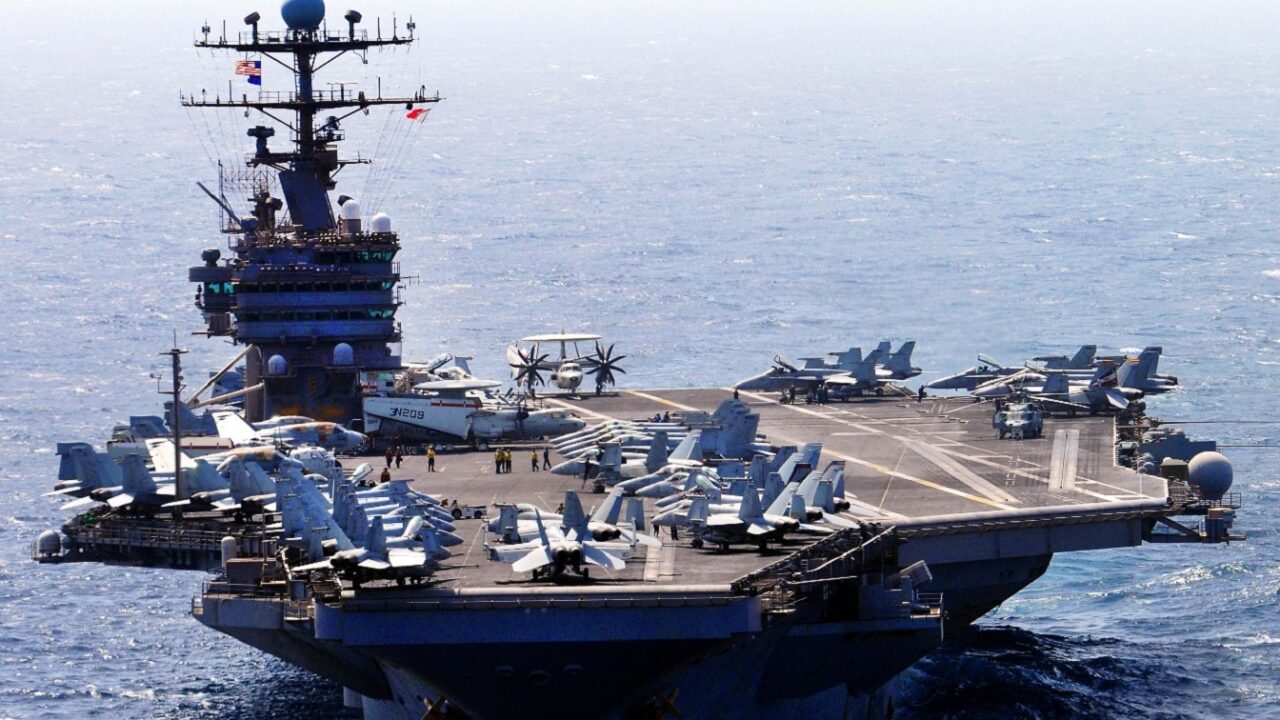
ARABIAN SEA (May 24, 2012) The Nimitz-class aircraft carrier USS Abraham Lincoln (CVN 72) transits the Arabian Sea. Abraham Lincoln is deployed to the U.S. 5th Fleet area of responsibility conducting maritime security operations, theater security cooperation efforts and support missions as part of Operation Enduring Freedom. (U.S. Navy photo by Mass Communication Specialist 3rd Class Amanda L. Kilpatrick/Released)
A carrier no longer needs to be sunk to produce a strategic effect. A credible threat alone can shape crisis signaling, deployment decisions, and escalation calculations. The platform retains its status as the centerpiece of maritime power while operating under conditions that render its symbolic weight exploitable.
The modern supercarrier remains a floating fortress by any operational measure.
Yet it also functions as a floating escalation trigger moving through contested waters where inexpensive systems seek contact for strategic effect rather than decisive destruction. Strength and exposure now travel together within the same hull.
About the Author: Dr. Andrew Latham
Andrew Latham is a non-resident fellow at Defense Priorities and a professor of international relations and political theory at Macalester College in Saint Paul, MN. You can follow him on X: @aakatham. Dr. Latham writes a daily column for 19FortyFive.com.