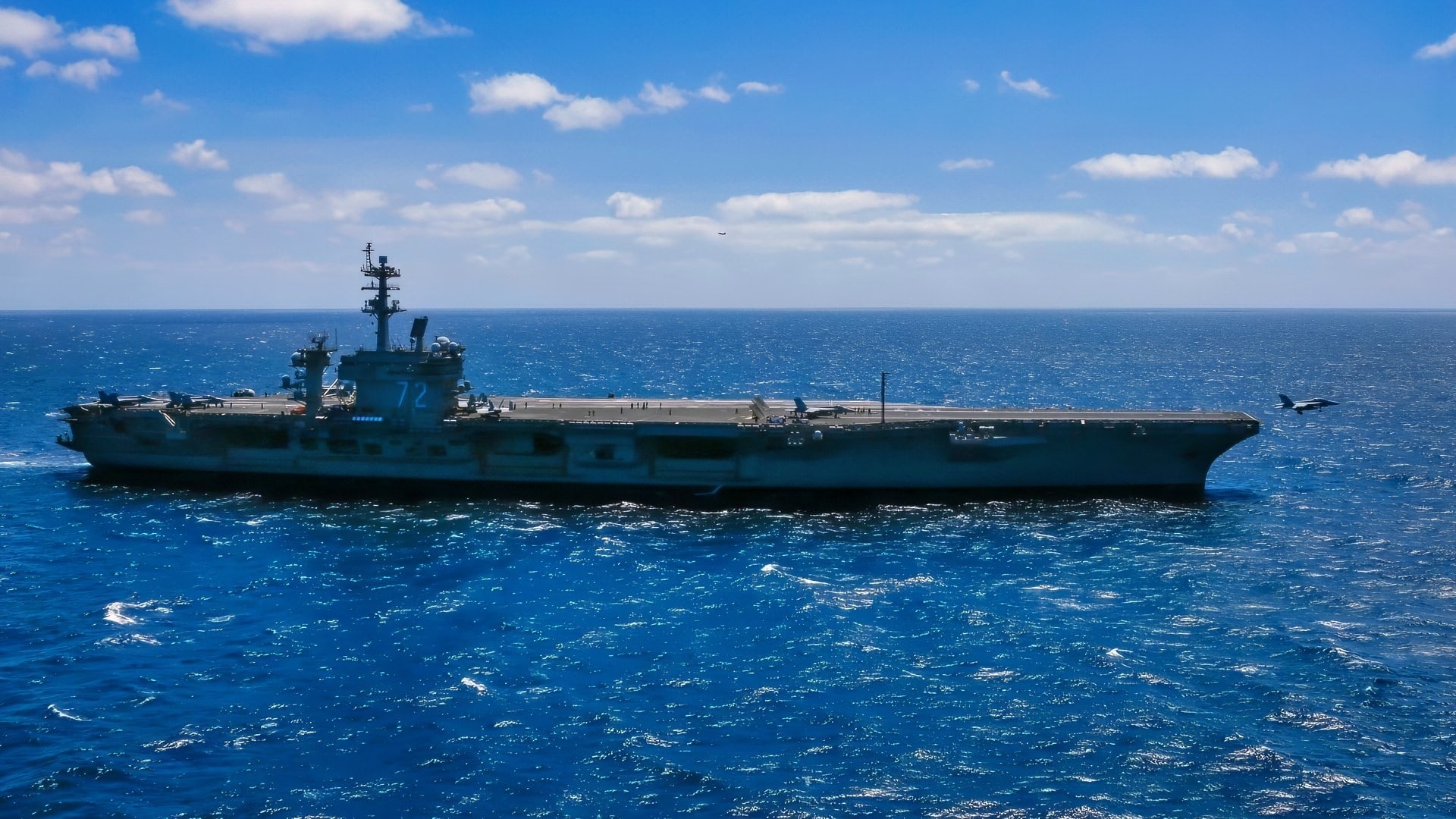
Summary and Key Points: As U.S. naval forces surge toward the Persian Gulf, Iran is signaling that any strikes would trigger retaliation—including attempts to target U.S. Navy warships.
-The piece argues that Tehran’s threats echo past rhetoric, but the practical odds of sinking a carrier strike group remain low.
-It points to the recent Houthi campaign as a relevant stress test: hundreds of drones and missiles were launched toward Western ships, yet layered defenses intercepted attacks without losses.
-Iran has additional tools—missiles, fast-attack boats, and a small submarine force—but geography and U.S. defenses constrain its options.
-The bottom line: propaganda wins are possible, decisive naval victories are unlikely.
Iran Threatens To Sink U.S. Navy Warships—But The Lincoln Strike Group Isn’t An Easy Target
As American warships and aircraft head ahead toward the Persian Gulf, Iran’s Islamist regime seems to be signaling that any strikes against their forces would be faced with stiff resistance — and that United States Navy warships would be sent to the bottom of the ocean.
The bellicosity largely follows similar threats made before and after the 12-day war, which saw Israeli and American warplanes fly over Iran with near-total impunity. American B-2 stealth bombers dropped the world’s largest bunker-busting munitions on Iran’s Fordow, Natanz, and Isfahan, the sites of much of Iran’s nuclear infrastructure.
Last week, American President Donald Trump rhetorically shook his fist at Tehran, dubbing the warships underway toward the Persian Gulf an “armada.” Speaking at the World Economic Forum in Switzerland, President Trump said, “We’ll see what happens.”
Though far from a forgone conclusion, Washington — and, indeed, the president himself — are riding the high of their wildly successful operation in Venezuela that captured that country’s strongman and wife in a nearly bloodless operation that suffered no American casualties.
Buoyed by that success, the prospects for an American campaign against Iran seem more likely than not. As of this writing, Polymarket, an online betting platform, shows that betters seem inclined to bet in favor of strikes in the coming months.
With the USS Abraham Lincoln and the warships that make up its Carrier Strike Group within Central Command’s area of responsibility, in tandem with other assets in the Middle East, there may soon be enough American firepower in the region to prosecute some strikes against the Iranian regime, either via aircraft, Tomahawk missiles, or some combination of the two.

PHILIPPINE SEA (Feb. 24, 2024) A U.S. Air Force B-52 Stratofortress, attached to the 5th Bomb Wing, and aircraft attached to Carrier Air Wing (CVW) 11, fly in formation over the Nimitz-class aircraft carrier USS Theodore Roosevelt (CVN 71), Feb. 24, 2024. Theodore Roosevelt, flagship of Carrier Strike Group Nine, is underway conducting routine operations in the U.S. 7th Fleet area of operations. U.S. 7th Fleet is the U.S. Navy’s largest forward-deployed numbered fleet, and routinely interacts and operates with allies and partners in preserving a free and open Indo-Pacific region. (U.S. Navy photo by Mass Communication Specialist 1st Class Thomas Gooley)
Protest Slaughter
Following widespread popular protests in Iran sparked by a worsening economic crisis, President Trump warned the Iranian regime not to do anything rash, saying that the United States is “locked and loaded” should any harm befall Iranian civilians, and encouraged demonstrators to show their distaste for the regime.
Iranian security forces responded with overwhelming force, massacring thousands of protestors in the streets and turning off internet access across the country. Though information about casualty numbers is still trickling out of the country, some estimates peg the number of deaths in the tens of thousands, potentially up to 30,000 or more — a level of violence almost unrivaled in modern history.
Iran’s Options
Iran’s top sailor took to X, formerly Twitter, in an attempt to project strength, saying “The Armed Forces are fully prepared to safeguard the country’s integrity.” His sentiment was echoed by Iran’s defense ministry spokesman, who said Iran’s “response will be more decisive and more painful than before if we become the target of a U.S.–Zionist attack,” a reference to the 12-day War, a lopsided loss for Iran.
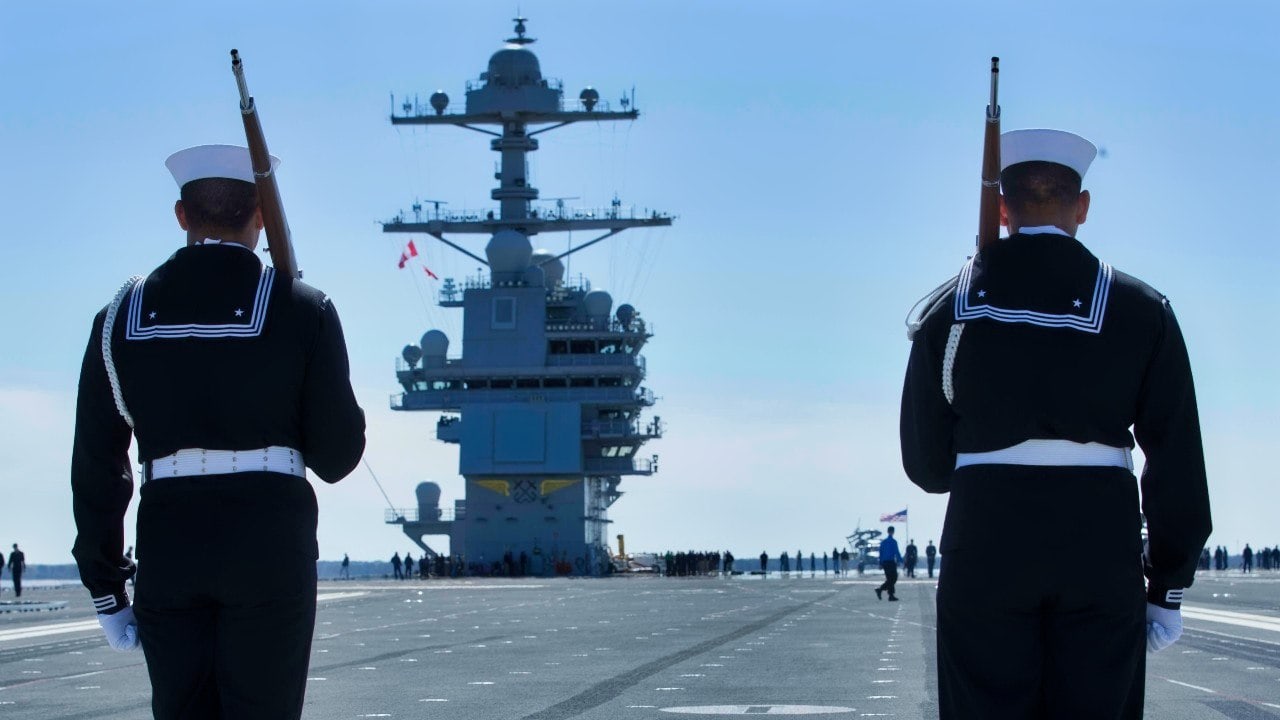
(April 8, 2017) — Logistics Specialist 3rd Class Miguel Monduy, from Miami, Florida, and Aviation Ordnanceman Airman Michael Valdez, from Pheonix, Arizona, assigned to Pre-Commissioning Unit Gerald R. Ford (CVN 78), stand on the flight deck for shifting colors. The future USS Gerald R. Ford (CVN 78) is underway on its own power for the first time. The first-of-class ship — the first new U.S. aircraft carrier design in 40 years — will spend several days conducting builder’s sea trials, a comprehensive test of many of the ship’s key systems and technologies. (U.S. Navy photo by Mass Communication Specialist Seaman Gitte Schirrmacher)
In the event of strikes against Iran, the country’s armed forces and the Iranian Revolutionary Guard Corps would likely try to target American, Israeli, and allied targets around the Middle East.
Successful strikes against the USS Abraham Lincoln Carrier Strike Group would, even if unsuccessful in sinking an American warship, be a powerful propaganda win.
The Houthis ’ Experience
Backed by Iranian financing and material support, Yemen’s Houthi rebels launched potentially hundreds of drones and missiles against United States Navy warships in 2024 and 2025, primarily in the Gulf of Aden and the Red Sea. The long-running episode is informative for shedding light on Iran’s prospects, should that regime decide to target American vessels.
Though the Houthis initially targeted commercial shipping, the scope of their campaign expanded upon the arrival of American and European naval assets sent to protect shipping, to include those vessels. The Yemeni rebels fired hundreds of munitions of varying types, with Western warships firing hundreds of interceptors at a rate broadly comparable to that last seen during the Second World War, Admiral Brendan McLane, commander of Naval Surface Forces, explained.
In an attack, the destroyer USS Spruance was “in a fight where they shot down three anti-ship ballistic missiles, three anti-ship cruise missiles and seven one-way (aerial drones) that were coming towards” them, Admiral McLane detailed. The layered air defense umbrella protects not only Western warships but also commercial shipping, and was seen as costly — but successful.
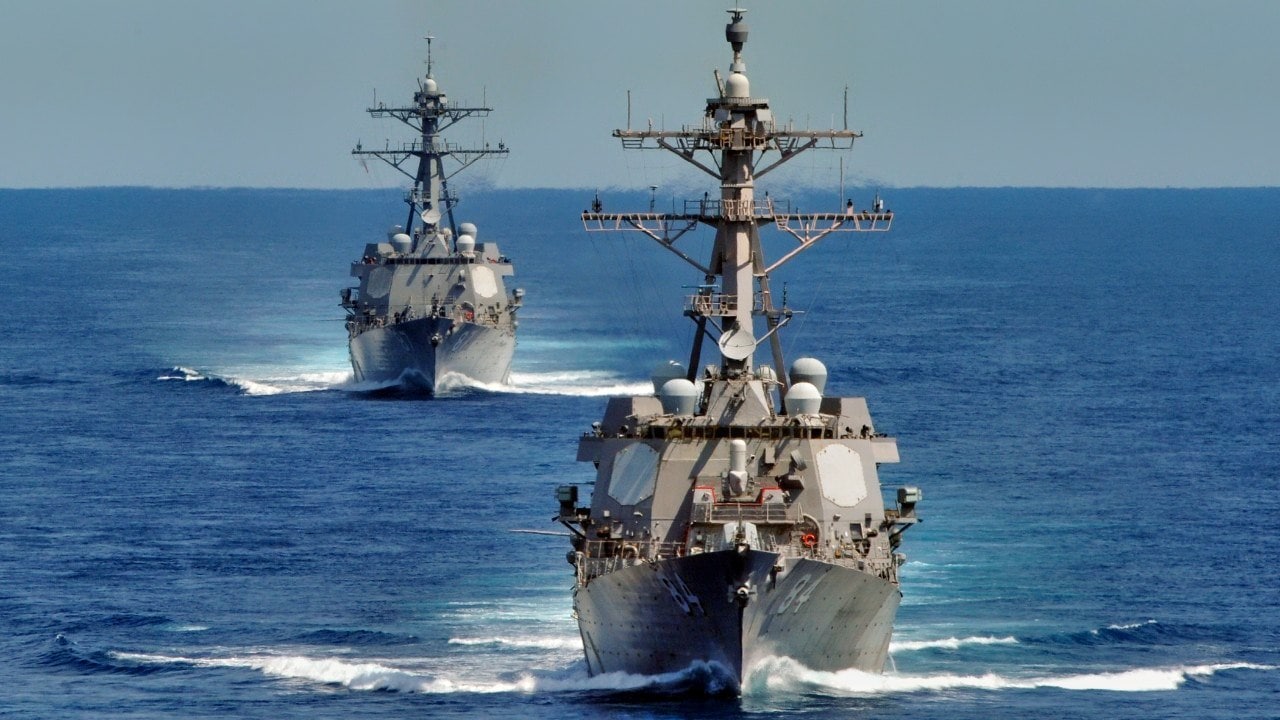
Navy warships. Image Credit: U.S. Navy.
No U.S. Navy warship was sunk or even hit during that mission, with successful interceptions of every Houthi-launched munition without the loss of any personnel, despite that environment representing the most intense naval threat environment for American warships in decades.
The Iranian Playbook
Though Iran possesses assets the Houthis do not — notably, the IRGC operates a fleet of fast-attack speedboats armed with a variety of anti-ship weaponry — and the country could, in theory, project power far from Iran’s borders thanks to its diverse inventory of cruise and ballistic missiles.
Additionally, the Iranian submarine fleet counts three Kilo-class diesel-electric submarines purchased from Russia in the early to mid-1990s. But as other analysts have noted, the unique conditions of the Persian Gulf, including relatively shallow depth, currents, and water salinity, significantly crimp their operational usefulness.
Iran’s prospects for striking, let alone striking American warships in the region, are rather dim. While the IRGC could, in theory, launch a concerted attack against the USS Abraham Lincoln Carrier Strike Group, an American defeat — or, indeed, the loss of any of that CSG’s vessels — would be unlikely.
About the Author: Caleb Larson
Caleb Larson is an American multiformat journalist based in Berlin, Germany. His work covers the intersection of conflict and society, focusing on American foreign policy and European security. He has reported from Germany, Russia, and the United States. Most recently, he covered the war in Ukraine, reporting extensively on the war’s shifting battle lines from Donbas and writing on the war’s civilian and humanitarian toll. Previously, he worked as a Defense Reporter for POLITICO Europe. You can follow his latest work on X.