
Summary and Key Points: Stephen Silver, an award-winning national security journalist, evaluates the DoD Inspector General’s report on the Military Working Dog (MWD) Program.
-Authored by Randolph R. Stone, the evaluation found that the 341st Training Squadron at Joint Base San Antonio-Lackland failed to provide the mandated five hours of daily engagement, leading to heat injuries, gastrointestinal parasites, and severe stress behaviors.
-This report analyzes the systemic neglect at 12 bases, exploring how the Air Force, as the executive agent, prioritized mission requirements over kennel renovation, resulting in the tragic loss of four canines and a nationwide health crisis for military animals.
The Pentagon Dog Scandal: Inside the Systemic Failure of Military Canine Welfare
A shocking new report from the Pentagon’s Inspector General found that four military dogs died “after being housed in poor living conditions at military kennels” between 2021 and 2023, Business Insider reported. The report was released last month.
According to Business Insider, the report also pointed to “concerning kennel conditions” at 12 different military bases. The dogs who died had been housed in “deteriorating kennels,” while at the same time, “dozens of others suffered injuries or disease or showed signs of severe stress.”
The report is titled Evaluation of the DoD Military Working Dog Program’s Management of Canine Welfare, and it was authored by Randolph R. Stone, Assistant Inspector General for Evaluations, Space, Intelligence, Engineering, and Oversight.
It found the worst conditions were at the Air Force’s 341st Training Squadron at Joint Base San Antonio-Lackland, which Business Insider described as “the military’s de facto canine program headquarters.”
“None of the 230 dogs at the facility received the five hours of daily play and engagement required by military policy,” Business Insider reported, citing the Pentagon report. “Instead, they were walked three or four times a week for about 10 minutes, spending most of their time confined to small kennels. Nearly two dozen dogs at the base reportedly suffered heat injuries. Investigators observed widespread stress behaviors, including repetitive spinning in tight circles and chewing on metal bowls.”
But that was far from the only trouble spot.
“Other bases reported outbreaks among their own canines after dogs from San Antonio-Lackland transferred to new facilities, arriving with skin disorders, histories of heat injuries, and spreading a gastrointestinal parasite known to thrive in areas not adequately disinfected of feces,” Business Insider reported. “Shoddy quarantine procedures and poor sanitation contributed to the spread of illnesses.”
The Reason for the Report
For the Department of Defense, “our objective was to determine whether the Air Force, as the DoD executive agent for the DoD Military Working Dog Program, and other oversight agencies are providing DoD MWDs with a high standard of canine welfare.”
The answer, in many cases, was no.
“We determined that MWDs in non-training status (awaiting deployment, medical disposition, or in training rejection status) with 5 hours per day of physical activity, social, and cognitive enrichment as required by Department of the Air Force Instruction 31-126,” DoD report said.
“Instead, we found that DoD MWDs in non-training status are walked for approximately 10 minutes, four times per week or less. During our August 2024 site visit, 230 DoD MWDs were in non-training status at the 341 TRS. The lack of enrichment activity occurred because the 341 TRS does not have enough caretakers to manage the volume of DoD MWDs in non-training status, and as a result, the 341 TRS experienced higher rates of diseases, injuries, and behavioral problems than at other DoD MWD operational units.”
Also, based on their visits to other bases, the DoD Inspector General’s office found that the Pentagon “needs to improve MWD kennel facility conditions across the DoD.” Service Component officials told the investigators that the substandard facilities persisted “because the Service Component Commands did not prioritize renovation or new construction of the kennels over other mission requirements.”
The DoD report did not go into a lot of detail about how the four dogs died.
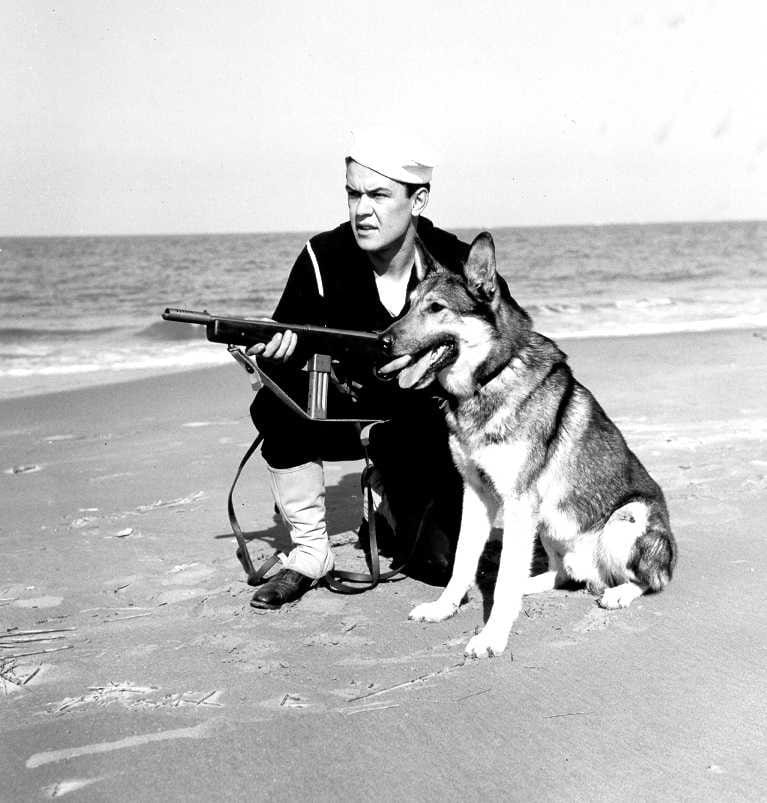
A United States Coast Guardsman with working dog and Reising SMG during WWII.
One expert told BI how bad the report looks.
“Depression is a real thing in dogs,” Robert Dougherty, a former police canine handler who now oversees the University of Pennsylvania’s Working Dog Center, told Business Insider after reviewing the report. “To sit around in a kennel and do nothing, either physically or mentally, is unacceptable, really.” He added that dogs are in need of “structured programs that challenge them mentally and physically while also minimizing injury risk.”
What’s Recommended
The DoD report issued a series of recommendations to address the dog safety issue.
“We recommend that the Secretary of the Air Force, as the DoD MWDs Executive Agent, in coordination with the DoD MWD Program Manager, reduce the number of DoD MWDs at the 341st Training Squadron to meet Title 9 Code of Federal Regulation requirements until the number of caretakers meets the Department of Air Force Instruction 31-126 requirements for 5 hours per day of physical activity, social, and cognitive enrichment,” the report said.
“In addition, we recommend that the Secretary of the Air Force, as Executive Agent for the DoD MWD Dog Program, and the DoD MWD Program Manager, in coordination with the Service Components, develop and implement an enterprise‑wide plan to upgrade DoD MWD kennel facilities to meet current DoD standards.”
The Air Force Assistant Deputy Chief of Staff for Logistics, Engineering, and Force Protection, responded and accepted the recommendations.
“Therefore, the recommendations are resolved but will remain open until all corrective actions have been completed and verified.”
The report concluded: “This final report provides the results of the DoD Office of Inspector General’s evaluation of the DoD Military Working Dog Program’s management of canine welfare. We previously provided copies of the draft report and requested written comments on the recommendations. We considered management’s comments on the draft report when preparing the final report.”
Horses, Too
The Army reported in 2022 that the military horses at Arlington National Cemetery were “living in unsanitary and potentially life-threatening conditions … consuming poor-quality feed, suffering from parasites and standing in their own excrement in tiny mud lots scattered with gravel and construction waste,” and that two such horses had died within 96 hours of each other that year.
The Army shut down that program for two years and later announced plans to shut down some ceremonial horse units, although it later partially reversed that decision.
About the Author: Stephen Silver
Stephen Silver is an award-winning journalist, essayist, and film critic, and contributor to the Philadelphia Inquirer, the Jewish Telegraphic Agency, Broad Street Review, and Splice Today. The co-founder of the Philadelphia Film Critics Circle, Stephen lives in suburban Philadelphia with his wife and two sons. For over a decade, Stephen has authored thousands of articles that focus on politics, national security, technology, and the economy. Follow him on X (formerly Twitter) at @StephenSilver, and subscribe to his Substack newsletter.