
From Chernobyl’s Reactor to DARPA’s Lab to the International Space Station: How a Fungus Became a Pentagon Priority
Nearly 40 years ago, in April of 1986, the worst nuclear accident in history took place at the Chernobyl Nuclear Power Plant in what was then the Soviet Union, but is part of what’s now Ukraine.
As described by the Nuclear Regulatory Commission, it happened on April 26, 1986, when “a sudden surge of power during a reactor systems test destroyed Unit 4 of the nuclear power station at Chernobyl, Ukraine, in the former Soviet Union. The accident and the fire that followed released massive amounts of radioactive material into the environment.”
At the site, 28 of the 600 workers died within months, and the radiation continued to pose problems for a long time to come.
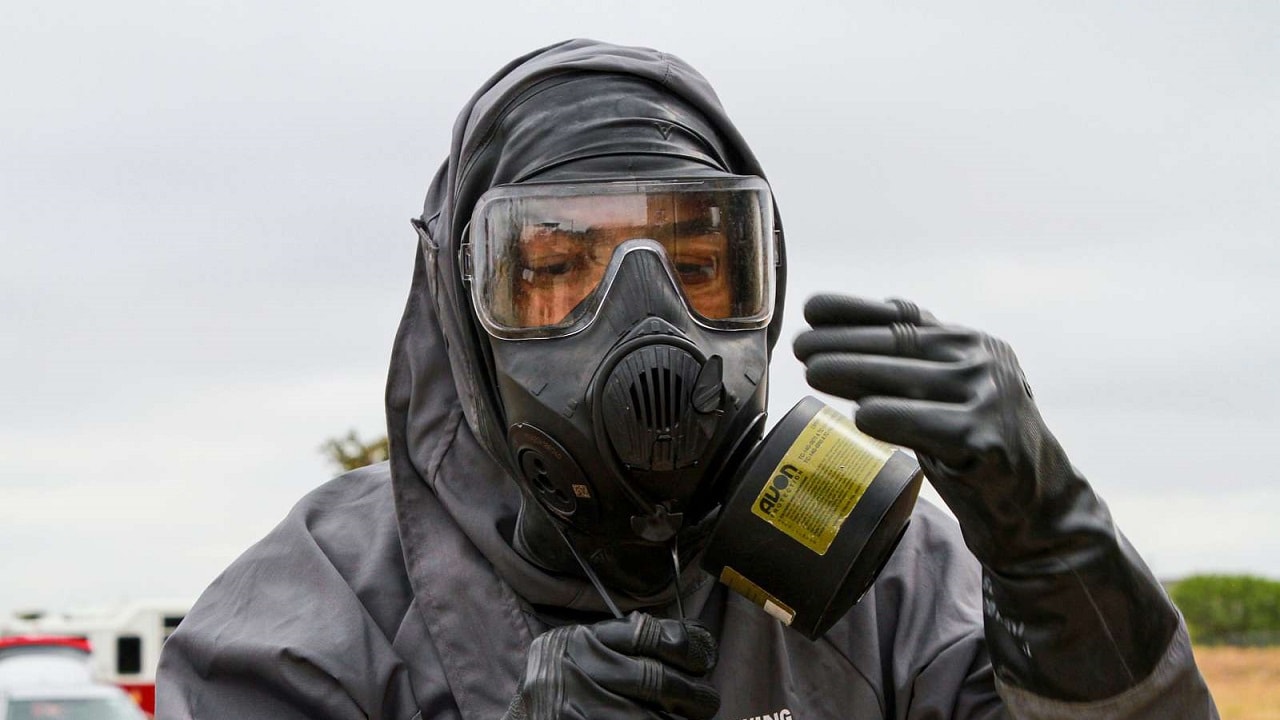
US military officer testing a radioactive sample.
“The Chernobyl accident contaminated wide areas of Belarus, the Russian Federation, and Ukraine inhabited by millions of residents. Agencies such as the World Health Organization have been concerned about radiation exposure to people evacuated from these areas,” the NRC report said.
The Chernobyl Exclusion Zone was established shortly after the accident. A new report, though, suggests that something surprising is going on at the Chernobyl site.
Meet Cladosporium Sphaerospermum
According to Science Alert, a particular fungus has made an appearance in the Exclusion Zone.
“For one organism, at least, the ionizing radiation lingering inside the reactor’s surrounding structures may be an advantage,” the Science Alert story says. “There, clinging to the interior walls of one of the most radioactive buildings on Earth, scientists have found a strange black fungus curiously living its best life.”
The fungus is called Cladosporium sphaerospermum. And per the story, “some scientists think its dark pigment – melanin – may allow it to harness ionizing radiation through a process similar to the way plants harness light for photosynthesis. This proposed mechanism is even referred to as radiosynthesis.”
Cladosporium sphaerospermum was discovered in the 19th century, and the discovery at Chernobyl, per the BBC, is not a new one- a scientist named Nelli Zhdanova of the Ukrainian National Academy of Sciences first spotted it in 1997. Their study discovered 37 different species of fungi. Sphaerospermum, however, “dominated the samples,” Science Alert said.
“The mould – formed from a number of different fungi – seemed to be doing something remarkable. It hadn’t just moved in because workers at the plant had left,” the BBC story said. “Instead, Zhdanova had found in previous surveys of soil around Chernobyl that the fungi were actually growing towards the radioactive particles that littered the area. Now, she found that they had reached into the original source of the radiation, the rooms within the exploded reactor building.”
In 2008, a paper proposed what Science Alert called “a biological pathway similar to photosynthesis.”
“The fungus – and others like it – appeared to be harvesting ionizing radiation and converting it into energy, with melanin performing a similar function to the light-absorbing pigment chlorophyll,” the report said. “At the same time, the melanin behaves as a protective shield against the more harmful effects of that radiation.”
Another paper, in 2022, analyzed what happened after C. sphaerospermum was taken to space, where it was strapped to the outside of the International Space Station.
“There, sensors placed beneath the petri dish showed that a smaller amount of radiation penetrated through the fungi than through an agar-only control,” Science Alert said. “The aim of that paper was not to demonstrate or investigate radiosynthesis, but to explore the fungus’s potential as a radiation shield for space missions, which is a cool idea. But, as of that paper, we still don’t know what the fungus is actually doing.”
Other Frontiers in Fungal Research
But that’s not the only research currently in progress involving fungus. The Defense Advanced Research Projects Agency (DARPA) is doing that type of work.
SingularityHub wrote last year about efforts on behalf of DARPA to “‘Grow’ Enormous Living Structures in Space.”
The idea is objects in space, like space stations and satellites, tend to be damaged, which require expensive efforts to fix or replace them.
So DARPA is looking for ways to grow them instead.
“The US Defense Advanced Research Projects Agency (DARPA) is now exploring an alternative: growing these parts directly in space,” the SingularityHub story said. “The concept would skirt delivery headaches. Without a rocket’s size and weight constraints, engineers could also design and construct large structures—over 1,640 feet or 500 meters long—that can’t be shipped from Earth.”
And fungus may be part of this.
“DARPA’s new vision is to rapidly engineer biological objects of unprecedented size” in microgravity, with lengths reaching over half a kilometer, or more than 1,640 feet,” the report said.
“One idea is to weave biomaterials, extremophiles, and non-organic fibers into materials with different stiffnesses and strengths. This would be a bit like manufacturing a tent. Some materials could be used as tent poles supporting the overall structure. Others—such as bacteria—can grow the tent’s walls, floor, and roof, which can stretch or shrink. Balancing the amount of each component would be critical for the material to work in multiple scenarios.”
What could that consist of?
“Some biomaterial building blocks sound rather exotic,” SingularityHub said. “For inspiration, DARPA suggested fungal filaments, protein-based fibers from hagfish slime, and graphene aerogels that are already being explored for drug delivery, wound healing, and bone and nerve regeneration.”
More Fungal Radiation Research
Another frontier of research is happening north of the border.
As reported in 2020, the University of Saskatchewan is conducting research, funded by the Defense Threat Reduction Agency of the U.S. Department of Defense, on “training fungi to sense radiation and potentially help clean up nuclear waste.”
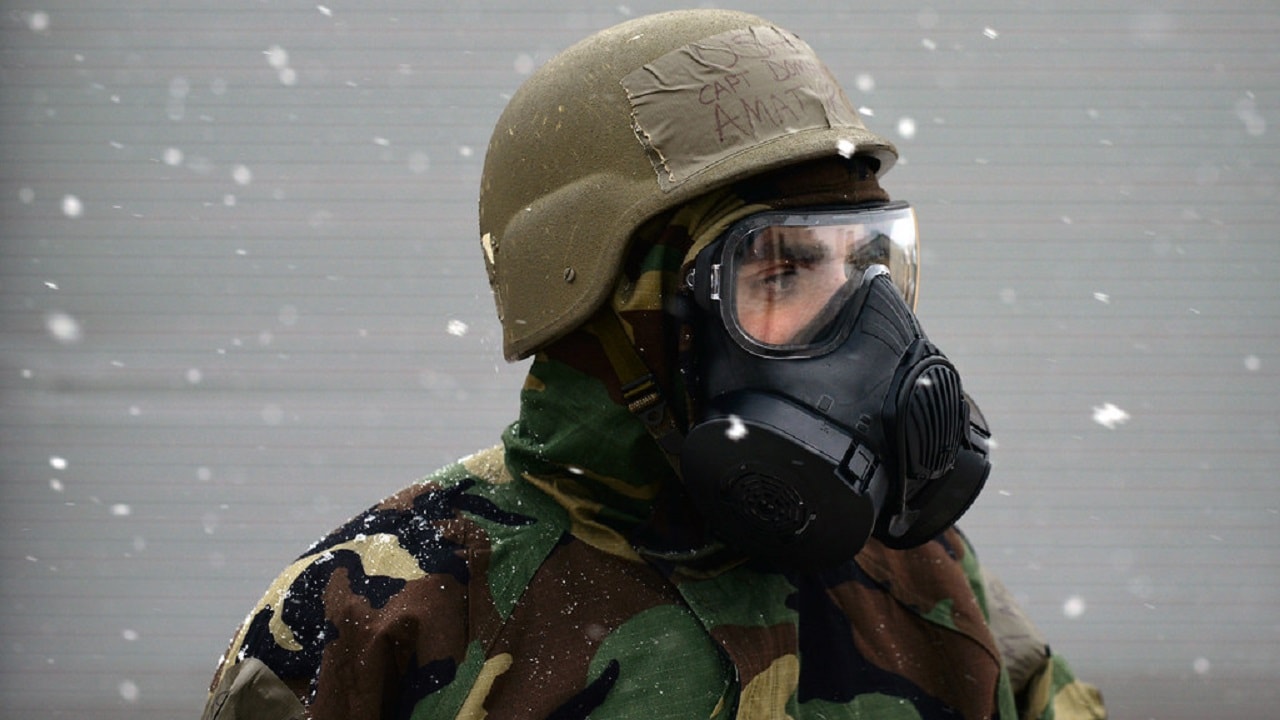
WESTHAMPTON BEACH, NY – NY National Guard Captain Dominic Amaturo pauses for a portrait during chemical, biological, radiological and nuclear defense training at FS Gabreski ANG Jan. 9th, 2015.
“Let’s say that there are suspicions of some kind of illicit nuclear activity going on somewhere—an underground nuclear test without notification, for instance,” said radiochemist Ekaterina Dadachova, who then held the Fedoruk Centre for Nuclear Innovation Chair in Radiopharmacy at USask, said in the 2020 article.
“We wanted to see whether we could train our fungi to recognize certain types of radioactive nuclides. This potentially would turn these fungi into cost-effective and highly sensitive biological detectors of nuclear fallout.”
About the Author: Stephen Silver
Stephen Silver is an award-winning journalist, essayist, and film critic, and contributor to the Philadelphia Inquirer, the Jewish Telegraphic Agency, Broad Street Review, and Splice Today. The co-founder of the Philadelphia Film Critics Circle, Stephen lives in suburban Philadelphia with his wife and two sons. For over a decade, Stephen has authored thousands of articles that focus on politics, national security, technology, and the economy. Follow him on X (formerly Twitter) at @StephenSilver, and subscribe to his Substack newsletter.