

Summary and Key Points: Defense expert Mackenzie Eaglen evaluates the strategic necessity of repurposing legacy military equipment to sustain capacity during the 2026 Iran conflict.
-This report analyzes high-profile “bridge” programs, including the Air Force’s B-52J modernization, the Navy’s AIM-174B (an air-launched SM-6), and the Army’s Apache “long-range shotgun” for drone interception.

A U.S. Air Force B-52H Stratofortress strategic bomber assigned to the 69th Expeditionary Bomb Squadron flies within the U.S. Central Command area of responsibility, Nov. 15, 2024. The B-52H provides strategic options and flexibility to U.S. and coalition senior leaders with the aircraft’s ability to employ a wide range of weapons with precision and deliver a decisive response to adversaries who threaten peace and security across the region. (U.S. Air Force photo)
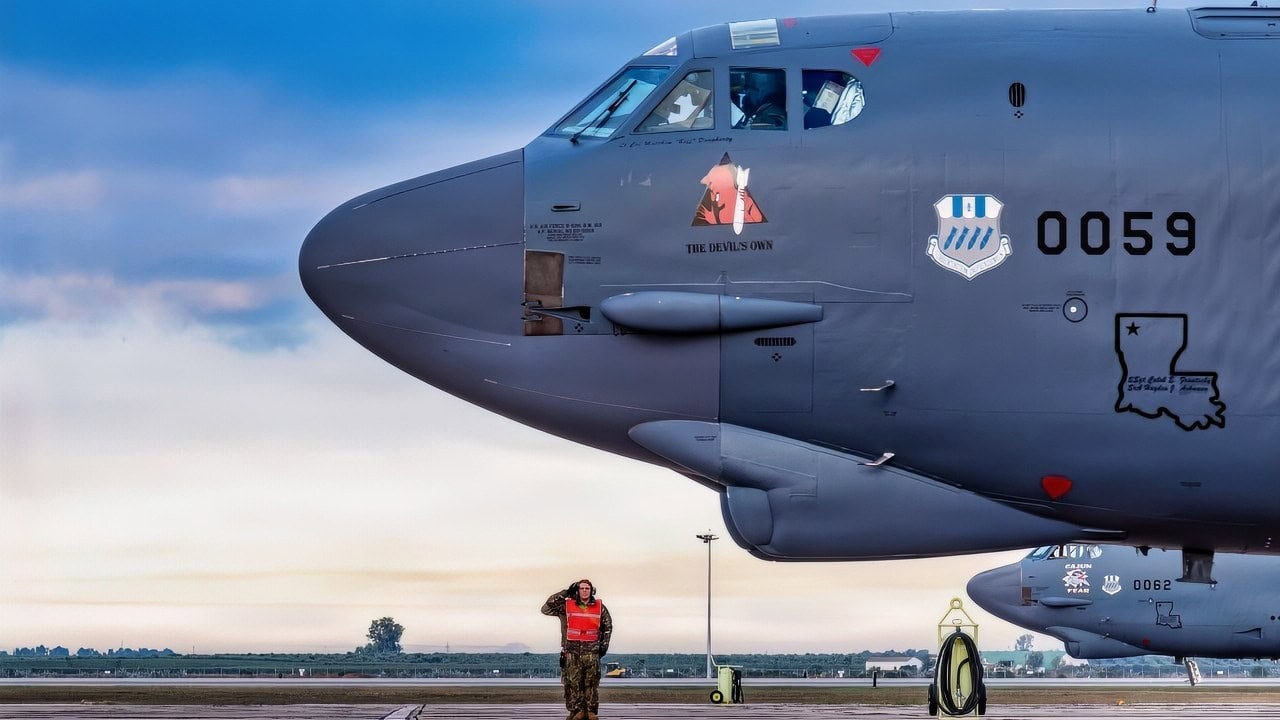
U.S. Airmen assigned to the 96th Expeditionary Bomber Generation Squadron salute the crew of a B-52H Stratofortress aircraft as they begin to taxi at Morón Air Base, Spain, Nov. 19, 2025, as part of Bomber Task Force Europe 26-1. The ability of U.S. forces and equipment to operate in conjunction with those of our Allies and partners is critical to bolstering an extended network of capabilities to decisively meet the challenges of today and tomorrow. (U.S. Air Force photo by Tech. Sgt. Codie Trimble)
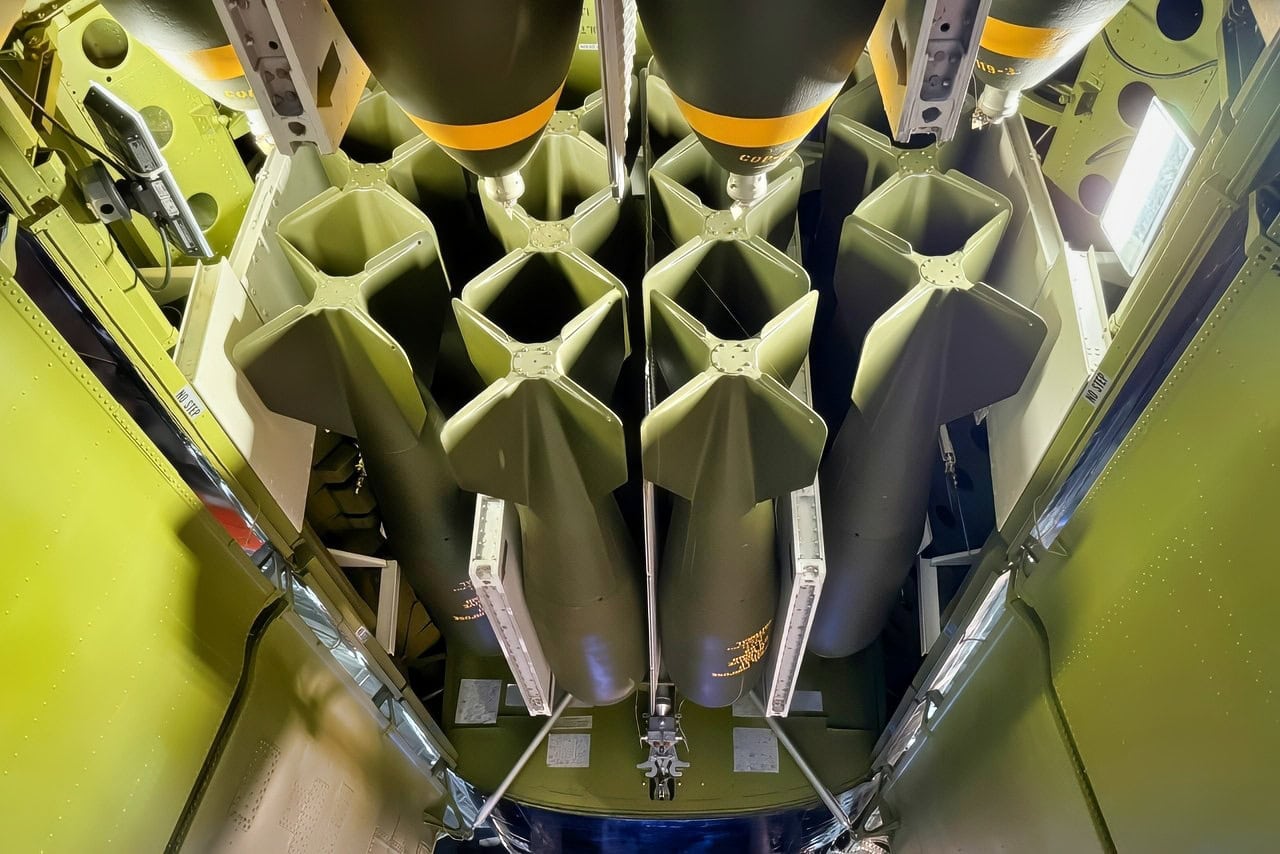
B-52 bombs. Image Credit: 19FortyFive.com Taken at the National Museum of the Air Force.
-Eaglen explores the bottlenecks of the DOTMLPF-P acquisition process, concluding that the military must balance the “high-low mix” of old and new.
-By integrating fresh capabilities like unmanned MCM packages onto proven hulls, the Pentagon can bypass the “valley of death” and maintain the mass required for high-intensity warfare.
The Legacy Bridge: Why the U.S. Military is Repurposing 40-Year-Old Assets Like the B-52 Bomber
When wars start, the armed forces bring all they can bear to the problem.
While mobilization of people and companies in the industrial base often follow, these processes take time. This simple reality reinforces the necessity of keeping legacy equipment on hand to be repurposed for new missions when economically viable.
The latest example of iterating old stuff made (sort of) new is the Army’s testing of the Apache attack helicopter into “a long-range shotgun” to kill drones. In service for four decades, the Apache’s design flexibility showed it can take on new ammunition in a quick turn cycle time.
While fielding shiny new fleets of aircraft, manned and unmanned, is necessary to win long wars of mass and attrition, the cumbersome acquisition process remains slow to onboard new equipment. A summary of key steps that must be taken include requirements generation, vendor qualification, contracting (everything from RFPs to proposal evaluation to contract awards and design reviews), airworthiness certification, operational and live fire testing, logistics and training support, fielding plans, and environmental and electromagnetic qualifications. Once fielded, leaders must develop the requisite DOTMLPF-P for each new capability lest it whither as a bespoke solution.
When using proven systems already in use, the services can go much faster to field cutting-edge capability by incorporating it onto older assets. Indeed, new technologies often need a platform with which to partner and demo utility in the real world. Example after example abound in showing success using this model beyond Apaches, including:
-The U.S. Navy’s Littoral Combat Ships (LCS) “carrying the first two operational mine countermeasure packages” deployed just last year after a decade. While the Navy is “currently procuring small USVs for lethal sea strike roles, the MCM package is the first in the service to incorporate an unmanned vessel into a program of record and include an autonomous capability.”
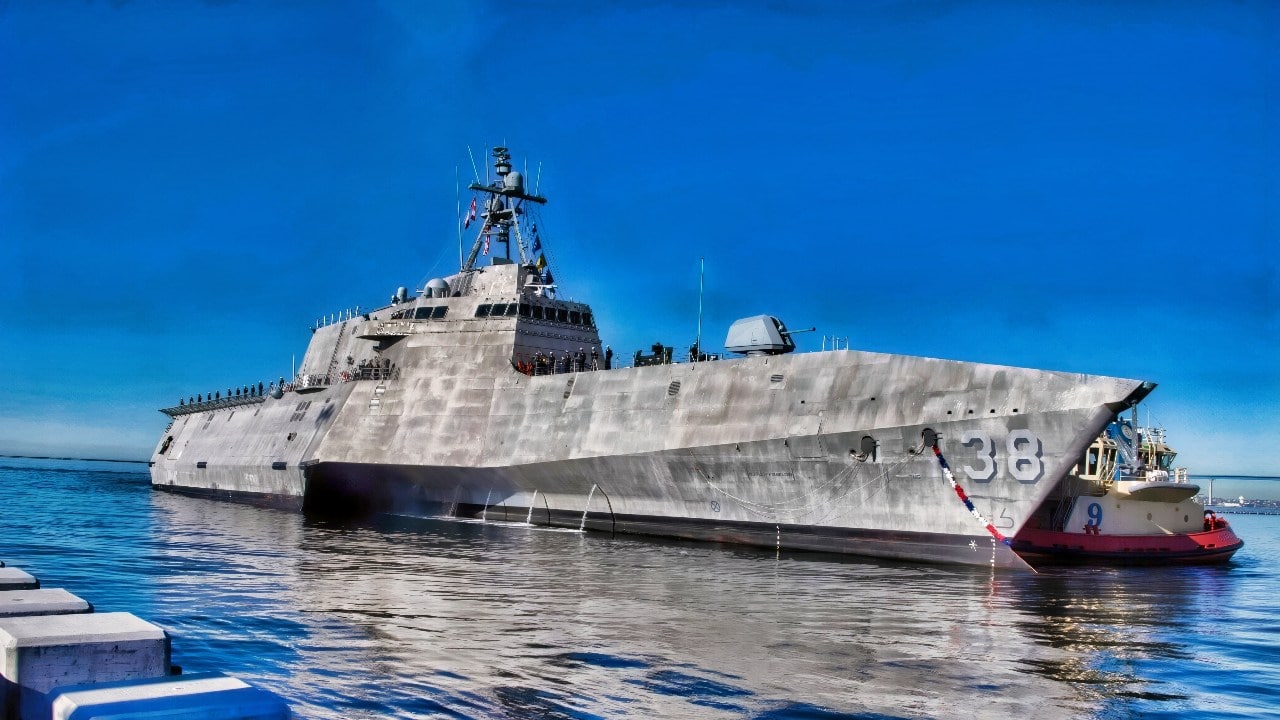
The Independence-Variant littoral combat ship USS Pierre (LCS 38) prepares to moor pier side during its arrival to its homeport of San Diego for the first time, Dec. 5, 2025. Pierre, the second U.S. Navy ship to bear this name, commissioned in Panama City, Fla. Nov. 15 as the final independence-variant LCS. Littoral combat ships are fast, optimally-manned, mission-tailored surface combatants that operate in near-shore and open-ocean environments, winning against 21st-century coastal threats.
-The Air Force’s RQ-4 Global Hawk surveillance drone has been repurposed into “Range Hawk” platforms to support, track, and test hypersonic missiles. According to Defense News, these two are “the first to be modified from a batch of 24 Global Hawk drones the Air Force has retired in recent years and passed on to TRMC for a second life as flexible and airborne test data collectors.”
-The Air Force’s B-52 Stratofortress bomber is being updated through its Commercial Engine Replacement Program and the Radar Modernization Program. The B-52J will have “new target acquisition and identification capabilities, as well as secondary electronic warfare capability and improved situational awareness.”

B-52 Bomber. Image Credit: Creative Commons.
-The Navy’s AIM-174B missile is a modified version of the SM-6 missile for airborne launch, allowing it to target aerial, ballistic, and surface threats at ranges of hundreds of miles, far beyond the tens of miles offered by existing air-to-air munitions.

SM-6 Missile Test U.S. Navy
-The Army’s MC-1C Grey Eagle drone has been integrated with new satellites and sensors to see at further ranges along with jamming pods for offensive electronic warfare.
America’s older military platforms can serve as a bridge for the next generation of capabilities to come online, and help the military sustain capacity in the wake of early retirements and divestments due to unaffordability.
Not all so-called legacy systems are created—or recreated—equal. The military is always a high-low mix of old and new. Leaders must more carefully consider what legacy systems are worth keeping and updating, particularly as the war in Iran reminds Washington of brittle U.S. military capacity, little slack for disruption, and dwindling stocks of key weapons and munitions.
This fine line—retiring legacy platforms without a replacement decreases operational availability of capabilities, but keeping aging platforms in service for too long drives up maintenance costs—must be treaded carefully.
Repurposing older technology creates a crucial bridge from the present to the future. Instead of prematurely retiring aging fleets before their replacements are ready, the military should find new uses for old equipment to field fresh capabilities. Nor must defense planners assume new tech makes legacy systems obsolete. Speedier acquisition pathways can still take years, and tech can’t replace mass before new capabilities make it out of the valley of death.
The Pentagon must field low-cost new capabilities at scale and rapidly integrate them within larger systems. As the services grapple with the proper high-low mix, they must not abandon either end of the spectrum.
As Anthony Zinni, the retired Marine four-star who once led U.S. Central Command, cautioned in 2022: “Before you step off that damn lily pad, make sure you got one to step onto.” Zinni emphasized that the military should be careful not to assume technology renders other capabilities obsolete rather than complementary.
About the Author: Mackenzie Eaglen
Now a 19FortyFive Contributing Editor, Mackenzie Eaglen is a senior fellow at the American Enterprise Institute (AEI), where she works on defense strategy, defense budgets, and military readiness. She is also a regular guest lecturer at universities, a member of the board of advisers of the Alexander Hamilton Society, and a member of the steering committee of the Leadership Council for Women in National Security.