
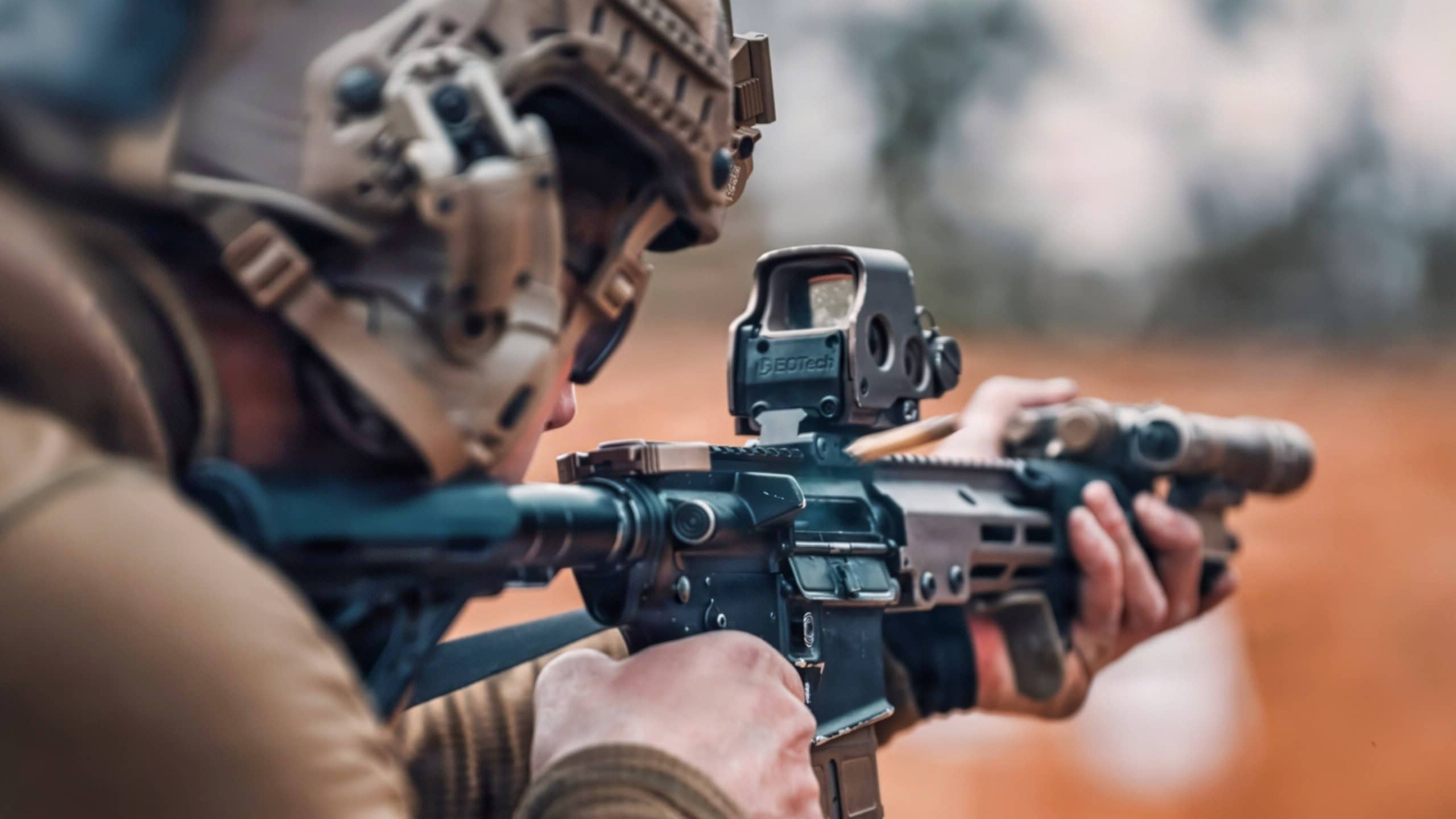
The M7, The Army’s New Rifle Just Got A Carbine Little Brother
The Army began fielding its newest rifle, the M7, to the 101st Airborne last spring, and to line units and Pacific-focused special operations units during the fall. It means to replace the M4 and the M16 family of weapons that have served the Army since the mid-1960s.
Now, the Army is adding a more compact carbine to its Next Generation Squad Weapon lineup. The XM8 is a shorter, lighter derivative of the M7 rifle that fires the same 6.8×51-mm round and shares internal components with the M7.
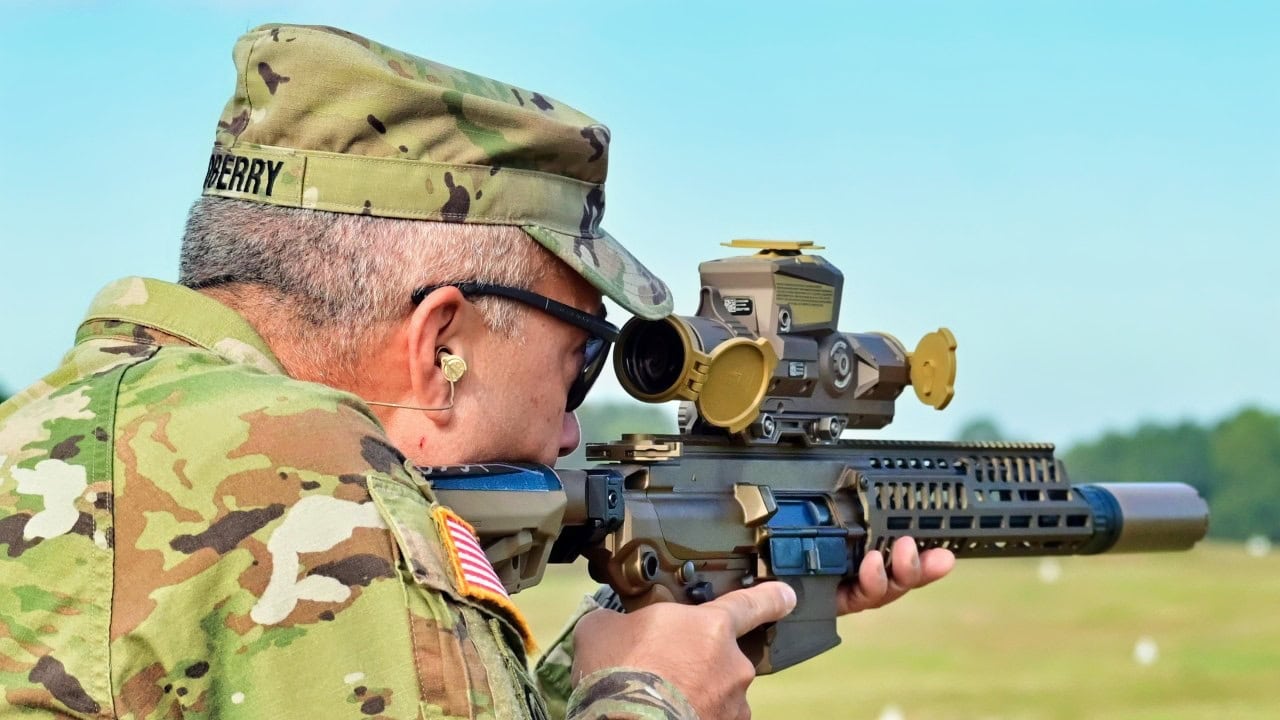
XM7 Next Generation Squad Weapon NGSW.
Early testing units are slated to receive the first examples by October 2026, according to recent articles in Stars and Stripes and Task & Purpose.
Meet The XM8, The Powerful Carbine Version Of the M7:
The carbine version of the M7, currently called the XM8, is five inches shorter (37” to 32”) and a pound lighter (8.36 lbs to 7.33) than the rifle. The barrel length has been cut from 13 inches to 11.
Despite the reduced barrel length, the muzzle velocity of the XM8 is greater than 3,000 feet per second, which is still more than the 5.56-mm projectile of the M4/M16 rifles accomplishes, even with longer barrels.
The FirearmsBlog.com posted a Spec Sheet which shows the differences between the two weapons.
|
Spec |
XM8 |
M7 |
|
Overall length |
32+ in. |
37 in. |
|
Barrel length |
11 in. |
13 in. |
|
Suppressor length |
6 in. |
7 in. |
|
Weight (no suppressor) |
7.33 lbs |
8.36 lbs |
|
Suppressor weight |
1.31 lbs |
1.46 lbs |
|
Stock |
Fixed |
Folding |
The SIG Sauer design team listened to soldiers’ feedback regarding the new M7 rifle and incorporated some changes to reflect what troops liked and didn’t like. These changes were developed under the M7 PIE, or Product Improvement Effort.
One of the changes was to remove the folding stock feature and make it a fixed stock. Removing the folding mechanism eliminates extra components and reduces overall weight.
It also simplifies stock assembly and aligns with the Army’s emphasis on durability and consistency over compact storage.
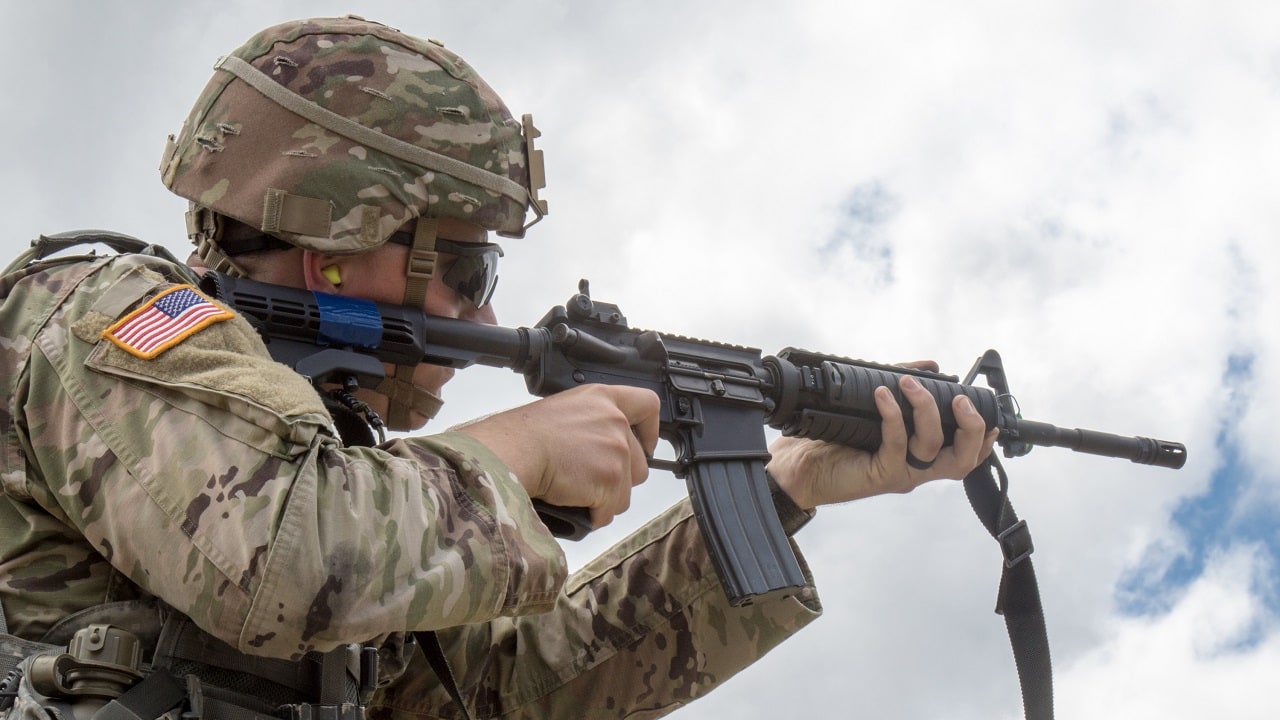
Sgt. Jacob Harrison, a U.S. Army Reserve Soldier from the 377th Theater Sustainment Command, takes aim with his M4A1 carbine at the M4 Reflexive Fire event during the 2021 U.S. Army Reserve Best Warrior/Best Squad Competition at Fort McCoy, Wis., May 22. Approximately 80 Soldiers from across the nation travelled to Fort McCoy to compete in the annually-recurring event running May 19-28. It brings in the best Soldiers and squads from across the U.S. Army Reserve to earn the title of “Best Warrior” and “Best Squad” among their peers. Competitors are evaluated on their individual and teamwork abilities to adapt and overcome challenging scenarios and battle-focused events, which test their technical and tactical abilities under stress and extreme fatigue. (U.S. Army Reserve photo by Staff Sgt. Christopher Hernandez/Released)
SIG also reduced the mass in the receiver to make it lighter. Overall, this removes about a pound of weight from the original.
The stock now comes with a softer butt pad and a more rigid front handguard where optics and other equipment are fixed. The suppressor is now an inch shorter and wider, further reducing the weapon’s length while improving its balance.
Short History Of the M7 Rifle:
Sig Sauer was awarded the contract for the Army’s Next Generation Squad Weapon program (NGSW)—the M7—as well as the squad automatic weapon, the M250.
Both weapons are chambered for the new 6.8-millimeter (.277-caliber) round, which the Army describes as superior in lethality and range to common battlefield rounds such as 5.56-millimeter and 7.62-millimeter.
The Army got reports from the troops in the field in Afghanistan that the M4’s 5.56-mm rounds were ineffective at penetrating body armor or barriers from long distances.
The Special Operations Command, Army Marksmanship Unit, and Army Armament Research, Development, and Engineering Center all conducted research and testing that influenced the Army’s switch from the 5.56-mm to the 6.8-mm cartridge.
M7 Specs:
Type Assault rifle
Manufacturer SIG Sauer
Weight 8.36 pounds,
Length 36 in (with suppressor)
Barrel length 13 inches
Cartridge 6.8×51mm (.277 in)
Action Short-stroke gas-operated piston, rotating bolt
Muzzle velocity 3,002 ft/s
Feed system 20-round detachable SR-25 pattern box magazine
25-round detachable SR-25 pattern box magazine (optional)
The M7 is a select-fire, magazine-fed, 6.8mm rifle. Its fully ambidextrous controls are similar to the M4/M4A1 carbine. Features include a non-reciprocating left-side charging handle and a free-floating MLOK handguard.
The weapon was designed to be suppressed and comes with a quick-detach suppressor—the Sig SLX suppressor—which also features a flash-reducing end cap, enhancing its performance.
Pacific Units Issued M7s First, With A Focus On China
As mentioned above, the Army’s Pacific- and special-operations units got the M7 first.
In Fiscal Year 2025, which began on October 1 last year, the Army started issuing weapons to slated units. After testing and adoption as the primary weapon, the “X” was dropped, and the weapons became the M7 and M250.
Issues With A New System Are Not New And Aren’t to the M7:
During testing, a unit in the 101st Airborne had some issues: the gun jammed, and the two-part ammunition casing came apart. There were some problems with the Vortex M157 advanced digital optic. These teething issues are expected with a new weapon system. For example, when the M16 was first used in Vietnam, it had many flaws. The Army and Colt ironed out the rough edges, and the weapon served for decades.
Basic Load Numbers
One criticism that hasn’t been addressed is the soldier’s basic load. The seven-magazine basic load for an M4 meant a soldier carried 210 rounds of ammunition.
The M7’s seven magazines carry only 140 rounds, a difference of one-third, which is significant. However, the Army believes the M7 and its new cartridge offer improved accuracy, range, and terminal effectiveness that are worth the added weight and reduced ammunition consumption. Concerns about soldiers being outranged, as well as improvements in adversary body armor, were key drivers behind the M7 program.
Troops love the power and penetration of the 6.8-mm round. Some experienced noncommissioned officers thought the added weight was negligible:
“…And the round punched straight through it, soldiers said that their M4s were barely putting dents into the steel. 5.56 can theoretically penetrate 12 mm of steel at 100 m….”
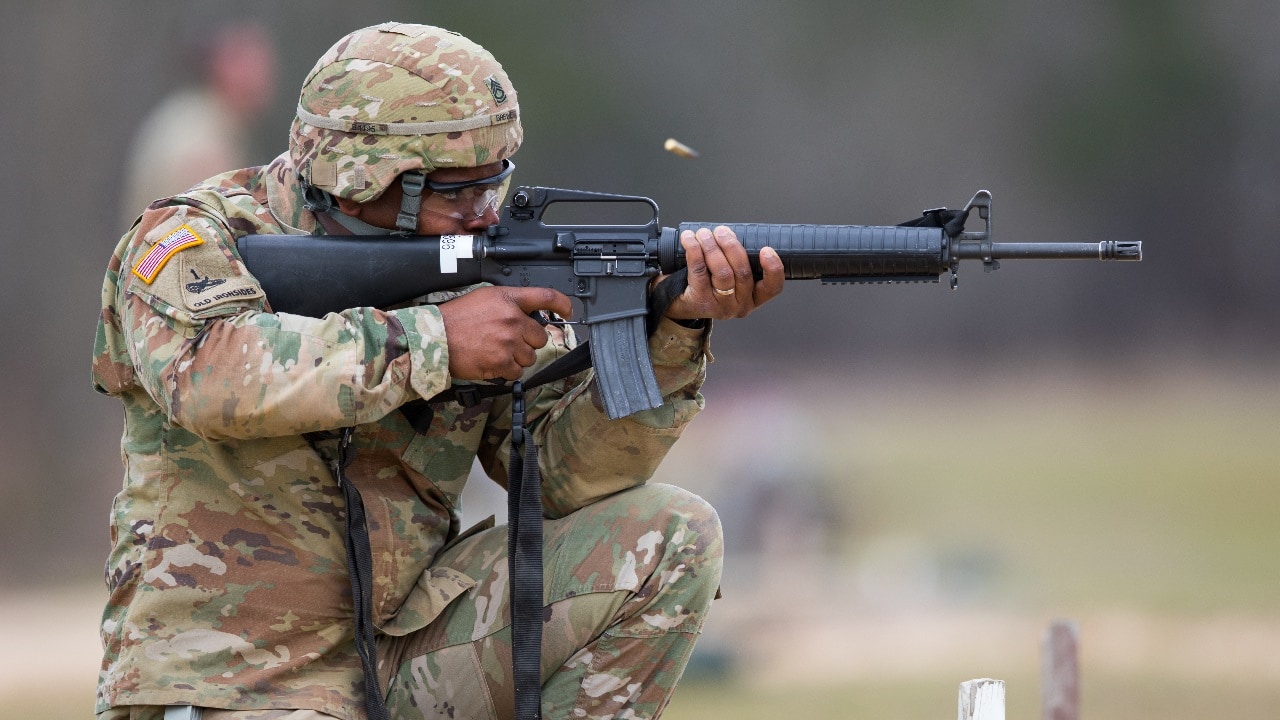
U.S. Army Reserve Sgt. 1st Class Harrison Brewer, G4 Chief Movements Supervisor for the 335th Signal Command (Theater), fires an M16 rifle on a range at Fort Gordon, Georgia, March 8, 2019. Soldiers from the 335th Signal Command (Theater) headquarters completed warrior tasks and battle drills to include weapons qualification, grenade practice and roll over training during a four-day training designed to increase their warfighting abilities. (U.S. Army Reserve photo by Staff Sgt. Leron Richards)
The M7 is still in its infancy, and, just like happened with the M16/M4, changes and improvements will continue as input from soldiers comes in. The Army and SIG have already made some changes to the rifle. The XM8 is proof that further refinement is occurring.
Once the “X” is dropped and the weapon becomes the M8 carbine, it may become the go-to standard weapon for many troops.
About the Author: Steve Balestrieri
Steve Balestrieri is a National Security Columnist. He served as a US Army Special Forces NCO and Warrant Officer. In addition to writing on defense, he covers the NFL for PatsFans.com and is a member of the Pro Football Writers of America (PFWA). His work was regularly featured in many military publications.