
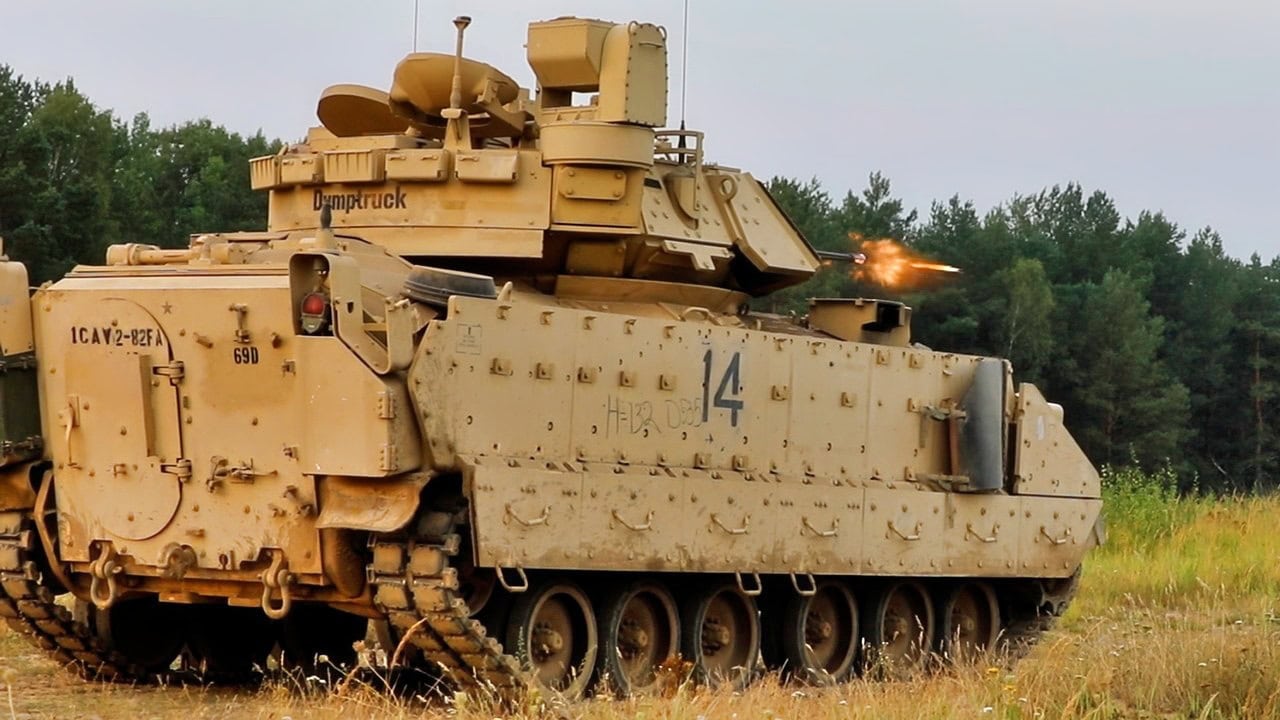
Summary and Key Points: Defense expert Christian D. Orr evaluates the M2 Bradley IFV, a platform that transitioned from a maligned “death trap” in the 1980s media to a modern battlefield legend.
-The Bradley remains a cornerstone of armored warfare, proven through its superior tank-destruction record in Operation Desert Storm and its current success in the Russia-Ukraine War.

M2 Bradley. Image Credit: Creative Commons.
-This report analyzes the influence of Col. James G. Burton and the film The Pentagon Wars on public perception, concluding that Bradley’s 45-year longevity is a testament to the Army’s ability to maximize a platform’s lethality through iterative combat adaptation.
The Bradley Paradox: Why the Most Maligned IFV in History is Now Russia’s Problem in the Ukraine War
Forty-five years after making its operational debut with the U.S. Army, the Bradley infantry fighting vehicle (IFV) keeps fighting on.
Named for the beloved General Omar Bradley, (“the G.I.’s General”), this hardy war machine has demonstrated its effectiveness in the crucible of combat time and time again.
From Operation Desert Storm, during which the M2 variant of the IFV ended up destroying more of Iraqi dictator Saddam Hussein’s tanks than the vaunted M1 Abrams main battle tank, to the current Russia-Ukraine War, during which there is at least one recorded instance of a Ukrainian Bradley crew destroying one of Russia’s ultramodern T-90M MBTs.

T-90 tank diagram. Image Credit: Creative Commons.
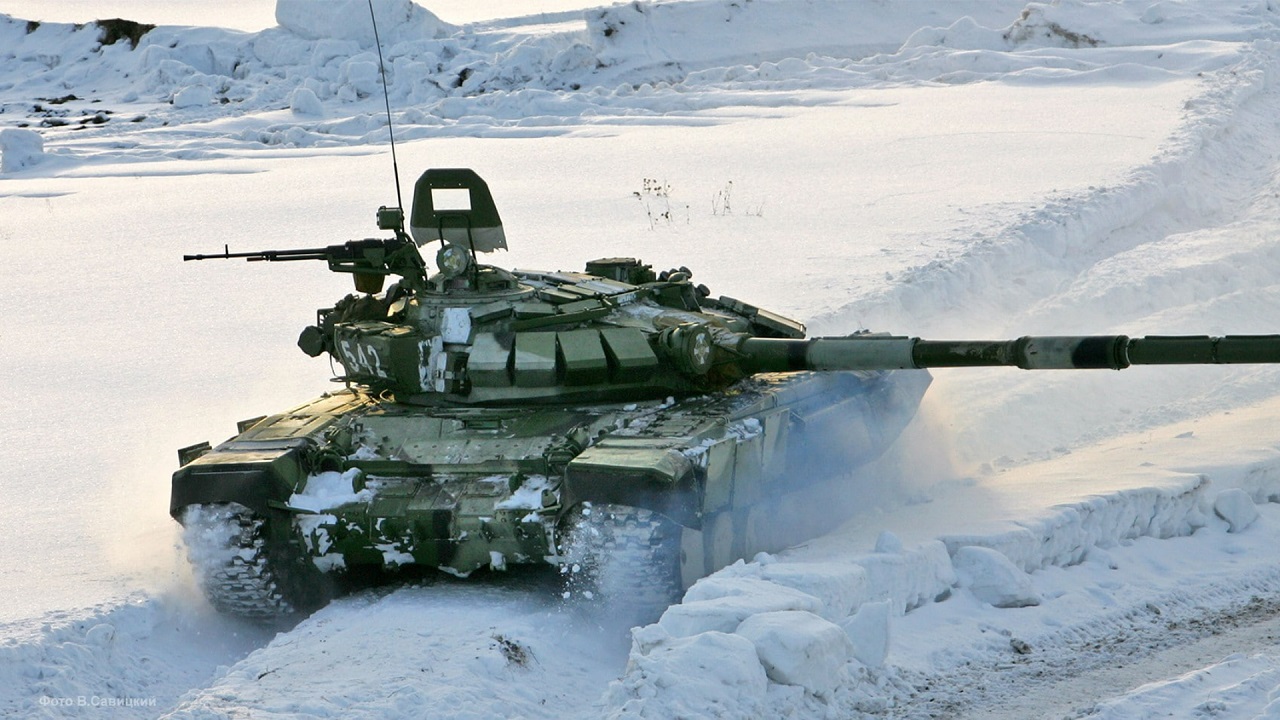
T-90 tank in the snow. Image Credit: Creative Commons.
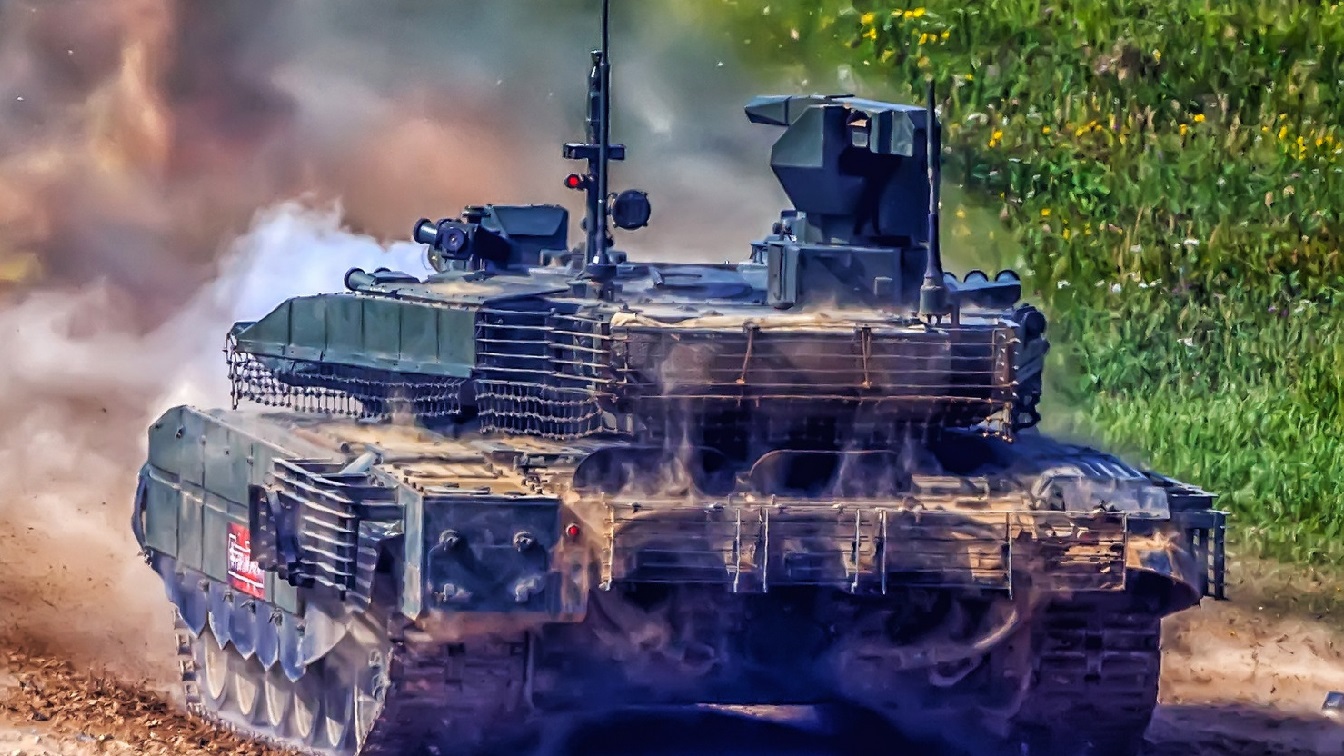
T-90M. Image Credit: Creative Commons.
However, there was a time when it looked as though the Bradley IFV wouldn’t last 5 years, let alone 45. Initially, it was hated and maligned.
Bad Blood for the Bradley Part I: Birthing Pains
The initial bad tidings for the Bradley IFV started before it was even born. Kenneth Merchant, who served as an armor officer in the U.S. Army from 1983 to 1992, sums it up pretty bluntly in a 2019 Quora post:
“At the time the Bradley was introduced there was a cottage industry in the US media dedicated to killing US military procurement programs. I noticed it first in 1985, when the M-247 Sergeant York air defense system was unceremoniously killed after a disastrous report on ABC’s 20/20 program featuring Geraldo Rivera.”
Merchant lists several other examples of battle-proven and time-honored weapons systems that observers excoriated back then:
-The F-16 Fighting Falcon fighter jet.
-The Abrams MBT
-The Multiple Launch Rocket System
-The AH-64 Apache helicopter gunship
-Unspecified “newer Navy warships of the day too.”
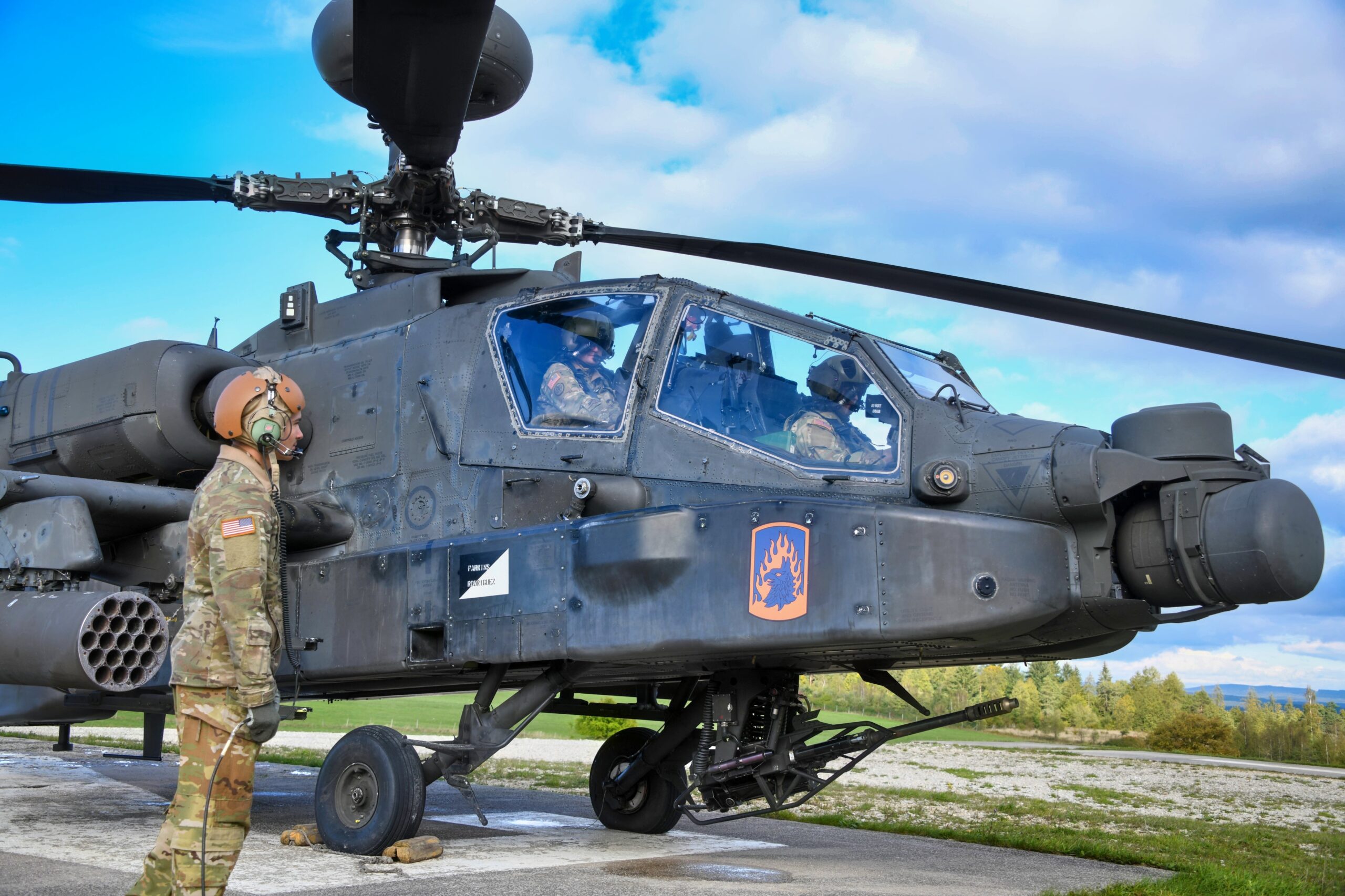
U.S. Soldiers assigned to 12th Combat Aviation Brigade conduct pre-flight checks on an AH-64D Apache longbow helicopter at the Grafenwoehr Training Area, Germany, Sept. 28, 2022. 12th CAB is among other units assigned to V Corps, America’s Forward Deployed Corps in Europe. They work alongside NATO Allies and regional security partners to provide combat-ready forces, execute joint and multinational training exercises, and retain command and control for all rotational and assigned units in the European Theater. (U.S. Army photo by Sgt. Randis Monroe)
Merchant continues:
“And Geraldo Rivera took on the Bradley fighting vehicle in another 20/20 hit piece. He criticized the profile, the fact that the Bradley couldn’t survive a hit from a tank main gun round, that the driver could get wet when it forded streams (and he left his hatch open). The basic line of attack was that if the Bradley couldn’t do everything perfectly (whether it was designed to do it or not) it wasn’t worth pursuing at all. That is the message I took away from ‘The Pentagon Wars’ too (an HBO product as I recall, just like that anti F-16 movie). … I remember after the first Gulf War marveling that all of these systems had performed better than anyone had expected. And I realized that if ABC, CBS, HBO and their fellow travelers had had their way we would have had none of them for that war.”
Deeper Dive: The F-35 of Armor for the U.S. Army?
In other words, journalists couldn’t seem to understand that even the best weapon systems go through teething issues, especially when they’re new on the scene and the troops in the field are still figuring out how to minimize the weaknesses and maximize the strengths of the new tools.
Instead, reporters paint gloomy pictures of yet-to-be-proven technologies. (The F-35 Lightning II is a perfect present-day example.)
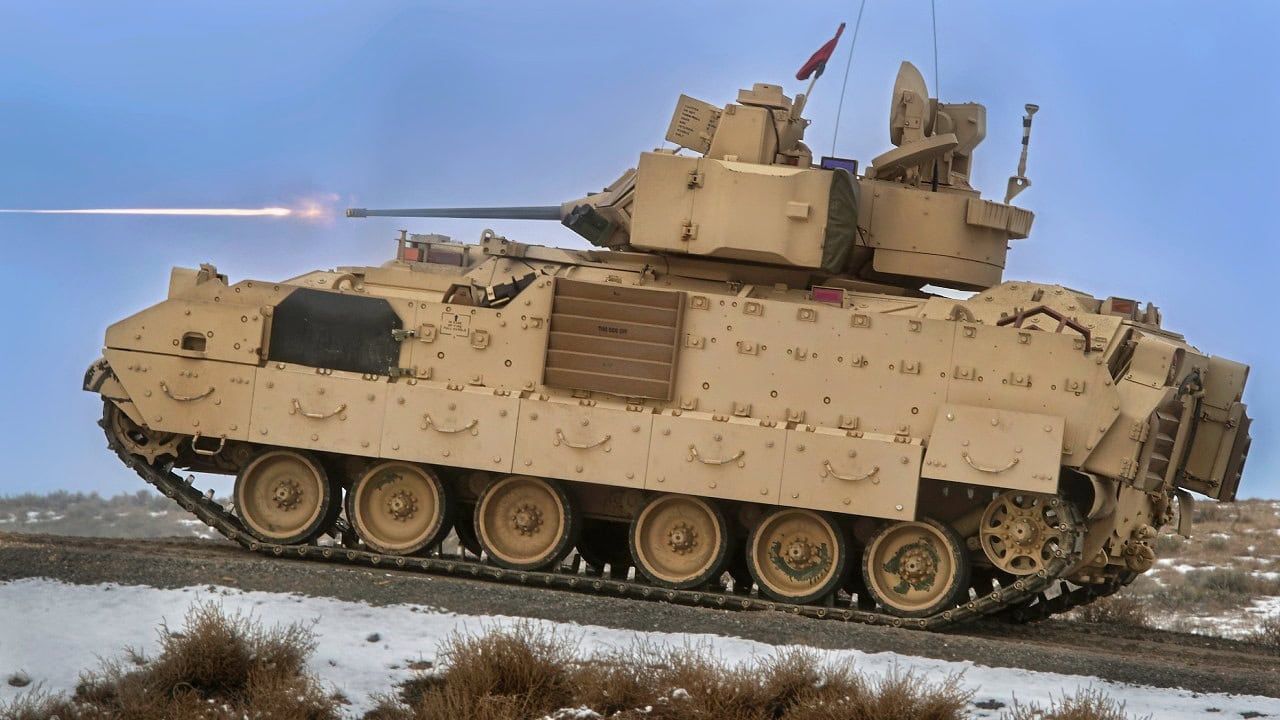
The Bradley Fighting Vehicle cuts loose several rounds from the 25mm main gun on the orchard Combat Training Center Range.
Soldiers completed training this week of the Bradley Commanders Course with the 204th Regional Training Institute, (RTI), of the Idaho Army National Guard on Gowen Field. The course is designed to train active duty, reserve and national guard officers and non-commissioned officers in combat critical M3 Bradley Fighting Vehicle Commander Skills. Field exercises were conducted on the newest Range 10, the Digital Air Ground Integrated Range (DAGIR), on the Orchard Combat Training Center grounds.
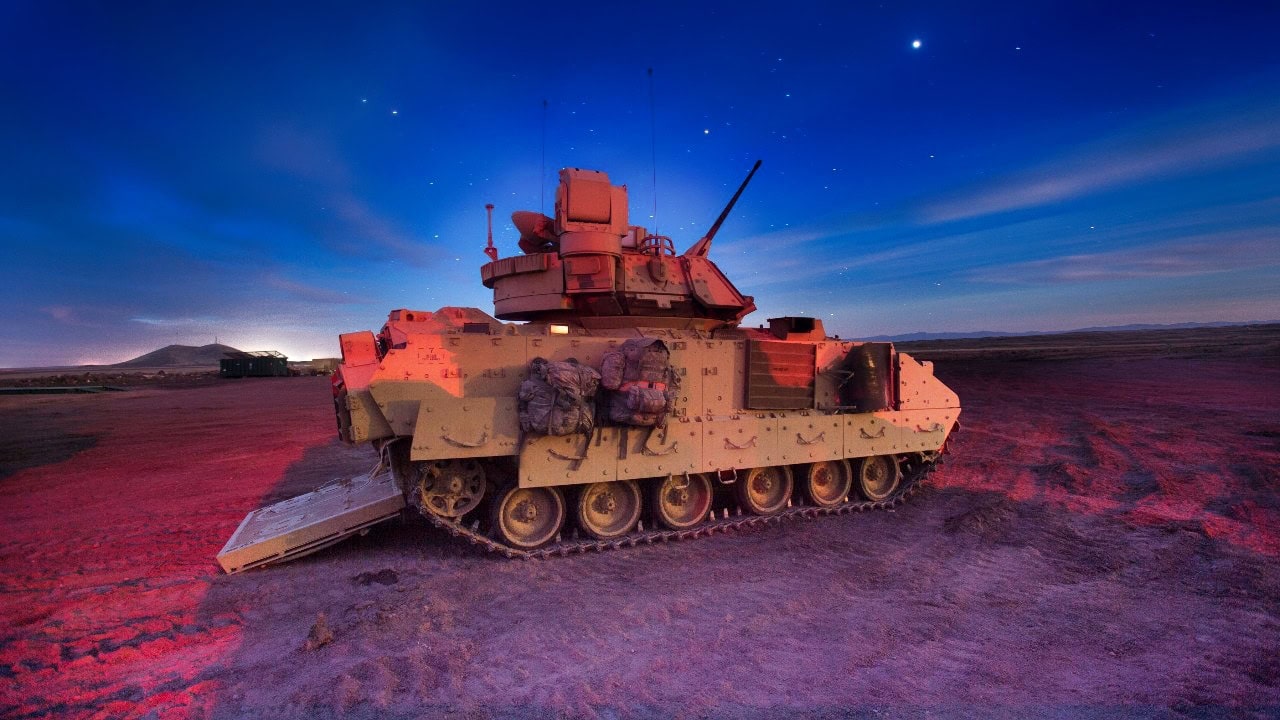
Engineers with the 116th Brigade Engineer Battalion conduct M2A3 Bradley fighting vehicle gunnery qualification on March 27, 2018, Orchard Combat Training Center, south of Boise, Idaho. Combat engineers with the 116th BEB trained through gunnery table XII, evaluating their ability to execute collective platoon-level tasks in a tactical live-fire environment; including integrating dismounted soldiers with their assigned BFV. (U.S. Army National Guard photo by 1LT Robert Barney)
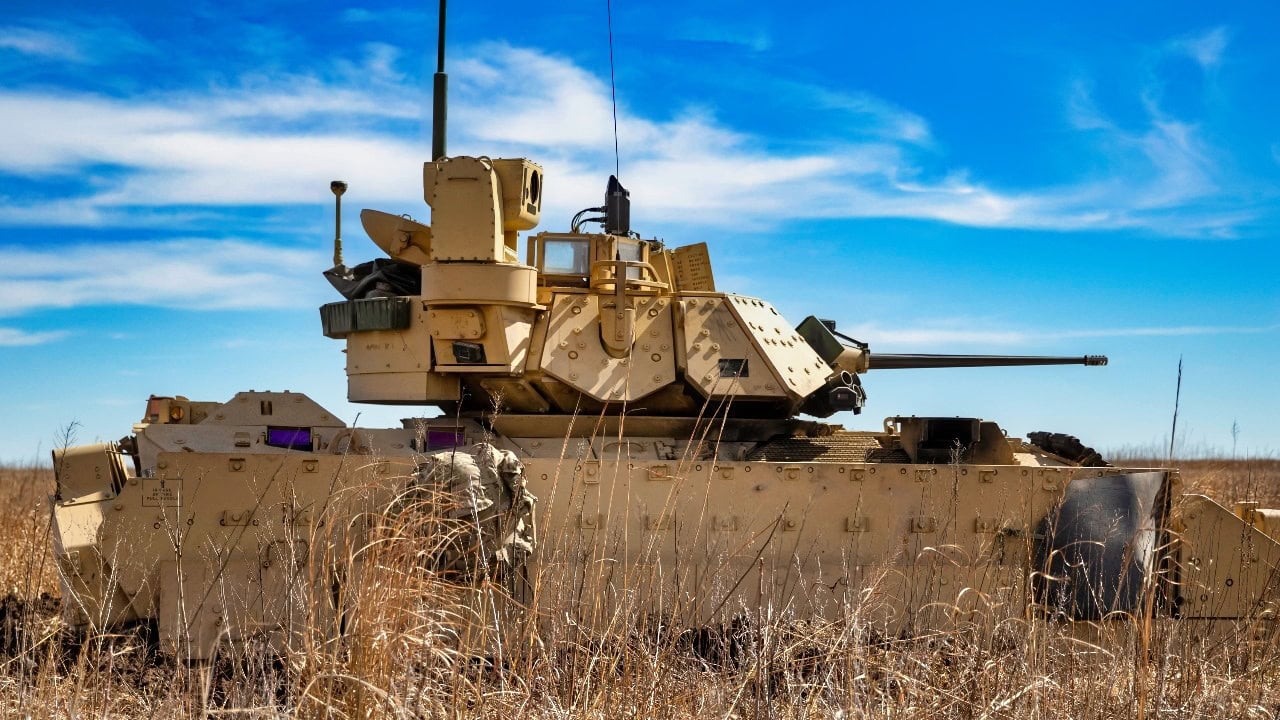
U.S. Army Soldiers with the 3rd Battalion, 66th Armored Regiment, 1st Infantry Division, participated in a battalion wide training event consisting of attacking and defending Bradley Fighting Vehicles and M1 Abrams Main Battle Tanks, on Fort Riley, February 4, 2024. The defending teams dug hasty trench defenses to further conceal and provide cover for their tanks. (U.S. Army Photo by Spc. Kenneth Barnet)
In fairness, the Bradley Fighting Vehicle project did stall in development hell for 17 years at a running cost of $14 billion to the U.S. taxpayers.
However, like other weapons systems, the IFV eventually proved it could deliver plenty of bang for taxpayers’ hard-earned bucks.
About “The Pentagon Wars”
The Pentagon Wars was a movie made in 1998, seven years after the Bradley had already finally proven the doubters wrong.
Though it’s a comedy, it is based on a 1993 non-fiction book by retired U.S. Air Force Colonel James G. Burton fully titled The Pentagon Wars: Reformers Challenge the Old Guard.
IMDb summarizes the film’s plot line thusly:
“An officer in the United States military becomes a whistleblower and pushes for survivability testing after corrupt generals in the Pentagon attempt to cover up glaring safety problems with the new Bradley Fighting Vehicle.”
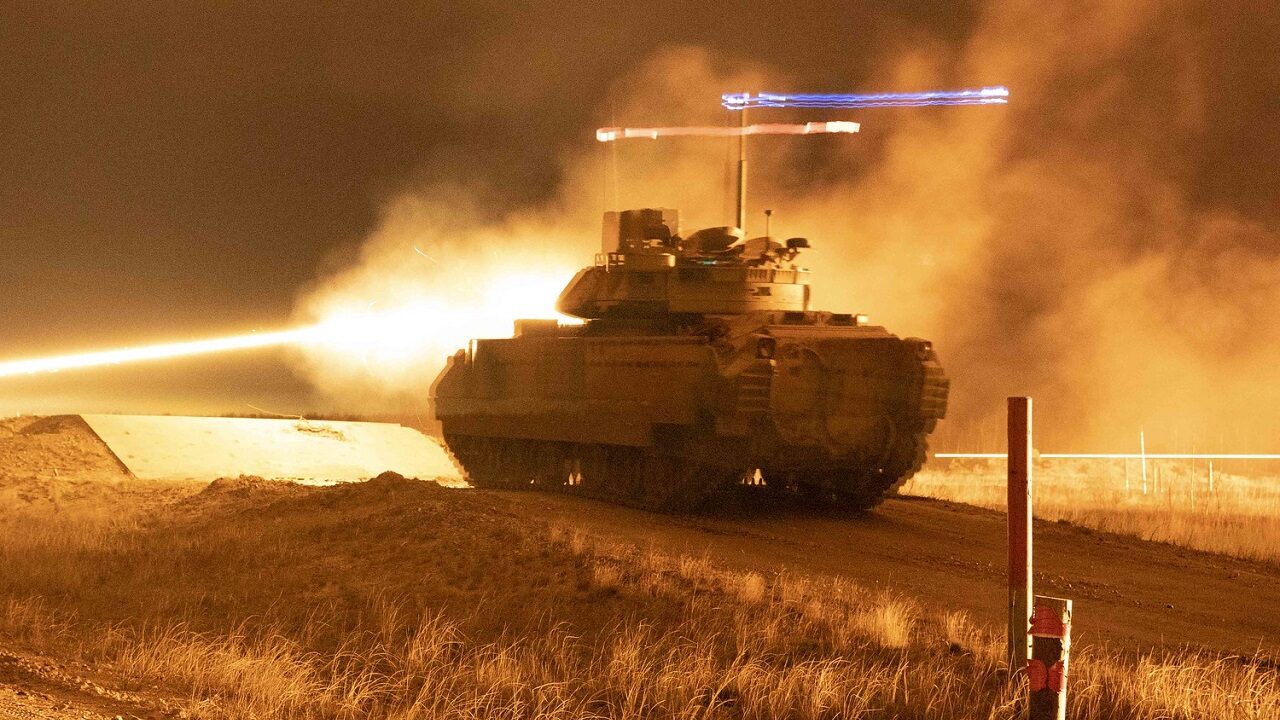
Soldiers fire a 25mm tracer round from an M2A3 fighting vehicle during an integrated night live-fire exercise at Camp Adazi, Latvia, Nov. 25, 2021.
The whistleblower is a thinly fictionalized and embellished version of then-Lieutenant Colonel Burton, played by Cary Elwes. Burton’s chief antagonist is the corrupt U.S. Army Major General Partridge, portrayed by Kelsey Grammar.
About the Author: Christian D. Orr, Defense Expert
Christian D. Orr is a Senior Defense Editor. He is a former Air Force Security Forces officer, Federal law enforcement officer, and private military contractor (with assignments worked in Iraq, the United Arab Emirates, Kosovo, Japan, Germany, and the Pentagon). Chris holds a B.A. in International Relations from the University of Southern California (USC) and an M.A. in Intelligence Studies (concentration in Terrorism Studies) from American Military University (AMU). He is also the author of the newly published book “Five Decades of a Fabulous Firearm: Celebrating the 50th Anniversary of the Beretta 92 Pistol Series.”