
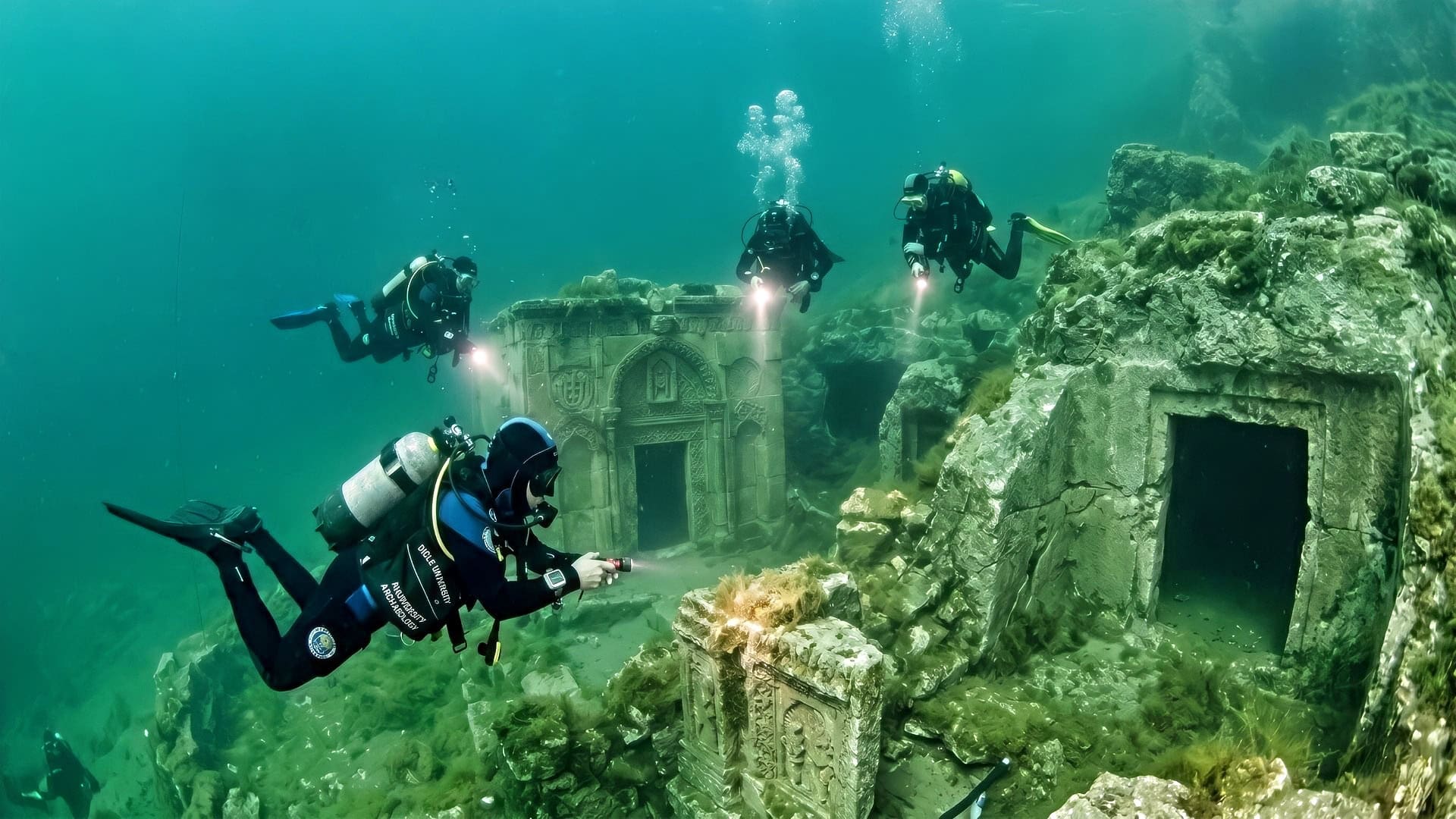
Archaeologists working with Dicle University have identified a surprisingly well-preserved settlement dating back approximately 2,400 years beneath Dicle Dam Lake in southeastern Turkey. The site, located in the Eğil district along the Tigris River, includes intact tombs and religious buildings that have remained largely undisturbed since the area was flooded following dam construction in the late 20th century.
The discovery was made after researchers conducted recent underwater imaging and dive surveys, revealing entire neighborhoods that were still standing beneath the reservoir.
Unlike usual archaeological finds, which are typically heavily degraded and damaged by years of being covered by earth, the new find offers a rare opportunity to examine a settlement’s true character. The conditions created by the dam appear to have aided in preserving the site rather than destroying it.
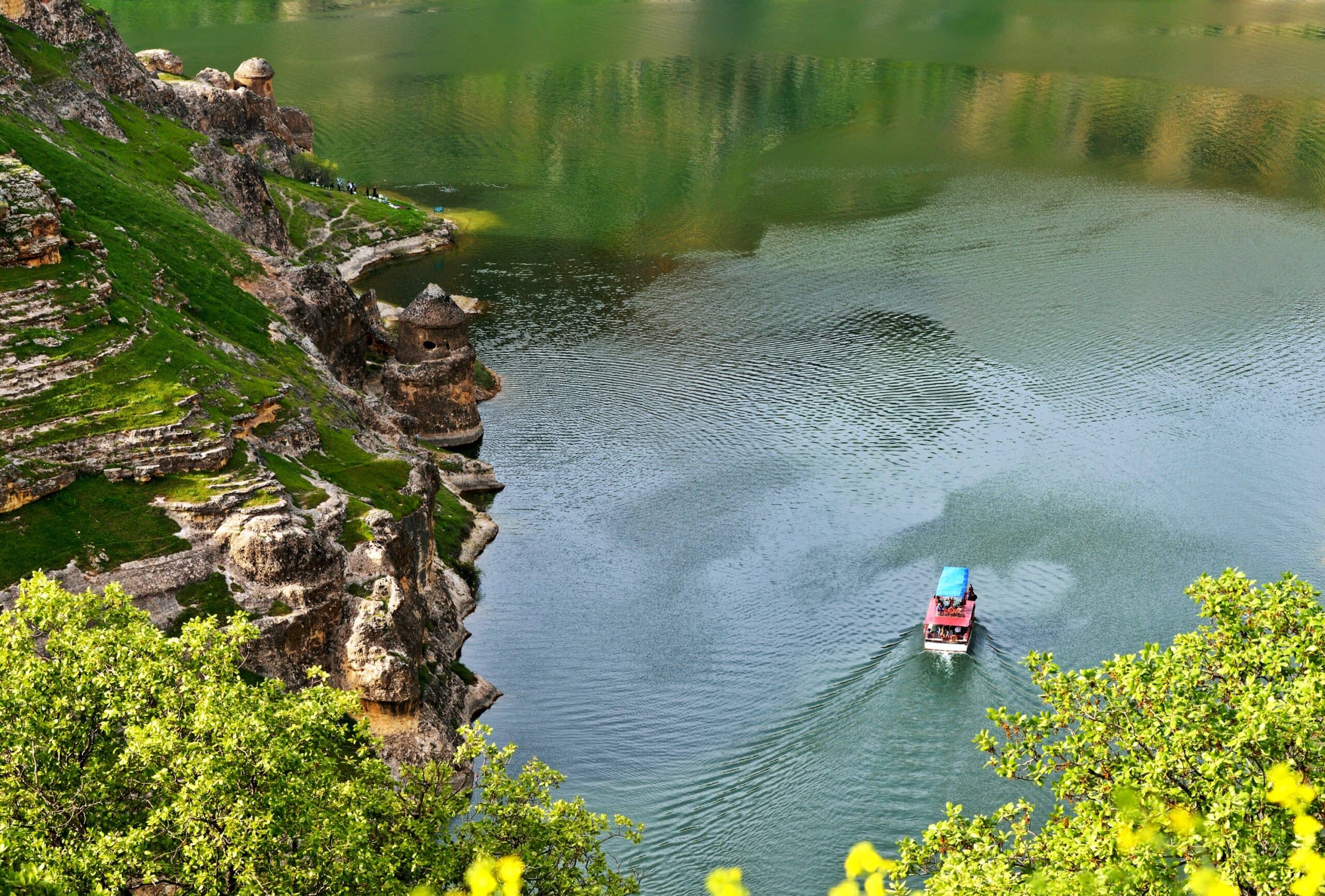
Dicle Dam Lake.
How This Happened
The construction of the Dicle Dam, a major hydroelectric and irrigation project built between 1986 and 1997 as part of Turkey’s regional development strategy, is ultimately the reason the preserved site exists.
In creating a large reservoir, large sections of the Tigris River valley were submerged, protecting multiple historic settlements in the process. And while in many cases flooding like this leads to irreversible loss, this time it was different.
Typically, archaeological material is eroded or displaced by water movement and sediment disruption – but the unique conditions of Dicle Dam lake appear to have done the opposite. According to researchers, a combination of low oxygen levels and minimal water current helped maintain the site’s structural integrity for decades.
Dr. Irfan Yildiz, Dean of the Faculty of Art and Design, described the preserved state of the buildings as “extraordinary.” The buildings’ walls, outlines, and a range of architectural features have all been preserved and are clearly identifiable in underwater footage.
And while this phenomenon is not entirely unique, it is certainly rare. Other submerged sites in Turkey, including the ancient city of Juliopolis, have also survived beneath reservoirs, though typically in a more degraded form. The Dicle site stands out because of the extent to which the structural layouts are still noticeable.
But how are we only just learning about this when the dam was constructed only a handful of decades ago? In short, it’s a result of the area not having been fully surveyed or excavated before it was flooded in the 1990s.
Archaeological work conducted ahead of dam construction in Turkey and across the wider region has historically been selective, prioritizing high-value monuments or religious sites rather than entire settlement systems.
Studies of dam-related archaeology in southeastern Turkey show that, in many cases, less than half of the reservoir areas were ever systematically investigated, and only a fraction of known sites were fully excavated before flooding. This is a pattern seen across large-scale infrastructure projects, where time constraints and funding limitations mean that submerged landscapes are not fully documented before the dams become operational.
What, Exactly, Was Found
The underwater surveys have reportedly revealed a settlement that includes rock-cut tombs and religious complexes, civic buildings, residential areas, cemeteries, and more. Among the most significant structures to be discovered was a tomb associated with the Prophet Elisha, a biblical and Islamic prophet who was revered as the spiritual successor to the Prophet Elijah.
Additionally, the Ottoman-era Caferiye Madrasa was found preserved beneath the water.
The buildings discovered indicate that the site was far more than a small rural outpost; this was a functioning community that had full social infrastructure, religious buildings, and a large number of homes.
The site is special not just for the buildings that were discovered, but because most archeological work is usually limited to finding partial remains, including foundations of buildings that have long crumbled and pieces of artifacts that researchers must painstakingly piece back together. In this instance, however, researchers can analyze how buildings relate to one another in situ, providing one of the most exciting examples of historic settlement planning and land use.
There are also indications that the site was used over a long period of time. While the settlement is broadly described as being 2,400 years old, some of the identified structures – particularly the Islamic-era buildings, which are far more modern given the relative youth of the religion – are clearly from later periods. That suggests that the site was either continuously occupied or it was reused across the centuries – a pattern consistent with similar sites discovered across the Tigris basin.
Divers have reported that in some areas, the outlines of buildings remain so clearly defined that they resemble a recently abandoned settlement rather than an ancient ruin.
A Region Shaped by Successive Civilizations
The submerged settlement sits within one of the most historically interesting regions in the Middle East, defined by successive civilizations. The Eğil district, located roughly 50 kilometres from Diyarbakır, has been inhabited for thousands of years and has served as a crossroads for multiple civilisations.
Historical records and archaeological evidence show that the area has been controlled by a succession of major powers, including the Hurri-Mitanni, Assyrians, Persians, Romans, Byzantines, and later Islamic empires. Earlier references also link the region to the Hittites and other ancient Anatolian cultures. The broader Tigris River Valley has long functioned as a strategic and economic corridor, supporting trade, agriculture, and political control across Mesopotamia. Its location made it an ideal site for settlement, but it has endured cycles of occupation, destruction, and reconstruction over the centuries.
The Race to Document the Site
While the discovery presents significant new research opportunities, it also comes with a time limit.
The same environmental conditions that preserved the site could well contribute to its eventual degradation if not properly managed.
A combination of fluctuating water levels and sediment movement poses a risk to the integrity of all structures. And, in some cases, falling water levels have temporarily exposed parts of the site, which was great for visual documentation but also made the structure vulnerable to human interference and environmental damage.
For the parts that remain underwater, there are additional challenges.
Surveying submerged structures requires specialized equipment and trained dive teams, and mapping is difficult, too. Access is also often limited to specific conditions, meaning the site can only be accessed at certain times, and excavation is significantly more complex than traditional land-based archeology.
Researchers are now calling for additional underwater studies to fully document the site before it deteriorates further, but this will require time and funding. If it goes ahead, it would involve detailed mapping of the settlement and analysis of the construction materials.
Ultimately, too, artifacts recovered from the site would provide further insight into daily life for those who inhabited it.
Turkey’s archaeological landscape helps explain why discoveries like this continue to appear decades after major structural and development projects.
The country is home to tens of thousands of recorded archaeological sites, with hundreds of active excavations taking place each year, many of which are conducted under time pressure or with limited funding.
About the Author: Jack Buckby
Jack Buckby is a British researcher and analyst specializing in defense and national security, based in New York. His work focuses on military capability, procurement, and strategic competition, producing and editing analysis for policy and defense audiences. He brings extensive editorial experience, with a career output spanning over 1,000 articles at 19FortyFive and National Security Journal, and has previously authored books and papers on extremism and deradicalization.