
SUMMARY AND KEY POINTS: China’s Haiyang Dizhi 2 research vessel has successfully tested a deep-sea cable-cutting device at 3,500 meters — 11,483 feet — marking the first publicly acknowledged demonstration by any country of severing capability at that depth. The test, completed last Saturday and confirmed by China’s Ministry of Natural Resources and the state-run China Science Daily, used an electro-hydrostatic actuator developed by the China Ship Scientific Research Centre and its State Key Laboratory of Deep-sea Manned Vehicles.
China Might Have a New Weapon of War: Cut the Cables
In one of those innovations that seems to represent a new frontier in weaponry, China has tested an undersea cable-cutting device that operates at a depth of 3,500 meters—more than 2 miles.
According to the South China Morning Post, which cited China’s Ministry of Natural Resources and the state-run China Science Daily, the Haiyang Dizhi 2 research vessel completed its first mission of the year last Saturday.
The mission included “a cutting test of a deep-sea electro-hydrostatic actuator at a depth of 3,500 meters (11,483 feet), using technology that has drawn attention for its potential military use,” the SCMP reported. It also quoted China Science Daily as writing that “the sea trial has bridged the ‘last mile’ from deep-sea equipment development to engineering application.”
The mission used what’s described as an electro-hydrostatic actuator in place of the more typical “external oil piping typical of conventional systems.”
What’s the Military Use?
An SCMP story from last month examined what China hoped to achieve with its cable-cutting device, even hinting that it would give Beijing the power to “disrupt global communications” and “reset the global order.”
“A compact, deep-sea, cable-cutting device, capable of severing the world’s most fortified underwater communication or power lines, has been unveiled by China – and it could shake up global maritime power dynamics,” the newspaper reported.
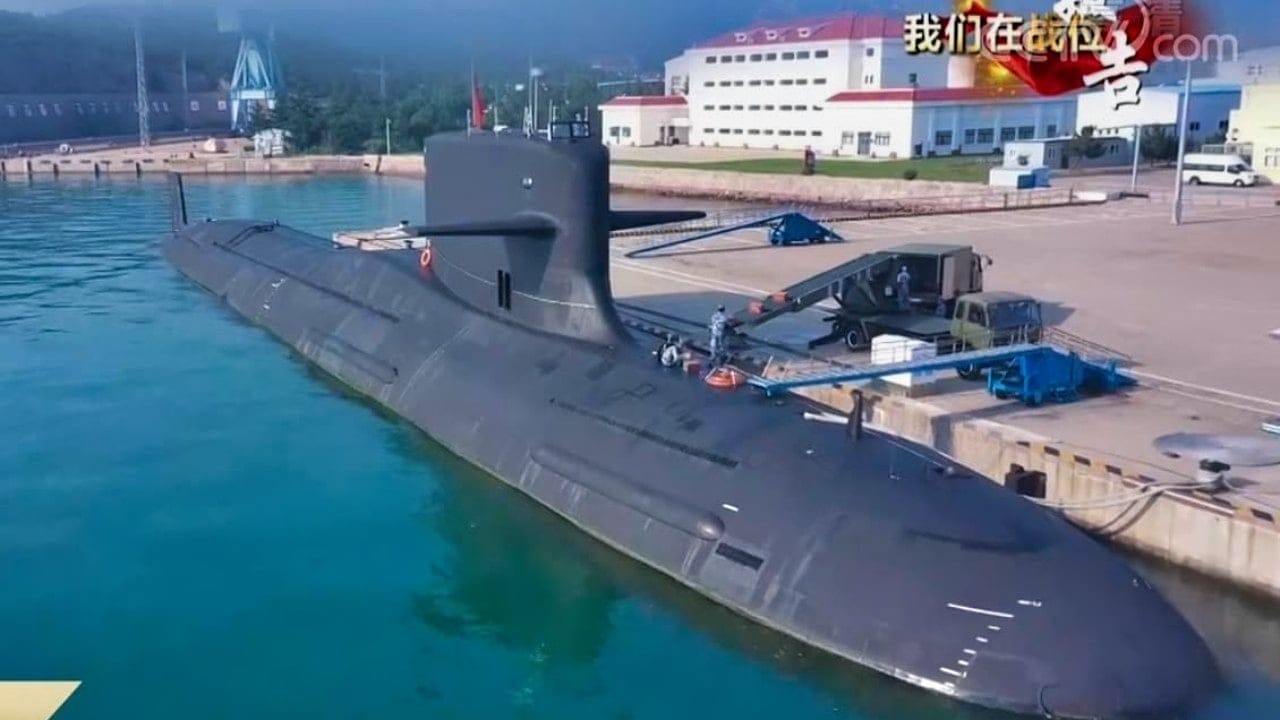
Type 093B Submarine from China. Image Credit: Screengrab.
The SCMP added that this is the first time any country has acknowledged the existence of such a device, and that it can operate at twice the depth of existing “subsea communications infrastructure.”
The device was reportedly developed by the China Ship Scientific Research Centre, along with its affiliated State Key Laboratory of Deep-sea Manned Vehicles, the SCMP reported in March.
“While it was created as a tool for civilian salvage and seabed mining, the dual-use potential of the tool could send alarm bells ringing for other nations,” the March SCMP report said of the new device.
A Threat to Guam?
This new technology could pose a threat to the U.S. in an unlikely place– the U.S. territory of Guam.
“Cutting cables near strategic chokepoints such as Guam, which is a linchpin of the US military’s second island chain, a defence strategy used to contain China, the tool could essentially destabilize global communications during a geopolitical crisis,” the March South China Morning Post story said.
The private sector also would be greatly affected by such a capability.
“Guam remains a cornerstone of the US Indo-Pacific strategy, hosting more than a dozen fibre-optic cables that serve both military and civilian clients, including Google,” SCMP reported.
An Early Warning
In early April 2025, the Center for Strategic and International Studies sounded the alarm with an article titled “China’s Underwater Power Play: The PRC’s New Subsea Cable-Cutting Ship Spooks International Security Experts.” The commentary, by Erin L. Murphy and Matt Pearl, discussed why experts were alarmed by early reports of the cable-cutting technology. The analysis was written in response to the first reports that China was working on such technology, a year before the recent tests.
“Though subsea cable ships are outfitted with equipment to repair damaged or cut cables, the record depths to which this ship can go and the increasing tension in maritime areas with critical subsea infrastructure suggest that China has strengthened a tool in its arsenal, whether for intentionally cutting cables or supporting ‘marine resource development,’ as alleged by Chinese scientists,” the CSIS report said.
The analysis added some background: Taiwan has long accused China of cutting its cables, while China has responded that any such cuts have been accidental. Subsea cables, furthermore, “have emerged as critical theater, given that they are indispensable to international communications and are vulnerable to deniable intentional disruption; accidental cuts; surveillance, particularly at cable landing sites; and other risks.”
With this new project, CSIS finds, Beijing “has laid bare that it regards sabotage and other intentional alteration of cables as just another coercive move in its playbook. Specifically, these actions signal that the PRC will likely further deploy cable-cutting capabilities in the Taiwan Strait, the South China Sea, and beyond.”
What Can Be Done?
The CSIS analysis also examined possible ways to safeguard cables or otherwise address this potentially devastating new capability.
The goal is “determining how to build redundancy into the subsea cable infrastructure,” by laying more cable and by finding ways that “governments and industry can work together to assess and bolster total system resiliency.”
There are multiple schools of thought on how best to do this, CSIS wrote.
“One school proposes laying cables in a designated corridor to prevent accidental cuts from ships, making it easier to work with the fishing industry to identify areas that can be avoided in laying cables or for fishing, and creating a smaller and more defined area to patrol for ships that could accidentally or purposefully cut cables,” the authors wrote. The other school proposes “laying more cables, but not in a concentrated area,” in order to prevent chokepoints. Both agree on the need for more cables.
“China’s newest capabilities also highlight the need for greater cooperation among governments and the private sector to protect the subsea cable network,” CSIS concluded. “The ocean is vast and cannot be patrolled by one country. At the same time, more joint patrols among cable-connected countries, particularly in areas with chokepoints, active conflict, or geostrategic waters, can provide additional security for cable repair ships and potentially deter saboteurs. … It is difficult to overstate the urgency of finding and implementing solutions to address these challenges.”
About the Author: Stephen Silver
Stephen Silver is an award-winning journalist, essayist, and film critic, and contributor to the Philadelphia Inquirer, the Jewish Telegraphic Agency, Broad Street Review, and Splice Today. The co-founder of the Philadelphia Film Critics Circle, Stephen lives in suburban Philadelphia with his wife and two sons. For over a decade, Stephen has authored thousands of articles that focus on politics, national security, technology, and the economy. Follow him on X (formerly Twitter) at @StephenSilver, and subscribe to his Substack newsletter.