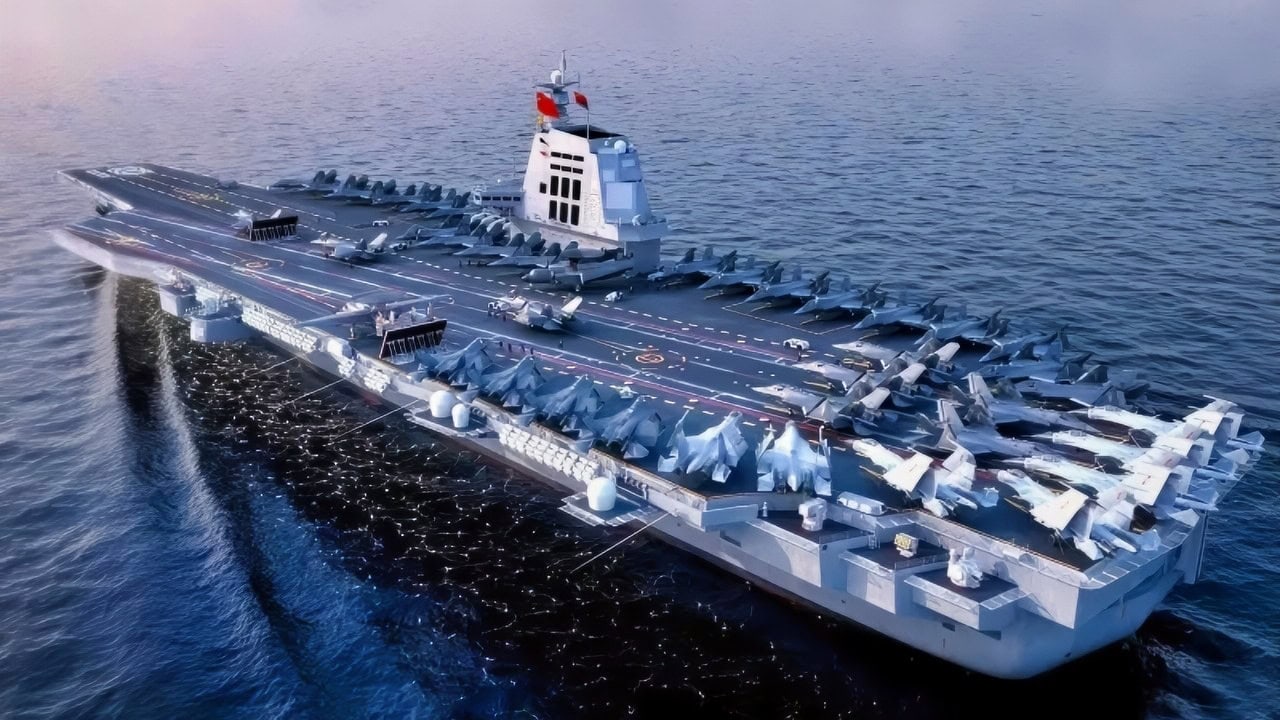
The Chinese Navy’s Aircraft Carriers Are Backed Up By Missiles; The U.S. Navy Has a Clear Challenge To Deal With
The People’s Republic of China (PRC) issues a warning to the United States Navy: you are not allowed to challenge the First Island Chain, which includes territories from Kamchatka through Japan and Taiwan down to the Philippines.
The Message from Beijing: Keep Out of the First Island Chain
China has developed a smart defensive strategy that combines favorable geography, missile saturation through anti-access/area-denial (A2/AD) tactics, and a cheaper, risk-tolerant carrier approach. Unlike the United States Navy, however, China has not made the carrier the centerpiece of its naval warfare strategy.
Instead, the Chinese have positioned long-range missiles within the A2/AD network across the region as the core of their grand strategy.
The carriers and other elements of the Chinese Armed Forces are simply parts of that larger plan.
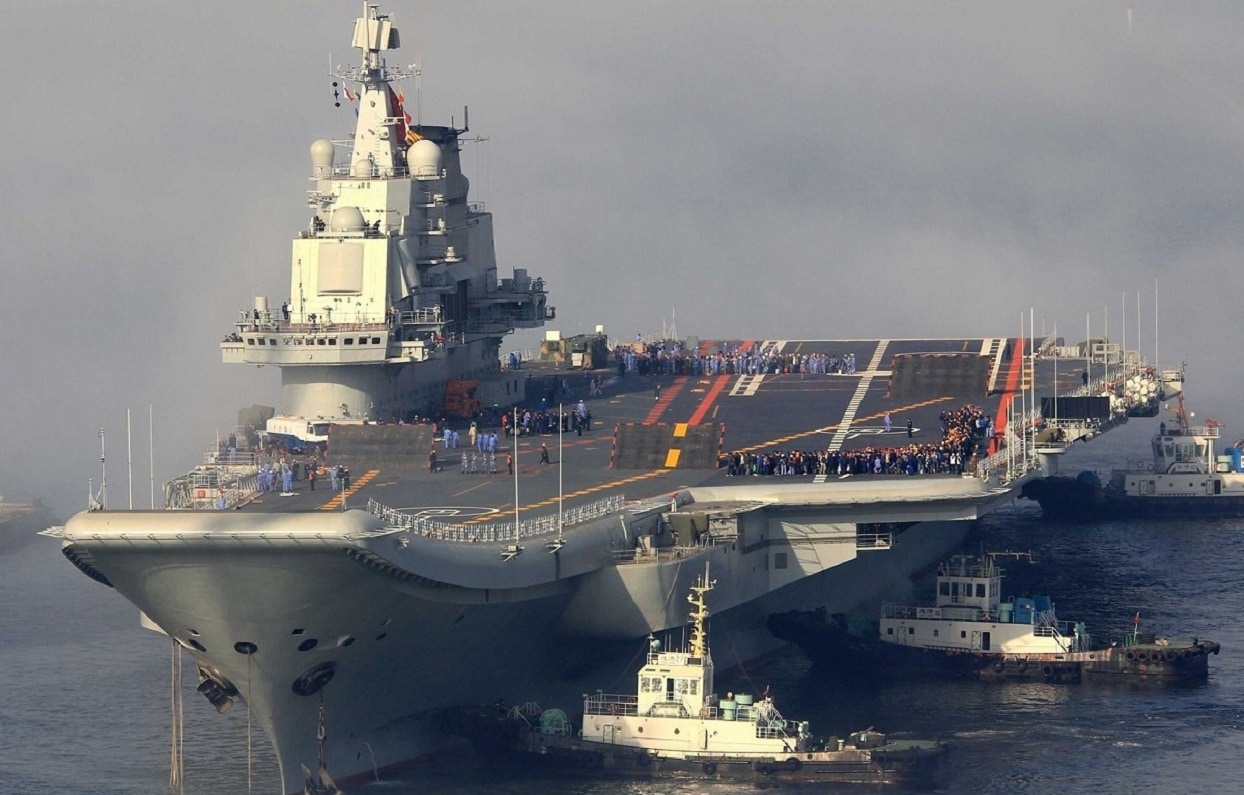
Image: Chinese Internet.
Since the Chinese are likely to fight any major war in their region, that defensive, geographical advantage becomes a key feature of any Chinese war plan when they face off against the Americans and their regional allies.
Essentially, the Chinese military has spent nearly a decade building a defensive A2/AD ring around the First Island Chain.
Geography as a Weapon: China’s Built-In Advantage
Chinese forces have built man-made islands in the South China Sea (SCS).
They have expanded their A2/AD network to target areas deep inside the East China Sea, the Sea of Japan, and even threaten US military bases as far as the Second Island Chain with long-range missiles and hypersonic weapons.
If the Chinese People’s Liberation Air Force (PLARF) successfully develops the Xi’an H-20 long-range strategic stealth bomber, China will gain an even greater ability to strike American targets within the Second Island Chain.
So, the A2/AD is a shield or bubble that allows the Chinese Armed Forces to carry out sweeping offensives against perceived enemies within the First Island Chain.
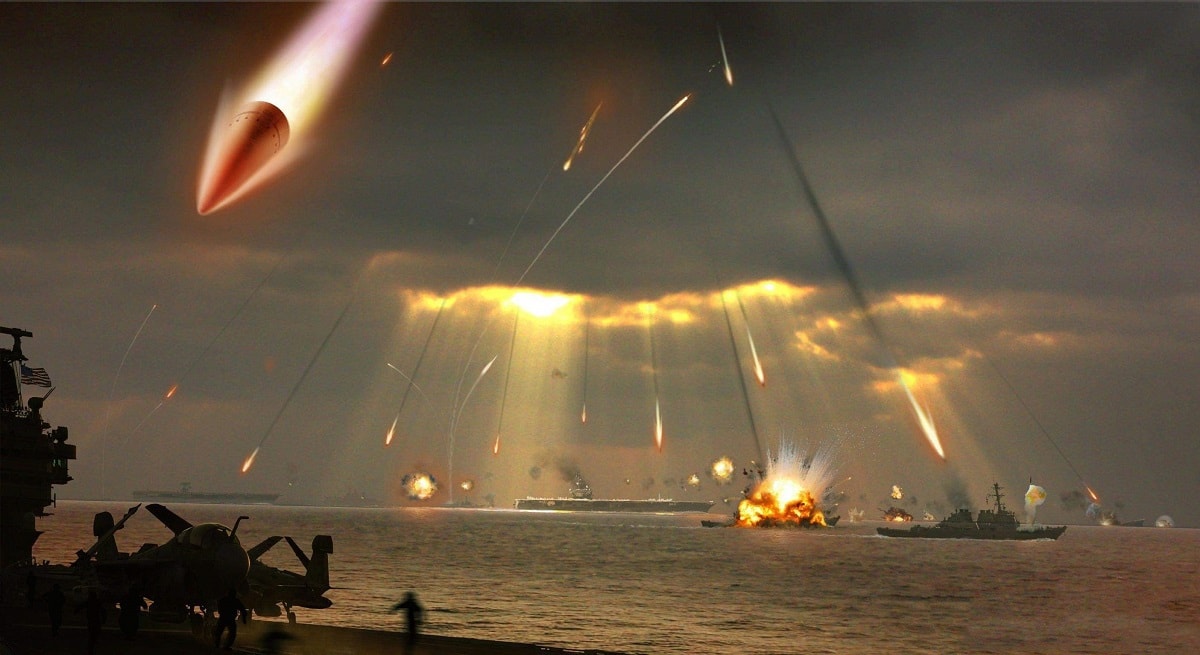
Depiction of Chinese missiles attacking the U.S. Navy. Image: Chinese Internet.
Consider that China and Japan, a key US ally in the Indo-Pacific, were at odds toward the end of last year, with Beijing and Tokyo clashing over China’s claim that Japan was displaying unwanted “renewed militarism.”
The Great “Missile Wall” of China
It got so bad, in fact, that China began posting maps of Japan showing how China’s massive missile arsenal could effectively strangle Japan the same way that the Houthis in Yemen, with their missiles, have been cutting off the Red Sea and the Strait of Bab el-Mandeb for years, or the way Iran today is strangling the Strait of Hormuz. Japan did not back down initially.
Although things cooled when it became clear at the start of this year that President Donald Trump would not vociferously support Tokyo.
This was probably because the American president wanted to maintain stable relations with China to secure his highly publicized new trade agreement with Beijing. It was also, however, likely because he fully understood the scale and nature of China’s military threat.
Washington quietly concedes that China’s A2/AD bubble acts as a protective shield, enabling Chinese forces to operate freely and even dominate the First Island Chain—mighty Japan is not immune from the kind of warfare China will impose.
This is especially true for places like Taiwan and even the Philippines.
Safe Inside the Bubble: How China Uses Aircraft Carriers Differently (‘Missile Shield’)
Enter China’s expanding fleet of aircraft carriers.
As you can see, China has demonstrated to the world that aircraft carriers are becoming increasingly obsolete thanks to its A2/AD networks. It has left many observers puzzled, trying to understand why the Chinese would invest so much time and money into building their own fleet of advanced carriers if, in fact, the carrier was made obsolete by A2/AD.
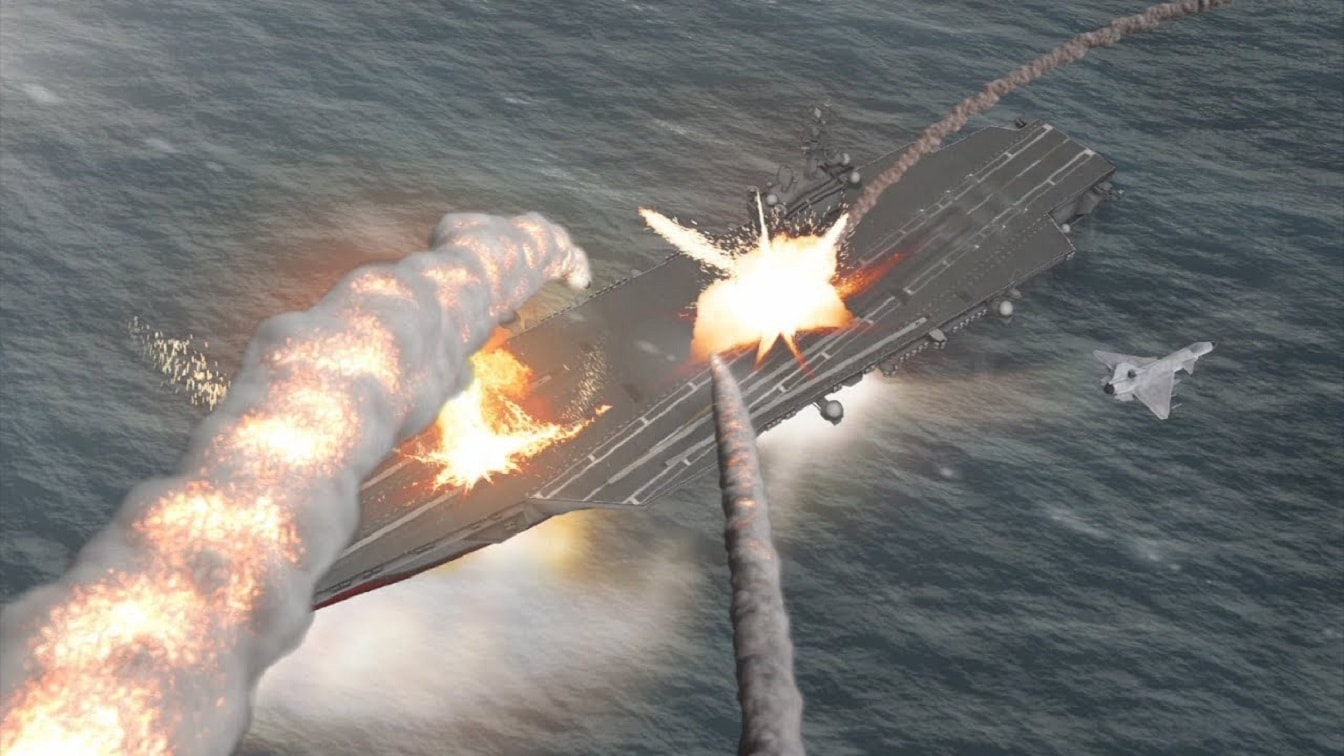
YouTube Screenshot of a Simulation of China Firing a DF-21 ASBM.
Well, the answer is straightforward. Using the carrier as a power-projection tool outside one’s own region’s protective boundaries is irresponsible. Within one’s own area, operating under the shield of a regional A2/AD network, carriers can be quite effective.
While American carriers might struggle to penetrate the Chinese A2/AD bubble surrounding the First Island Chain, within that chain, thanks to those defenses, China’s carriers would theoretically have free rein to impose their will. AKA, the missile shield that allows China’s carriers to dominate a fight, potentially.
In other words, the Chinese have adopted a strategy of denial. Beijing believes that without reliable military support from the United States during a geopolitical crisis, even Japan would find it hard to resist the PRC’s overwhelming force. Any capabilities that advanced countries like Japan, Taiwan, or the Philippines have are not designed for a prolonged war of attrition.
The Grim Reality: America Watching from the Outside
China, on the other hand, is built not just for a war of attrition. China’s military is designed to be protected by a vast and comprehensive A2/AD network that will strike down any defenders and shield Chinese attackers—all while denying those defenders access to their strong American ally.
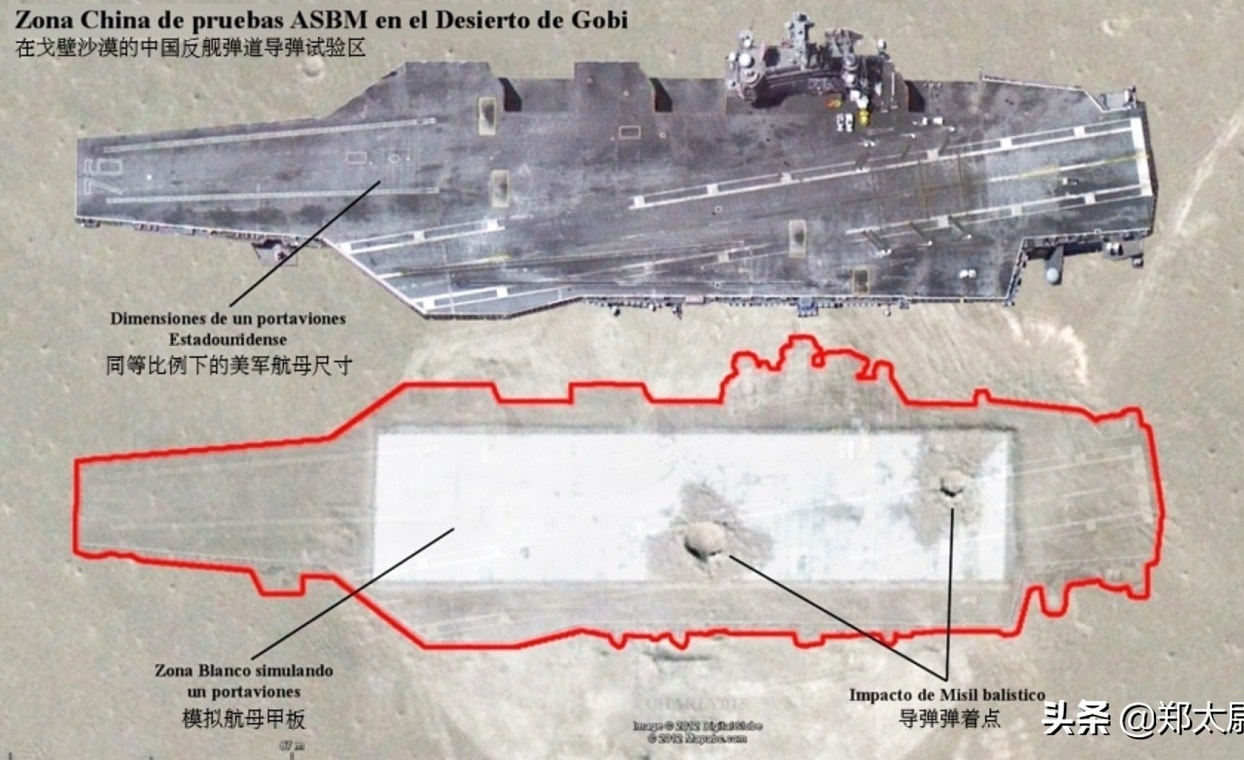
Image from the now closed WantChinaTimes. This shows a mock attack on a U.S. Navy aircraft carrier.
This is called overmatch. Regarding the First Island Chain, China’s A2/AD network provides them with that advantage. Additionally, their carrier force guarantees China’s dominance.
At this point, all the United States can do is watch somewhat helplessly as the Chinese take control of US partners within the First Island Chain.
MORE – The U.S. Navy Needs to Stop Building Aircraft Carriers Now
About the Author: Brandon J. Weichert
Brandon J. Weichert is the Senior National Security Editor at 19FortyFive.com. Recently, Weichert became the editor of the “NatSec Guy” section at Emerald.TV. He was previously the senior national security editor at The National Interest. Weichert is the host of The National Security Hour on iHeartRadio, where he discusses national security policy every Wednesday at 8 pm Eastern. He hosts a companion show on Rumble entitled “National Security Talk.” Weichert consults regularly with various government institutions and private organizations on geopolitical issues. His writings have appeared in numerous publications, among them Popular Mechanics, National Review, MSN, and The American Spectator. And his books include Winning Space: How America Remains a Superpower, Biohacked: China’s Race to Control Life, and The Shadow War: Iran’s Quest for Supremacy. Weichert’s newest book, A Disaster of Our Own Making: How the West Lost Ukraine, is available for purchase wherever books are sold. He can be followed via Twitter/X @WeTheBrandon.