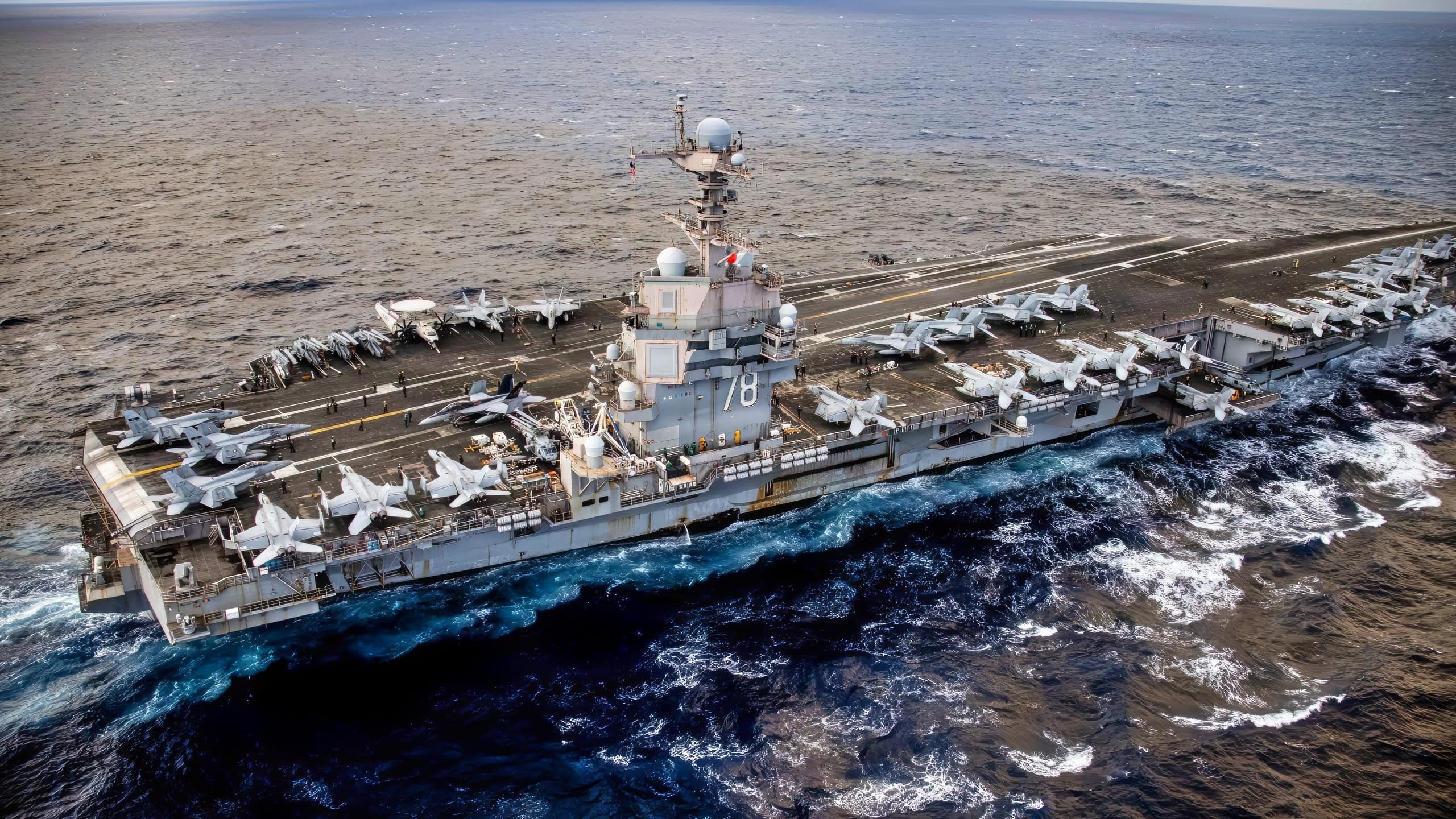
The USS Gerald R. Ford Is Heading Into Its 11th Month at Sea — Broken Toilets, a 30-Hour Fire, and a Munitions Crisis
The USS Gerald R. Ford (CVN-78), the lead ship of the U.S. Navy’s new Ford-class aircraft carriers, is on pace to carry out one of the longest carrier deployments of the post-Vietnam era.
The Ford has been deployed since June 2025, and its deployment was extended in February ahead of the beginning of Operation Epic Fury, the joint Israeli-U.S. operation against Iran.
Speaking at an event hosted by the Center for Strategic and International Studies,Chief of Naval Operations Admiral Daryl Caudle said that the Ford will “probably go into the 11th month of deployed operations. For those who are not in the Navy, that’s an extraordinary thing to even think about something of that kind of deployment length. So my hat’s off to the Ford.”
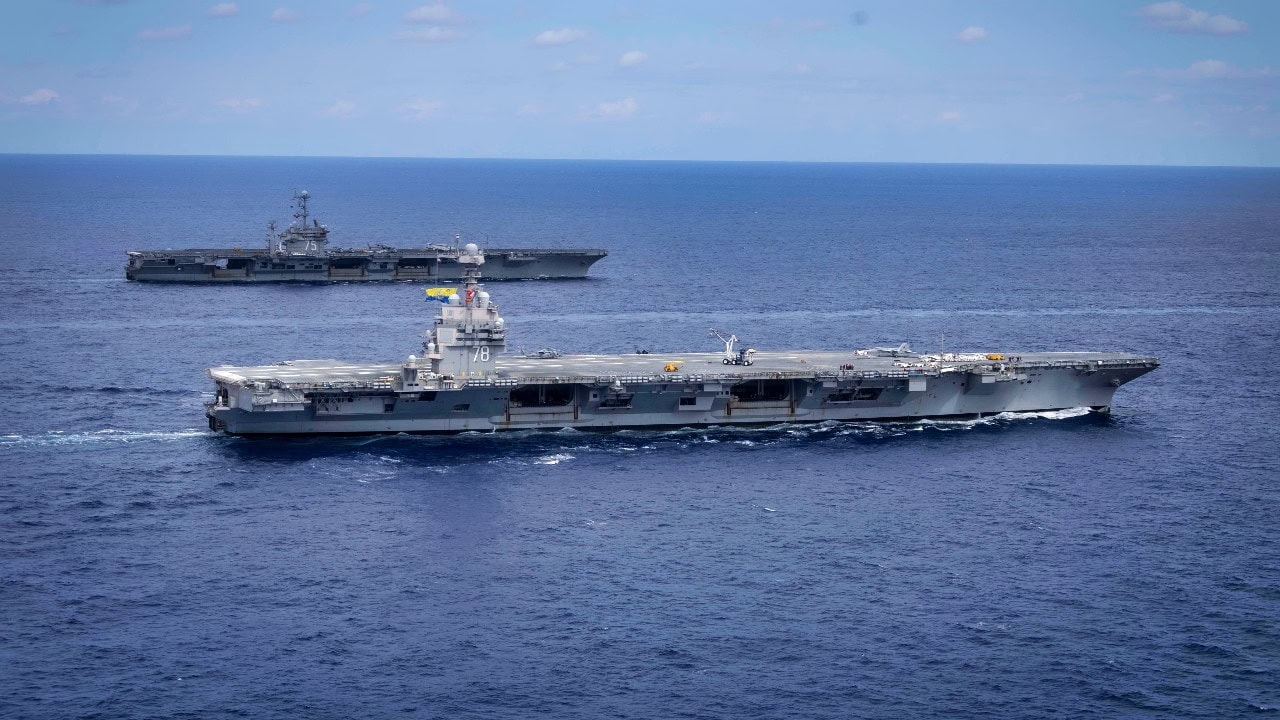
ATLANTIC OCEAN. (Aug. 24, 2024) The Nimitz-class aircraft carriers USS Harry S. Truman (CVN 75), back, and the world’s largest aircraft carrier, USS Gerald R. Ford (CVN 78), sail in formation in the Atlantic Ocean, Aug. 24, 2024. USS Gerald R. Ford is the flagship of the Gerald R. Ford Carrier Strike Group. The aircraft carrier is underway in the Atlantic Ocean to further develop core unit capabilities and skills such as fuels certification and ammunition on-load during its basic phase of the optimized fleet response plan. (U.S. Navy photo by Mass Communication Specialist 2nd Class Maxwell Orlosky).
It is unclear when Ford will return to the United States. In 2019 and 2020, the USS Abraham Lincoln (CVN-72) was at sea for 294 days. Later, the USS Nimitz (CVN-68) stayed at sea for 341 days.
Prior to its deployment to Central Command, the Ford had been deployed to the Caribbean in support of the operation that nabbed Venezuelan strongman Nicolás Maduro and his wife, who were brought to New York for arraignment.
The Ford’s deployment is not unmarred by mishaps or accidents. “I mean, she did have a fire in her laundry,” Admiral Caudle conceded, referring to a fire that began in the ship’s laundry facility and raged for hours, burning hundreds of sailors’ clothes and reportedly affecting living quarters as well. “And they fought that, put it out, recovered from that, and started flying, you know, sorties two days after that. So I’m very proud of that crew.
The carrier also experienced serious issues with its toilet system, which frequently broke down and clogged.
That sanitary system, adapted from civilian cruise liners, was designed to use water sparingly, but the technology proved poorly suited to a Navy warship.
“So, you know, this is, you know, a full, whole-of-government approach to actually do that. And there’s a whole joint force. You know, some of the force elements that are being consumed, you know, are not unilaterally applied across the entire joint force as well. So, but, yes, I’m concerned,” Admiral Caudle said. “I mean, it’s, again, we’ve shot a lot of munitions … the munitions have taken a hit. You know, you’re going to see a record-breaking deployment by Ford.”
Setting aside teething issues aboard the carrier, the deployment has also exposed the precariousness of defending capital ships from attack—and the seemingly sluggish response from the Pentagon to incentivize increased production of offensive and defensive munitions.
Show Me the Money
The fighting in Iran lays bare the difficulty the U.S. defense industrial base will face in replenishing some of the munitions used in the opening stages of Operation Epic Fury. By one count, the United States fired more than 850 Tomahawk cruise missiles at targets across Iran.
Exquisite, precise, and strategically important, the munitions are also expensive to purchase and slow to manufacture. According to U.S. Navy budgeting documents, these cruise missiles cost about $3.6 million each.
The Navy is set to receive just a paltry 110 Tomahawk missiles in Fiscal Year 2026.
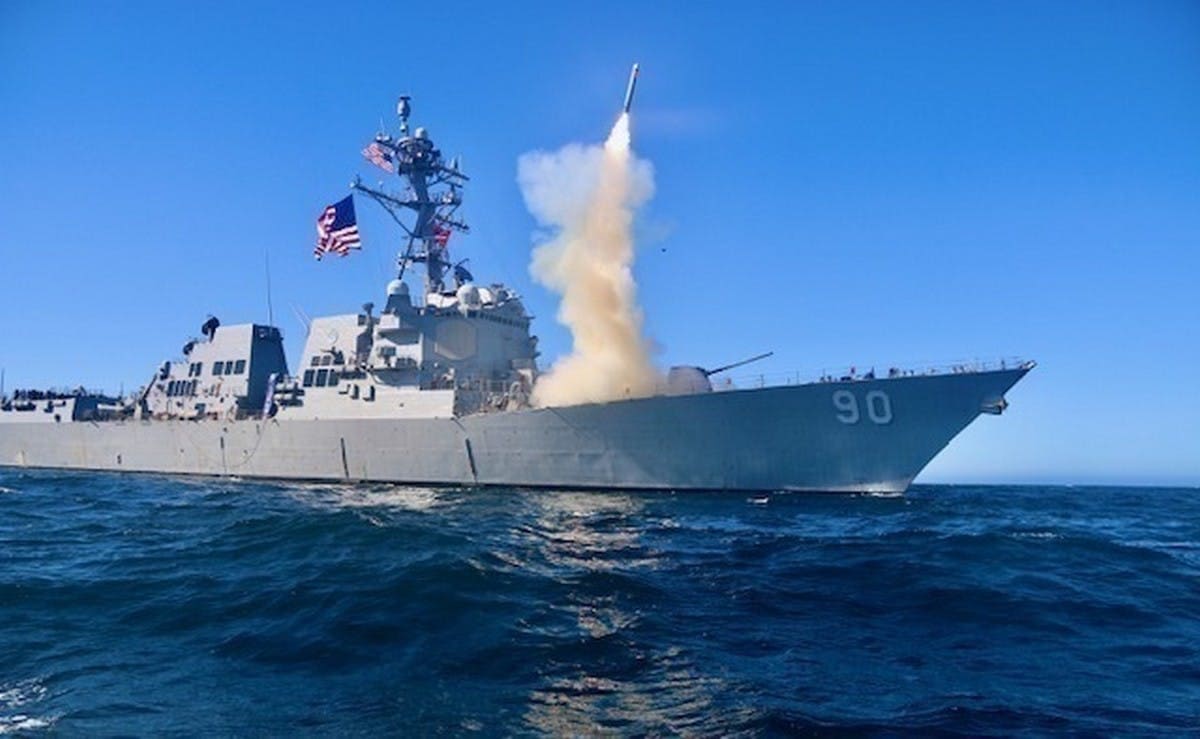
Tomahawk Missile. Image: Creative Commons.
By one estimate, the Tomahawk missile stockpile numbers in the low 3,000s. And while there are almost certainly enough Tomahawk missiles to fight the war in Iran, further expenditure has implications for the next war—namely, that there will not be enough Tomahawk munitions to fight a protracted conflict in the Indo-Pacific.
With the United States reportedly cannibalizing air-defense infrastructure from Ukraine for use in the Middle East, the cost disparity between Iran’s cheap one-way attack drones and the U.S. air-defense interceptors used by a number of Middle Eastern countries, as well as the United States, has been the subject of intense focus. Admiral Caudle also acknowledged the need to field more interceptors and to rely on more affordable interceptors when possible.
“And so, yeah, we were upside down, you know, shooting an SM-6 at a $5,000 one-way UAV, of course,” Admiral Caudle said. “And so, you know, we answered that pretty quickly by several systems that we tried out, like Coyote and Road Runner, you know, and these versions of, you know, Hellfire-size missiles. They can really do very well in that environment.”
Those munitions, manufactured by Raytheon and Anduril respectively, cost significantly less than the Standard Missile (SM) family of air defense munitions and promise to close the cost gap between inexpensive attack drones and expensive interceptors.
Whether they can do so remains to be seen. Another question is the applicability of counter-drone systems to a conflict in the Indo-Pacific.
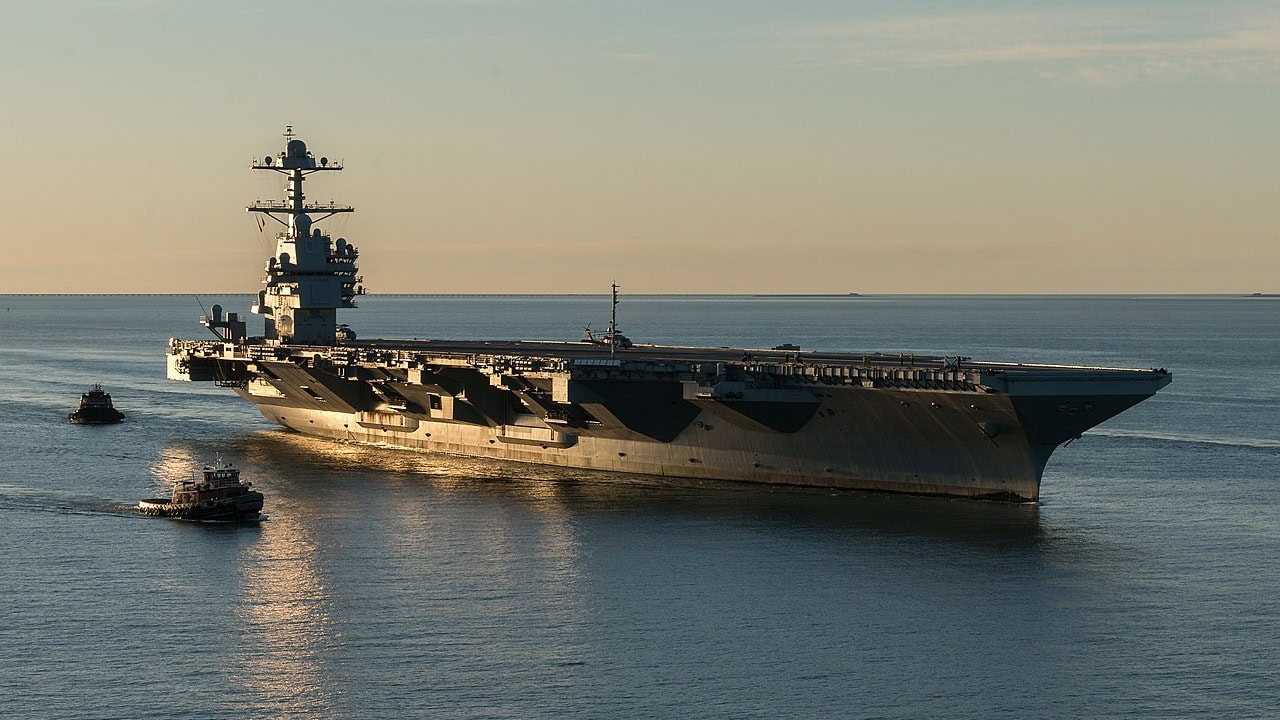
From 2017 – The aircraft carrier Pre-Commissioning Unit (PCU) Gerald R. Ford (CVN 78) pulls into Naval Station Norfolk for the first time. The first-of-class ship – the first new U.S. aircraft carrier design in 40 years – spent several days conducting builder’s sea trails, a comprehensive test of many of the ship’s key systems and technologies. (U.S. Navy photo by Matt Hildreth courtesy of Huntington Ingalls Industries/Released)
Though these systems are optimized to engage smaller unmanned aerial vehicles and larger Shahed-type attack drones, they might be less useful against the kind of carrier-killer anti-ship missiles the Navy expects to encounter in the Indo-Pacific.
But during the ongoing war in Iran, they may prove useful.
MORE: Donald Trump Could Break the Back of NATO
About the Author: Caleb Larson
Caleb Larson is an American multiformat journalist based in Berlin, Germany. His work covers the intersection of conflict and society, focusing on American foreign policy and European security. He has reported from Germany, Russia, and the United States. Most recently, he covered the war in Ukraine, reporting extensively on the shifting battle lines in Donbas and writing about the war’s civilian and humanitarian toll. Previously, he worked as a Defense Reporter for POLITICO Europe. You can follow his latest work on X.