
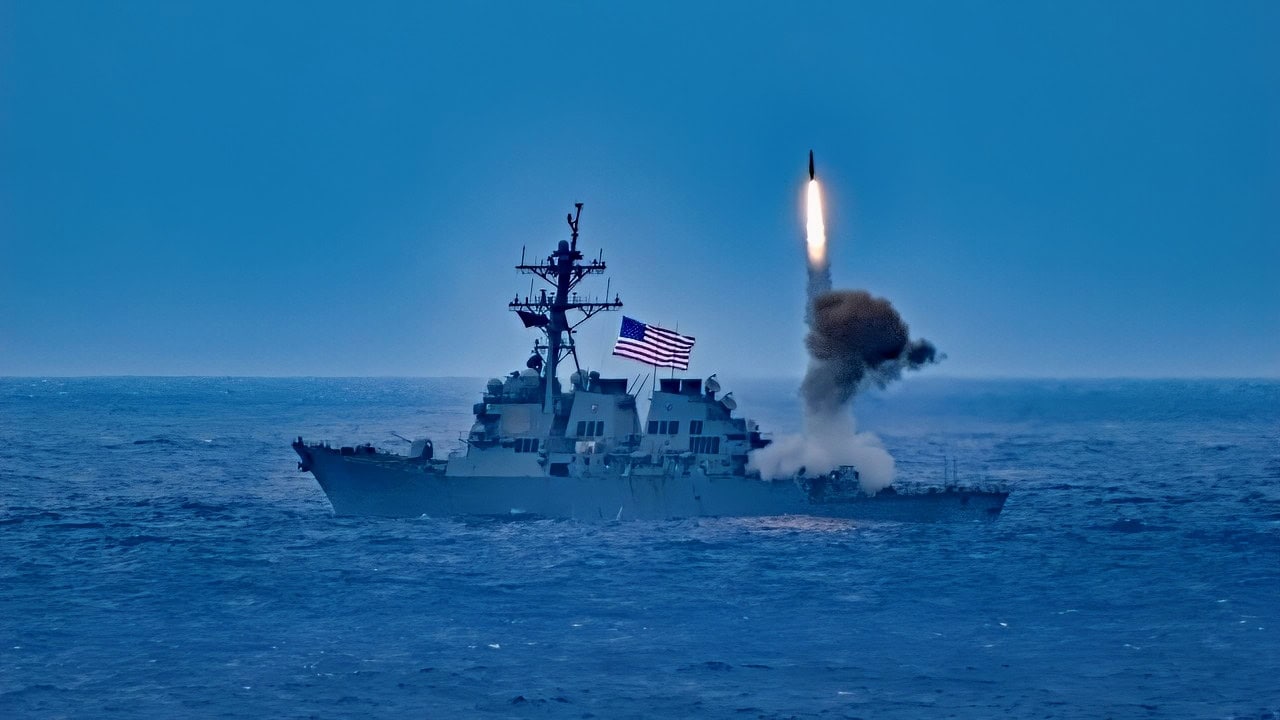
Operation Epic Fury, aka Operation Roaring Lion, i.e., the joint U.S.-Israeli military operation against the theocratic terrorist regime of the Islamic Republic of Iran (Jomhuri-ye Eslâmi-ye Irân) has been underway for 1.5 months, and is currently manifesting itself as a blockade of the Strait of Hormuz imposed by U.S. President Donald John Trump that brings to mind (1) John F. Kennedy’s blockade of Cuba during the Cuban Missile Crisis of October 1962 (although, for legalistic reasons, it was technically termed a “quarantine” instead of a “blockade”) and (2) Abraham Lincoln’s blockade of the Confederate states as part of the so-called “Anaconda Plan” during the American Civil War.
However, although Iran’s military forces—the regular forces and the Islamic Revolutionary Guard Corps (IRGC, aka Sepah or Pasdaran) alike—have been severely degraded and are hemorrhaging both literally and figuratively, they’re not completely dead yet.
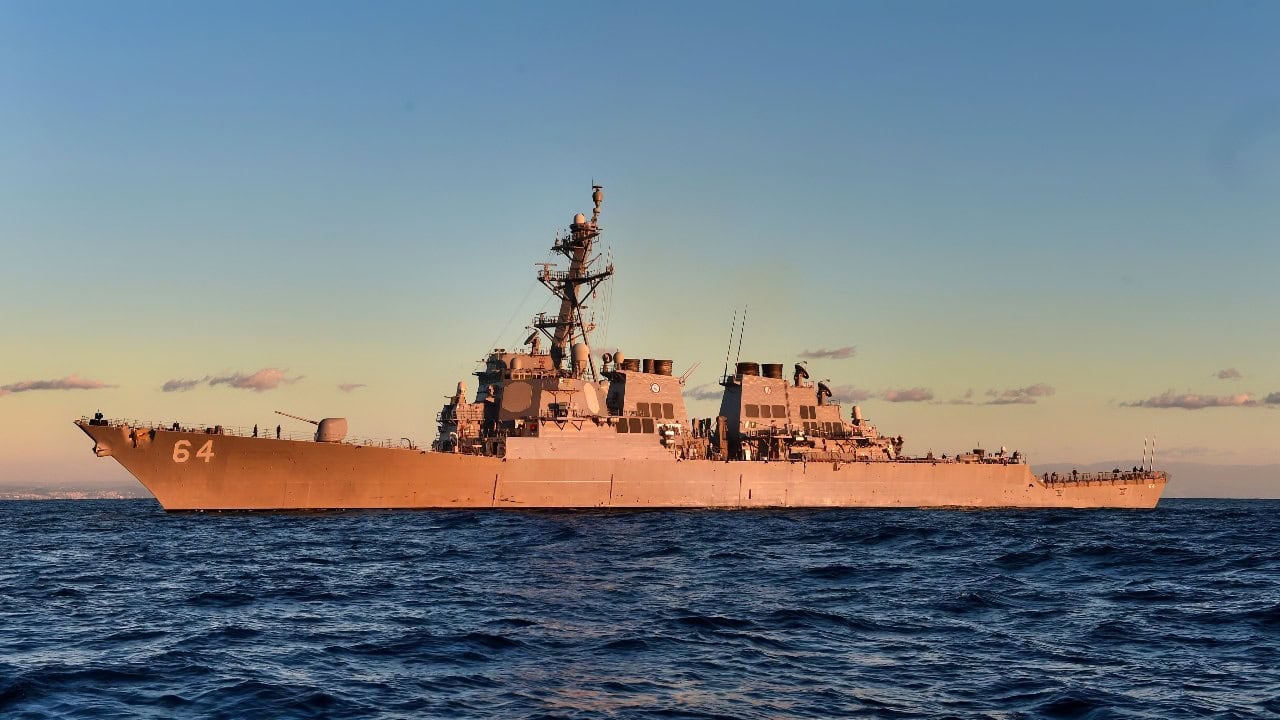
(Dec. 6, 2015). USS Carney (DDG 64) awaits the return of its small boat crew during a passenger transfer Dec. 6, 2015. Carney, an Arleigh Burke-class guided missile destroyer, forward deployed to Rota, Spain, is conducting a routine patrol in the U. S. 6th Fleet area of operations in support of U.S. national security interests in Europe. (U.S. Navy photo by Mass Communication Specialist 1st Class Theron J. Godbold/Released)
So then, that begs the question: What tools does the Iranian regime still have at its disposal to try to break Mr. Trump’s (and the U.S. Navy’s) blockade?
Iranian Threat Vector #1: Midget Submarines, aka Minisubs
Back on March 20, specifically regarding the Iranian minisubs.
U.S. Secretary of War Pete Hegseth stated that “their submarines – they once had 11 – are gone.” He was specifically referring to Iran’s minisubs.
However, the World Directory of Modern Military Warships (WDMMW) reported at the beginning of the year that the Islamic Republic of Iran Navy (IRIN) actually had a total of 21 midget submarines, not just 11. Ergo, if we take Secretary Hegseth’s quoted statistic at face value, that still leaves ten Iranian minisubs with the potential to menace military and commercial vessels alike in the Strait of Hormuz.

North Korea Mini Submarine. Image Credit: Creative Commons.
-The Ghadir-class boats (based on the North Korean Yono-class submarine), which were introduced in 2007, have a 125-ton displacement, a maximum submerged speed of 8 knots (9.2 mph ; 15 km/h), and are capable of wielding both missiles and torpedoes. The IRIN started off the war with 20 of these.
-The 2006-vintage Nahang-class displaces 115 tons. Armament-wise, it has no torpedo tubes, though it may be able to carry mines or torpedoes externally; its primary mission is likely transporting special operations forces such as the Takavaran (“attack-trooper”) commandos. Estimated top speed is between 8 knots (9.2 mph; 15 km/h) and 12 knots (14 mph; 22 km/h). The IRIN had only one to begin with, and this writer has not been able to ascertain as to whether it was among the 11 dead minisubs that Mr. Hegseth was talking about.
Iranian Threat Vector #2: Naval Mines
Regarding those minelaying capabilities (whether via submarine or surface warship), during an April 8, 2026, press briefing, White House Press Secretary Karoline Leavitt stated that “97% of Iran’s once massive inventory of more than 5,000 naval mines has also been targeted and destroyed.”
Of course, that remaining 3 percent still comes out to 150 mines, and with an estimated 15 USN warships enforcing the blockade, that averages out to 10 surviving mines per vessel, so the sailors on those ships still need to maintain a wary vigil.
Iranian Threat Vector #3: Anti-Ship Ballistic Missiles (ASBMs)
Even with the severe degradation of Iran’s ballistic missile launchers and production facilities, these remain a very real threat, particularly the ASBM subcategory. The Iran Watch website (part of the Wisconsin Project on Nuclear Arms Control) lists the following ASBM types:
-Khalij Fars (“Persian Gulf”): A variant of the Fateh-110 baseline missile, this one entered service in 2014, with a maximum range of 300 kilometers (186 miles) and a reported 650-kilogram (1,433-pound) payload. It is equipped with an electro-optical terminal seeker, which Iran claims is capable of striking targets in all light and weather conditions, accurate up to within 8.5 meters (27 feet) of its point of aim.

Fateh-Class Submarine. Image: Iranian State Media.
– Zolfaghar Basir: “In 2020, the IRGC Aerospace Force unveiled the Zolfaghar Basir, an anti-ship version of the Zolfaghar surface-to-surface ballistic missile. The Zolfaghar Basir has a claimed range of 700 km and, like the Khalij Fars, is equipped with an electro-optical terminal seeker.”
Iranian Threat Vector #4: Anti-Ship Cruise Missiles (ASCMs)
If you’ll pardon the gallows humor here, “One good ASBM deserves an ASCM,” eh?
According to the Strauss Center for International Security and Law, “Iran has acquired a number of Chinese ASCM models ” perhaps 100 Seersuckers, 125 Sardines and 75 Saccades, and perhaps more. There are also reports that Iran acquired the Russian SS-N-22 Moskit, also known as the Sunburn, though the reliability of these reports is disputed.”
-Sardine/CS 801: To seafood connoisseurs, “Sardine” may not sound like a terribly intimidating moniker for a weapon system, but sardines (suborder Clupeoidei) are in fact predatory fish (feeding upon zooplankton).
Likewise, the Sardine missile, based upon the infamous French-made Exocet, can be quite “predatory” towards adversaries’ ships, as it packs a semi-armor-piercing warhead weighing 363 pounds (164 kilograms). Once fired, the missile boosts to 164 feet (50 meters), cruises between 65 feet (20 meters) and 98 feet (30 meters), and then descends to 15-20 feet (4.5-6 meters) before striking its victim.
– Saccade/ CS 802: Merriam-Webster defines “saccade” as “a small rapid jerky movement of the eye, especially as it jumps from fixation on one point to another (as in reading).”
As for the eponymous missile, Iran Watch doesn’t specify how it “rapidly” it “jumps” (as in flies, that is) through the air, but they do note that it’s an upgraded Sardine with mostly similar characteristics to the original, including the 363-pound semi-armor-piercing warhead and the range of 70 to 75 miles (112.5 to 120 kilometers). “One main difference is the Saccade has a turbojet propulsion system after its rocket-assisted boost phase.”
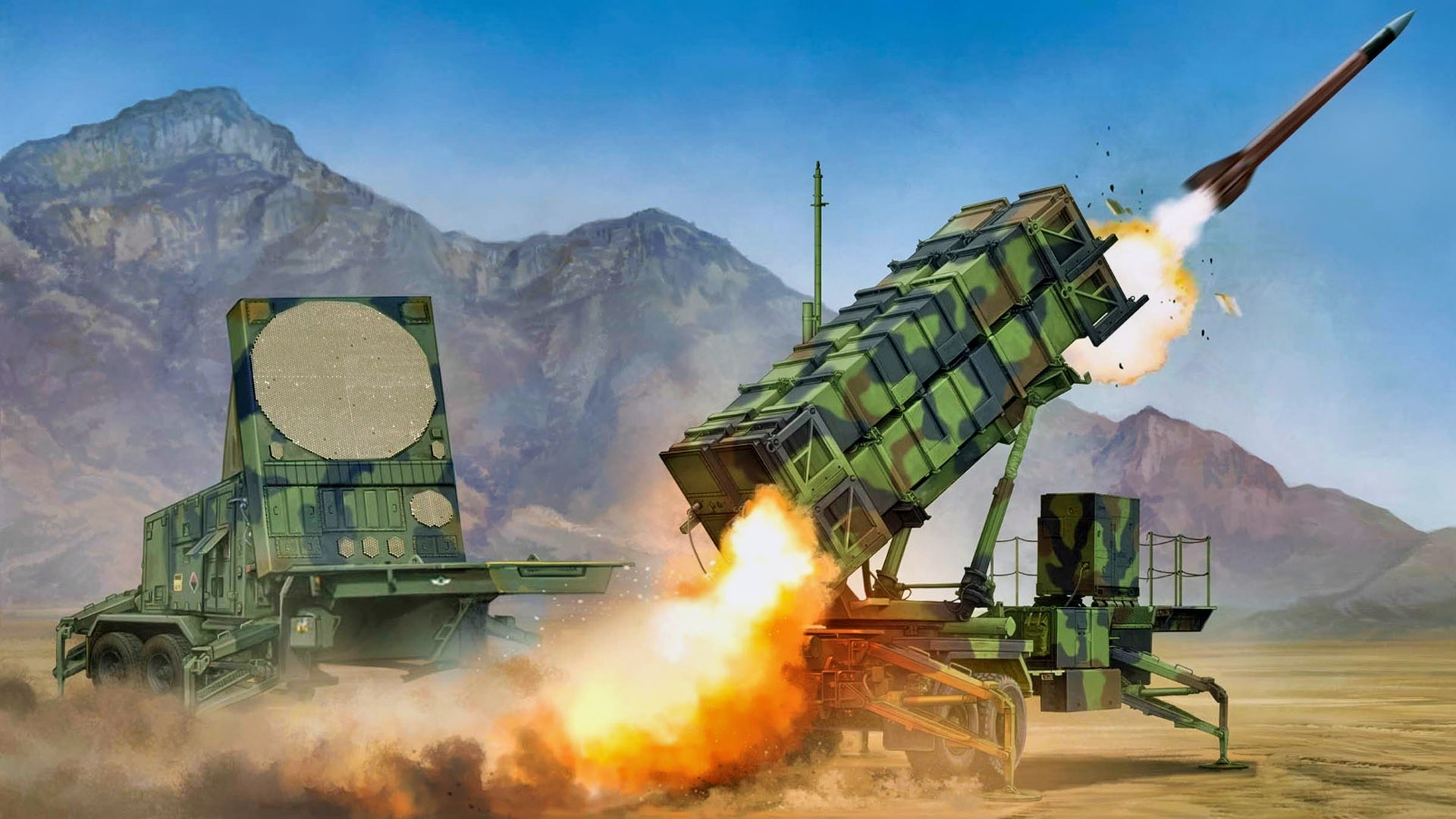
Patriot Missile. Image Credit: Creative Commons.
-M-80E Moskit (“Mosquito;” NATO reporting name SS-N-22 “Sunburn”): Mosquitoes and sunburn alike are two of Mother Nature’s hazards to outdoor living (especially on the waterfront), so they’re both highly appropriate names for a ship-killing missile.
Made in Russia (and assuming the rumors of Iranian acquisition of it are true), it “employs a 661-pound, semi-armor piercing warhead.
The Moskit uses a liquid ramjet engine and four solid boosters to reach a speed of Mach 2.1 with a cruising trajectory between seven and ten meters above the water’s surface. It is fueled by a kerosene-type fuel but also has a solid-propellant booster. Its maximum range is 108 nautical miles.”
-Seersucker: Not to be confused with the seersucker suit, the CSS-N-3 Seersucker is a variant of the Chinese-made Silkworm missile. “It uses a Russian ‘Square Tie’ fire control radar and a radio altimeter guidance system. The Seersucker cruises at 98 feet above the sea and descends to 26 feet during the terminal phase. The Seersucker warhead is quite large at 1,130 pounds.”
About the Author: Christian D. Orr
Christian D. Orr is a Senior Defense Editor. He is a former Air Force Security Forces officer, Federal law enforcement officer, and private military contractor (with assignments worked in Iraq, the United Arab Emirates, Kosovo, Japan, Germany, and the Pentagon). Chris holds a B.A. in International Relations from the University of Southern California (USC) and an M.A. in Intelligence Studies (with a concentration in Terrorism Studies) from American Military University (AMU). He is also the author of the book “Five Decades of a Fabulous Firearm: Celebrating the 50th Anniversary of the Beretta 92 Pistol Series,” the second edition of which was recently published.