

Iran closed the Strait of Hormuz to force Washington’s hand — to make the cost of inaction high enough that the U.S. would move toward some version of Tehran’s terms. Washington didn’t. It raised the stakes, imposing a naval blockade on Iranian ports designed to flip that logic: make the cost of resistance higher than the cost of a deal.
That’s a reasonable bet. It may even work.
But Tehran hasn’t shown much appetite for concession under pressure, and the blockade gives it both a pretext and a practical incentive to escalate further. The real question isn’t whether Iran responds.
It’s how, specifically, how it applies more pressure without crossing into a direct military confrontation; it can’t win.

STRAIT OF HORMUZ (Jan. 8, 2026) A U.S. Sailor, assigned to the Arleigh Burke-class guided-missile destroyer USS Roosevelt (DDG 80), observes an MH-60R Sea Hawk, assigned to Helicopter Maritime Strike Squadron (HSM) 79, during flight operations in the Strait of Hormuz. Roosevelt is deployed to the U.S. 5th Fleet area of operations to support maritime security and stability in the U.S. Central Command area of responsibility. (U.S. Navy photo by Mass Communication Specialist 1st Class Indra Beaufort)
The answer to that question isn’t vertical. It’s horizontal. Not more force in Hormuz, but more geography — pulling the crisis into a second theater where the U.S. position is weaker and the costs of response are harder to absorb.
That theater is the Bab al-Mandab. About 1,800 miles from Hormuz, at the southern end of the Red Sea, where it pinches down before opening into the Gulf of Aden. Eighteen miles wide.
Roughly 12 percent of global oil moves through it. The Yemen side of that coastline is Houthi territory. And a significant share of the Gulf oil now avoiding Hormuz has already been rerouted onto Red Sea corridors — which means every one of those barrels has to clear the Bab al-Mandab before it reaches a buyer.
Iran doesn’t need to send a single ship to disrupt the so-called “Gate of Tears”. It already has proxies there – the Houthis – who are ready, willing, and able to do the job.
Iran Has Already Said This Out Loud
This isn’t guesswork. Iranian officials have been pointing to it, more or less directly. Ali Akbar Velayati — not a peripheral figure — tied the Bab al-Mandab to Hormuz explicitly, warning that energy flows could be disrupted quickly if Washington stayed on its current course.

U.S. Navy F/A-18 Super Hornets, assigned to the Harry S. Truman Carrier Strike Group’s Strike Fighter Squadron (VFA) 136, fly a mission over the U.S. Central Command area of responsibility, March 2, 2025. The HSTCSG is responsible for patrolling approximately 2.5 million square miles of ocean and includes the Arabian Gulf, Gulf of Oman, Red Sea, parts of the Indian Ocean and three critical choke points at the Strait of Hormuz, Suez Canal and Strait of Bab al-Mandeb. (U.S. Air Force photo by Staff Sgt. Jackson Manske)
Around the same time, a Yemeni military official described the closure of the strait as a “trump card,” with American and Israeli shipping in view.
When statements like that line up in timing and content, they are doing something.
They are shaping expectations without committing to action.
They Don’t Need to Close It
There’s a tendency to think in binary terms — open or closed. That isn’t how this works, and the Houthis have already shown it.
Between late 2023 and early 2025, they struck more than 100 commercial vessels and sank a couple of them. That was enough. Shipping companies pulled back. Routes shifted.
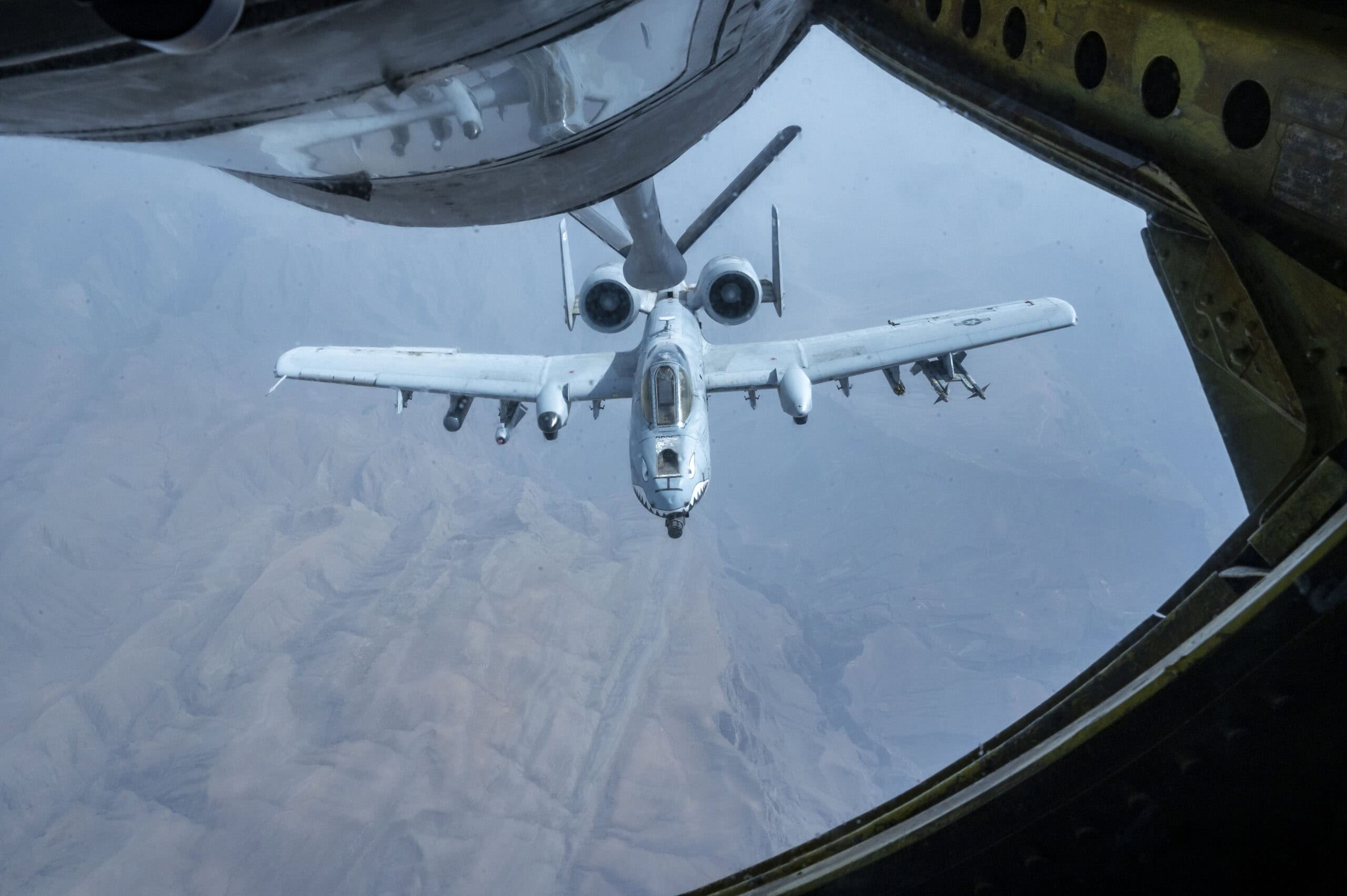
A U.S. Air Force A-10 Thunderbolt II from the 75th Expeditionary Fighter Squadron receives fuel from a KC-135 Stratotanker during air refueling operations above the Strait of Hormuz, July 21, 2023. In an ongoing effort to ensure the security and freedom of navigation in the region, U.S. Air Forces Central (AFCENT) reaffirms its unwavering commitment to maintaining stability and safeguarding global trade in this vital maritime route. (U.S. Air Force photo by Staff Sgt. Frank Rohrig)
No formal blockade, no legal threshold crossed. Just enough disruption, repeated often enough, that the route stopped functioning the way it needed to.
Once that line is crossed, the system adjusts automatically. Insurers step away first. Operators follow. The strait remains physically open, but it no longer works.
Nothing about the Houthi toolkit has gotten easier to manage. Drones, anti-ship missiles, explosive boats, launch platforms that blend into civilian traffic until they don’t — all of it creates a problem that can be contained in places but not cleared entirely.
The U.S. Navy can impose friction. It can’t remove the risk. And it doesn’t have to miss often for the effect to take hold.
Why This Works for Tehran
For Tehran, this is a clean play. The effects are real. Attribution is not.
The Houthis operate with enough independence to give Iran room to maneuver. Support, coordination, alignment — all there. Direct control is harder to prove. That gap is enough. It lets Iran apply pressure and then step back, depending on how Washington reacts.

The crew of a U.S. Air Force B-1B Lancer display their mascot from the cockpit window during a presence patrol above the U.S. Central Command’s area of responsibility Oct. 30, 2021. Multiple partner nations’ fighter aircraft accompanied the B-1B Lancer at different points during the flight, which flew over the Gulf of Aden, Bab el-Mandeb Strait, Red Sea, Suez Canal, Arabian Gulf, Strait of Hormuz and the Gulf of Oman before departing the region. (U.S. Air Force photo by Senior Airman Jerreht Harris)
The economic side moves quickly once disruption begins. Prices have already climbed with Hormuz under strain. Add a second chokepoint and the system tightens. There isn’t much slack when both routes are unstable at the same time.
There’s also a geographic shift that matters. Some Gulf exports have already moved away from Hormuz toward Red Sea routes. That doesn’t reduce exposure. It moves it. Those shipments now pass through the Bab al-Mandab, inside a zone the Houthis can reach.
Iran didn’t build that vulnerability. It doesn’t need to.
The Signal Is Already There
The Houthis aren’t improvising. Their leadership has been clear enough about coordination with Iran and readiness to act if the pressure continues to build. Closure of the Bab al-Mandab has been described as a live option, not a distant one. The threshold they’ve pointed to — increased pressure on Iran — has already been crossed.
The problem for Washington is that its response has been built around a single point. Hormuz is the focus, and the coalition taking shape reflects that. It assumes a bounded fight, something that can be managed inside a defined space.
That assumption doesn’t hold once the pressure shifts outward.
What follows is harder to contain and more expensive to stabilize. Iran doesn’t need to win a naval contest. It needs to stretch the system, force responses in multiple places, and let the costs accumulate faster than the pressure on Tehran.
The Bab al-Mandab gives it that option.
Washington has already made its move. If Tehran answers in kind, the problem stops being Hormuz alone — and starts looking like something the current plan was never built to handle.
About the Author: Dr. Andrew Latham
Andrew Latham is a non-resident fellow at Defense Priorities and a professor of international relations and political theory at Macalester College in Saint Paul, MN. You can follow him on X: @aakatham.