U.S. President Donald Trump’s decision to blockade the Strait of Hormuz puts the United States at loggerheads with much of the rest of the world—especially China. For many, that prospect is a welcome change, given that Beijing has been engaged in a shadow war with the United States for years.
But is blockading the Strait of Hormuz the most effective way to bring China down to size?
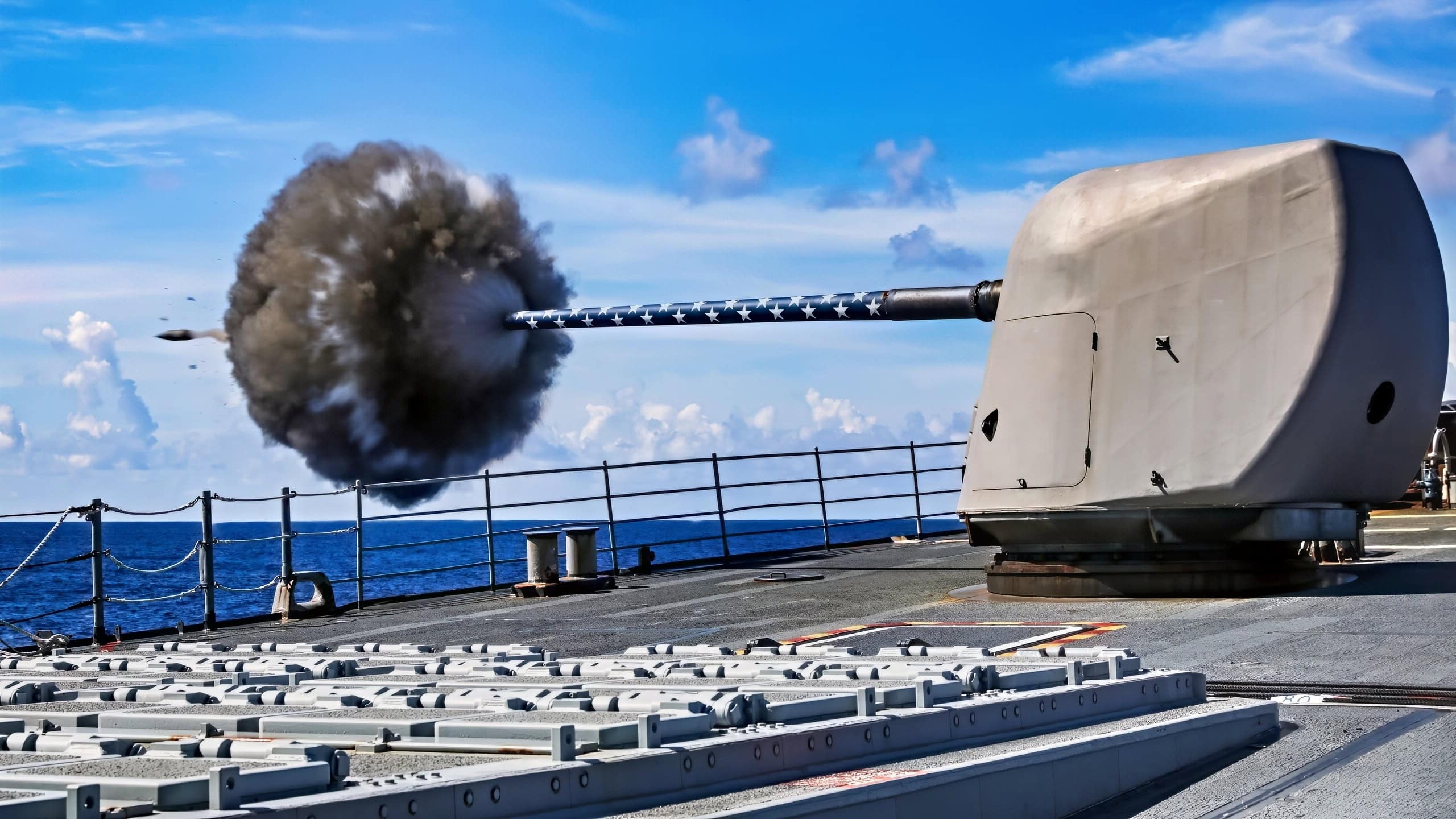
(Oct. 3, 2025) – Arleigh Burke-class guided-missile destroyer USS Gonzalez (DDG 66), fires the Mk45 5-inch gun system while underway as part of the Titans of the Sea Presidential Review. The Titans of the Sea Presidential Review is one of many events taking place throughout the country to showcase maritime capabilities as part of the U.S. Navy’s 250th birthday. America is a maritime nation. For 250 years, America’s Warfighting Navy has sailed the globe in defense of freedom. (U.S. Navy photo by Mass Communication Specialist Seaman Jayden Howard)
China Calls the Bluff
The Chinese have already put their marker down. As the blockade began, the head of China’s navy stated that China’s civilian cargo ships would continue to traverse the Strait of Hormuz, irrespective of the U.S. Navy’s presence there.
According to Beijing, it negotiated trade deals with Tehran long ago. Those deals are legitimate, even if the Americans don’t like them. Therefore, the Chinese will collect what they have already purchased.
A Leaky, Unenforceable Blockade
Interestingly, the U.S. Navy refined the parameters of its blockade, stating that it would interdict only ships bound for Iranian ports.
This indicates a clear lack of seriousness on the part of the Americans: It is not easy to tell which ships are headed for Iranian ports and which are simply using nearby ports to receive or deliver Iranian goods via third parties.
That is to say nothing of the practice of spoofing a ship’s transponder signal to trick third-party observers, such as the Navy, into thinking that a cargo vessel is sailing for a port outside of Iran.
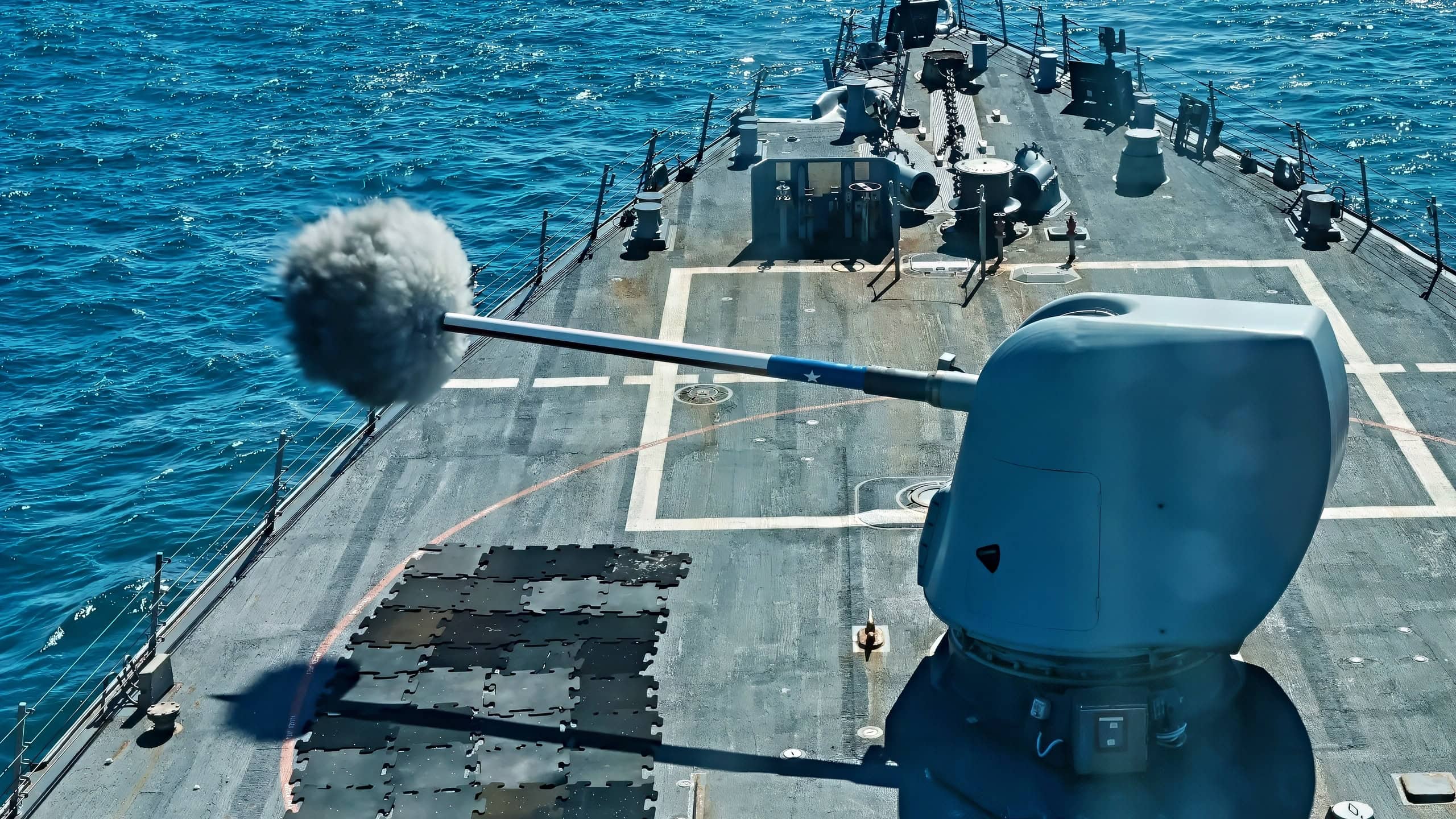
(July 29, 2025) The Ticonderoga-class guided-missile cruiser USS Princeton (CG 59) fires its forward Mark 45 5-inch gun during a weapons maintenance shoot, July 29, 2025. The Carl Vinson Carrier Strike Group is underway conducting routine operations in the U.S. 3rd Fleet area of operations. (U.S. Navy photo by Mass Communication Specialist 1st Class Jacob I. Allison)
The blockade becomes ineffective quite quickly. Indeed, it turns out the Navy has already allowed a Chinese ship carrying Iranian goods to pass.
The Energy Weapon Isn’t Working
Whatever concerns China might have had before the blockade began, Beijing—for now—is cautiously optimistic that its ships will get through. However, the blockade could, in theory, be a serious threat to China’s economy, given that Beijing receives more than 50 percent of its oil from the Middle East.
The Chinese have lost some of that energy flow—but not nearly enough of it to threaten its economy in the way the Trump administration would hope. If Washington did ratchet up the economic pressure on China through this blockade, war would become a viable prospect.
China Prepared for This Moment
China has had ample time to build resilience against the kind of crisis unfolding in the Strait of Hormuz.

An F/A-18E Super Hornet, attached to Strike Fighter Squadron (VFA) 151, launches from the flight deck of Nimitz-class aircraft carrier USS Abraham Lincoln (CVN 72) during Operation Epic Fury, March 31, 2026. (U.S. Navy photo)
Beijing built a robust strategic petroleum reserve that has given its economy some wiggle room, even as it feels a pinch from energy disruptions in the Middle East.
The Chinese government also managed to redirect some of its energy flows to neighboring Russia.
Again, this is not a panacea, but it helps China muddle through this difficult moment.
China has also become the epicenter of the revolution in alternative energy, meaning the Chinese could conceivably become the first major nation to pivot away from petroleum-based energy toward sustainable, renewable sources.
(China is the world leader in nuclear, hydropower, geothermal, and solar energy.) The country spent the past decade building out key infrastructure to support the clean energy revolution.
The Global System Starts Tilting Toward Beijing
Again, Beijing is not coming out of this crisis unscathed.
But China has had time to prepare, and its efforts have ensured the regime is positioned to survive this crucible and possibly emerge ahead of its geopolitical rivals.

A U.S. Sailor observes an F/A-18E Super Hornet, attached to Strike Fighter Squadron (VFA) 151, prepare for flight operations on the flight deck of Nimitz-class aircraft carrier USS Abraham Lincoln (CVN 72) during Operation Epic Fury, March 30, 2026. (U.S. Navy photo)
Recent reporting from the Middle East indicates that Arab states, such as the United Arab Emirates, are seeking closer economic ties with Beijing to help them navigate the crisis. European states are also increasingly looking to enhance trade with China.
All this suggests Beijing might emerge stronger from the crisis in the long term, especially as the world seeks to reorient away from overreliance on the U.S.-led system.
The Fantasy of Regime Change in Beijing
Among American elites, there is hope that if China is deprived of critical goods over the next several weeks, Beijing will feel political fallout from its own people. The Trump administration might even think the crisis could trigger regime change in China.
But this has long been a fantasy among Washington elites. Remember, last year those same elites were theorizing that Chinese President Xi Jinping was weakened and about to be ousted by fellow party members in the Communist Party of China.

Arleigh Burke-class guided-missile destroyer USS McFaul (DDG 74) makes its approach alongside fleet replenishment oiler USNS Henry J. Kaiser (T-AO-187) for a replenishment-at-sea during Operation Epic Fury, March 27, 2026. (U.S. Navy photo)
A year has passed, and that never happened. In fact, Xi’s rule appears stronger than ever.
The global backlash to the U.S.-Israeli war in Iran is so serious that the Chinese don’t need to run the blockade, or even seriously challenge Washington, for the edifice of Washington’s global hegemony to bend toward collapse.
So, yes, China will feel the squeeze from the blockade—as they have from the wider war in the Middle East.
But there is no evidence that such a pinch will be anything more than short-lived.
MORE – America Can’t ‘Drill Baby Drill’ Out of the Iran Crisis
About the Author: Brandon J. Weichert
Brandon J. Weichert is the Senior National Security Editor at 19FortyFive.com. Recently, Weichert became the editor of the “NatSec Guy” section at Emerald.TV. He was previously the senior national security editor at The National Interest. Weichert is the host of The National Security Hour on iHeartRadio, where he discusses national security policy every Wednesday at 8pm Eastern. He hosts a companion show on Rumble entitled “National Security Talk.” Weichert consults regularly with various government institutions and private organizations on geopolitical issues. His writings have appeared in numerous publications, among them Popular Mechanics, National Review, MSN, and The American Spectator. And his books include Winning Space: How America Remains a Superpower, Biohacked: China’s Race to Control Life, and The Shadow War: Iran’s Quest for Supremacy. Weichert’s newest book, A Disaster of Our Own Making: How the West Lost Ukraine, is available for purchase wherever books are sold. He can be followed via Twitter/X @WeTheBrandon.