
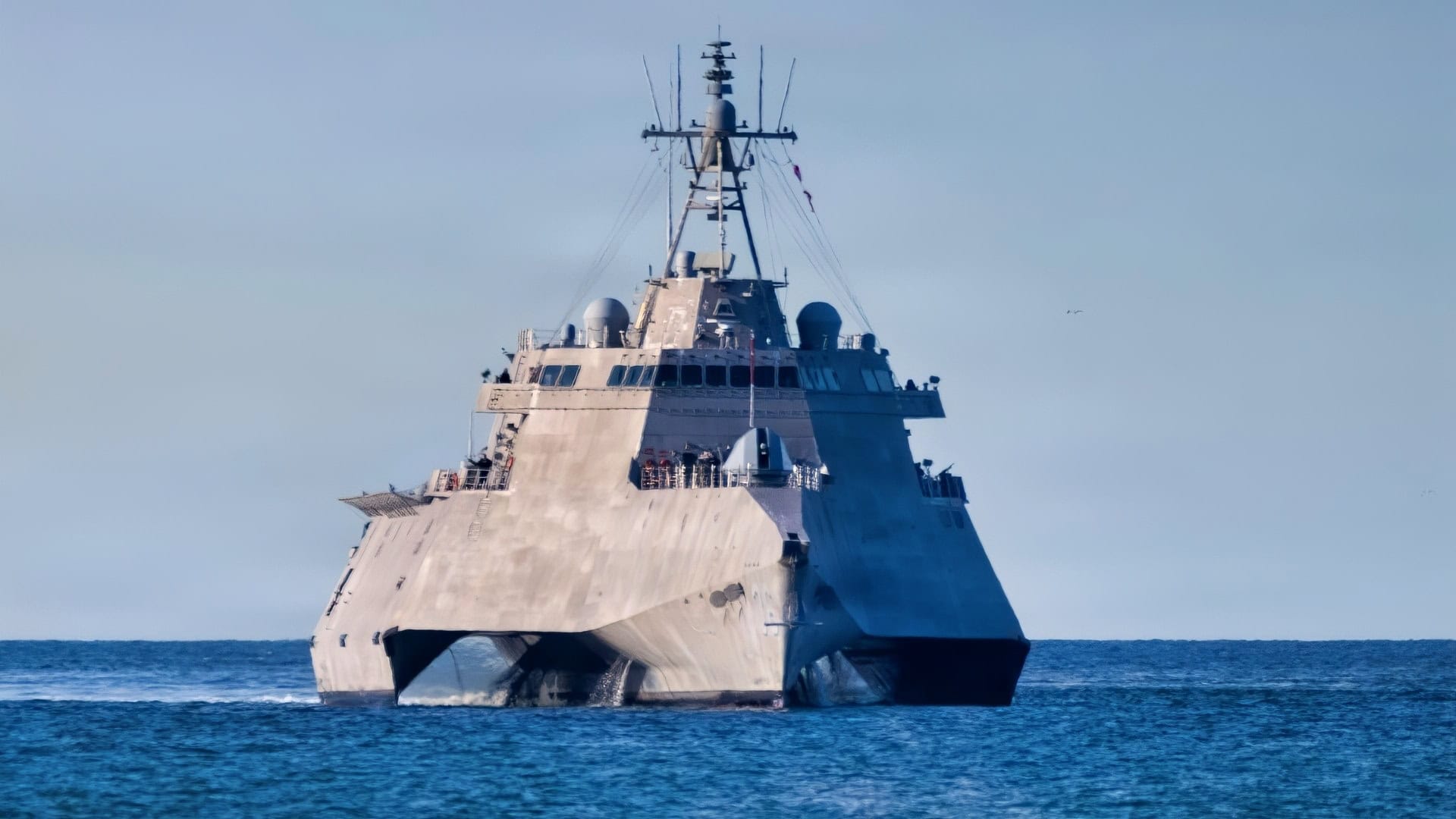
The United States’ April 13 naval blockade targets Iranian oil exports and could reshape global energy markets. This shift is arguably already underway, as economies dependent on Gulf and Iranian oil seek alternatives. U.S. President Trump surprised the world by announcing a targeted interdiction strategy. Instead of shutting down the Strait of Hormuz, the U.S. aims to block only Iranian shipments. This approach lets most global traffic pass, while U.S. forces remove Iranian mines and isolate Tehran’s oil exports.
The regime no longer has an economic lifeline, and Trump is piling on the pressure to get them to agree to a 20-year moratorium on nuclear enrichment and nuclear weapons development.
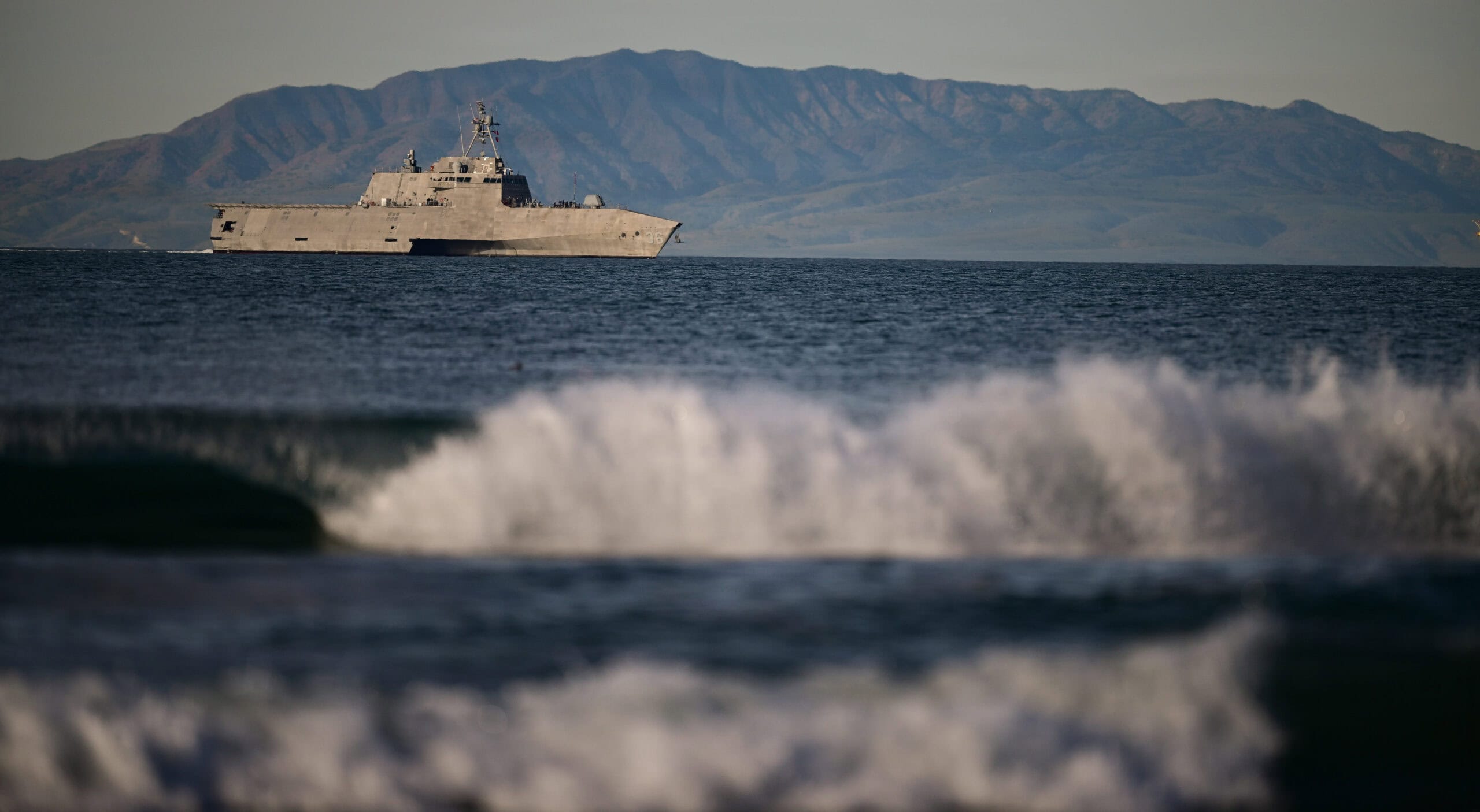
USS Kingsville (LCS 36) sails past Santa Cruz Island recently on its way to Naval Surface Warfare Center, Port Hueneme Division (NSWC PHD) in California. The Independence-variant littoral combat ship paid its first visit to NSWC PHD for a Combat Systems Assessment Team event, which helps ensure mission readiness. (U.S. Navy photo by Dana Rene White)
The Strait of Hormuz is the world’s most important energy artery. Roughly 20 million barrels per day – about one-fifth of global oil supply – normally pass through Hormuz, and even partial disruption has already tightened markets and pushed prices higher. Meanwhile, Iran’s own exports – around 1.5 to 2 million barrels per day – are now directly constrained.
Iran is feeling the pressure, and so is the rest of the world. Asian economies that depend heavily on Gulf oil are scrambling for alternatives, while European markets are absorbing price volatility and supply uncertainty.
But at the same time, the United States – already producing as much as 13.7 million barrels per day – may be poised to expand its energy exports.
But can U.S. oil meaningfully replace lost Iranian supply? The answer, at least for now, is no.
But over time, if prices remain elevated, the conflict could reshape global energy flows in favor of American producers.
What the Blockade Does and Why Iran Is Taking the Hit
Iran tried to mine sea lanes and close Hormuz to all but those willing to pay. The U.S. aims to maximize pressure on Iran while minimizing global disruption. The blockade involves intercepting vessels linked to Iranian exports and deterring buyers.
The measure chokes off a critical revenue stream for Iran. In 2025, Iran produced about 3.5 million barrels per day and exported around 1.7 million barrels of crude and condensate.
Oil Pump. Image: Creative Commons.
With exports now restricted, a substantial portion of that volume is now effectively stranded or forced into storage. There are also early signs of disruption: dozens of tankers carrying Iranian oil have been left idling in the Gulf or rerouted, and congestion is building across regional ports.
With oil revenues accounting for a major share of the regime’s income, Trump’s blockade is a direct hit to Iran, and if it remains in place for some time, it will constrain spending, subsidies, foreign operations, and all measures of other Iranian activity.
Tehran has responded by condemning the blockade and warning that it would “backfire” – but the comments are not backed by evidence – or indeed any indication – that Iran has any real ability to mitigate the damage being done.
Some reports have even suggested that Iran is looking for alternative trade routes through Russia and Central Asia, and that China may be able to assist in offsetting those losses – but in the short term, Iran is clearly in a bind. Bypassing the blockade would require a massive infrastructure project, which would be extremely costly. It would also require global buyers’ faith in the stability of the Iranian oil industry.
Asia Feels It First, Europe Sees Price Hikes
While Iran is absorbing the most immediate economic damage, Asia is being forced to restructure its supply, and Europe is also feeling the pressure.
Around 80% of oil flowing through Hormuz is destined for Asian buyers, with China, India, Japan, and South Korea among the largest consumers. China alone has been the primary buyer of Iranian crude, making it especially exposed to the effects of the blockade. Refiners in countries like Japan and South Korea are already cutting throughput or turning to alternative suppliers, while governments are tapping reserves to stabilize supply. And at the same time, shipping costs and insurance premiums continue to surge.

U.S. Dollars. Image: Creative Commons.
Brent crude has climbed past $100 per barrel repeatedly throughout the crisis, with some forecasts suggesting sustained elevated prices and the potential for $150-200 per barrel if problems persist.
Meanwhile, in Europe, the effect is different. Having reduced dependence on Middle Eastern and Russian energy in recent years, the effect here is largely price increases. In late March, U.S. President Trump told European leaders to “get your own oil” and to open the Strait of Hormuz if they deemed it necessary, and suggested they could even buy it from the U.S. instead. But how much could the U.S. really supply to the rest of the world, and how much could its oil industry mitigate the damage being done right now?
What the U.S. Can Actually Do
The U.S. can afford to initiate the blockade and survive Iranian efforts to close the Strait of Hormuz. It is the world’s largest oil producer, with exports ranging between 3.5 and 5 million barrels per day. President Trump has long argued that U.S. energy dominance reduces vulnerability to disruption in the Middle East and allows Washington to exert pressure on adversaries – like Iran – without triggering a full-scale crisis. And so far, he’s been proven right.
U.S. crude exports are surging, with projections suggesting they could reach a record 5 million barrels per day – consistently – as Asian buyers seek alternative suppliers. It’s good news for the U.S., but there are limits – especially in the short term.
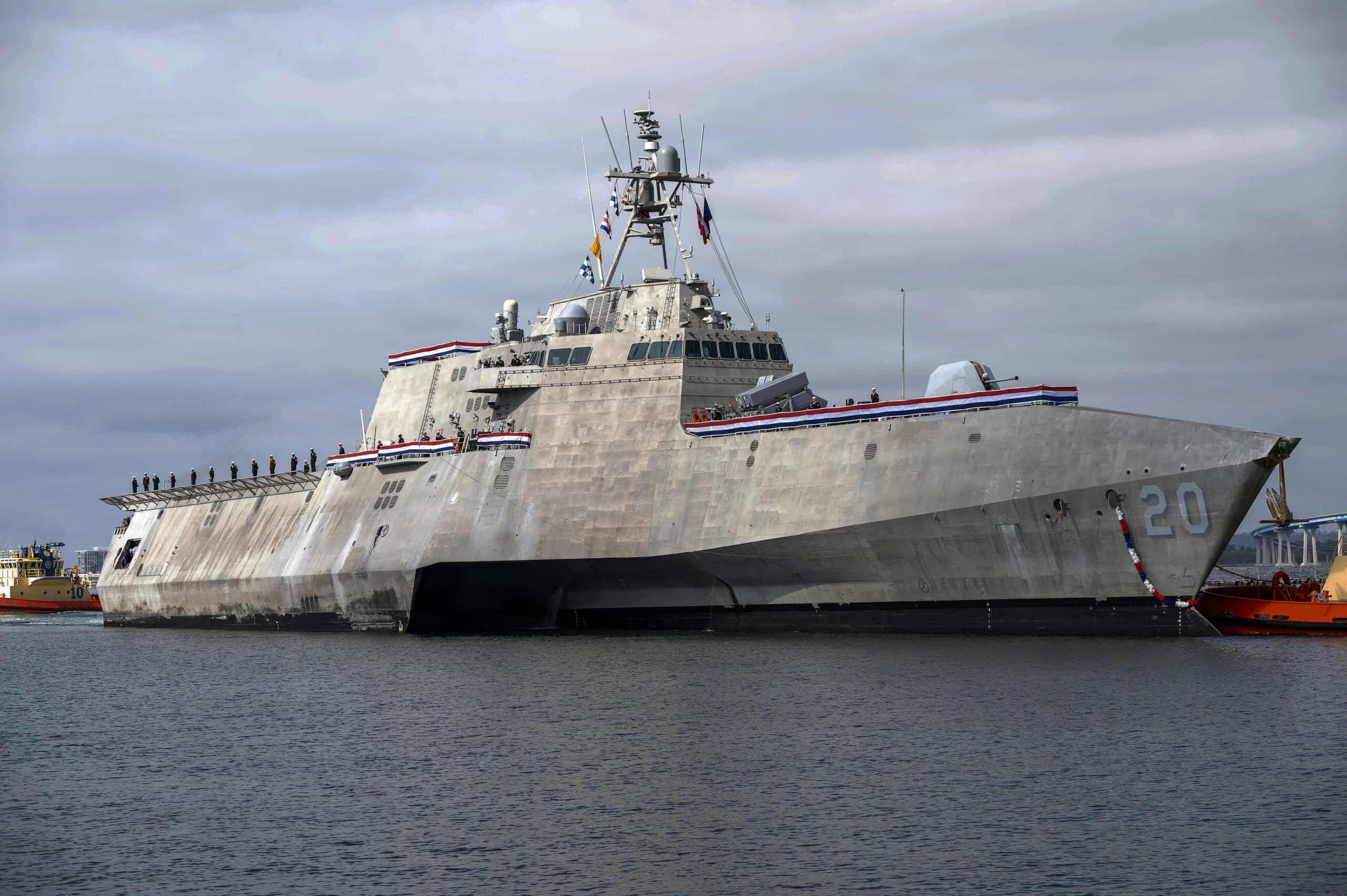
NAVAL BASE SAN DIEGO (March 4, 2026) — Independence-variant littoral combat ship USS Cincinnati (LCS 20) returned to its homeport of Naval Base San Diego after eight months of sustained operations in the U.S. 3rd and 7th Fleet areas of operations, March 4, 2026. Littoral combat ships are fast, optimally manned, mission-tailored surface combatants that operate in near-shore and open-ocean environments, winning against 21st-century threats. LCSs integrate with joint, combined, manned, and unmanned teams to support forward presence, maritime security, sea control, and deterrence missions around the globe. (U.S. Navy photo by Mass Communication Specialist 2nd Class Aja Bleu Campbell)
First, U.S. shale production is not infinitely scalable. Unlike conventional oil fields, shale wells decline rapidly and require constant reinvestment to maintain output. Industry analysts note that producers are unlikely to ramp up production quickly, even with higher prices, due to operational constraints. Industry experts told the Financial Times that shale producers are likely to resist spending more on drilling until they are certain that oil prices will remain high.
“But once the war ends, then it’s gonna fall back pretty quickly,” industry expert Scott Sheffield said. “Also, you got to remember the companies are running out of [drilling] inventory…I do not anticipate anybody adding any rigs.”
One must also consider infrastructure. Export terminals along the Gulf Coast are already operating near capacity, and shipping oil to Asia involves longer and more expensive routes than Middle Eastern supply chains.
And then there’s the matter of refining mismatches. Not all oil is the same, and U.S. crude is typically very light, while many refineries – especially those in Asia – are configured for much heavier grades from the Middle East. That presents distribution challenges. The result is a ceiling: the U.S. can certainly help stabilize markets and fill part of the gap, but it cannot quickly or easily replace interrupted supplies barrel-for-barrel.
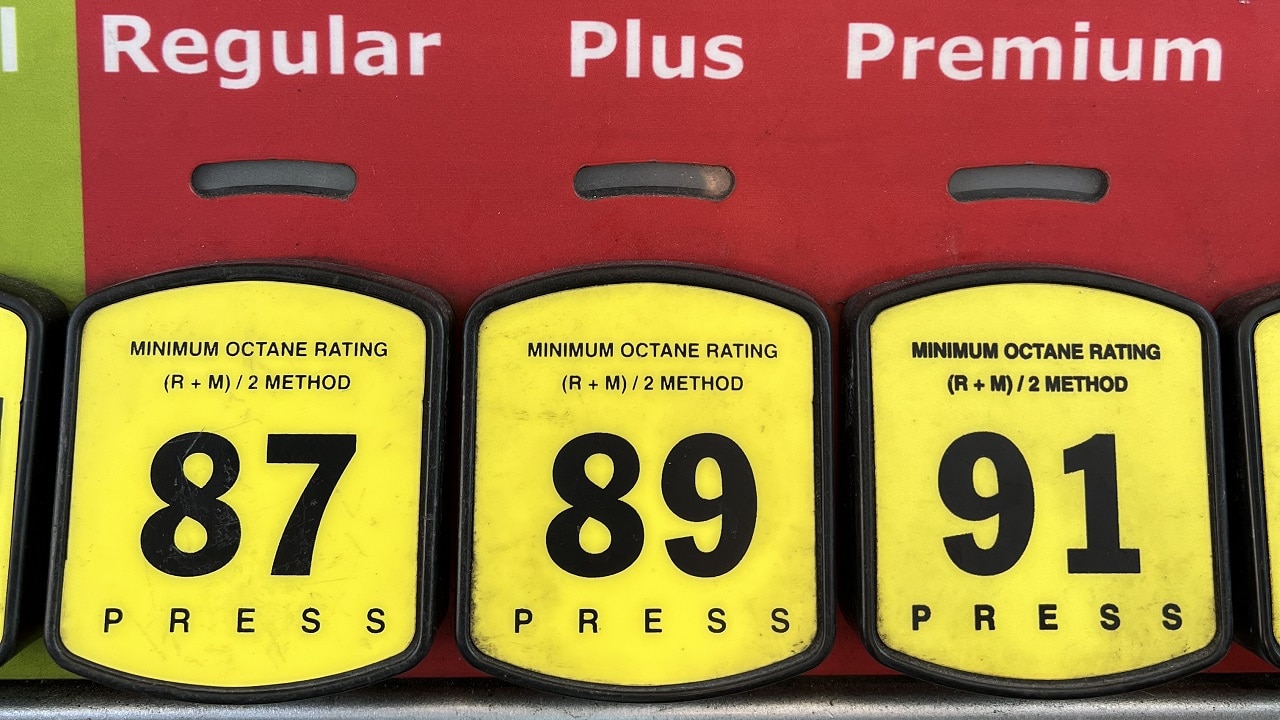
Gas Prices keep going up. Image Credit: Creative Commons.
Is There A Long-Term Upside?
But what about over the longer term? Well, if prices remain elevated, U.S. producers will have a stronger incentive to expand output. The Energy Information Administration already expects production to rise modestly toward 13.8 million barrels per day by 2027. Sustained high prices could accelerate that trend and bring some fields back online. It could, in theory, also support new investment.
Higher prices may also revive debates over expanding drilling in areas such as Alaska or offshore regions, which have long been constrained by regulatory and environmental considerations. Should that occur, it would be an enormous vindication for former Alaska Governor Sarah Palin, who was known for her slogan, “drill baby drill.” It’s a slogan that President Trump has since picked up, and unsurprisingly so.
On the export side, the U.S. could also deepen its role as a supplier to both Europe and parts of Asia – assuming the refineries can accommodate it.
The current surge in shipments demonstrates that the markets are willing to absorb American crude when alternatives are limited.
But it won’t be a quick and easy process, not least because shale production doesn’t work like Saudi Arabia’s spare capacity, which can be brought online quickly in response to market shocks. Growth for U.S. production is incremental and not immediate – so while there is certainly an opportunity here, it really depends on how long the crisis with Iran lasts, whether the regime survives, and how larger powers respond.
About the Author: Jack Buckby
Jack Buckby is a British researcher and analyst specializing in defense and national security, based in New York. His work focuses on military capability, procurement, and strategic competition, producing and editing analysis for policy and defense audiences. He brings extensive editorial experience, with a career output spanning over 1,000 articles at 19FortyFive and National Security Journal, and has previously authored books and papers on extremism and deradicalization.