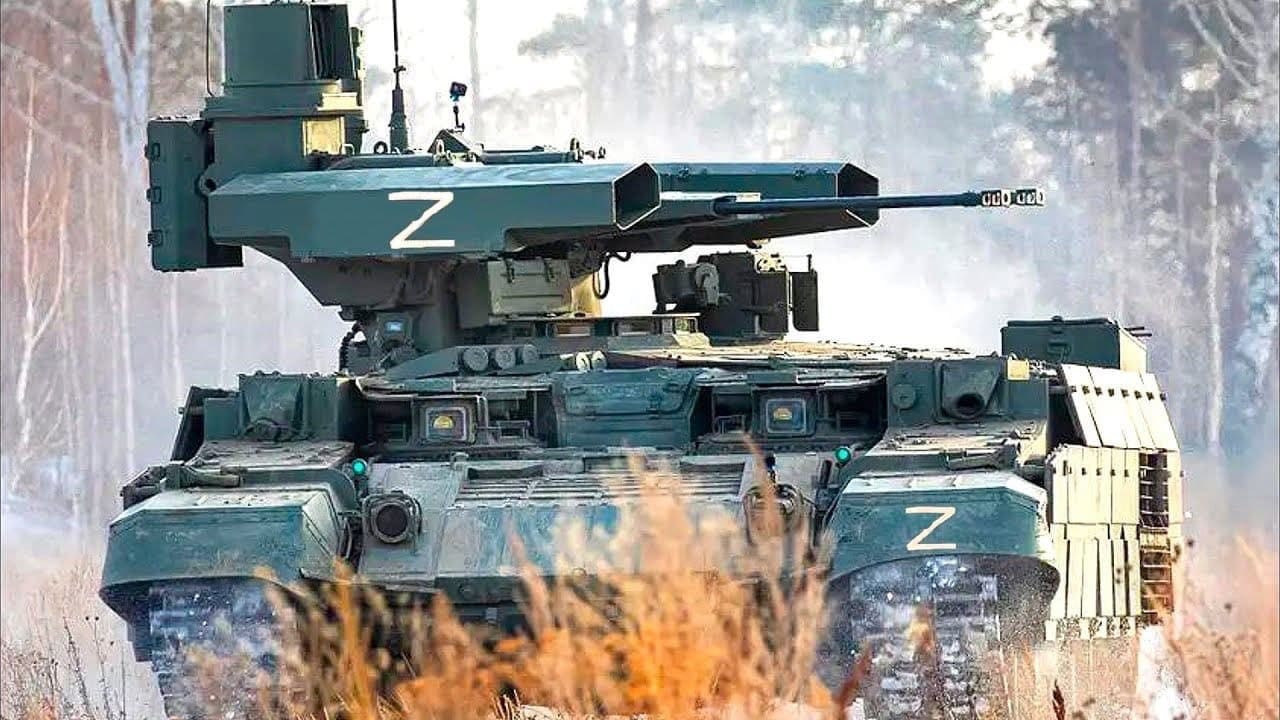
Russia Has a Robot That Fires Mortars Every 5 Seconds Without a Human Crew: Recent reports reveal Russia is developing several new robotic weapon systems. The new designs are sometimes referred to as “ground drones” and highlight Russia’s growing use of autonomous and semi-autonomous systems.
Due to these systems’ unique capabilities, some media refer to them as “Putin’s killer robots.”
The most famous is the Kurier Ground Robotic System, which has only been seen in video footage from official live tests released this month.
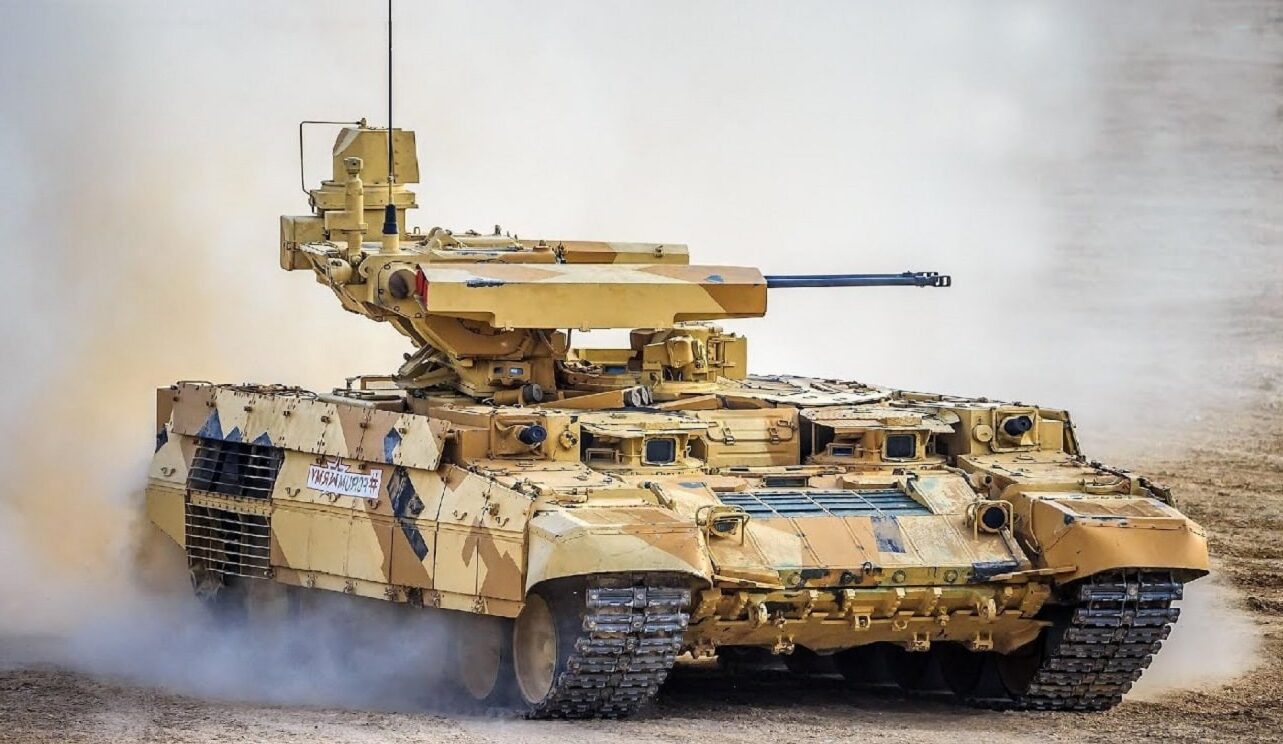
Terminator Tank from Russia. Image Credit: Creative Commons.
That system appears to be a tracked ground robot equipped with an 82-mm mortar module.
As Russian commentators point out, in this mortar-carrier configuration, the Kurier is capable of “loading and firing rounds without any human input.”
The Kremlin-approved footage of the Kurier’s Bagulnik-82 module is the only material seen of this system in action.
Much has already been made of the mortar module’s robotic arm autoloader, which is key to the system’s rate of fire.
According to the videos, as well as other information released about the system’s live-fire tests, the autoloader is able to place a new shell into the mortar’s tube within five seconds of the previous round’s firing.
Utility of An Autoloader
A robotic vehicle with an autoloader requires no human crew while in operation.
This system’s arrangement also minimizes the possibility of a vehicle’s weapon system jamming, as can occur with an autofeeder/autoreloader mechanism similar to that of an automatic or semi-automatic ammunition-feeding design.
Autoloaders are one of the first innovations in the history of Russian armored vehicle construction.
Every main battle tank design from the T-64 forward, including the modern T-90, has been fitted with an autoloader arm similar to the one seen on the Kurier.
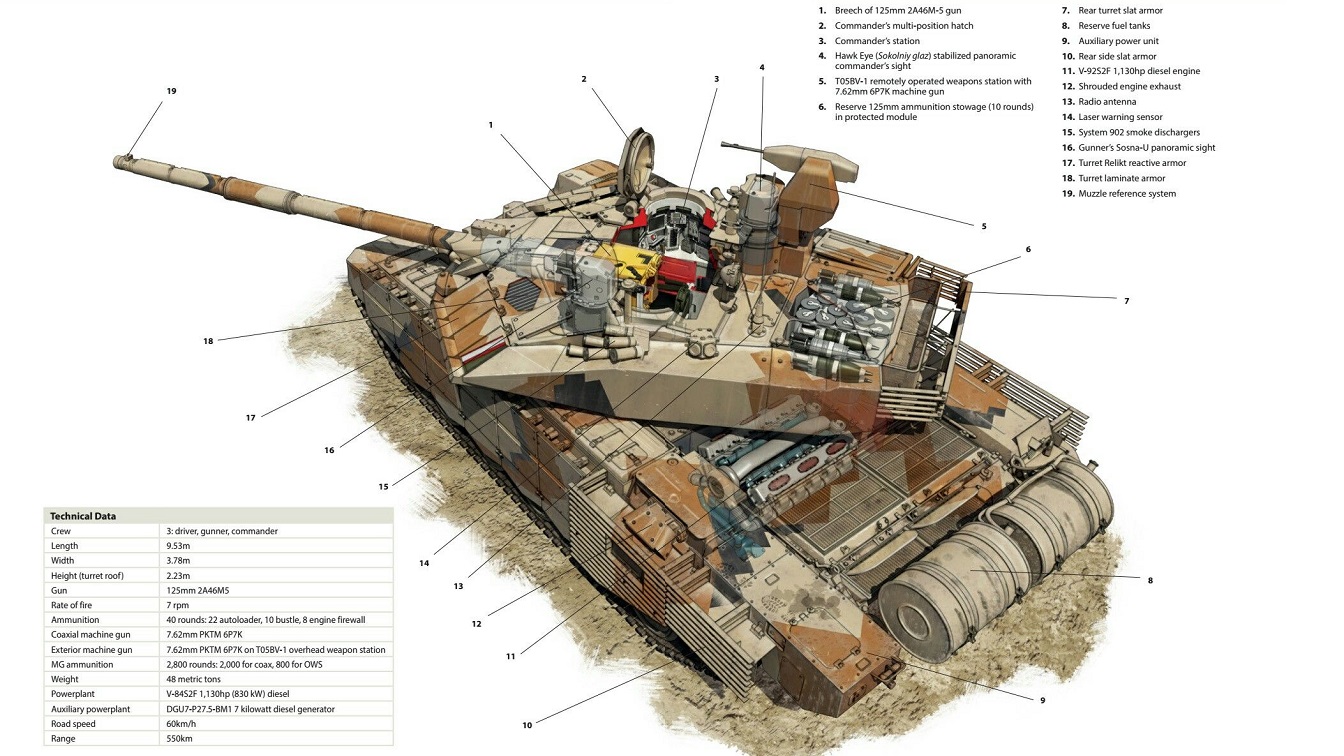
T-90 Tank. Image Credit: Creative Commons.
By eliminating the need for a human loader, Russian tanks could operate with a crew of only three: a commander, a gunner, and a driver. Meanwhile, U.S. and European designs still require four-man crews.
Removing the additional crew member also gave tanks a smaller, lower profile. The reduced crew and more compact ammunition enabled the design of vehicles with a lower-to-the-ground silhouette, making tanks more difficult to spot, target, and strike.
Testing and Deployment of New Robot
The version of the Kurier system seen thus far has undergone live-fire trials in snow-covered terrain.
But designers state it is intended for use against Ukraine and is not confined to operations in winter conditions. It should enter the conflict once testing is complete—possibly in late spring or early summer.
The weapon is reportedly designed to operate remotely on the battlefield—alongside Russian troops or without them.
The mortar seen in the footage is not specified, but military analysts familiar with Russia’s inventory believe it is based on the 2B24 82-mm light mortar.
This mortar design was seen in the summer of 2025 and is the latest variant in a family of such weapons. Its predecessors were developed as lightweight weapons optimized for mobility and for use in difficult environments, such as mountainous terrain.
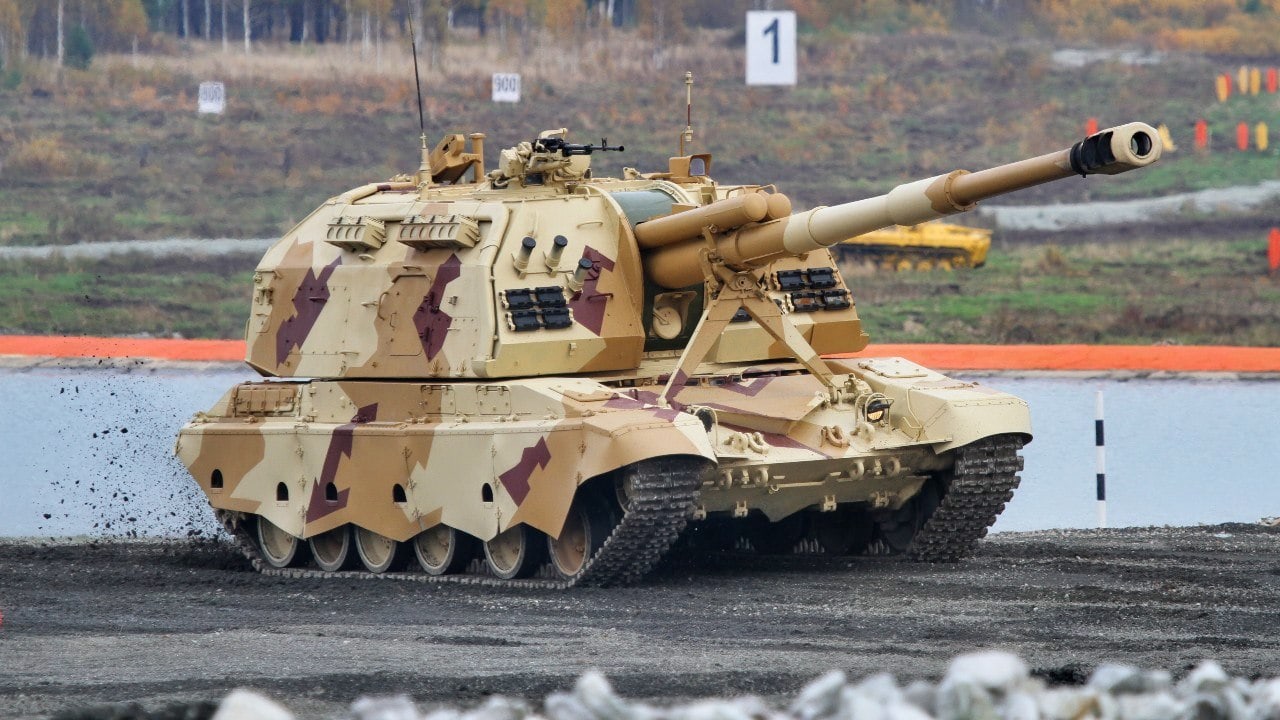
MSTA Artillery from Russian Army.
Representatives from the Rostec defense-industrial conglomerate state, “Despite its simplicity, the 2B24 mortar is a highly effective antipersonnel, anti-shelter, and anti-armor weapon. It features a rotator that allows it to fire from any soil type. The efficiency of the mortar is further enhanced when used in conjunction with modern guidance and live recording systems, such as drones.”
The Kurier’s appearance is seen as representing two new developments in Russia’s use of unmanned ground systems.
First, it is an operational evolution: These robot systems have been used primarily for logistical purposes—delivering ammunition and supplies or evacuating wounded personnel.
Second, while the Kurier is seen armed with a mortar, the weapon is wholly contained within the Bagulnik-82 module.
That implies the ground-vehicle industry in Russia is starting to develop modular designs that, like unmanned aerial vehicles, can carry different payloads.
About the Author: Reuben F. Johnson
Reuben F. Johnson has thirty-six years of experience analyzing and reporting on foreign weapons systems, defense technologies, and international arms export policy. Johnson is the Director of Research at the Casimir Pulaski Foundation. He is also a survivor of the Russian invasion of Ukraine in February 2022. He worked for years in the American defense industry as a foreign technology analyst and later as a consultant for the U.S. Department of Defense, the Departments of the Navy and Air Force, and the governments of the United Kingdom and Australia. In 2022-2023, he won two consecutive awards for his defense reporting. He holds a bachelor’s degree from DePauw University and a master’s degree from Miami University in Ohio, specializing in Soviet and Russian studies. He lives in Warsaw.