
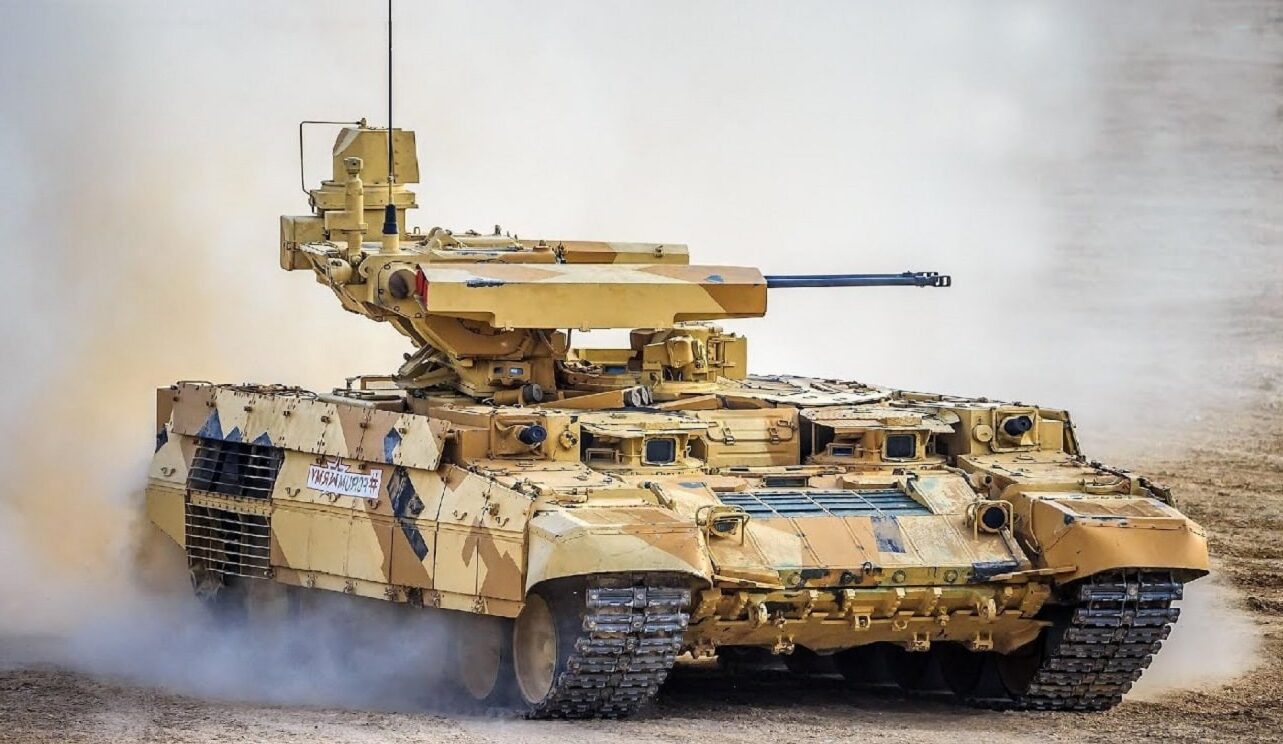
Key Points and Summary – Russia’s BMPT “Terminator” tank-support vehicle was marketed as an urban-combat solution born from lessons in Grozny, but its battlefield impact in Ukraine has been limited and controversial.
-Only a small number were built and even fewer have appeared on the front, making it hard to be decisive in high-intensity mechanized fighting.
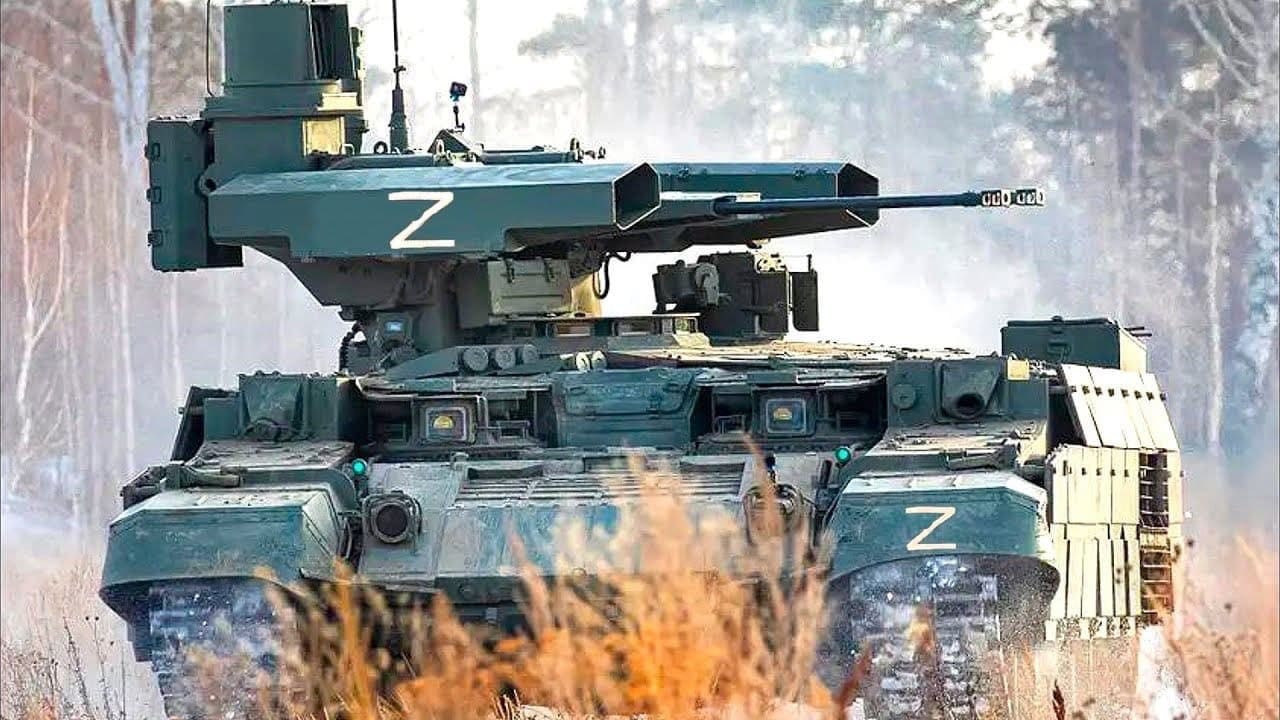
Terminator. Image Credit: Russian State Media.
-A recent promotional video reignited criticism by appearing to show severe cannon vibration and poor stabilization, raising questions about accuracy and build quality.
-Despite carrying missiles, autocannons, grenade launchers, and a machine gun, the BMPT remains vulnerable to top-attack weapons and drones.
-With sparse deployments and reported losses, skeptics argue the Terminator is better at parades than war.
Why Russia Built So Few BMPT Terminators—and Why It Matters in Ukraine
Leave it to the Russians to come up with a nickname for an armored vehicle that is over-hyped and a failure on the battlefield. The much-ballyhooed “Terminator” tank support combat vehicle, officially known as the BMPT, has been a disappointment in Ukraine.
Russia built only 33 Terminators, and just a handful have been deployed on the front lines. This inadequate performance has even some Russian military observers wondering if this armored vehicle is more for propaganda and military parades rather than for combat.
The BMPT Is Not Ready for Prime Time
Recently, the critics have more grist for their mill. The manufacturer released a promotional video in October that showed the Terminator in action. The reception has been negative. When the cannon fired, the weapons system vibrated, hindering firing accuracy. One can clearly see in the video that the gun is weaving terribly from left to right as it sends rounds downrange.
Shaky and Shoddy Manufacturing
Manufacturer Uralvagonzavod (UVZ) noted how the BMPT is a modern marvel, but critics came out of the woodwork.
The twin 30mm 2A42 autocannons looked shaky, and this led some to wonder whether the BMPT could ever be a success in combat. The video made the rounds on social media and had eagle-eyed Internet viewers in stitches, noting that such difficulty with the gun system was distinctly visible in the clip.
UVZ, undeterred, announced in October that the manufacturer would send another batch of BMPTs to the army.
Andrey Tarasenko, a tank analyst, said, “The vehicle is terrifying the enemy with shaking guns and pompous, meaningless words. The BMPT hasn’t been used in battles for over a year. Apparently, like the only T-72B3M with the ‘Arena’ active protection system, it’s now busy filming movies. The additional gun barrel support is missing—the cover is purely decorative,” according to Defence Blog.
It Has No Shortage of Weapons
The BMPT is adorned with multiple weapons systems. The vehicle is equipped with four 9M120 Ataka missile launchers, two 30 mm 2A42 autocannons, two AG-17D grenade launchers, and one coaxial 7.62 mm PKTM machine gun.
That should be enough to do some damage against enemy tanks and dismounted fighters. Still, the Terminator has a weakness on top of the turret, and its five-person crew is in danger from Kamikaze loitering drones and anti-tank missiles.
The Russians have tried to use “cope cages” on the few BMPTs that have seen action, but this remedy hasn’t really worked.
Plans for an Urban Assault Vehicle
The first generation of the BMPT was developed after the First Chechen War, when urban combat with conventional tanks proved disastrous for the Russians in the Battle for Grozny in 1994. There was a need for a quick-moving support vehicle capable of firing missiles and grenades to counter urban insurgents.
The street fighting could be more successful with a Terminator vehicle, it was believed.
The BMPT was initially built on a T-72 tank chassis, so maintenance was thought to be minimized. A few prototypes were ready for testing and evaluation in 2005.
Ten vehicles were delivered to the army in 2018. Then the engineers decided that the Terminator could have greater speed, maneuverability, and range by using a T-14 Armata tank chassis and hull, which was then dubbed the Terminator 3.
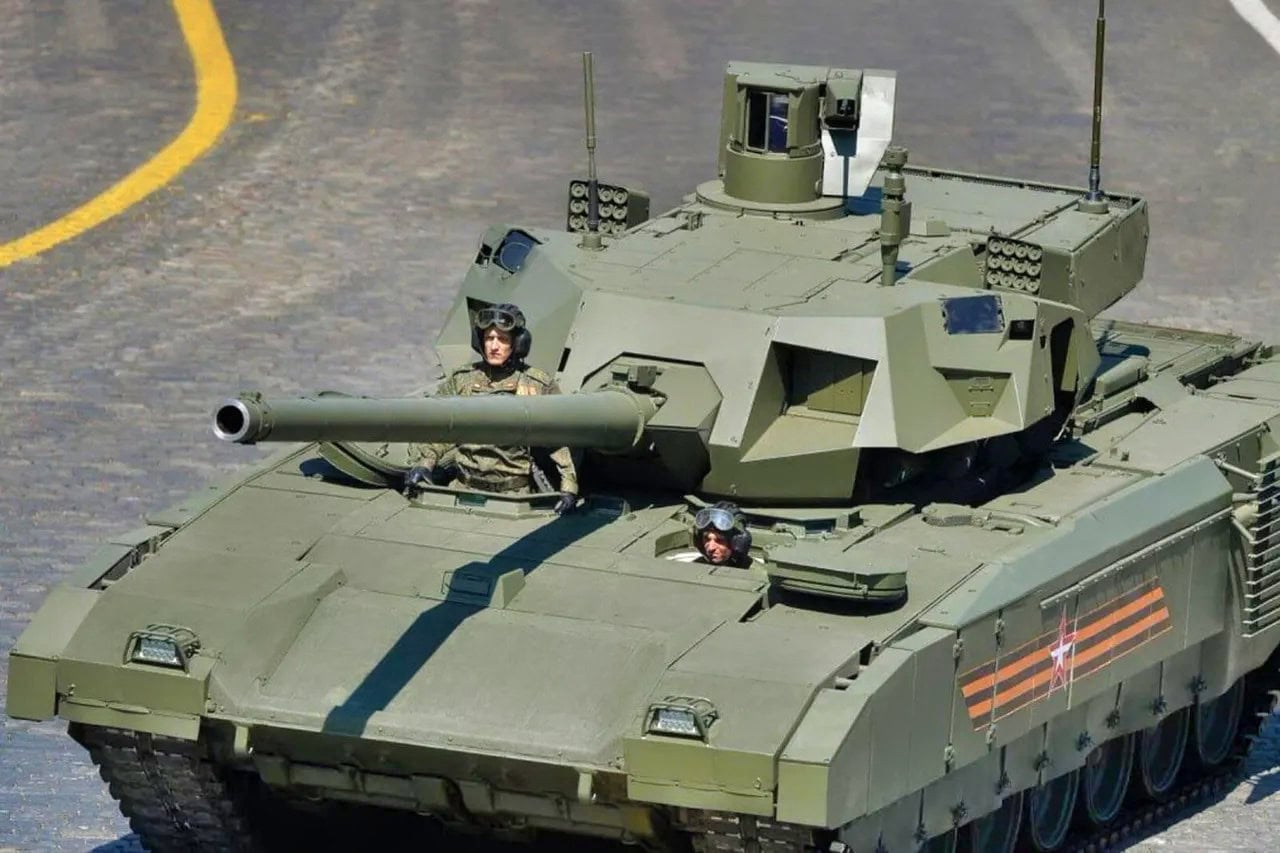
Russian T-14 Armata Tank. Image Credit: Social Media Screenshot.
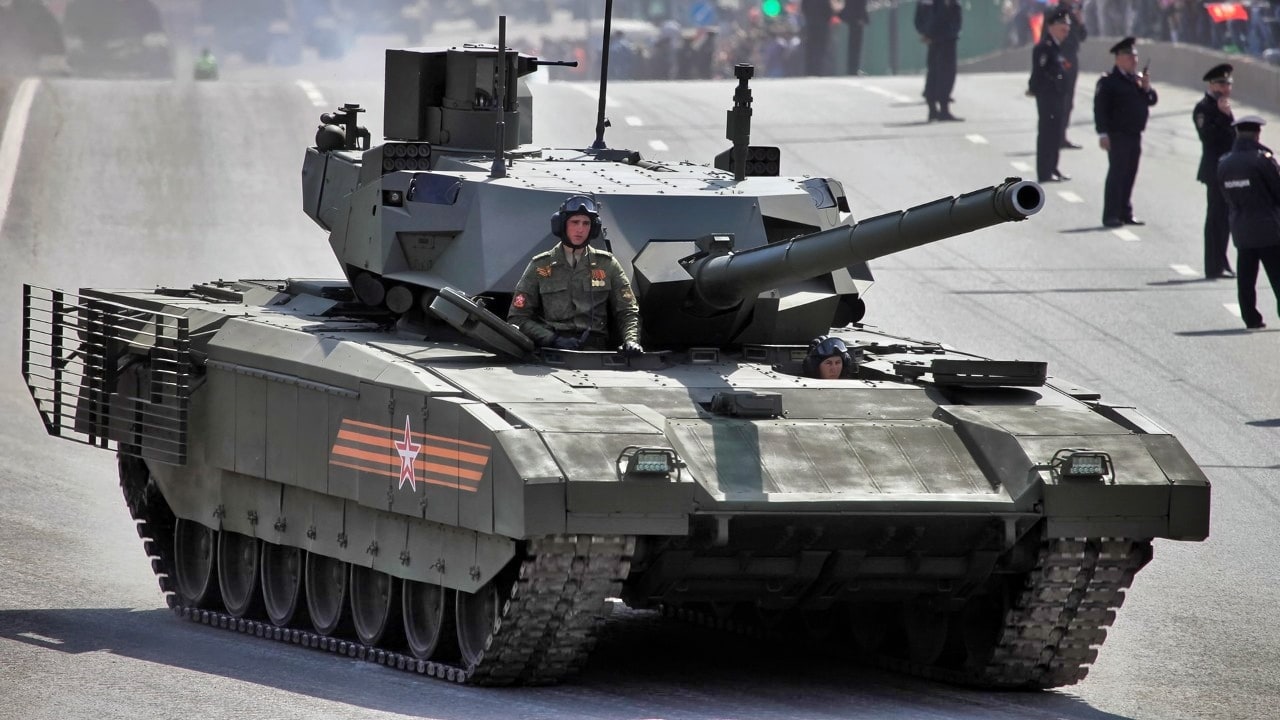
T-14 Armata Tank from Russia
The vehicle was meant to assist tanks in urban warfare in a vehicle that would be much better armed than a base model armored personnel carrier, which Ukrainian soldiers have easily destroyed. The BMPT was made with thicker armor, but that hasn’t helped. The Terminator still has not lived up to its press clippings.
It’s No Bradley Fighting Vehicle
The biggest problem has been its fire stabilization system, which has prevented the main autocannons from firing with precision. The recent video shows how this issue has still not been fixed. Russian generals consider the Terminator superior to the Bradley Fighting Vehicle, which has been a mostly successful piece of military hardware for the Ukrainians since the United States donated it to them.
That was one of the original selling points for the Terminator. According to UVZ, “the BMPT features all-around protection, advanced fire control systems, and high target acquisition capability.”
The manufacturer believes it is effective for rooting out dismounted infantry to prevent them from firing anti-tank missiles. The BMPT could also be used for reconnaissance-in-force missions as a scout vehicle for motorized regiments. But so far, the Terminator has been disappointing in combat.
The BMPT is just not that much better than the tanks and armored personnel carriers that have already been destroyed. Plus, the UVZ did not make them in great numbers that would have put pressure on Ukrainian forces in high-speed mechanized operations that could strike deep into the invaded country.
Around 24 BMPTs have seen action in Ukraine, and open source intelligence service Oryx reckons that Russia has lost at least three in fighting. This is not an impressive combat record.
The Terminator does have the looks to intimidate. That’s why it is fodder for hype videos and parades. But in reality, it has been a failure. And with the main gun vibration, the Terminators may need to go back to maintenance for a fix.
What Happens Now?
The BMPT is meant to be a “tweener” between a tank and an infantry fighting vehicle. The armor is not as thick as a tank’s, and the agility and speed are not that of a modernized armored personnel carrier. The gun is problematic, and it hasn’t been built in sufficient numbers to be decisive.
Vladimir Putin hoped that his “super” weapon could dominate, but instead it has become the inspiration for propaganda and military festivities. The Terminator has been a bust, and it is another example of how the Russian army has failed to bring modern weapon systems to the battlefield in a way that could turn the tide of the war.
About the Author: Brent M. Eastwood
Author of now over 3,000 articles on defense issues, Brent M. Eastwood, PhD is the author of Don’t Turn Your Back On the World: a Conservative Foreign Policy and Humans, Machines, and Data: Future Trends in Warfare plus two other books. Brent was the founder and CEO of a tech firm that predicted world events using artificial intelligence. He served as a legislative fellow for US Senator Tim Scott and advised the senator on defense and foreign policy issues. He has taught at American University, George Washington University, and George Mason University. Brent is a former US Army Infantry officer. He can be followed on X @BMEastwood.