
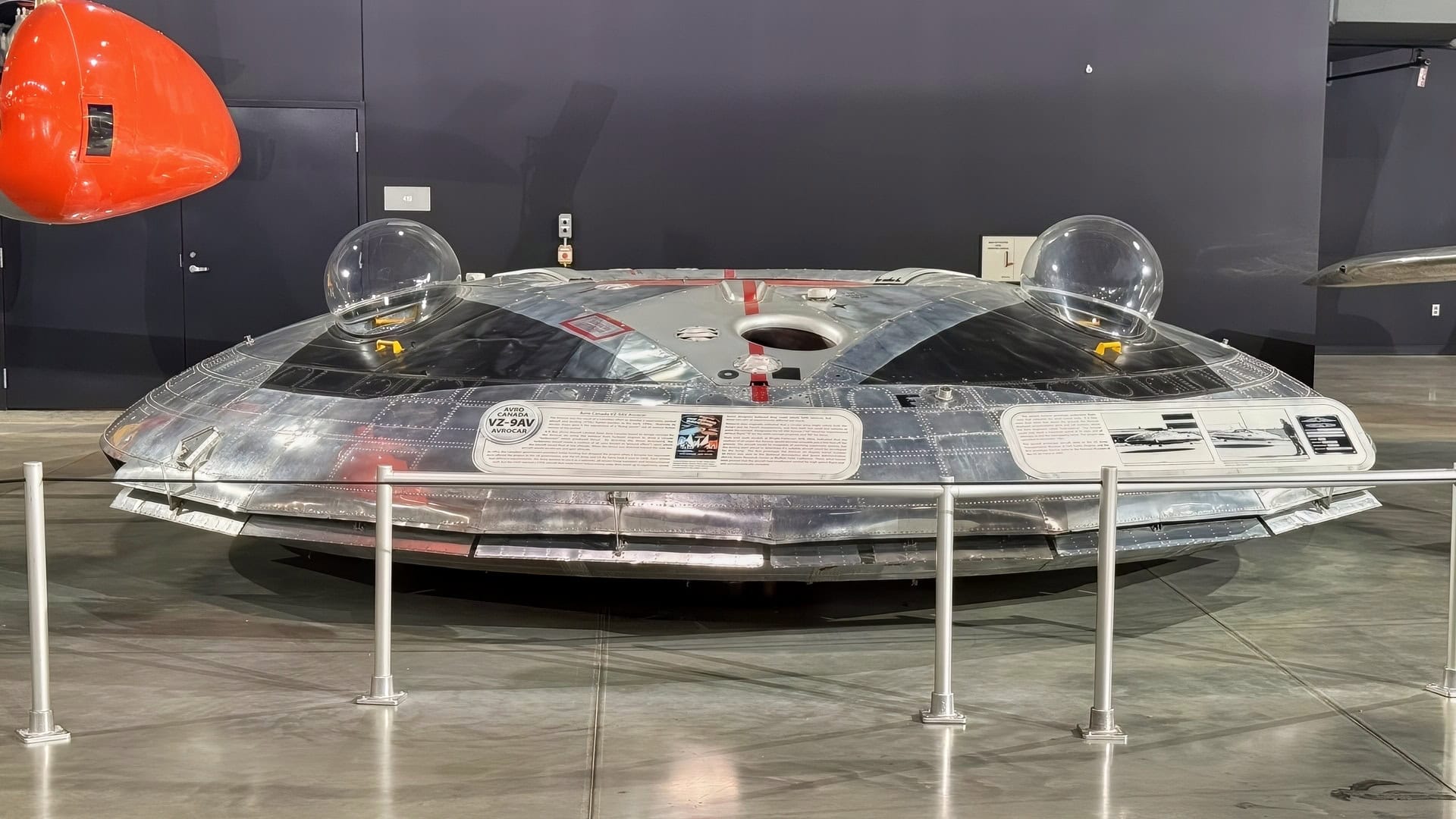
The VZ-9AV Avrocar Was a 26.5-Foot Flying Disk Powered by Three Continental J69-T9 Turbojets With 927 Pounds of Thrust Each
The Avrocar program was one of the most unusual aircraft ever built. We visited it last year at the National Museum of the U.S. Air Force and it stopped us in our tracks, to say the least.
It was a 1950s Canadian-American project designed to build a “flying saucer”- style V/STOL aircraft with high-speed, high-altitude performance, but it failed due to severe stability issues.
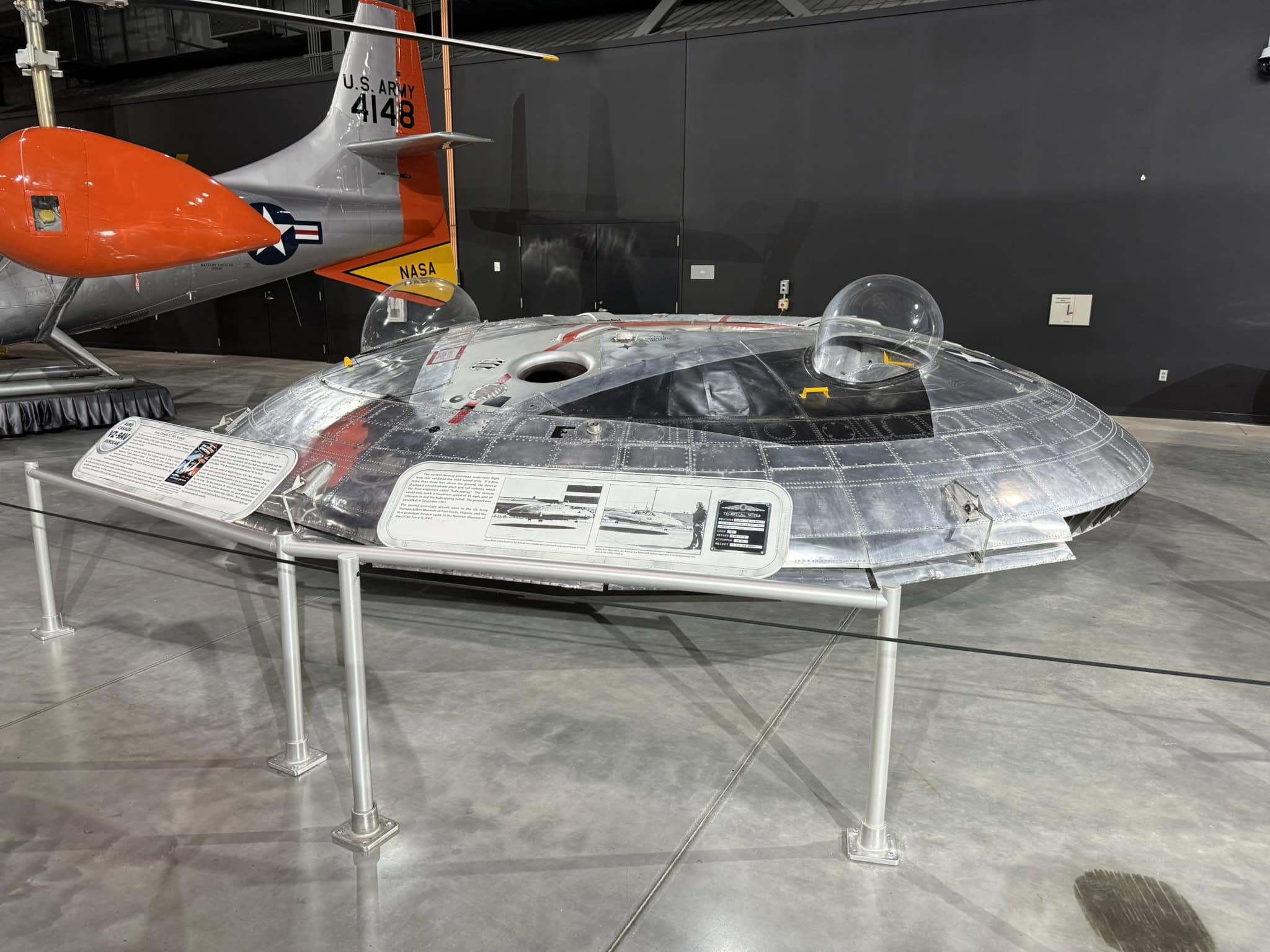
Avrocar Flying Saucer Up Close 19FortyFive.com Image
Developed by Avro Canada and funded by the US Air Force and Army, it was canceled in 1961 after failing to fly higher than a few feet, and much slower than it was envisioned.
The aircraft design, although a failure, would inspire the AV-8 Harrier II and live on in the F-35B V/STOL variant.
We have some great close-up photos of the aircraft from its visit to the National Museum of the Air Force, which are included here.
It Was Not From Outer Space, But May Have Been Inspired By It:
In the 1950s, the Canadian Air Force sought to design and build a vertical take-off and landing (VTOL) vehicle capable of hovering below radar coverage, intercepting enemy aircraft, and taking off at high speed. The VZ-9AV, with its distinctive flying-saucer shape, was the proposed solution.
Following World War II, the US and Allies were very interested in developing VTOL aircraft. VTOL aircraft can take off vertically, eliminating the need for runways and associated infrastructure.
With the beginning of the Cold War, it was believed that airfields would be the first targets for an enemy. If the Air Force could disperse its assets across a wide swath of small airfields, then the chances of survival would increase.
During the 1950s, alien visitation in science fiction books and films was all the rage, and the typical alien spacecraft was the flying saucer. And perhaps art did influence life a bit here.
The VZ-9AV Avrocar Saucer Design:
Avro’s project design was essentially a flying disk, or doughnut-like airframe. The ambitious, unique design aimed to build a jet aircraft with good subsonic and supersonic performance.
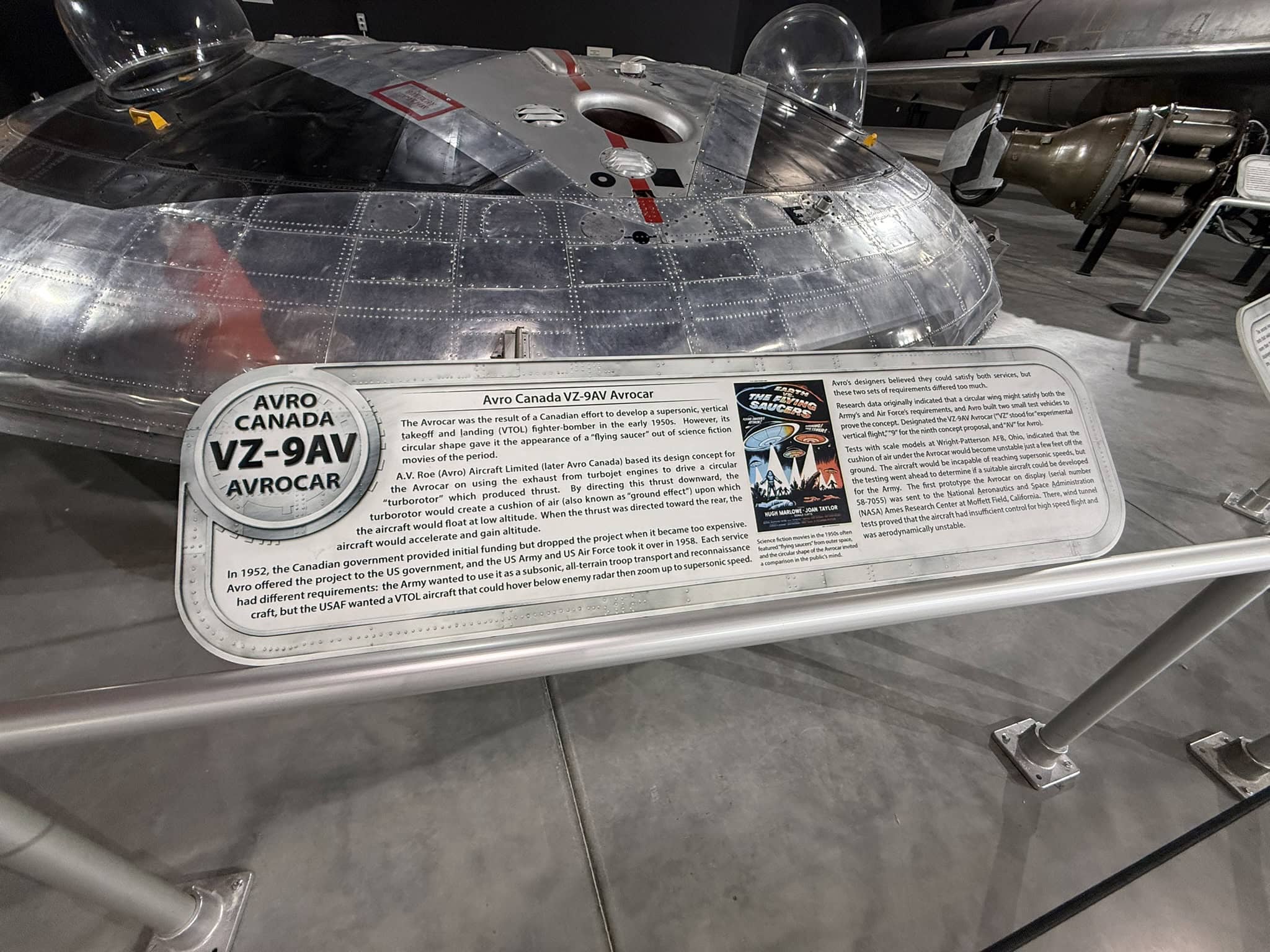
Avrocar Flying Saucer Up Close 19FortyFive.com Image
Avro’s designer, John Carver “Jack” Frost, designed the Avrocar to take advantage of the Coandă effect, which is the tendency of a fluid (liquid or gas) jet to stay attached to a convex, curved surface rather than following a straight line.
Discovered by Henri Coandă in 1910, this phenomenon occurs because the fast-moving fluid drags surrounding air (viscosity), creating a low-pressure area that pulls the flow toward the surface.
In Frost’s design, it was to provide lift and thrust from one engine by blowing exhaust out of the rim of a circular aircraft. The Avrocar was a flying saucer-shaped disk 26.5 feet in diameter, 5 feet tall, and weighing 5,000 pounds.
The aircraft’s circular design would use three Continental J69-T9 turbojets, each with 927 lbs. of thrust, to drive a “turbo rotor” and produce thrust.
The vents and fans in the fuselage would direct thrust downward, creating a cushion of air that would allow the aircraft to float at low altitudes.
Thrust vectoring was directed aft, enabling the aircraft to accelerate and gain altitude.
The Army And Air Force Were Both Interested:
Frost’s initial design called for the aircraft to fly at three times the speed of sound (Mach 3).
But as expenses mounted, the United States took over funding for the project. This complicated things further, as both the Air Force and the Army were interested in the program.
The Army was looking for a “durable and adaptable, all-terrain transport and reconnaissance aircraft” that would replace helicopters, while the Air Force was seeking an aircraft that could hover beneath enemy radar coverage and then accelerate to supersonic speeds.
Avro’s designers believed they could satisfy both services, but these two sets of requirements differed too much and were too unrealistic. But the tests would make all of that moot.
The Tests Were An Absolute Flop:
All the hopes for the project were soon dashed. The Avrocar was neither aerodynamic nor stealthy.
While the saucer was stable, hovering at three feet off the ground, any further height made it extremely dangerous. Modifications to the design didn’t alleviate the issues.
The saucer’s engine noise was extreme, but the intense heat generated by the engines was a bigger issue, limiting the two pilots’ effectiveness.
But the worst issue was the speed. The engineers discovered that the aircraft couldn’t exceed 35 mph. The hope of supersonic speed was shot down. The US stopped funding the program in 1961.
The Avrocar Theory Lived On For Newer Aircraft:
While the flying saucer itself was a flop, the technology developed in the program would live on with improved designs.
Those resulted in the AV-8 Harrier II, the V-22 Osprey, and the F-35B.
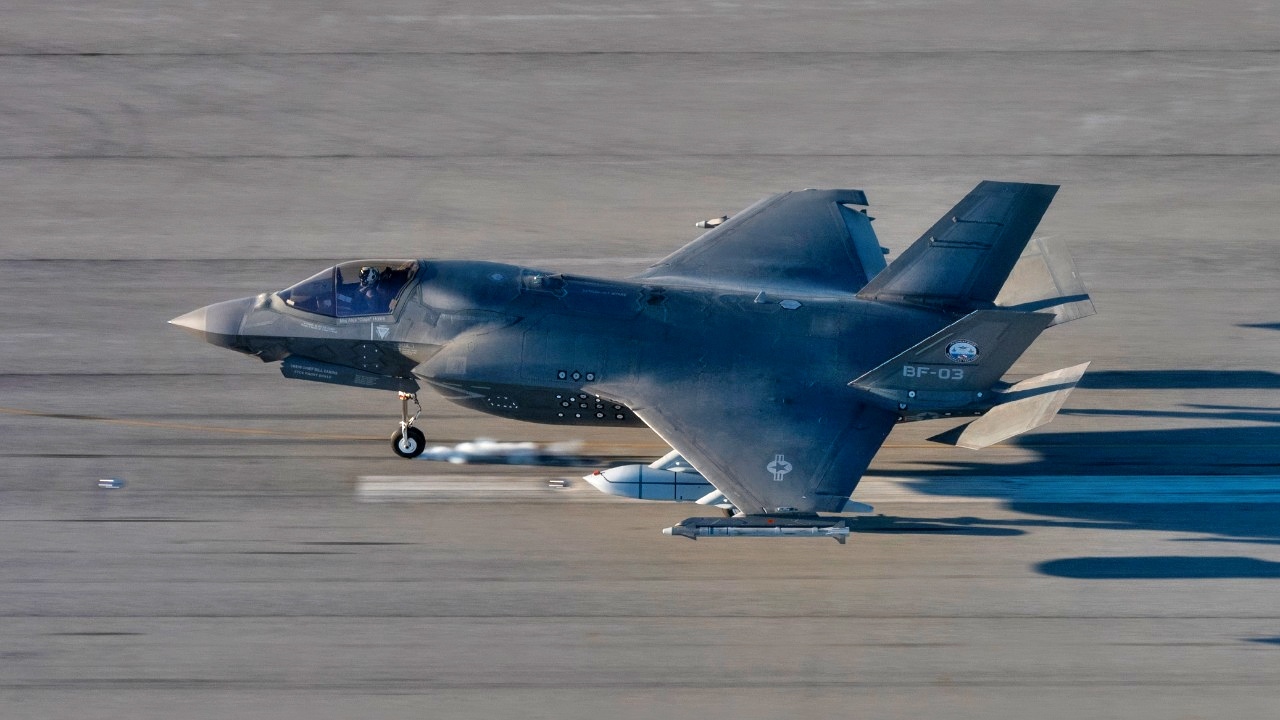
NAS PATUXENT RIVER, Md. — An F-35 Lightning II test pilot conducts the first flight test to certify the F-35B short takeoff and vertical landing variant of the fighter aircraft for carrying the AGM-158C Long-Range Anti-Ship Missile (LRASM). As part of ongoing weapon integration efforts, the Pax River F-35 Integrated Test Force (Pax ITF) team for the first time flew test flights Jan. 14 with two AGM-158 loaded on external stations. LRASM is a defined near-term solution for the Offensive Anti-Surface Warfare (OASuW) air-launch capability gap that will provide flexible, long-range, advanced, anti-surface capability against high-threat maritime targets. The Pax River ITF’s mission is to effectively plan, coordinate, and conduct safe, secure, and efficient flight test for F-35B and C variants, and provide necessary and timely data to support program verification / certification and fleet operational requirements.
In 2007, one of the test models was placed in the Air Force’s National Museum, and in 2019, another was placed in the Army’s Transportation Museum.
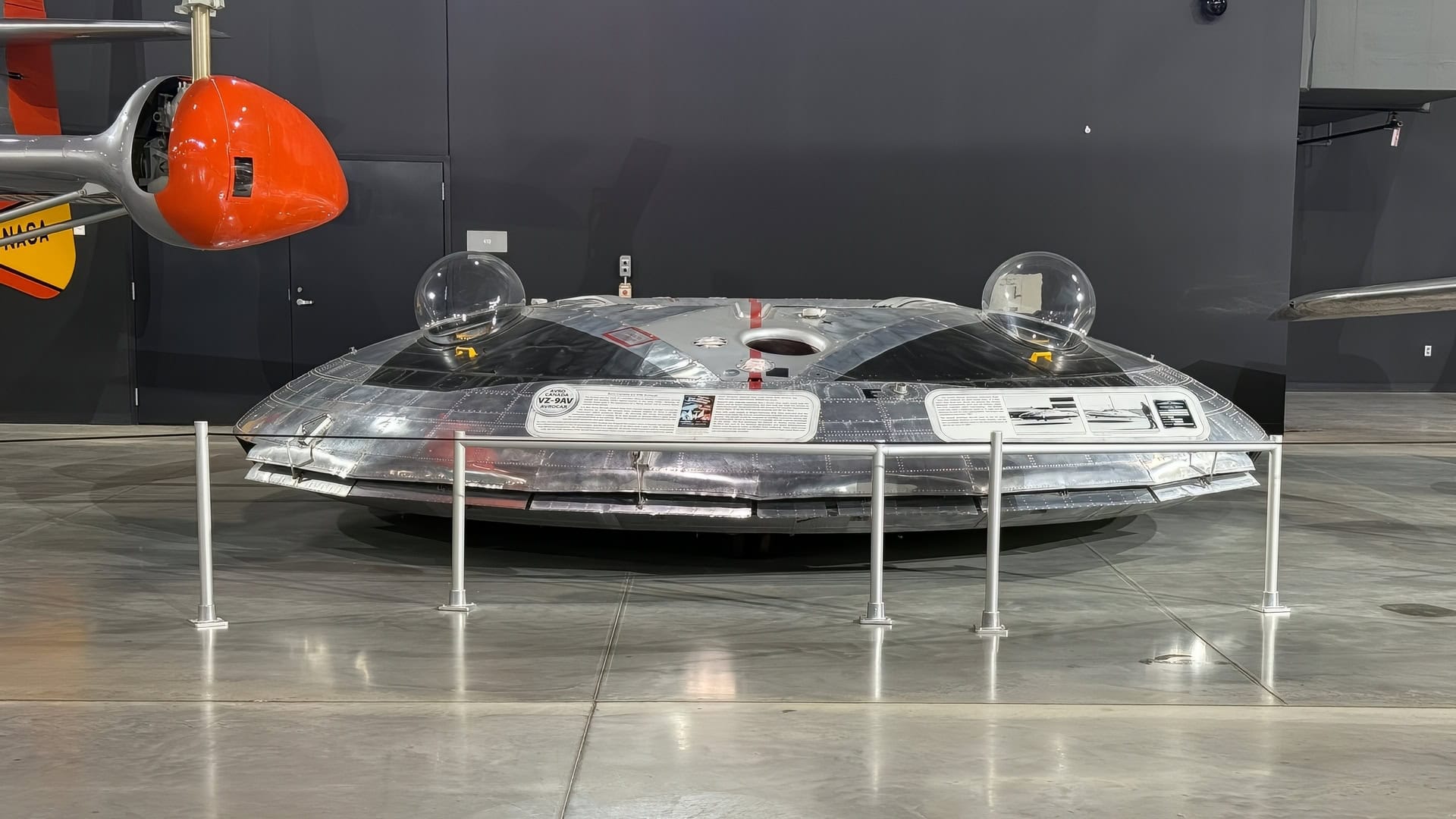
Avrocar Flying Saucer. Image Credit: 19FortyFive.com
About the Author: Steve Balestrieri
Steve Balestrieri is a National Security Columnist. He served as a US Army Special Forces NCO and Warrant Officer. In addition to writing on defense, he covers the NFL for PatsFans.com and is a member of the Pro Football Writers of America (PFWA). His work was regularly featured in many military publications.