
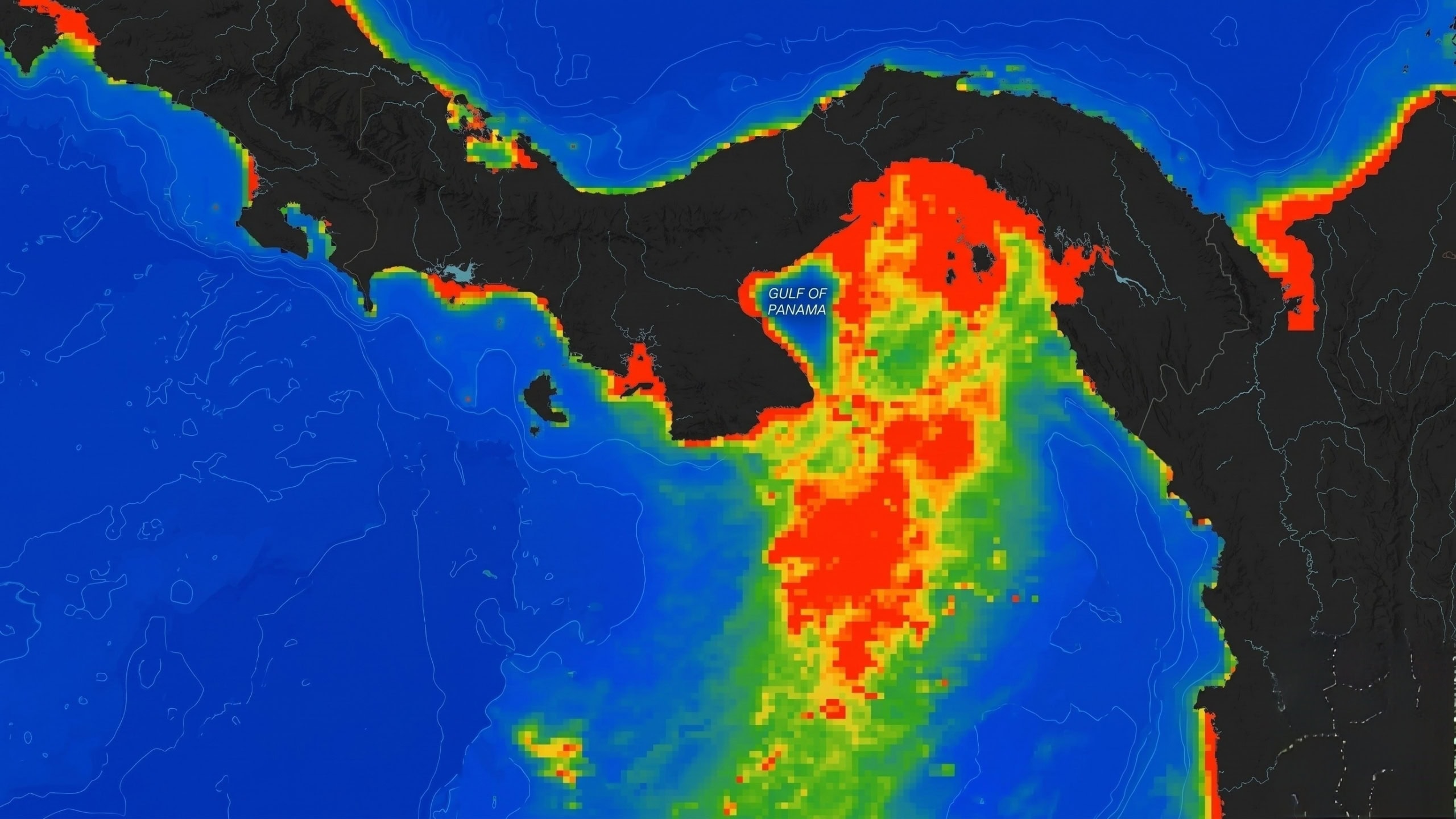
Why Did the Gulf of Panama Miss Out on Upwelling Last Year?
The Gulf of Panama has long enjoyed a phenomenon known as “upwelling, in which season winds deliver “cool, nutrient-packed water to the surface.” But as noted by Science Daily, this did not happen in 2025, and scientists think they know why.
According to a study published last year by the Smithsonian Tropical Research Institute (STRI), the lack of upwelling was likely due to “weakening of the trade winds,” which is itself tied to climate change. It’s been described as “the ocean’s breath.”
There are likely cascading events from this phenomenon, or lack thereof.
The Gulf of Panama is the body of water off Panama’s Southern coast.
How It Works
According to the Smithsonian article, “upwelling is a process that allows cold, nutrient-rich waters from the depths of the ocean to rise to the surface. This dynamic supports highly productive fisheries and helps protect coral reefs from thermal stress.
This weather phenomenon keeps the Pacific beaches in that region cooler, especially during the summer.
This happened every year for 40 years. But then, in 2025, it didn’t.
“As a result, the typical drops in temperature and spikes in productivity during this time of year were diminished. In the recently published article in the journal PNAS, scientists suggest that a significant reduction in wind patterns was the cause of this unprecedented event, revealing how climate disruption can quickly alter fundamental oceanic processes that have sustained coastal fishing communities for thousands of years.”
As for the “precise cause,” scientists caution that further study is needed.
The study also states that the causes and effects of upwelling in different parts of the world are poorly understood.
The Smithsonian study was part of a collaboration between the Max Planck Institute’s S/Y Eugen Seibold research vessel and STRI, which was announced in 2023 as a joint effort to “expand collaboration among local, regional, and international researchers; to build regional capacity in marine research, to train marine scientists, and to support innovation in Latin America.”
What PNAS Found
The PNAS study of the phenomenon examined upwelling and why it didn’t occur last year.
“Coastal upwelling systems support disproportionately high marine productivity and biodiversity relative to their spatial extent,” the study said. In the Gulf of Panama, specifically, this happens because “when the Intertropical Convergence Zone reaches its southernmost position (January–April), generating northerly trade winds that funnel through the topographic low of the Canal Zone to form the Panama low-level jet and drive strong nearshore upwelling across ~60,000 km2 of Pacific Ocean.”
And this upwelling has numerous effects.
“This upwelling delivers critical ecological and economic benefits: nutrient-rich deep waters fuel phytoplankton that support productive food webs and fisheries, while cool upwelled waters provide thermal buffers that moderate coral bleaching events,” PNAS said in its study, which found “unprecedented suppression” of Gulf of Panama upwelling in 2025.
“Historically, upwelling began by January 20th, persisted for 66 [days] and reached minimum temperatures of 19 °C (extremes 14.9 °C),” the results section of PNAS’s study said. “The 2025 season deviated markedly: Temperatures dropped below 25 °C on March 4th… reached minimum temperatures of just 23.3 °C… and accumulated progressively fewer cold days than any historical year.” This was after upwelling was fairly normal in 2024.
There were also, PNAS found, “anomalously low offshore wind speeds in 2025.”
“The unprecedented failure of upwelling in the GOP in 2025… appears linked to anomalous wind patterns, particularly reduced frequency, strength, and duration of wind-jet formation,” PNAS concluded.
“When northerly winds formed, they were as strong in 2025 as in any previous year… but occurred significantly less frequently, for shorter periods and accumulated less wind stress,” PNAS found. “These nearshore observations are also reflected in the anomalous reduction in offshore wind speeds in the [Gulf of Panama] region, providing a plausible mechanism for the 2025 upwelling failure.”
There were other notable upwelling-related phenomena in 2025, including on the West Coast of the United States.
“Upwelling Saved the Day”
According to a March report by National Fisherman, which cited NOAA Fisheries’ annual California Current Ecosystem Status Report, upwelling had a positive effect further north, off the coast of the United States.
“Despite a massive marine heatwave that gripped the eastern Pacific through much of 2025, the West Coast marine ecosystem held its own — thanks largely to strong wind-driven upwelling,” the National Fisherman report said.
“Warming continues to be an inescapable reality off the West Coast, but upwelling saved the day,” Andrew Leising, a research oceanographer at NOAA’s Southwest Fisheries Science Center, told National Fisherman.
This had a strong effect on what National Fisherman described as the “food web.”
“Krill proved abundant coastwide, and juvenile salmon, young rockfish, and anchovy all flourished — providing vital prey for salmon, whales, and seabirds,” the report said. “Seabird colonies along the West Coast largely recovered from prior years of low productivity. Surveys even recorded the highest numbers of juvenile coho and chum salmon on record, a promising indicator for future adult returns.”
Total commercial landings, meanwhile, saw a 25 percent increase over the year before, with revenue rising 6 percent year over year.
On the negative side, however, “a large harmful algal bloom in early 2025 poisoned hundreds of sea lions and dolphins and hampered the Dungeness crab fishery, National Fisherman said. Also, four coastal fish processors closed in the West Coast states.
Meanwhile, the Northern Gulf Institute (NGI) recently published a study of the “unique interplay between surface winds, the Gulf Stream current, and the continental shelf in the South Atlantic Bight (SAB), [which] has long been overlooked.”
About the Author: Stephen Silver
Stephen Silver is an award-winning journalist, essayist, and film critic, and contributor to the Philadelphia Inquirer, the Jewish Telegraphic Agency, Broad Street Review, and Splice Today. The co-founder of the Philadelphia Film Critics Circle, Stephen lives in suburban Philadelphia with his wife and two sons. For over a decade, Stephen has authored thousands of articles that focus on politics, national security, technology, and the economy. Follow him on X (formerly Twitter) at @StephenSilver, and subscribe to his Substack newsletter.