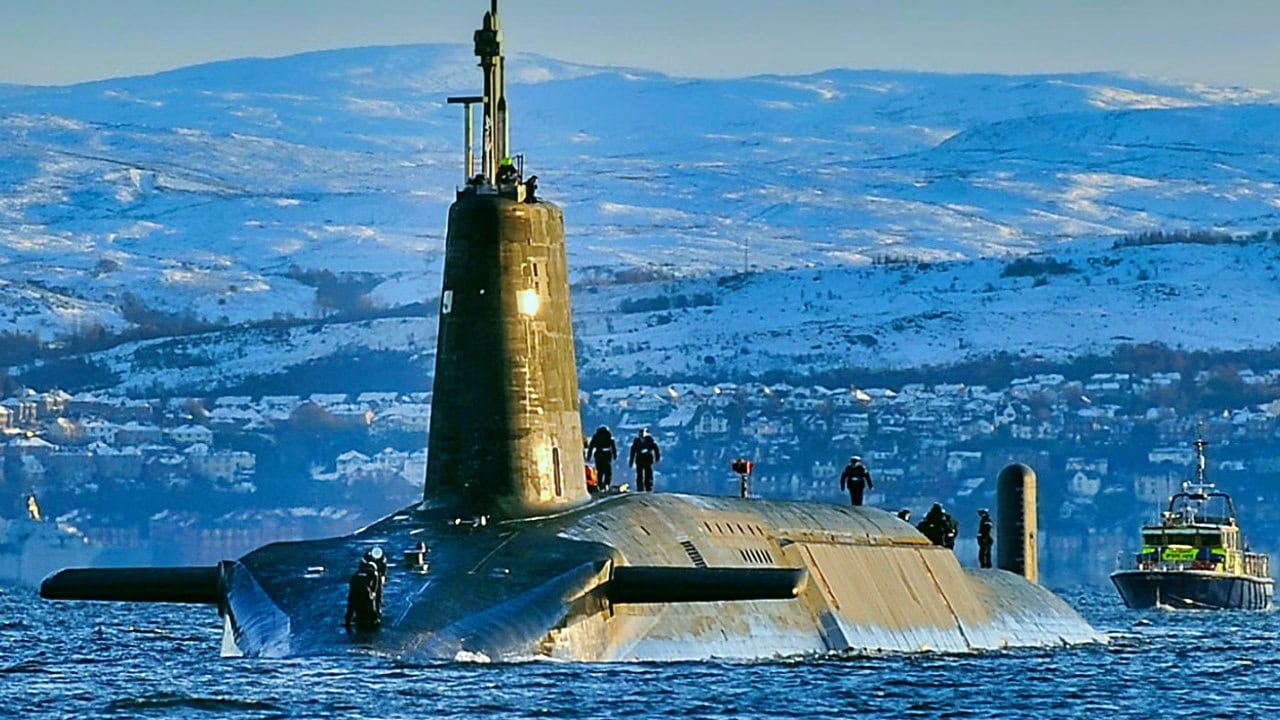
The United Kingdom’s Vanguard-class submarines are the Royal Navy’s persistent, continuous nuclear deterrent force at sea. A class of just four boats, one of which is a ballistic missile submarine, is continuously on patrol and allows for a potential nuclear response should the United Kingdom come under attack — in essence, a hedge against a surprise attack.
The nuclear deterrent provided by the Vanguard-class is often dubbed Continuous At-Sea Deterrence, or CASD, and forms the bedrock of the U.K.’s strategic nuclear posture. Armed with Trident II D5 missiles, the submarines — the HMS Vanguard, Victorious, Vigilant, and Vengeance — patrol silently, unseen beneath the waves.
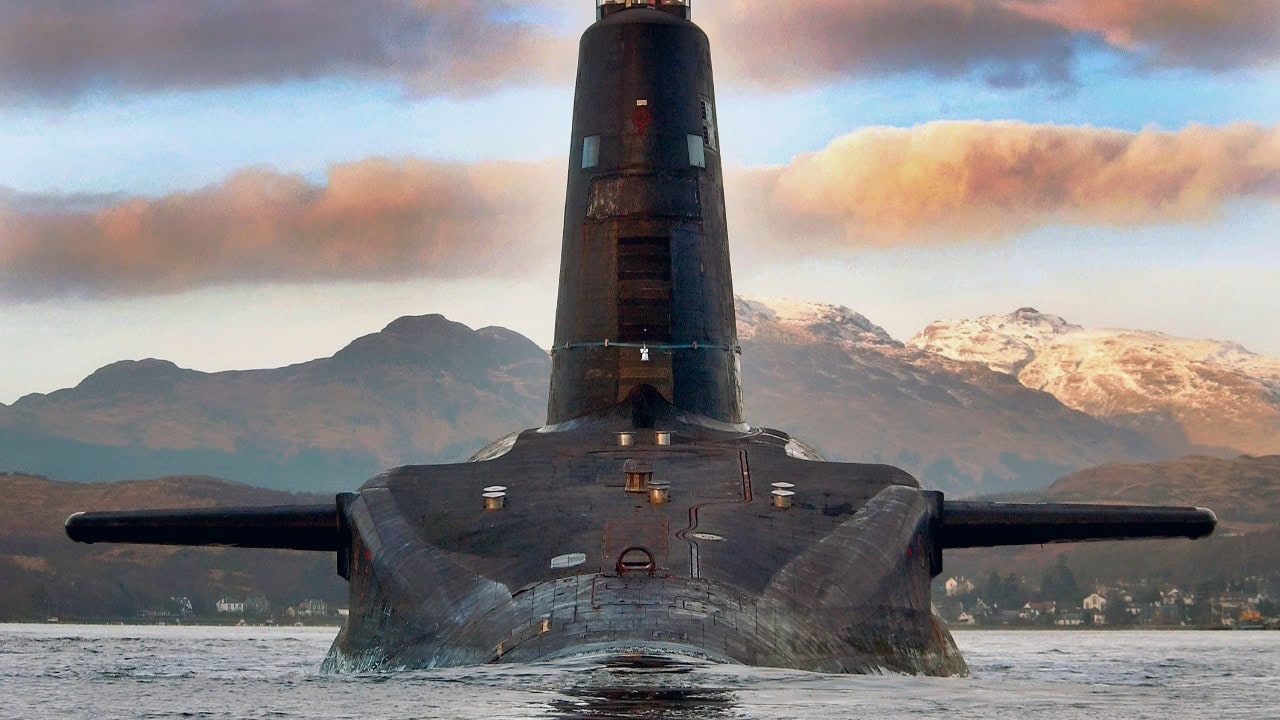
Vanguard-Class Submarine Royal Navy
During the Cold War, London Relied on the Resolution-class
Prior to the Vanguard-class submarine, the Royal Navy’s at-sea nuclear deterrence was provided by the Resolution-class submarines. Armed with the earlier Polaris missile system, the class of submarines, also numbering just four hulls, was built during the Cold War in the mid-1960s. It was not until the end of Cold War hostilities that the Resolutions were retired from service in the mid-1990s.
Into the Future: the Royal Navy’s Future Dreadnought-class
The Vanguard-class replacement, the upcoming Dreadnought-class, is already under construction and slated for entry into service in the early to mid-2030s, when it will take up the Vanguard-class’s nuclear deterrent mission.
The Vanguard-class is Not Without Controversy
Controversy has swirled around the Vanguard-class almost since its inception, with pointed criticism directed at several aspects of the submarine program, particularly building delays, subsequent cost overruns, and aging hardware and machinery.
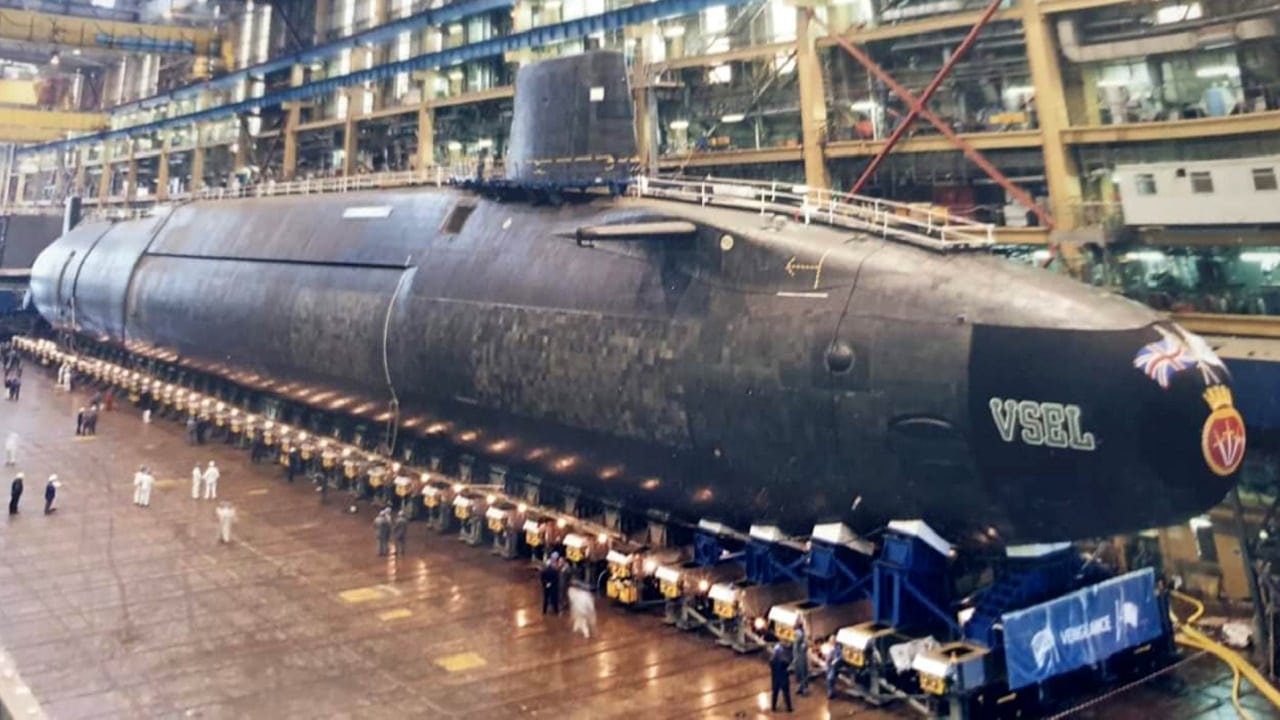
Vanguard-class Submarine. Image Credit: Creative Commons.
The first boat of the class, the HMS Vanguard, was forced to spend an extended period of time tied up at port for maintenance after a tiny but critical leak was found in the submarine’s reactor coolant system. Though ultimately repaired and cleared for patrol, the unexpected repairs were costly and drove program costs to unanticipated levels.
Separately, however, there is an ongoing debate about whether the United Kingdom should retain its nuclear weapons at all, with arguments against generally asking pointed questions about the morality of nuclear weapons use. Questions about the class’s life-extension program remain topical, as the boats have long since exceeded their originally anticipated 25-year service lives.
But questions about the boat’s capabilities or lifespan aside, perhaps one of the more controversial defense topics today concerns not the submarines themselves, but how much funding is allocated to both the Vanguard-class and their Dreadnought-class replacements, and to the United Kingdom’s armed forces more generally.
A Spate of Resignations at the Highest Level
In a sign of how embattled the current British Prime Minister, Keir Starmer, has become, two of the United Kingdom’s top defense officials resigned last week over what they characterized as deeply insufficient funding to keep the United Kingdom safe.
Defense Secretary John Healey and Armed Forces Minister Al Carns both resigned in protest. In his resignation letter, former Secretary Healy said that the current U.K. defense spending trajectory “falls well short of what is required for defence and the country at this dangerous time.”
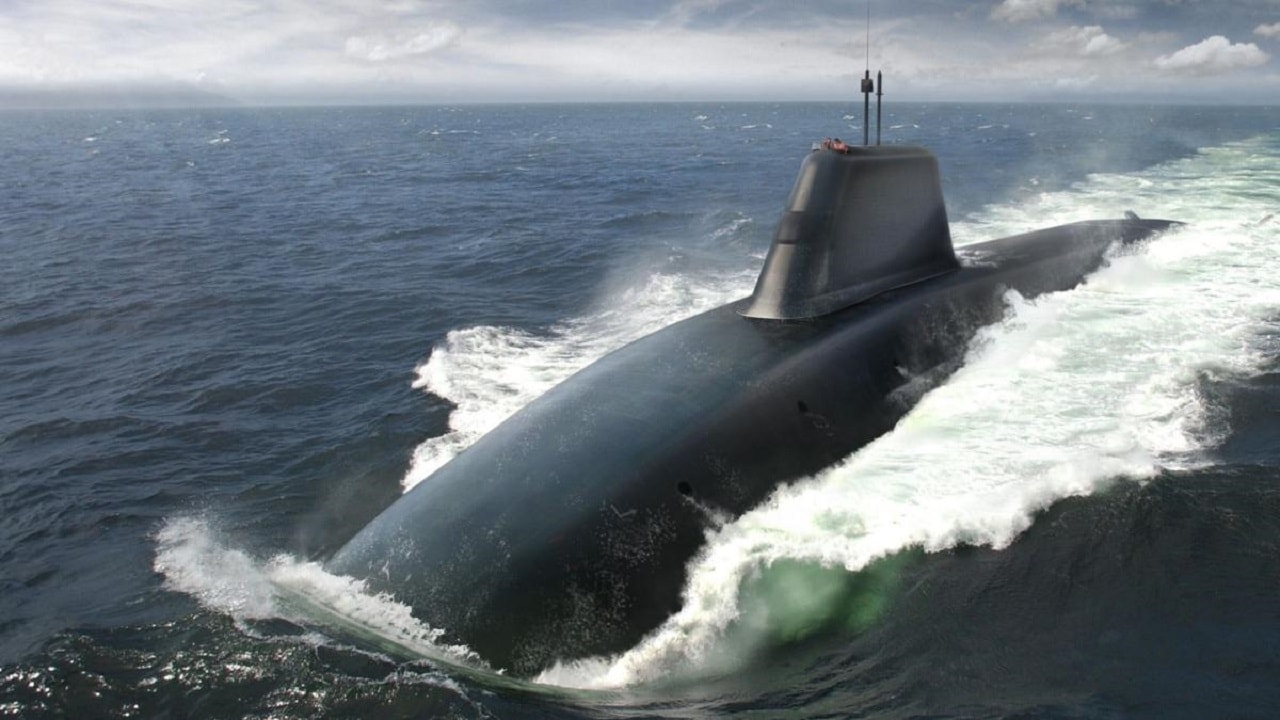
The Dreadnought-class is the future replacement for the Vanguard-class of ballistic missile submarines.
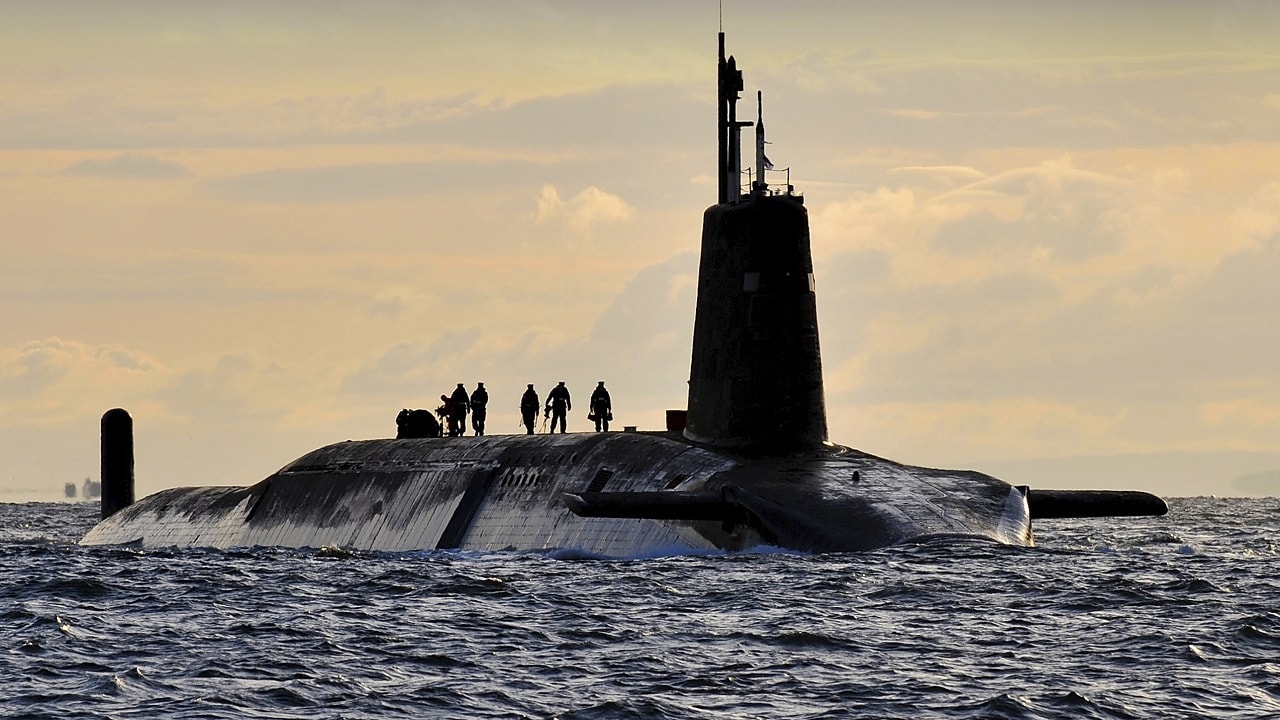
Nuclear submarine HMS Vanguard arrives back at HM Naval Base Clyde, Faslane, Scotland following a patrol.
Separately, former minister Carns, in his own letter, explained that he could not “in good conscience stand at the dispatch box and defend a level of investment I know to be inadequate to the task.”
The British Broadcasting Corporation published both letters in full.
Britain at the Breaking Point?
While Europe is in the throes of the most expansive, deadliest war on the continent since the Second World War, over eighty years ago, the United Kingdom has been something of a laggard in adjusting to the new reality of warfare that the war in Ukraine has made apparent.
Though an early and enthusiastic supporter of Kyiv during the early days of Russia’s full-scale invasion, and notably under former Prime Minister Boris Johnson, London has seemingly been slow to absorb the lessons of the ongoing war in the east. Perhaps one of the clearer examples of the British leadership’s lack of urgency can be seen in the British Army’s upcoming Challenger 3 main battle tank.
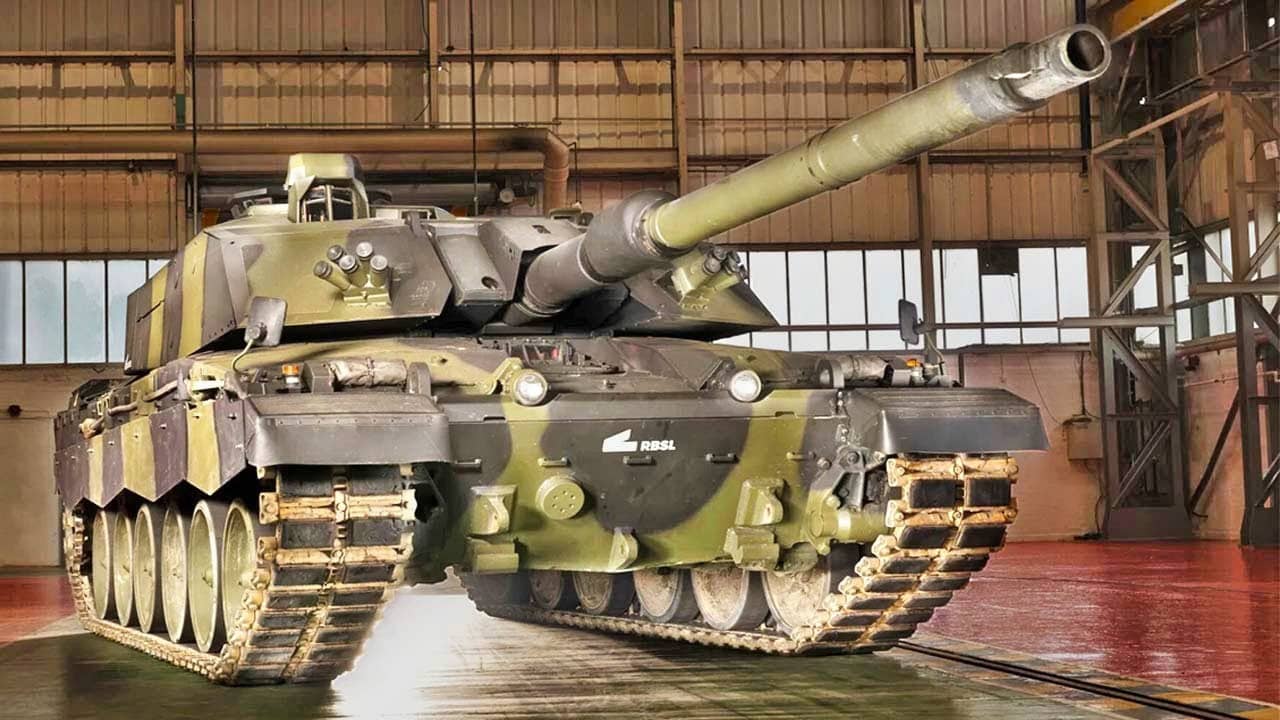
Challenger 3 Tank. Image Credit: Creative Commons.
While that platform is expected to offer significant benefits in firepower, armored protection, and streamlined logistics with close allies within the NATO alliance — a fact its detractors broadly acknowledge — the Challenger 3 fleet is believed to be grossly underprepared for the kind of protracted, attritional fighting seen in Ukraine.
Cumulatively, both Moscow and Kyiv’s forces are believed to have lost at least 5,500 tanks. It is a staggering figure. But more surprising still is the underwhelmingly diminutive number of Challenger 3s that will be acquired for the British Army: less than 150
About the Author: Caleb Larson
Caleb Larson is an American multiformat journalist based in Berlin, Germany. His work covers the intersection of conflict and society, focusing on American foreign policy and European security. He has reported from Germany, Russia, and the United States. Most recently, he covered the war in Ukraine, reporting extensively on the war’s shifting battle lines from Donbas and writing on the war’s civilian and humanitarian toll. Previously, he worked as a Defense Reporter for POLITICO Europe. You can follow his latest work on X.