
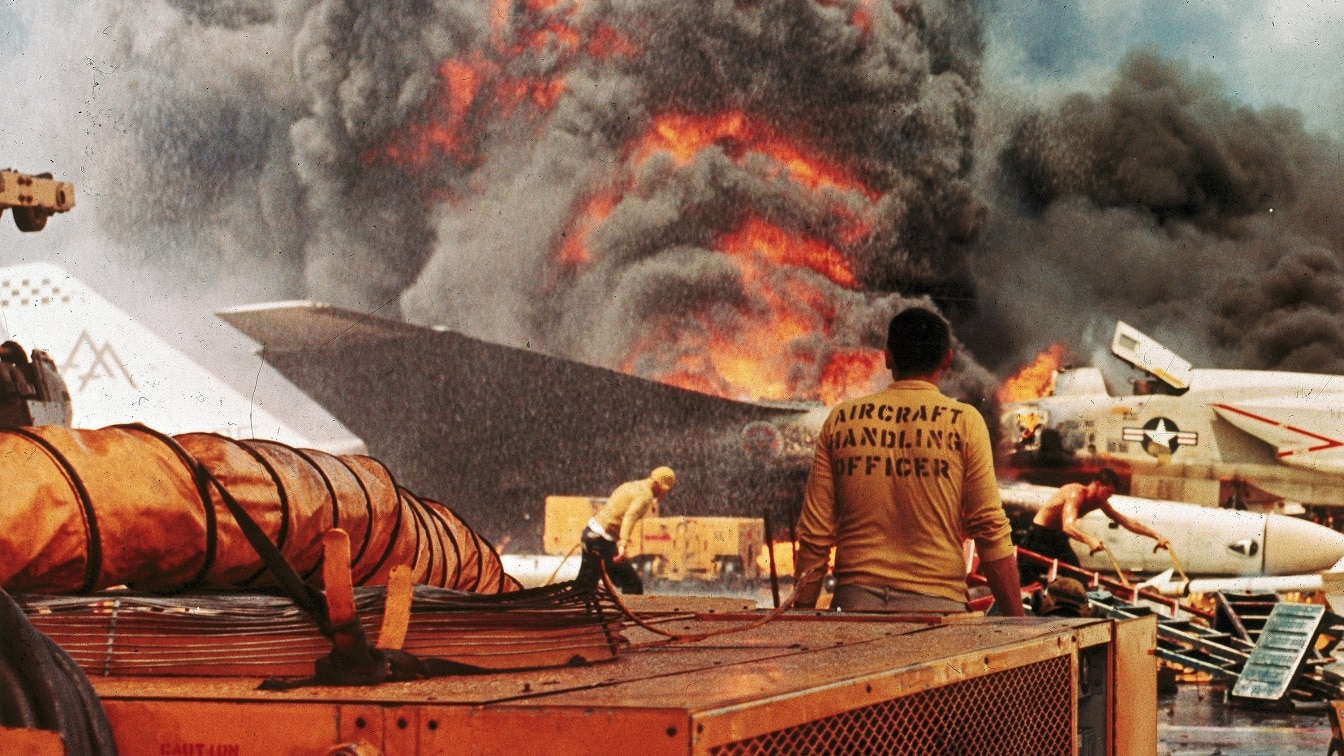
US Navy Aircraft Carrier USS Forrestal Had 94 Seconds Before a 1,000-Pound Bomb Exploded: The first bomb exploded 94 seconds after fire broke out aboard USS Forrestal on July 29, 1967. A five-inch Zuni rocket fired from an F-4B Phantom II, crossed roughly 100 feet of crowded flight deck and ruptured an external fuel tank on an A-4E Skyhawk. Burning rocket propellant ignited the spilled JP-5.
The chain of fire and explosions killed 134 sailors and airmen, injured 161, destroyed 21 aircraft and damaged 40 more. The Navy placed the material loss above $130 million in 1967 dollars, including $72 million to repair the ship.
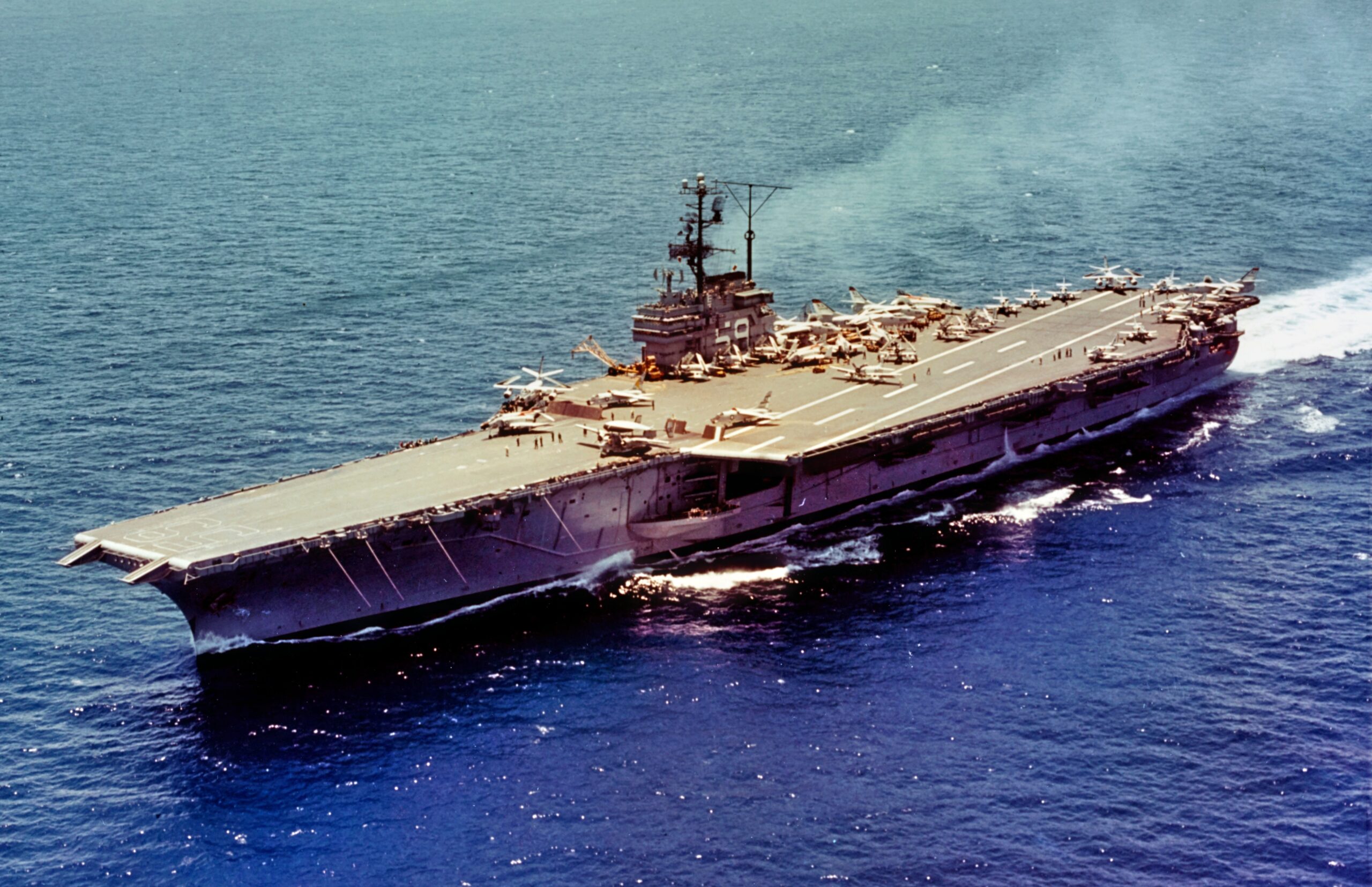
USS Forrestal Aircraft Carrier. Image Credit: Creative Commons.
Forrestal was the Navy’s first completed supercarrier. She had reached Yankee Station off Vietnam four days earlier, and her air wing had already flown more than 150 combat sorties without losing an aircraft.
The disaster began with an electrical fault, but no single malfunction explains its scale. Launcher defects, safety procedures shortened to maintain launch tempo, unstable Korean War-era bombs, and uneven firefighting training turned a fuel fire into an emergency that threatened the survival of the ship.
Forrestal’s Flight Deck Was Packed for an 11 A.M. Strike
At 10:50 a.m., more than 20 aircraft occupied the aft flight deck, with nearly 20 others positioned elsewhere. Pilots sat in fully fueled and armed jets while engines ran and crews completed final checks. About 5,400 people were aboard during preparations for the second strike of the day.
The arrangement reflected what the Forrestal-class design was built to deliver: rapid launches of large jet formations. Fifteen attack aircraft held 80 bombs containing 24.5 tons of explosives. The capacity that made the first jet-era supercarrier powerful also concentrated fuel and ordnance in a confined area.
The F-4B carrying the Zunis had two safeguards. The electrical “pigtail” connecting the rocket pod to the aircraft was supposed to remain disconnected until late in the launch sequence. A pin on the triple ejector rack provided a second barrier.
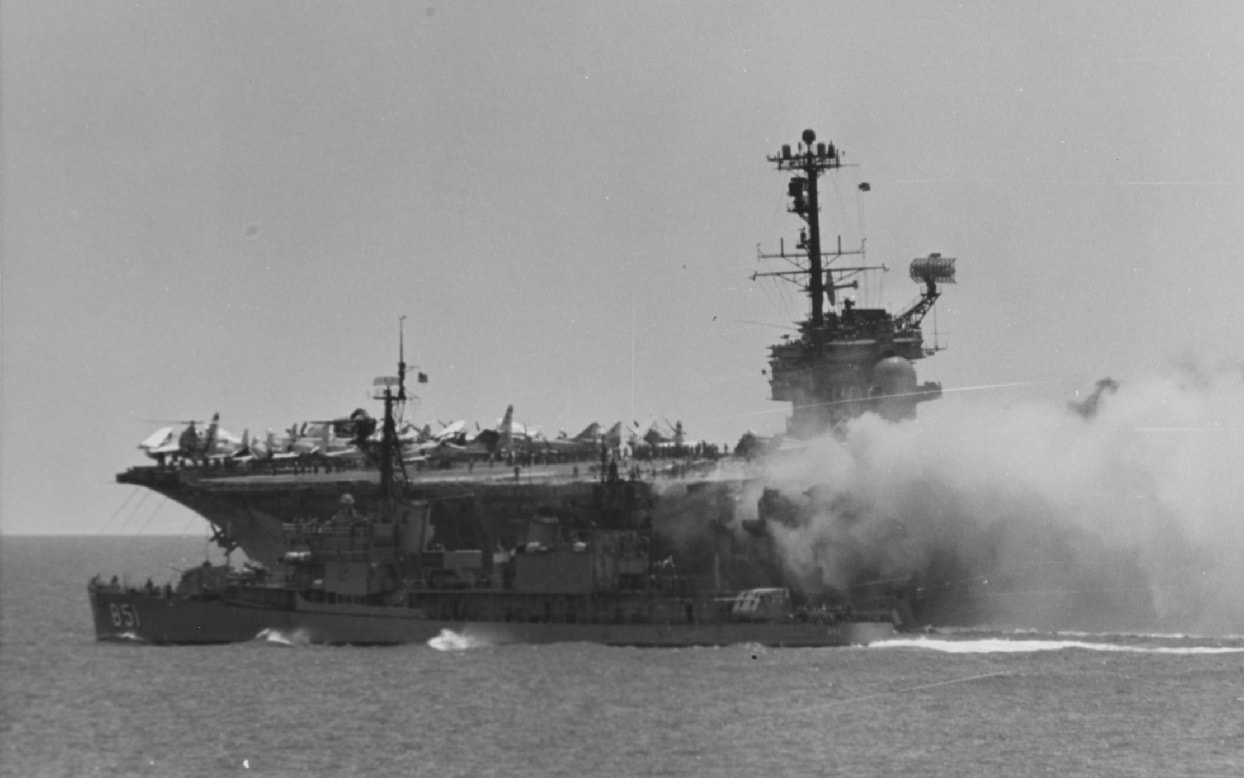
USS Forrestal on fire in 1967. Image Credit: US Navy.
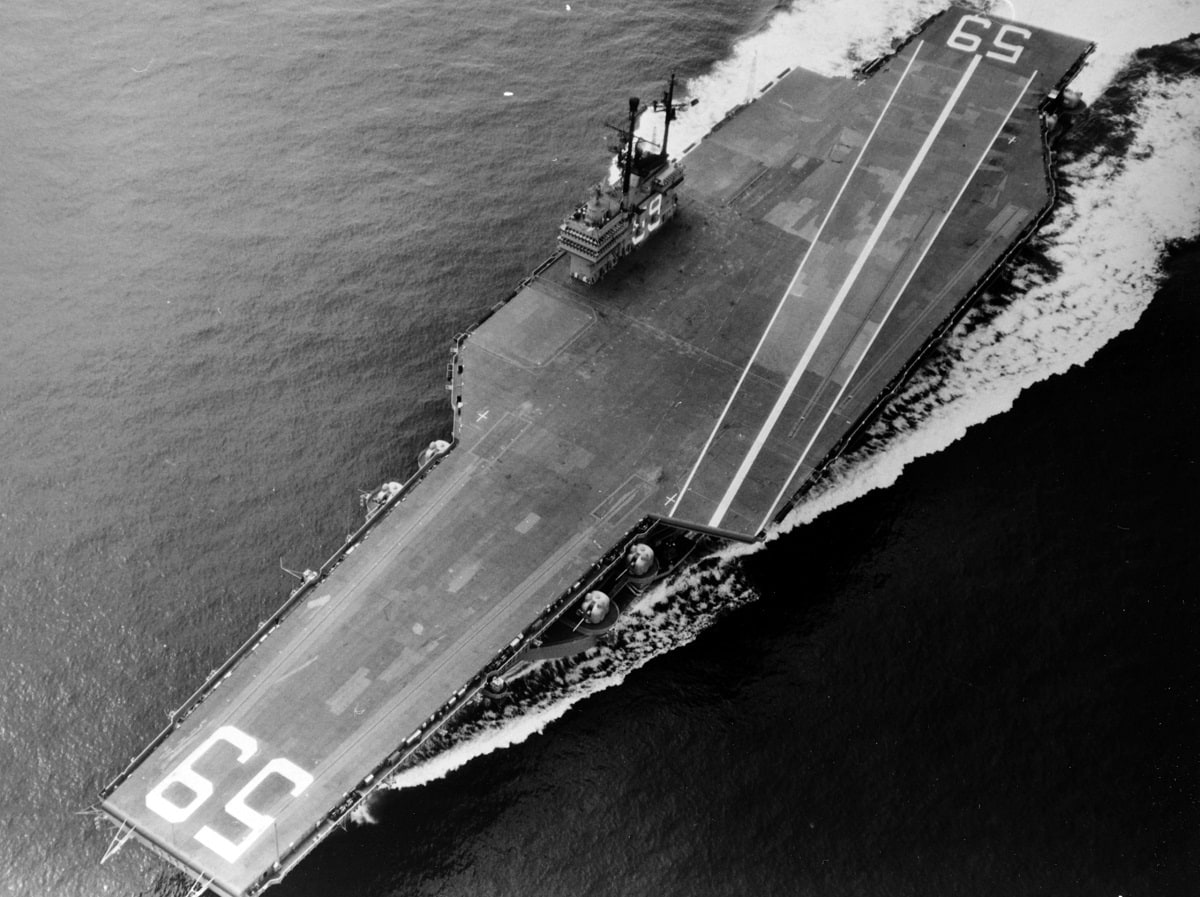
Forrestal undergoing sea trials, 29 September 1955
Crews had connected the pigtail and removed the pin before the jet reached the catapult, practices intended to speed launches. When the pilot switched from external to internal power, an electrical surge reached the rocket motor. The Zuni crossed the deck and struck A-4 No. 405, assigned to Lieutenant Commander Fred White.
The warhead did not detonate on impact. The rocket broke apart, ruptured a 400-gallon fuel tank and scattered burning propellant into the fuel. Flames ran beneath nearby Skyhawks, including future Senator John McCain’s aircraft. The official investigation found McCain had no role in starting the fire.
Chief Gerald Farrier Had Less Than Two Minutes
Chief Aviation Boatswain’s Mate Gerald W. Farrier and Damage Control Team No. 8 reached the fire within 54 seconds. Farrier attacked a 1,000-pound bomb lying in burning fuel with a portable dry-chemical extinguisher. Hose crews arrived about 20 seconds later.
The firefighters had trained around modern bombs whose thicker cases gave them several minutes before a cook-off. The weapon in front of Farrier was a thin-skinned AN-M65A1 filled with Composition B. Its casing had split open under the heat.
The bomb detonated slightly more than 90 seconds after the rocket fired. Farrier and most of the trained flight-deck firefighters died. A second bomb exploded nine seconds later. Within five minutes, the aft deck endured a succession of major bomb explosions and numerous smaller detonations.
McCain escaped down the nose of his Skyhawk. White was among those killed as fire and explosions engulfed the aircraft around him. Other pilots climbed from burning jets, jumped into safety nets, or went over the side.
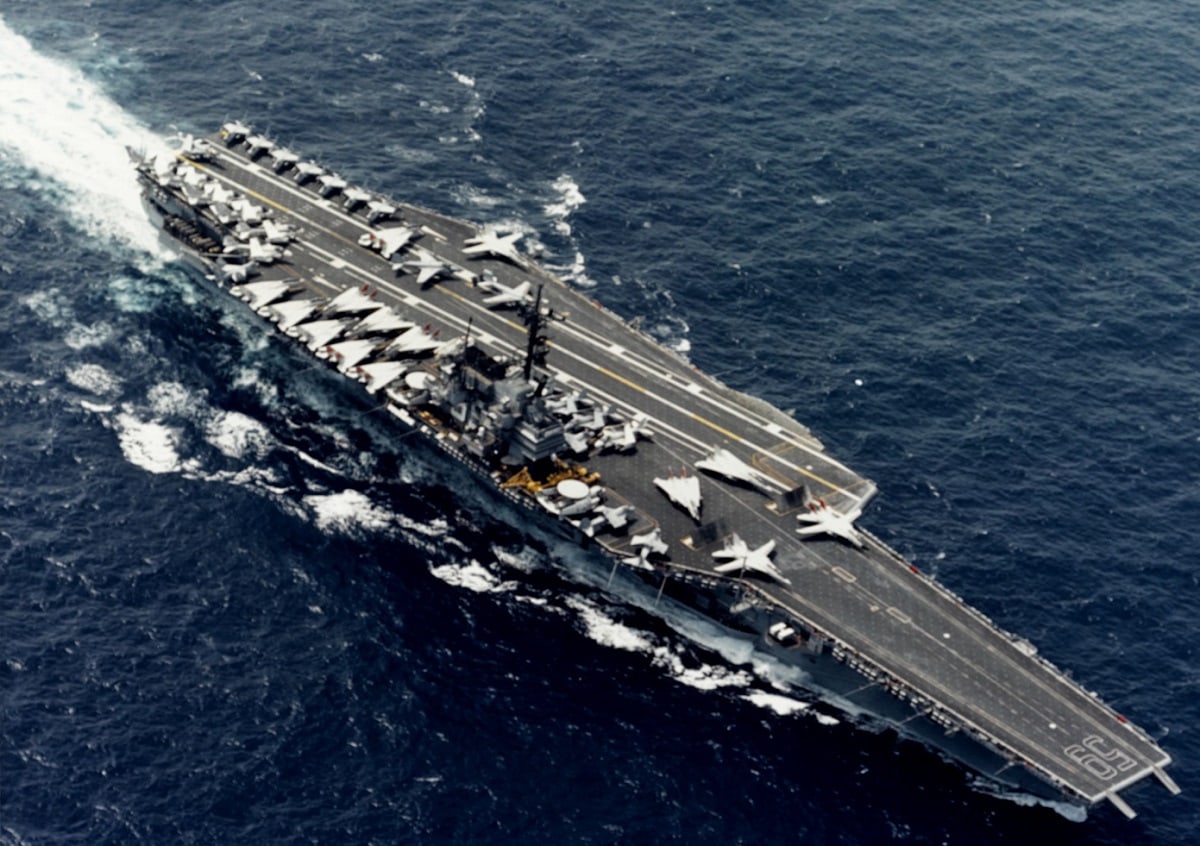
USS Forrestal in 1987. Image: Creative Commons.
Old Bombs Removed the Time Needed to Stop the Fire
Sixteen bombs prepared for the mission were AN-M65A1 weapons manufactured in 1953. They had spent years in hot, humid storage and used Composition B, an explosive that became less stable with age under those conditions. Their casings were thinner than those of newer Mk 80-series bombs.
A Norfolk Naval Shipyard history says handlers warned that some were leaking paraffin phlegmatizing agent, evidence of deteriorated filler. Captain John Beling accepted the weapons because combat operations needed ordnance, but kept them on the flight deck rather than in a magazine. The Navy account states that a magazine detonation might have destroyed the ship.
Seven old 1,000-pound bombs detonated in high order. Most newer weapons burned, melted, or went overboard without exploding. None of the modern bombs detonated until more than five minutes had passed. Experts later estimated that a trained team needed about three minutes to contain the original fire.
The Zuni started the emergency. The old bombs removed the time needed to control them.
Burning Fuel Poured Into Berthing Compartments
The explosions punched large holes through an armored flight deck nearly two inches thick. About 40,000 gallons of fuel escaped from aircraft tanks and cells. Burning fuel, water, and foam poured through the openings into hangar spaces and crew compartments.
Only 28 of the dead had been on the flight deck. Fifty men died while asleep in their racks below it. Smoke, heat, and toxic gases trapped others inside dark passageways. The flight-deck blaze was contained within an hour, but fires below continued until 4 a.m. on July 30.
The first explosion had destroyed most of the trained firefighting force and its foam lines. Sailors from elsewhere took their places. Some used seawater on the JP-5, washing away foam and carrying fuel toward holes in the deck. The Navy had seen another deadly carrier fire aboard USS Oriskany in 1966, yet firefighting instruction still was not universal.
Sailors rolled bombs toward the edge, pushed burning aircraft overboard, carried casualties, and entered smoke-filled compartments. USS Rupertus moved within about 20 feet and remained alongside for three hours, directing hoses against Forrestal and cooling threatened magazines while other ships recovered men from the sea.
The Investigation Found a Broken Safety Chain
The investigation board convened aboard Forrestal on August 2. It examined the F-4’s wiring, the LAU-10 rocket pod, ordnance procedures, bombs, firefighting equipment, and crew training. The final report did not assign direct responsibility to one person aboard the carrier.
The findings described a wider failure. The launcher had design weaknesses. Flight-deck crews altered safeguards to speed operations without consistent command oversight. The carrier accepted deteriorated ordnance because the bombing campaign strained supplies. When the trained firefighters died, much of the crew lacked enough instruction to replace them cleanly.
Neither shortcut alone would have fired the rocket. The electrical surge became dangerous because both barriers were gone.
Aircraft Carrier Forrestal Changed How the Navy Prepared Every Sailor for Fire
Forrestal received emergency work at Subic Bay, then returned to Norfolk. More than 300 welders worked around the clock during a six-and-a-half-month repair effort that replaced major sections of the aft ship. The carrier returned to sea in April 1968.
The Navy tightened Zuni procedures, removed the old bombs from the munitions pipeline, and added protective coatings to newly manufactured bombs. Flight-deck suppression systems improved. The military adopted aqueous film-forming foam for rapid control of fuel fires after Forrestal, according to the Naval Research Laboratory’s history of AFFF.
Firefighting became a shipwide responsibility. Sailors learned about extinguishers, hoses, protective equipment, compartment isolation, and escape procedures. Film shot during the disaster became the training production Trial by Fire: A Carrier Fights for Life.
The reforms faced another test on January 14, 1969, when a Zuni-related fire erupted aboard USS Enterprise. That accident killed 28 and injured 314, but trained crews contained it faster, and the ship did not carry Forrestal’s unstable old bombs. The later fire included 18 explosions across Enterprise’s flight deck.
The firefighting school at Naval Station Norfolk still bears the name of Chief Gerald W. Farrier.
About the Author: Harry J. Kazianis
Harry J. Kazianis (@Grecianformula) was the former Senior Director of National Security Affairs at the Center for the National Interest (CFTNI), a foreign policy think tank founded by Richard Nixon based in Washington, DC. Harry has over a decade of experience in think tanks and national security publishing. His ideas have been published in the NY Times, The Washington Post, The Wall Street Journal, CNN, and many other outlets worldwide. He has held positions at CSIS, the Heritage Foundation, the University of Nottingham, and several other institutions related to national security research and studies. He is the former Executive Editor of the National Interest and the Diplomat. He holds a Master’s degree focusing on international affairs from Harvard University.

